Why Franchise Income Differs From Passive Income
Franchise income is operating cash flow you generate by running a system. Passive income is a distribution you collect from an asset while doing nothing. That distinction determines who your best prospects are and how you should sell to them.
The gap comes down to three drivers you can put in front of any qualified buyer today:
- Unit economics. Margins vary by quartile, not by the top performer in your marketing deck, and manager salary eats into owner return before a dollar reaches the buyer's pocket.
- Operational leadership. Someone has to run daily operations, whether that's the owner or a general manager the owner hires, trains, and backs up.
- System maturity. A brand's ramp curve, resale history, and Item 19 disclosures tell a buyer how proven the model actually is.
Franchisors who lead with these facts, rather than a "be your own boss and earn passive income" pitch, close faster with higher income prospects.
Key Takeaways
Franchise income depends on operating leadership, staffing costs, and repeatable demand, while passive income requires none of those to keep flowing.
| Point | Details |
|---|---|
| Franchise income is operational | Cash flow depends on manager salaries, staffing floors, and daily leadership, not a hands-off distribution. |
| Segment leads before you pitch | Route owner-operators, asset managers, and semi-absentee buyers to different evidence and messaging tracks. |
| Lead with quartile data, not hero numbers | Unit economics by quartile and Item 19 disclosures build trust faster than top-decile claims. |
| Five traits signal semi-passive potential | GM role, sufficient margin, repeatable demand, KPI dashboards, and franchisee proof all need documentation. |
| Franchise Fast Track fills the qualified pipeline | It delivers verified appointments with $150K to $500K earners and a reported 34 percent lead-to-close rate. |
Table of Contents
- Which buyer archetype are you actually talking to?
- What structural facts separate franchise income from passive income?
- What makes a franchise plausibly semi-passive?
- What belongs in a franchise diligence pack?
- How do you qualify serious capital allocators fast?
- How franchisor policy choices attract or repel capital-minded buyers
- Why segmentation beats a bigger marketing budget
- How Franchise Fast Track helps you close the gap faster
- Sources
Which buyer archetype are you actually talking to?
Every high-income prospect fits roughly one of three profiles, and each one asks a different core question before they'll sign.
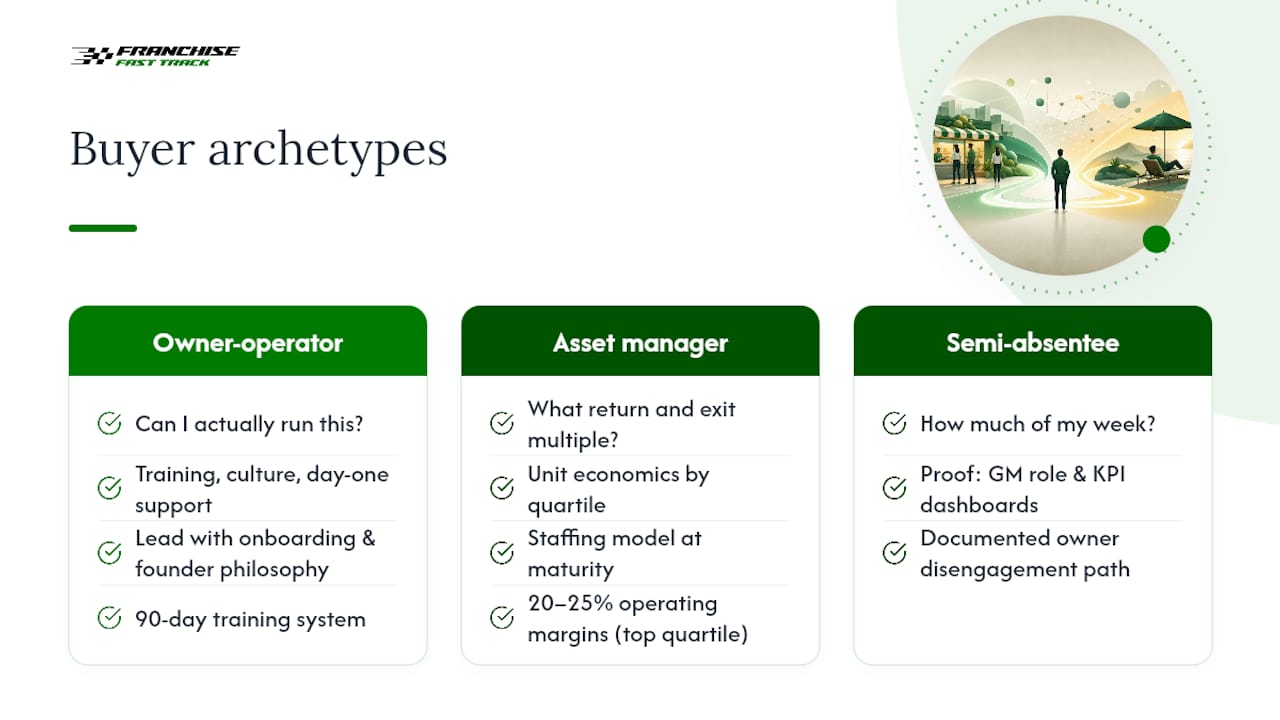
The owner-operator asks, "Can I actually run this?" They want to see training depth, culture, and day-one support. Lead with your onboarding program and the founder's operating philosophy.
The asset manager or multi-unit buyer asks, "What return do I get, and what's my exit multiple?" This buyer is buying a compounding opportunity, not a concept, so lead with unit economics by quartile and a real staffing model at maturity.

The semi-absentee buyer asks, "How much of my week does this actually take?" They need proof of a general manager role, KPI dashboards, and a documented path to owner disengagement, not just a promise.
Pro Tip: Write one-line value props for each archetype and hand them to your sales team as swipe copy. "Run it with our 90-day training system" lands with owner-operators; "20 to 25 percent operating margins across our top-quartile units" lands with capital allocators.
Matching evidence to buyer style matters more than most development teams assume. Franchising found that data-driven buyers and action-oriented buyers respond to entirely different sales sequences, and forcing one script on both groups quietly loses deals.
What structural facts separate franchise income from passive income?
A franchise is a business with a manager problem baked in. Here's what actually drives that difference:
- Staffing and manager floor. Every mature unit needs a GM or shift lead, and that salary is a fixed cost before profit exists.
- Payroll and the "manager tax." Owners routinely underestimate this line item when they model returns off gross revenue instead of net.
- Revenue repeatability. Subscription, membership, and route-based models produce steadier cash flow than one-off transactional sales.
- Local marketing and acquisition risk. Franchise income depends on the owner's ability to keep a local funnel full, something a passive bond or index fund never requires.
- Ramp time. Time to cash-flow positive varies widely, and buyers deserve the real curve, not the fastest outlier.
- Platform maturity. A five-year-old brand with thin resale history carries more income variance than a mature system with a track record.
Franchisors preparing disclosure materials should treat Item 19 unit economics by quartile as the centerpiece, not an afterthought buried in an appendix. Presenting only the top-decile performer is the fastest way to lose a sophisticated buyer's trust the moment they read the actual FDD.
Pro Tip: Before you finalize any owner-return model for outreach, run it with a full-time manager salary and a backup coverage line included. If the model only works with the owner working 50 hours a week for free, that's not what you're marketing.
What makes a franchise plausibly semi-passive?
Most "passive income franchise" claims are marketing language dressed up as fact. FranchiseIQ's analysis lays out five traits that determine whether semi-absentee ownership is realistic, and franchisors need proof points for each one:
- A clear GM role. Show the actual job description and hiring criteria, not a vague "hire someone eventually" note.
- Enough margin to pay management. Categories like commercial services and select wellness models regularly show 20 to 30 percent operating margins, compared with sub-10 percent for many quick-service concepts.
- Repeatable, recurring demand. Membership and subscription-based revenue reduces the owner's need to personally drive sales every week.
- Measurable KPIs and dashboards. Buyers want to see the reporting tools that let an absentee owner monitor performance without being on-site.
- Franchisee proof. Existing operators who genuinely run multiple units on managers are your strongest evidence, stronger than anything in a brochure.
Route businesses, membership gyms, and certain appointment-based service models tend to fit this profile best, though even those still carry location and staffing risk that requires oversight.
What belongs in a franchise diligence pack?
High-income buyers expect a document set, not a slideshow. Build these five items before your next round of outbound outreach:
- FDD walkthrough with the Item 19 section flagged and pre-explained
- Unit economics by quartile, showing bottom, middle, and top performance ranges
- Staffing model at maturity, including a manager salary stress test
- Ramp curve showing realistic time to positive cash flow
- Resale history and at least one multi-unit operator case example
For discovery meetings, sequence the content by buyer type:
- Asset managers see unit economics and staffing models first, culture and training last.
- Owner-operators see training, support, and culture first, financial detail second.
- Everyone gets the same Item 19 summary, presented as a range with quartile context rather than a single hero number.
If your team can't assemble this pack within a week of a serious inquiry, that delay signals the same gap a sophisticated buyer reads directly in the FDD. Review your franchise-ready business model criteria before your next development push to close that gap.
How do you qualify serious capital allocators fast?
Score every inbound lead on three axes before you invest development time:
- Capital and liquidity. Do they have the net worth and available liquidity to fund unit one plus a real reserve, not just the initial franchise fee?
- Time horizon and growth intent. Are they thinking about one unit or ten over five years?
- Operating involvement preference. Do they want to run daily operations, manage a manager, or stay fully hands-off?
Score each axis low, medium, or high. High capital plus high growth intent routes straight to a senior discovery call with the full diligence pack attached. Owner-operator scores route to a training-first discovery track instead.
Ask directly: "How many units are you thinking about long-term?" and "Would you want to work in the business or manage someone who does?" Sophisticated buyers respond better to this direct approach than to automated nurture sequences, and clear lead qualification criteria keeps your sales team from wasting time on the wrong fit.
Watch for red flags: a buyer fixated only on your top-decile unit, no interest in the staffing model, or reliance on the founder's personality rather than the system itself. Those signals usually predict a poor multi-unit fit regardless of net worth.
How franchisor policy choices attract or repel capital-minded buyers
The way you structure fees and support directly determines whether asset-minded buyers can afford to scale with you.
- Staged or reduced follow-on fees for unit two and beyond keep growth capital available instead of front-loading every fee at full price.
- Protected development schedules and sensible territory sizing let multi-unit buyers plan expansion without cannibalizing their own units.
- Capital-preserving royalty structures and support milestones tied to performance, not just calendar dates, protect franchisee cash during the ramp period.
Pro Tip: Publish minimum working-capital guidelines and vendor credit terms in your diligence pack. Buyers doing real due diligence will ask for this anyway, so handing it over first builds credibility instead of triggering suspicion.
Why segmentation beats a bigger marketing budget
Every franchisor I've watched struggle with development has the same blind spot: they treat "passive income" as a marketing hook instead of a claim that has to survive an FDD review. It doesn't survive that review, and sophisticated buyers know it within the first ten minutes of reading Item 19.
The stronger move is segmenting leads before you ever send a brochure, then backing every claim with quartile data instead of a hero number. Development teams that build the diligence pack once and reuse it save weeks of back-and-forth on every serious inquiry, and they lose fewer qualified buyers to competing brands who simply answered faster.
How Franchise Fast Track helps you close the gap faster
Building segmentation scripts and diligence packs solves half the problem. Filling your calendar with buyers who actually qualify for that pack solves the other half, and that's where most in-house development teams lose momentum. Franchise Fast Track exists to close that gap: it delivers verified appointments with income and intent already confirmed, so your team spends its week presenting unit economics instead of screening tire-kickers.
The system books hundreds of appointments monthly with qualified high-income prospects, and franchisors using it report strong lead-to-close rates. That number reflects what happens when qualification and messaging line up before the first call, not after it. If your development team already has the diligence pack built, the missing piece is usually pipeline volume with the right buyer profile already verified.
A sensible way to test the fit is a small pilot engagement rather than a full rollout. Visit the franchise lead generation page to see how the appointment-setting process works and request a pilot scoped to your current development capacity.
Sources
- Stop chasing multi-unit operators — 1851 Franchise
- Passive income franchise — FranchiseIQ (FDDIQ)
- Is buying a franchise worth it? — Long Angle
Recommended
- How Franchise Income Supplements Your Salary in 2026 | Franchise Fast Track Blog
- Difference Between Franchise and Corporation | Franchise Fast Track Blog
- Franchise Ownership for Executives: A Strategic Guide | Franchise Fast Track Blog
- Why High-Income Professionals Buy Franchises | Franchise Fast Track Blog
Ready to see results like these for your franchise?
Stop wasting money on leads that never close. Start getting hundreds of replies from high-net-worth professionals daily.