Franchise Lead Qualification: What It Means and Why It Matters
Franchise lead qualification is defined as the structured process of evaluating a prospective franchisee's financial capacity, operational readiness, and territory fit before any sales conversation begins. This process separates serious buyers from casual inquiries and protects your development team's time. Without it, your pipeline fills with contacts who look like leads but will never close. Understanding what does franchise lead qualification mean in practice is the difference between a productive sales funnel and an expensive revolving door.
What does franchise lead qualification mean for franchisors?
Franchise lead qualification is the systematic filtering of inbound prospects against defined criteria before they enter your sales pipeline. The industry term for this process is "candidate screening," though franchise developers also call it "lead scoring" or "pre-qualification." Both terms describe the same goal: separate serious buyers from casual inquiries before your team invests time in them.
The distinction between lead generation and lead qualification matters enormously. Lead generation fills the top of your funnel with names and contact details. Lead qualification determines which of those names deserve a discovery call. A form submission is data collection, not qualification. True qualification requires a rapid, structured response that probes financial capacity, timeline, and intent.

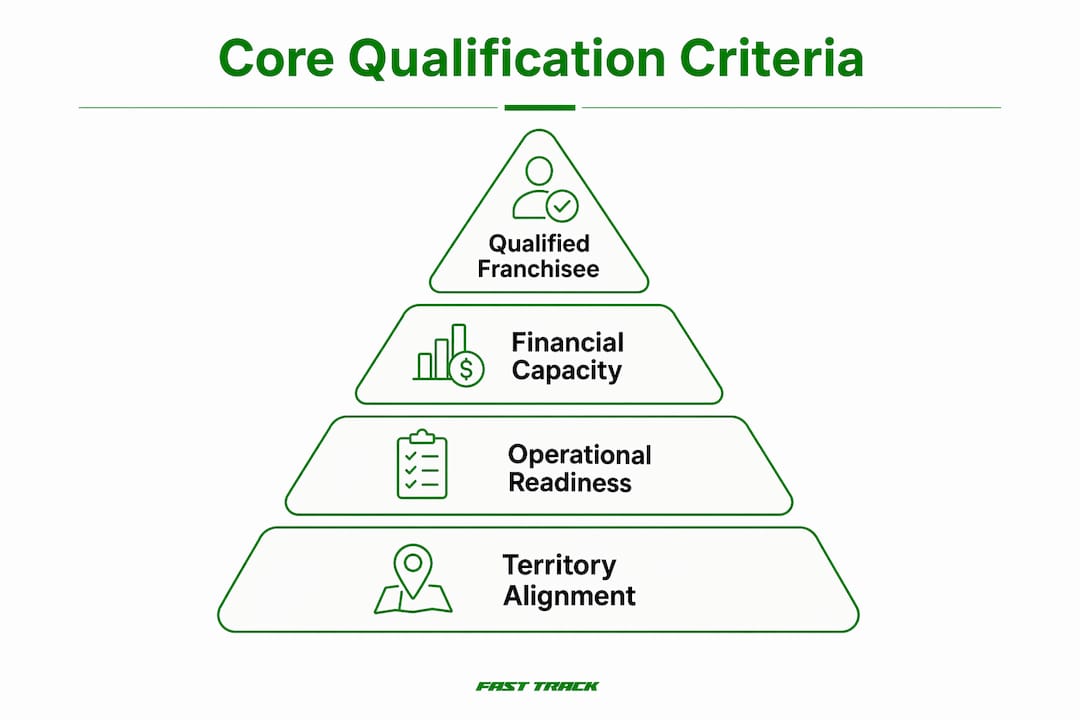
Three criteria form the foundation of every effective qualification framework. First, financial capacity: does the candidate meet your minimum liquid capital and net worth requirements? Second, operational intent: do they have a realistic timeline, relevant business experience, and an honest understanding of the commitment? Third, territory fit: is their preferred market available, and are they geographically flexible if it is not? Leads that fail any one of these three tests rarely close, regardless of how enthusiastic they appear.
What are the core criteria for qualifying franchise candidates?
Financial thresholds are the most objective filter in your qualification process. Most franchise systems define a minimum liquid capital requirement and a net worth floor. Leads that fall below these numbers are disqualified immediately, regardless of their enthusiasm. This is not a judgment call. It is a business rule that protects both parties.
Beyond the numbers, operational readiness separates candidates who are ready to act from those who are still exploring. Key indicators include:
- Timeline: Is the candidate targeting a launch within 6–12 months, or are they "just looking"?
- Business experience: Have they managed employees, run a P&L, or operated in a relevant industry?
- Risk tolerance: Do they understand that franchise ownership carries financial and operational risk?
- Multi-unit interest: Are they open to scaling, or are they committed to a single location?
Territory alignment is the third pillar. A financially strong candidate with no available market in their preferred geography is still an unqualified lead for your system. Capturing territory interest early in the process prevents wasted discovery calls and misaligned expectations.
Scoring systems give these criteria a consistent structure. Hot leads typically score 80 or above on a 100-point scale, combining financial, operational, and territory data. Warm leads score in the 50–79 range and may need nurturing before a discovery call. Cold leads fall below 50 and should be deprioritized or removed from active outreach.
Pro Tip: Build your scoring model directly from the profiles of your top 10 performing franchisees. Their financial, behavioral, and demographic patterns are your most reliable qualification benchmark.
| Criterion | Qualified Signal | Disqualifying Signal |
|---|---|---|
| Liquid Capital | Meets or exceeds minimum threshold | Below minimum with no clear path to funding |
| Timeline | 6–12 month launch window | "Someday" or no defined timeline |
| Business Experience | Managed teams or operated a business | No management or ownership experience |
| Territory Fit | Available market in preferred geography | No available territory in desired area |
| Multi-Unit Interest | Open to scaling | Resistant to growth expectations |
What are the signs of unqualified or risky franchise leads?
Financial disqualification is straightforward. Behavioral disqualification is harder to spot and far more costly if you miss it. Coachability and mindset are often stronger predictors of long-term franchisee success than pure financials. A candidate who cannot follow a system will create compliance problems, operational failures, and brand damage after the sale closes.
The most reliable behavioral red flags include:
- Resistance to systems: The candidate repeatedly questions why your processes work the way they do, rather than asking how to execute them well.
- "I know better" attitude: They reference their past business experience as a reason to modify your model before they have even signed.
- Poor preparation: They arrive at discovery calls without having reviewed your FDD, website, or basic brand materials.
- Unrealistic expectations: They project first-year revenues that exceed your Item 19 disclosures without any supporting rationale.
- Pressure tactics: They push for faster timelines or special pricing, signaling that they are not engaging with your process in good faith.
"Financially qualified leads may still fail due to mindset and behavior issues. Resistance to systems and an 'I know better' attitude often predict compliance and operational problems." — FranchiseBA, Ricardo Fontana
When you spot these flags, the right response is not immediate disqualification. Investigate first. Some candidates are nervous or uninformed, and a structured coaching conversation can correct the issue. Others are genuinely poor fits, and no amount of coaching will change that. The key is to make that determination early, before your team has invested 10 hours in the relationship.
Pro Tip: Score behavioral signals the same way you score financial ones. Assign point deductions for red flags during discovery calls and track them in your CRM. Patterns across disqualified candidates will sharpen your criteria over time.
How does AI improve the franchise lead qualification process?
AI changes franchise lead qualification by removing the manual bottleneck that causes lead decay. Manual qualification delays allow leads to sit in unprioritized backlogs, and faster competitors close them first. AI addresses this by scoring and triaging leads the moment they enter your system.
The practical applications of AI in franchise qualification include:
- Automated initial scoring: AI evaluates liquidity, experience, motivation, and territory interest from form data and assigns a score before a human ever reviews the lead.
- Conversational AI interviews: Natural language processing tools conduct preliminary interviews via voice or chat, asking dynamic follow-up questions based on candidate responses.
- Predictive modeling: AI identifies engagement patterns that correlate with conversion, flagging leads that show high intent even before they request a discovery call.
- Intelligent segmentation: AI lead nurturing sequences keep longer-term candidates engaged until they reach readiness, so your team focuses only on leads that are ready to move.
| AI Function | Manual Process | AI-Enhanced Process |
|---|---|---|
| Initial lead scoring | 24–48 hour delay | Instant, upon form submission |
| Preliminary interview | Scheduled call, 3–5 day lag | Immediate conversational AI session |
| Lead prioritization | Manual review by developer | Automated score-based queue |
| Nurture sequencing | Generic email drip | Dynamic, behavior-triggered follow-ups |
The speed advantage is not marginal. Franchise leads that receive a response within the first 72 hours are significantly more likely to advance through the pipeline. AI makes that response window achievable at scale, even for development teams managing hundreds of inquiries per month.
How do you build effective franchise lead qualification criteria?
The most effective qualification frameworks start before a lead ever submits a form. Transparent criteria on franchise landing pages enable self-qualification. When your page clearly states minimum investment levels, liquid capital requirements, and territory availability, unqualified candidates opt out before they consume your team's time. This is not a deterrent. It is a filter that improves your pipeline quality at zero cost.
Structured discovery is the next layer. A short pre-screening application, a brief financial assessment, and an educational webinar each serve as qualification gates. Candidates who complete all three are demonstrably more serious than those who submit a single contact form. CRM and pipeline tracking tools like Salesforce, HubSpot, or franchise-specific platforms such as FranConnect give your team a consistent view of where each candidate stands against your criteria.
Pro Tip: Review your qualification criteria quarterly against your closed deals. If your top-performing new franchisees share a profile that differs from your current scoring model, update the model. Your best franchisees are your most accurate qualification template.
The balance between speed and thoroughness is where most development teams struggle. Moving too fast means skipping behavioral assessment and closing candidates who will fail. Moving too slowly means losing qualified candidates to competitors who responded faster. The solution is a two-stage process: automated scoring handles the first 72 hours, and a human discovery call handles the behavioral assessment within the first week.
Regular analytical review of your qualification data closes the loop. Track which questions correlate with closed deals, which red flags predicted failures, and which criteria are filtering out candidates who later succeeded with competitors. That data drives continuous improvement in your process.
Key takeaways
Effective franchise lead qualification requires financial, behavioral, and territory criteria applied consistently and quickly to every inbound prospect.
| Point | Details |
|---|---|
| Define three core criteria | Evaluate financial capacity, operational readiness, and territory fit before any sales engagement. |
| Score leads systematically | Use a 100-point scoring model where hot leads score 80+ to prioritize developer time. |
| Flag behavioral red flags early | Resistance to systems and poor preparation predict post-sale compliance failures. |
| Automate the first 72 hours | AI scoring and conversational interviews prevent lead decay and outpace slower competitors. |
| Build in self-qualification | Transparent landing pages and pre-screening forms filter unqualified candidates before they reach your team. |
Why most franchisors confuse data collection with qualification
I have reviewed franchise development processes across dozens of systems, and the same mistake appears repeatedly. A prospect fills out a contact form, gets added to a CRM, and the development team calls it a "qualified lead." That is not qualification. That is data collection with a label on it.
Real qualification requires a response within 72 hours, a structured set of questions, and a scoring decision. The form is just the door. What happens in the first three days determines whether that lead converts or disappears. Franchisors who treat form submissions as qualified leads are measuring their pipeline by volume, not quality. Volume feels productive. Quality closes deals.
The behavioral piece is where I see the most expensive mistakes. A candidate with $500,000 in liquid capital and a resistance to following systems is not a qualified lead. They are a liability with a checkbook. I have watched franchisors close those deals and spend the next two years managing compliance nightmares, territory disputes, and brand violations. The financial qualification was perfect. The behavioral qualification was skipped entirely.
The fix is not complicated. Build a behavioral scorecard. Train your team to use it on every discovery call. Review it quarterly against your outcomes. The franchisors who do this consistently report shorter sales cycles, higher franchisee satisfaction scores, and fewer post-sale operational problems. The ones who skip it keep wondering why their pipeline looks full but their close rate stays flat.
— Cody
How franchise fast track delivers pre-qualified franchise leads
Franchise Fast Track was built specifically to solve the qualification problem at the top of the funnel. The platform connects franchisors with verified high-income professionals earning between $150,000 and $500,000 annually, targeting executives, directors, and senior managers who are actively evaluating franchise ownership.
Every candidate delivered through Franchise Fast Track has been pre-screened against financial and intent criteria before your development team sees them. That means no casual inquiries, no tire-kickers, and no leads that fail your minimum investment threshold. The platform reports a lead-to-close rate of 34%, which reflects the difference between a pre-qualified pipeline and a general advertising funnel. If your team is spending more time filtering leads than closing them, Franchise Fast Track is built for exactly that problem.
FAQ
What does franchise lead qualification mean?
Franchise lead qualification is the process of evaluating prospective franchisees against defined financial, operational, and territory criteria before any sales engagement begins. The goal is to separate serious buyers from casual inquiries before your development team invests time in them.
What is an unqualified franchise lead?
An unqualified franchise lead is a prospect who fails to meet one or more of your core criteria, including minimum liquid capital, realistic timeline, operational readiness, or available territory. Behavioral red flags such as resistance to systems or unrealistic expectations can also disqualify an otherwise financially eligible candidate.
How do you filter unqualified franchise leads effectively?
The most effective method combines transparent landing page criteria for self-qualification, a short pre-screening application, and an automated scoring system that triages leads within 72 hours. CRM tools like Salesforce or FranConnect support consistent pipeline tracking across your development team.
Why does the 72-hour window matter in franchise lead qualification?
Leads that go uncontacted for more than 72 hours are significantly more likely to engage with a competing franchise system. Automating initial scoring and outreach within that window prevents lead decay and keeps your pipeline competitive.
How do you build franchise lead qualification criteria from scratch?
Start by profiling your top 10 performing franchisees across financial, behavioral, and demographic dimensions. Use those profiles to set your scoring thresholds, then validate and refine the model quarterly against your closed deal data.
Recommended
- Franchise Lead Generation: Qualified Franchisee Candidates for Serious Franchisors | Franchise Fast Track
- Pre-Qualified Leads: The Engine of Franchise Growth | Franchise Fast Track Blog
- Franchise Glossary: Key Franchising Terms Defined
- Franchise Sales: Funded, Pre-Screened Buyers for Your Sales Team | Franchise Fast Track
Ready to see results like these for your franchise?
Stop wasting money on leads that never close. Start getting hundreds of replies from high-net-worth professionals daily.