Franchise Ownership for Executives: A Strategic Guide
Franchise ownership for executives is defined as a business model where corporate leaders acquire and oversee franchise operations through hired management teams, focusing on financial control and growth rather than daily store tasks. This model suits senior managers and directors who want to build business equity without abandoning their professional expertise. Approximately 25–30% of multi-unit franchise acquisitions involve buyers with significant corporate management backgrounds. That figure confirms executive franchise ownership is not a niche path. It is a mainstream investment channel for experienced leaders. Understanding what is franchise ownership for executives means recognizing it as an active ownership role, not a passive income stream.
What is franchise ownership for executives and how does it work?
Executive franchise ownership is a management model where the owner acts as a strategic operator, not a frontline worker. The industry term for this structure is the "executive model franchise," and it sits at the opposite end of the spectrum from the owner-operator model, where the franchisee runs daily operations personally.
Executive franchise owners typically dedicate 10–20 hours per week overseeing strategy, finances, and coaching managers. That time commitment is closer to a board role than a store manager role. The owner hires a general manager to handle scheduling, staffing, and customer operations. The owner then focuses on financial reporting, growth planning, and holding the management team accountable.

Multi-unit franchise ownership aligns better with executive capital resources and leadership skills than single-store ownership. It also delivers higher exit value and a more scalable management structure. Executives who buy two or three units from the start build a portfolio that justifies the overhead of a salaried general manager and creates a real asset on their balance sheet.
The key distinctions between the executive model and the owner-operator model are worth spelling out clearly:
- Time on site: Owner-operators work 40–60 hours per week in the business. Executive owners work 10–20 hours per week on the business.
- Hiring responsibility: Owner-operators often serve as the primary manager. Executive owners hire and develop a management layer.
- Growth path: Owner-operators scale slowly, limited by personal bandwidth. Executive owners scale by replicating their management system across additional units.
- Income structure: Owner-operators draw a salary replacement. Executive owners build equity and distributions across multiple locations.
Pro Tip: Before signing a franchise agreement, ask the franchisor how many of their existing franchisees operate the executive model. A brand with fewer than 20% of owners in that model may not have the support infrastructure you need.
What financial requirements apply to executive franchise ownership?
Capital requirements for executive franchise ownership are higher than most executives expect. Executive franchise candidates typically require a net worth of at least $1 million and $250,000 in liquid assets to cover initial investments and ongoing expenses including management payroll during ramp-up. Those thresholds exist because the executive model carries costs that a solo owner-operator avoids entirely.
Most executives underestimate working capital needs during ramp-up, especially the cost of funding management salaries before the business reaches profitability. A general manager earning $60,000–$80,000 per year must be paid from day one, regardless of revenue. That salary is a fixed cost that runs parallel to franchise fees, royalties, and marketing contributions.
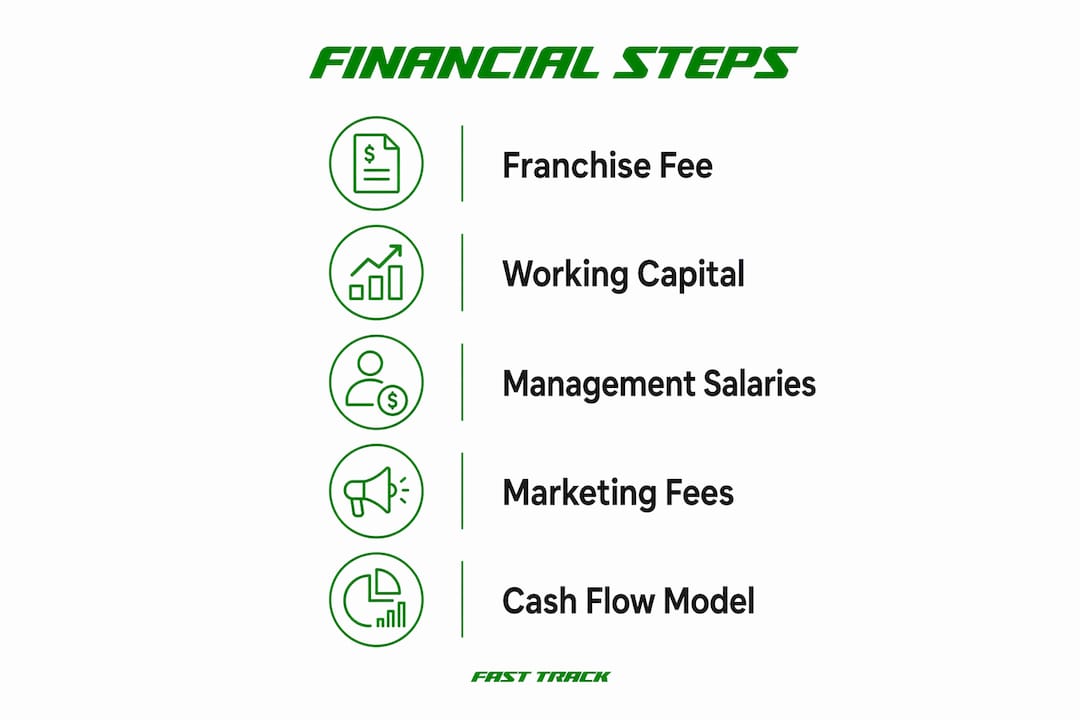
The table below outlines the core financial categories executives should plan for before signing a franchise agreement.
| Financial category | What to plan for |
|---|---|
| Franchise fee | Typically $30,000–$60,000 per unit, paid upfront at signing |
| Total initial investment | Varies widely by brand and sector; multi-unit deals multiply this figure |
| Liquid capital reserve | Minimum $250,000 recommended; more for multi-unit acquisitions |
| Management payroll | Budget 12–18 months of GM salary before expecting break-even |
| Net worth requirement | Most executive-model franchisors require at least $1 million |
Lenders favor executive-model franchises because the management structure reduces single-owner dependency risk. SBA lenders and franchise-specific finance companies view a manager-led operation as more bankable than a solo owner-operator setup. That preference can improve your loan terms if you enter the process with a clear organizational chart and a named general manager candidate.
Pro Tip: Build a 24-month cash flow model before you commit. Include GM salary, royalties, and marketing fees from month one. If the model only works after month 18, confirm you have the liquidity to bridge that gap without stress.
To understand the full range of franchise investment risks before committing capital, review the financial risk categories specific to your target sector.
How do corporate leadership skills translate into franchise success?
Corporate experience transfers directly into executive franchise ownership, but the translation is not automatic. Executives transitioning to franchise ownership succeed best when they adopt a CEO mindset focused on growth, team building, and direct ownership responsibility rather than committee decision-making. That shift is the hardest part of the transition for most senior managers.
In a corporate role, you influence outcomes through departments, budgets, and approval chains. As a franchise owner, you are the final decision-maker on every hire, every capital expenditure, and every customer complaint escalation. There is no committee to defer to. That autonomy is the appeal, and the challenge, of ownership.
The skills that transfer most directly include:
- Financial analysis: Reading P&L statements, managing cash flow, and identifying cost variances are daily tasks in executive franchise ownership.
- Team development: Recruiting, onboarding, and retaining a general manager is the single most important operational decision you will make.
- Performance management: Holding managers accountable to KPIs mirrors the performance review culture most executives already practice.
- Vendor and partner negotiation: Franchise systems have preferred vendors, but local contracts, real estate, and staffing agencies require negotiation skills.
- Sales and marketing engagement: Success requires assuming full responsibility for business outcomes, including sales and marketing efforts, even when delegating daily operations.
The last point catches many executives off guard. Corporate leaders often delegate marketing to a department and rarely engage directly with customer acquisition. In franchise ownership, you must understand your local marketing spend, track lead conversion, and hold your team accountable for revenue growth. The franchise system provides tools and brand support, but local execution is your responsibility.
Corporate executives perform best in franchises that allow them to act as CEO-level leaders rather than store managers. Brands with strong training programs, established operations manuals, and dedicated franchise business coaches give executives the infrastructure to apply their skills without reinventing processes from scratch.
What are the practical steps for executives exploring franchise ownership?
The first step is selecting franchise categories that fit the executive model. Service-based franchises in sectors like home services, business services, health and wellness, and staffing tend to support manager-led operations better than food service concepts that require constant owner presence. Review the franchise business model structure of any brand you consider to confirm it supports multi-unit, manager-run ownership.
The practical process for evaluating and entering franchise ownership follows a clear sequence:
- Define your investment parameters. Set a firm ceiling on total capital at risk, including working capital reserves. Do not let enthusiasm push you past a number that keeps you financially secure.
- Review the Franchise Disclosure Document (FDD). The FDD is a federally mandated document that franchisors must provide to prospective buyers. Item 19 shows financial performance representations. Item 21 contains audited financials. Both are non-negotiable reading.
- Validate with existing franchisees. Contact franchisees who entered the system with a corporate background and ask about their actual time commitment, ramp-up timeline, and GM hiring experience. Their answers are more reliable than any sales presentation.
- Plan for a 3–5 year growth timeline. Franchise ownership builds value over time. Executives who expect profitability in year one often exit too early. A realistic model shows break-even in 12–24 months and meaningful equity by year three.
- Hire your general manager before or immediately after opening. The GM hire determines your actual time commitment. A weak GM forces you into daily operations. A strong GM frees you to focus on growth.
- Balance ownership with existing commitments. If you are still employed, confirm the franchise agreement permits outside employment. Many executive-model franchises are designed for owners who maintain other professional roles during the ramp-up phase.
Pro Tip: Ask the franchisor for a list of franchisees who operate the executive model while holding a corporate job. If they cannot provide three names, the brand may not be structured for your situation.
For executives ready to take the first concrete step, the guide on how to become a franchise owner covers the full process from initial research through signing day.
Key takeaways
Executive franchise ownership is an active, manager-led business model that rewards corporate leadership skills when paired with realistic capital planning, a strong general manager hire, and a CEO-level ownership mindset.
| Point | Details |
|---|---|
| Executive model defined | Owners oversee strategy and finances; a hired GM handles daily operations. |
| Time commitment | Plan for 10–20 hours per week, not passive income or full-time presence. |
| Capital requirements | Net worth of $1 million and $250,000 in liquid assets are standard thresholds. |
| Skills that transfer | Financial analysis, team development, and performance management apply directly. |
| Growth timeline | Expect 12–24 months to break even and 3–5 years to build meaningful equity. |
The passive income myth is the biggest trap in executive franchising
Executives ask me one question more than any other: "Can I own a franchise without really being involved?" The honest answer is no, and the ones who believe otherwise are the ones who fail fastest.
Executive franchise ownership demands active leadership and financial stewardship. The absentee myth is not just a misconception. It is the most common reason executive-model franchises underperform. When the owner disappears after signing, the general manager loses accountability, standards slip, and revenue follows.
What I have seen work consistently is a specific mindset: treat the franchise like a startup you are building to sell, not a dividend you are collecting. That means showing up for weekly GM calls, reviewing financials every Monday morning, and staying close to customer feedback even when you are not on site. The 10–20 hours per week is not optional. It is the minimum viable ownership commitment.
The transition from corporate committee culture to autonomous ownership is genuinely difficult. In a corporate role, you share accountability across a leadership team. As a franchise owner, the buck stops with you on every outcome, including the ones you delegated. Executives who embrace that accountability early build better teams, because their GMs know the owner is paying attention.
My practical advice: spend the first 90 days in the business more than you planned. Learn the operations, meet the customers, and understand what your GM is managing. After that foundation is set, you can step back to the strategic oversight role the model is designed for. Skipping that foundation phase is the mistake I see most often from executives who assume their corporate experience makes the learning curve irrelevant.
— Cody
How Franchise Fast Track connects executives with the right opportunities
Finding the right franchise as an executive buyer is not a search problem. It is a qualification and matching problem. Most franchise lead generation channels deliver unqualified prospects who lack the capital or commitment to close.

Franchise Fast Track is built specifically for this gap. The platform connects franchisors with verified high-income professionals earning between $150,000 and $500,000 annually, including executives, directors, and senior managers who are actively evaluating franchise ownership. Franchise Fast Track reports a lead-to-close rate of 34%, which reflects the quality of buyers entering the pipeline rather than volume alone. For executives evaluating franchise opportunities, that same system means your time is spent in conversations with franchisors whose models match your investment profile and ownership goals.
FAQ
What is the executive franchise ownership model?
The executive franchise ownership model is a structure where the franchisee acts as a strategic owner, hiring a general manager to run daily operations while focusing personally on financial oversight, growth planning, and team accountability.
How many hours per week does executive franchise ownership require?
Executive franchise owners typically dedicate 10–20 hours per week to their business, covering financial review, manager coaching, and strategic planning rather than frontline operations.
What financial qualifications do executive franchise buyers need?
Most executive-model franchisors require a minimum net worth of $1 million and at least $250,000 in liquid assets to cover the initial investment and working capital needs during ramp-up.
Can executives own a franchise while still employed?
Many executive-model franchises are designed for owners who maintain other professional roles, but you must confirm the franchise agreement permits outside employment before signing.
What skills from corporate careers apply most directly to franchise ownership?
Financial analysis, team development, performance management, and accountability culture all transfer directly. The key adjustment is moving from shared corporate accountability to full personal ownership of all business outcomes.
Recommended
- Franchise vs Licensing: A Guide for Established Brands | Franchise Fast Track Blog
- How to Become a Franchise Owner: Your Essential Guide | Franchise Fast Track Blog
- Franchising Pros and Cons: A 2026 Guide for Franchisors | Franchise Fast Track Blog
- How Do You Open a Franchise | Franchise Fast Track Blog
Ready to see results like these for your franchise?
Stop wasting money on leads that never close. Start getting hundreds of replies from high-net-worth professionals daily.