What Does a Franchise-Ready Business Model Mean?
A franchise-ready business model is defined as a profitable, replicable, and legally protected operating system that any trained person can run without the founder's direct involvement. The industry term for this state of readiness is "franchise-ready," and it goes well beyond simply owning a successful business. Three core criteria separate a franchisable business from one that merely performs well: consistent unit-level profitability over multiple years, fully documented and teachable operations, and federally protected intellectual property. Entrepreneurs who understand what does franchise-ready business model mean before they begin the franchising process save years of costly trial and error.
What does a franchise-ready business model mean financially?
Financial performance is the first filter every serious franchisor must pass. A franchise-ready business model requires consistent unit-level profitability over at least 2–3 years, with net margins of 15% or higher. That threshold matters because franchisees pay royalty fees of 4–8% of gross revenue plus brand fund contributions of 1–3%, and the business must still generate a healthy return after those deductions.
The target return for a franchisee is approximately 15% on invested capital by year 2 or 3. That number is not arbitrary. It reflects the minimum return a rational investor needs to choose franchising over other investment vehicles. If your unit economics cannot support that return after fees, the franchise business model explained to prospective buyers will not hold up under scrutiny.
Key financial benchmarks to verify before franchising:
- Net margin at unit level: 15% or higher, sustained over 2–3 years
- Royalty fee impact modeled: 4–8% royalty plus 1–3% brand fund deducted from gross revenue
- Franchisee ROI target: approximately 15% by year 2 or 3
- Multi-unit profitability: performance confirmed across more than one location and market
Profitability at a single flagship location proves nothing about replicability. The financial case for franchising only holds when multiple units across markets show the same margin profile. A single high-performing location often reflects the founder's personal relationships, local reputation, or unique site advantages that do not transfer.
Pro Tip: Model your unit economics with royalty and brand fund fees already deducted before you show numbers to any prospective franchisee. If the return still clears 15%, you have a fundable opportunity.
How do systems and operations determine franchise readiness?
Operational readiness is where most businesses fail the franchise test. A franchise-ready system must be teachable to someone with zero brand experience within roughly 90 days, supported by a comprehensive operations manual of 100 or more pages. That manual must cover every aspect of the business: hiring, training, customer service, quality control, vendor management, and financial reporting.

The simplest test of operational readiness is also the most revealing. Hand your operations manual to someone who has never worked in your business and ask them to run a unit using only that document. If they cannot, the system is not ready. Operations manual testing by third parties reveals gaps before franchisees encounter them in the field, where the cost of failure is far higher.
The characteristics of franchise-ready operations include:
- A written operations manual of 100+ pages covering all business functions
- A 90-day training program that produces a competent operator from scratch
- Process independence from the founder, meaning daily operations run without founder input
- Documented quality control checkpoints that maintain brand standards across locations
- Vendor and supplier agreements that franchisees can access on standardized terms
Founder dependency is the single most common franchise model killer. When the business runs because of the founder's personal relationships, tacit knowledge, or daily presence, it cannot be replicated. Franchising requires formal, teachable systems that operate without founder intervention. That is a structural requirement, not a preference.
Pro Tip: Record video walkthroughs of every key process alongside your written manual. New franchisees absorb procedural content faster through demonstration than through text alone, and video reduces training time significantly.
Why is intellectual property protection essential for a franchise-ready business?
A franchise is, at its legal core, a license to use a brand's systems and identity. Without protected intellectual property, there is nothing to license. Federally registered or actively pending trademark status is a foundational requirement before any franchise agreement can be executed.
A trademark does more than protect the franchisor. It protects every franchisee who invests in the brand. Without federal trademark protection, a competitor can legally use a similar name or logo in a different state, eroding the value of every franchise unit in that market. Franchisees buying into an unprotected brand carry a legal risk they almost certainly do not understand at signing.
The elements of a successful franchise IP foundation include:
- Federal trademark registration covering the brand name, logo, and any distinctive trade dress
- Active monitoring of trademark use across the network to prevent dilution
- Franchise agreement provisions that clearly define how franchisees may use brand assets
- Trade secret protections for proprietary recipes, processes, or formulas that differentiate the brand
The franchise vs. licensing distinction matters here. A licensing arrangement transfers rights to use a product. A franchise transfers rights to operate an entire system under a protected brand. That distinction requires a higher standard of legal protection and ongoing enforcement.
What leadership and organizational shifts signal franchise readiness?
Leadership readiness is the most underestimated element of the franchise-ready checklist. Transitioning to franchisor demands a complete shift in focus: from operating one business to supporting and managing a network of independent business owners. The skills that built a successful single-unit operation are not the same skills that sustain a franchise network.
The franchisor's product is no longer the goods or services the business sells. The product becomes the system itself, and the franchisor's primary KPIs shift from customer satisfaction to franchisee profitability and brand standard compliance. That is a fundamental change in what the founder measures, manages, and prioritizes every day.
Organizational signals that indicate leadership readiness:
- Multi-unit management experience: the founder has successfully delegated operations across more than one location
- Franchisee support infrastructure: dedicated staff or systems exist to answer franchisee questions and monitor performance
- Performance monitoring tools: dashboards or reporting systems that track franchisee financial health and brand compliance
- Clear role definition: the founder can articulate what the franchisor does and does not do for franchisees
Pro Tip: Before franchising, spend 90 days operating entirely out of your units. If the business performs without you, your leadership transition is on track. If performance drops, the system needs more work before you add franchisees.
How can entrepreneurs assess and prepare their business for franchising?
Assessing franchise readiness requires evidence, not optimism. The recommended benchmark is at least three corporate units operating in at least two distinct markets for 24 months. That combination proves the model works across different customer bases, competitive environments, and operating conditions.
The steps to franchise a business follow a logical sequence:
- Audit unit-level financials across all locations to confirm 15%+ net margins after projected royalty deductions.
- Document every operational process in a formal operations manual of 100+ pages.
- Test the manual by having an inexperienced operator run a unit using only the written documentation.
- File for federal trademark registration or confirm active pending status before any franchise sales activity.
- Evaluate leadership readiness by measuring how well the business performs without the founder's daily involvement.
- Engage a franchise attorney to draft a Franchise Disclosure Document and franchise agreement that meet Federal Trade Commission requirements.
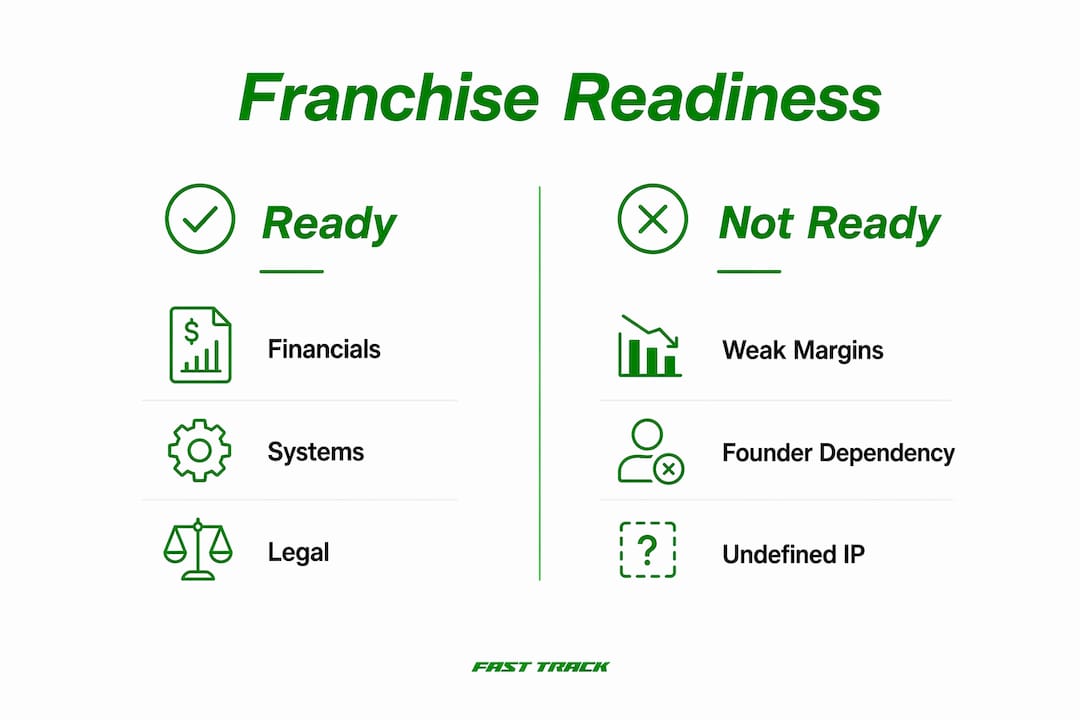
The table below compares businesses that are franchise-ready against those that are not yet ready across the four critical dimensions:
| Dimension | Franchise-ready | Not yet ready |
|---|---|---|
| Financial performance | 15%+ net margins across 2+ units over 2–3 years | Strong margins at one location only |
| Operations | 100+ page manual; 90-day training program proven | Processes exist but are undocumented or founder-dependent |
| Legal protection | Federal trademark registered or pending | Brand name unregistered or trademark application not filed |
| Leadership | Founder operates as network manager, not unit operator | Founder required for daily unit operations |
Franchise readiness is not a single milestone. It is an accumulation of evidence built across multiple sites, markets, and documented cycles of repeatability. Entrepreneurs who treat it as a checklist to complete once, rather than a standard to maintain, typically struggle when their first franchisees hit operational problems the system was not designed to handle.
Key Takeaways
A franchise-ready business model requires proven profitability, documented and teachable systems, federal trademark protection, and a founder prepared to lead a network rather than operate a unit.
| Point | Details |
|---|---|
| Financial threshold | Net margins must clear 15% at unit level after modeling royalty and brand fund fees. |
| Operational documentation | A 100+ page operations manual and 90-day training program are the minimum standard. |
| Intellectual property | Federal trademark registration or active pending status is required before franchising. |
| Leadership shift | The founder must transition from unit operator to franchisee support and network manager. |
| Evidence base | Three units across two markets over 24 months provide the replicability proof franchising demands. |
The readiness gap most entrepreneurs miss
I have worked with enough business owners exploring franchising to recognize a pattern that almost never gets discussed directly. Most founders assume that because their business is profitable and their customers love them, the hard work is done. It is not. Profitability is the entry fee, not the finish line.
The real gap is almost always founder dependency. The business runs because the founder knows every supplier personally, handles every difficult customer, and makes dozens of micro-decisions daily that are never written down. That knowledge does not transfer through enthusiasm or a logo. It transfers through documented systems, and building those systems takes longer than most founders expect.
The mindset shift required to become a franchisor is genuinely difficult. You stop being the expert who does the work and become the architect who builds the system others use to do the work. Founders who resist that shift, even unconsciously, build franchise networks that underperform because franchisees never get the support infrastructure they were promised. The training systems that scale well are built before the first franchisee signs, not after.
My honest recommendation: before you talk to a single prospective franchisee, spend six months trying to break your own system. Hand your manual to someone unfamiliar with your business. Step away from daily operations. If the business holds, you are ready. If it does not, you have found exactly what needs fixing before you put someone else's capital at risk.
— Cody
How Franchise Fast Track helps franchise-ready businesses grow
Building a franchise-ready business model is one challenge. Finding the right franchisees to grow it is another. Franchise Fast Track works specifically with franchisors who have done the preparation work and are ready to connect with serious, funded buyers.
Franchise Fast Track uses a proprietary system to deliver appointments with verified high-income professionals earning $150K–$500K annually, including executives, directors, and senior managers actively seeking franchise ownership. The platform's franchise lead generation approach targets qualified buyers rather than general inquiries, which is why franchisors using the system report a lead-to-close rate of 34%. For a business that has done the work to become franchise-ready, that kind of buyer quality changes the economics of franchise development entirely.
FAQ
What does franchise-ready mean for a business?
A franchise-ready business is one that is consistently profitable, fully documented, legally protected, and operable without the founder's daily involvement. It meets financial, operational, legal, and leadership benchmarks that allow the model to be replicated by trained franchisees.
What net margin does a business need to franchise?
A business needs net margins of 15% or higher at the unit level, sustained over 2–3 years, after accounting for royalty fees of 4–8% and brand fund contributions of 1–3%.
How many locations do you need before franchising?
The recommended benchmark is three corporate units operating in at least two distinct markets for 24 months. That evidence base demonstrates replicability across different operating conditions.
Why is a trademark required for franchising?
A franchise is legally a license to use a brand's systems and identity. Without a federally registered or pending trademark, there is no protected brand asset to license, and franchisees carry unacceptable legal risk.
How do I know if my business is too founder-dependent to franchise?
If daily operations require your direct involvement or personal relationships to function, the business is not yet franchise-ready. Test readiness by stepping away from operations and measuring performance using only your documented systems.
Recommended
- Franchising as a Business Model: What You Need to Know | Franchise Fast Track Blog
- How to Franchise Your Business for Sustainable Growth | Franchise Fast Track Blog
- What Is a Turnkey Business: Franchisor's 2026 Guide | Franchise Fast Track Blog
- Franchise Business Model a Strategic Analysis for Growth | Franchise Fast Track Blog
Ready to see results like these for your franchise?
Stop wasting money on leads that never close. Start getting hundreds of replies from high-net-worth professionals daily.