How Franchise Training Systems Are Built for Scale
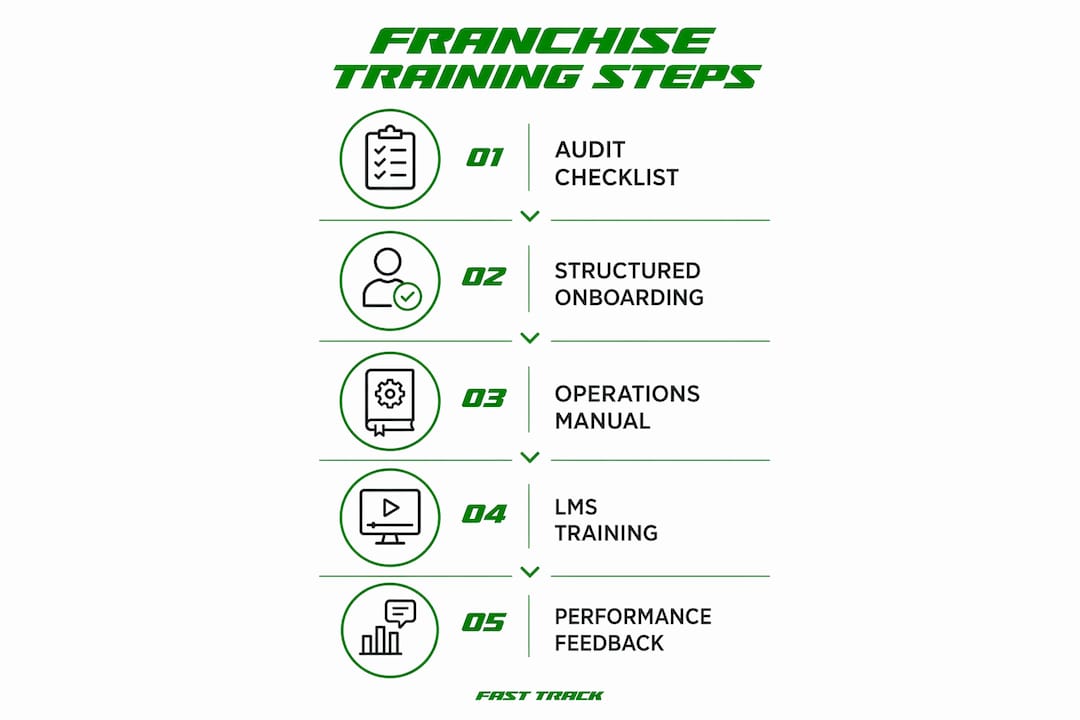
A franchise training system is a modular, audit-driven operational learning framework enforced through contractual agreements and verified by on-floor performance data. Understanding how franchise training systems are built separates franchisors who maintain brand consistency at 50 locations from those who lose it at 10. The architecture relies on four connected pillars: audit checklists, structured onboarding, version-controlled operations manuals, and LMS technology. Platforms like iSpring, Trainual, and GoAudits each play specific roles in this structure. Get the architecture right before writing a single training module, and the entire system becomes self-reinforcing.
How franchise training systems are built around audit checklists
The audit checklist is the foundation of any effective franchise training system. It defines what inspectors should see on the floor, which means it also defines what training must teach. Build training content directly from audit checklist items, and every module connects to a measurable operational standard.
This approach creates a training-audit-retrain feedback loop that measures execution, not just completion. A franchisee who passes a module but fails the corresponding audit reveals a gap in behavior, not knowledge. That distinction matters because most franchise training failures happen at the execution stage, not the learning stage.

Digital checklists serve a dual purpose that most franchisors underuse. During onboarding, the same checklist functions as a learning tool and SOP reference. After training ends, it becomes the daily operational standard. Using one artifact for both purposes cuts paperwork and keeps training aligned with real-world expectations.
Triggered refresher training outperforms generic training schedules. When a location fails an audit on food safety or customer service, the system automatically assigns the relevant module rather than waiting for the next quarterly training cycle. This precision targets the actual problem instead of retraining everyone on everything.
Pro Tip: Map every training module to a specific audit checklist item before you write any content. If a module cannot be tied to an auditable standard, question whether it belongs in the system at all.
What does structured franchise onboarding actually include?
Franchise onboarding is a mandatory, structured program that typically delivers 40–80 hours of instruction over 2–4 weeks before a new location opens. The franchise agreement makes this non-negotiable. Franchisees who skip or rush onboarding cannot receive a ready-to-open certification from the LMS, which means they legally cannot open.
The content categories in a well-designed onboarding program follow a logical sequence:
- Brand values and history — establishes why standards exist, not just what they are
- Operating standards — covers daily procedures, safety protocols, and quality benchmarks
- Product knowledge — includes preparation, presentation, and customer-facing specifications
- Marketing and local store execution — covers approved promotions, signage, and digital presence
- Technology systems — trains franchisees on POS, inventory, and reporting platforms
- Financial reporting — covers P&L reading, cash handling, and required submissions to the franchisor
Franchise onboarding differs fundamentally from corporate training. Franchisees are independent business owners, not employees. The franchisor's authority to mandate training comes entirely from the franchise agreement, not from an employment relationship. This legal distinction shapes every design decision in the training workflow, including how gating and certification are structured.
LMS platforms built for franchise networks support multitenant access, meaning the franchisor, a multi-unit operator, and a single-location manager each see a different dashboard with role-appropriate content and reporting. Performance reports by outlet show training compliance gaps at the location level, which allows field support teams to intervene before problems compound.
How do operations manuals integrate legal, training, and brand functions?
The franchise operations manual is simultaneously a legal document, a training reference, and a brand standards definition tool. Its legal weight comes from incorporation by reference into the franchise agreement. That single clause makes every procedure in the manual a contractual obligation, which is why version control and quarterly updates are not optional maintenance tasks. They are compliance management.
A proven framework organizes the manual across 17 chapters covering four domains: brand foundation, daily operations, people management, and technology systems. Chapter 12 in this framework covers training and certification procedures specifically, including requirements for new-hire onboarding and ongoing recertification timelines. Placing training requirements inside the manual rather than in a separate document keeps them legally enforceable and operationally visible.
- Quarterly revision planning prevents the manual from drifting out of sync with actual procedures
- Version numbering on every page ensures field teams and franchisees always know which version governs current operations
- Digital distribution through the LMS ties manual updates directly to training assignments, so a procedure change automatically triggers a module review
- Acknowledgment tracking creates a compliance record showing each franchisee received and accepted the updated version
Pro Tip: Write the manual with revision in mind from day one. Use numbered sections and modular chapter structures so a single procedure change does not require rewriting adjacent content.
The operations manual also reduces franchisor liability. When a franchisee claims they were not trained on a procedure, a version-controlled manual with LMS acknowledgment records provides clear documentation of what was communicated and when.
What technology architecture scales franchise training past 30 locations?
Beyond 20–30 locations, in-person training becomes a bottleneck. A franchisor cannot physically be present at every new hire orientation across a growing network. Self-directed LMS delivery solves this by making training available on demand, at any location, without requiring franchisor presence.
The design principle that makes this work is microlearning. Role-specific modules of 5–10 minutes fit the operational reality of franchise environments, where staff train between shifts and new hires need to be functional within days. A cashier does not need the same curriculum as a shift manager, and a shift manager does not need the full franchisee onboarding track.
| Training approach | Best for | Key limitation |
|---|---|---|
| In-person instructor-led | Initial franchisee onboarding | Does not scale past 20–30 locations |
| Self-directed LMS modules | Staff training at all locations | Requires strong content design upfront |
| Microlearning (5–10 min) | High-turnover roles, refreshers | Needs audit data to trigger correctly |
| Blended (LMS + field visits) | Complex operational standards | Higher cost, harder to schedule |
Brand consistency is driven by training system architecture, not by content quality alone. A well-produced video module that no one completes, or that is never connected to an audit result, does nothing for operational standards. The system must link completion data to operational evidence.
The critical LMS capabilities for franchise networks at scale include:
- Automated triggered assignments based on audit failures or new product launches
- Offline access for locations with unreliable internet connections
- Completion tracking by role and location feeding into field support dashboards
- Certification gating that blocks location opening or role advancement until prerequisites are met
Connecting training completion data with audit results and mystery shopping scores creates the feedback loop that prevents standards decay. Without that connection, training and operations run as separate systems, and brand consistency erodes quietly over time.
Key Takeaways
Franchise training systems succeed when audit checklists, structured onboarding, version-controlled manuals, and LMS technology operate as a single connected framework rather than separate programs.
| Point | Details |
|---|---|
| Start with the audit checklist | Build every training module from auditable standards so execution can be measured, not just completion. |
| Enforce onboarding contractually | Use the franchise agreement and LMS certification gates to make 40–80 hours of onboarding non-negotiable before opening. |
| Treat the operations manual as a living document | Plan quarterly revisions and version control every update to maintain legal compliance and training accuracy. |
| Design for self-directed delivery | Structure LMS content in 5–10 minute role-specific modules so training scales past 30 locations without franchisor presence. |
| Connect training data to operational evidence | Link LMS completion records to audit results and mystery shopping scores to catch standards decay early. |
Why most franchise training systems fail before they start
The most common mistake I see franchisors make is building content before building architecture. They hire a video production team, record 40 modules, and then ask how to deliver them. At that point, the training system is already broken. Content without a delivery structure, a verification mechanism, and a feedback loop is just a library nobody uses.
The second mistake is treating completion as success. A franchisee who finishes every module and then runs a location that fails three consecutive audits is not a training success story. Training completion alone is insufficient. The only metric that matters is whether behavior changed on the floor.
What I have found actually works is designing the audit checklist first, then building the training architecture around it, and only then developing content. This sequence forces every module to answer one question: what does the franchisee need to do differently after completing this? If the answer is vague, the module is not ready.
The franchisors who maintain brand consistency at 100-plus locations share one habit. They treat their franchise operating system as a product that requires ongoing maintenance, not a project that gets finished. Audits feed training updates. Training updates feed manual revisions. Manual revisions feed audit criteria. That loop, running continuously, is what keeps standards from drifting.
— Cody
Franchise Fast Track: scaling your network with the right buyers
Building a training system that works at scale only matters if the franchisees entering that system are qualified to execute it. Recruiting the wrong operators wastes your training investment before they open their first location.
Franchise Fast Track connects franchisors with verified high-income professionals earning between $150,000 and $500,000 annually, including executives, directors, and senior managers actively seeking franchise ownership. The platform delivers hundreds of qualified appointments each month and reports a lead-to-close rate of 34%. For franchisors who have built the training system and are ready to scale, Franchise Fast Track removes the bottleneck of unqualified leads and puts development resources where they produce results.
FAQ
What is a franchise training system?
A franchise training system is a structured, contractually enforced learning framework that uses audit checklists, LMS platforms, and operations manuals to train franchisees and their staff to consistent operational standards across all locations.
How long does franchise onboarding typically take?
Franchise onboarding typically delivers 40–80 hours of instruction over 2–4 weeks before a new location opens, covering brand standards, operations, technology, and financial reporting.
Why do franchise training systems need ongoing programs?
Standards decay without continuous refresher training tied to audit data and operational feedback. Quarterly updates and role recertification prevent training drift and keep procedures aligned with current brand requirements.
What is the role of an LMS in franchise training?
An LMS delivers self-directed, role-specific training modules, tracks completion by location, gates certification before opening, and triggers refresher assignments based on audit failures or new product launches.
How does the operations manual connect to franchise training?
The operations manual is incorporated by reference into the franchise agreement, making its procedures legally binding. Chapter-level training requirements inside the manual define onboarding content and recertification timelines for every role in the network.
Recommended
- Effective Franchise Training Programs for Franchisors | Franchise Fast Track Blog
- Franchise Growth Strategies for Sustainable Scale in 2026 | Franchise Fast Track Blog
- Franchise Business Model a Strategic Analysis for Growth | Franchise Fast Track Blog
- Franchise Growth Agency: Grow Your System With Funded Franchisees | Franchise Fast Track
Ready to see results like these for your franchise?
Stop wasting money on leads that never close. Start getting hundreds of replies from high-net-worth professionals daily.