Franchise Growth Strategies for Sustainable Scale in 2026
When it comes to franchise growth strategies, the most effective playbooks have flipped the script. We're moving away from simply generating a high volume of leads and toward a much sharper focus on attracting high-caliber candidates.
A modern approach rests on three core pillars: pinpointing qualified investors, automating the qualification pipeline, and meticulously tracking sales efficiency metrics. This is about building a predictable engine for expansion, not just casting a wide, leaky net and hoping for the best.
The Modern Playbook for Franchise Expansion
The old rules for growing a franchise just don't cut it anymore. For decades, the go-to strategy was to blanket franchise portals, sifting through thousands of casual inquiries to find a few serious buyers. It was inefficient, expensive, and a huge drain on development teams who spent most of their days chasing down "tire-kickers."
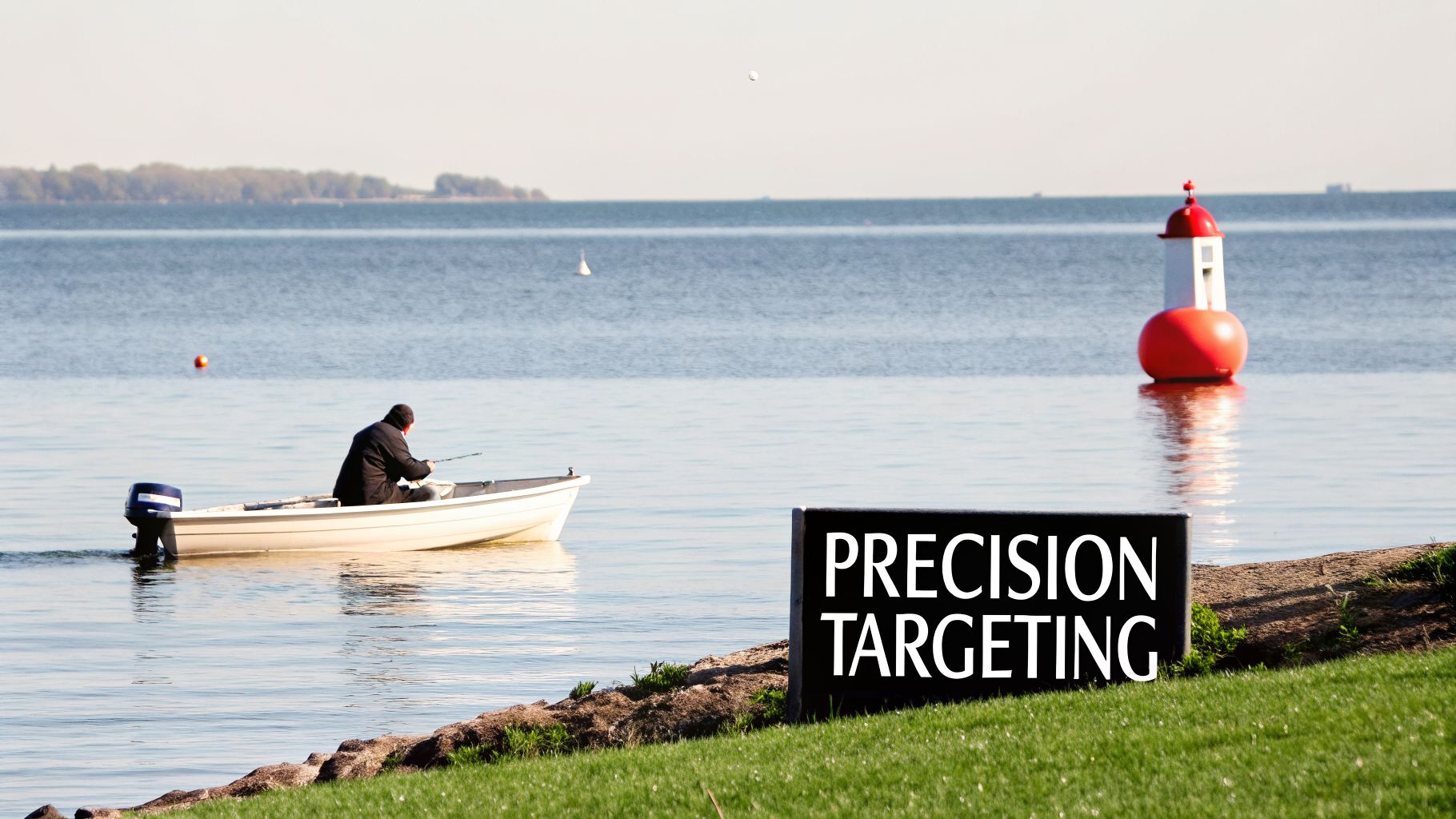
Smart franchisors are leaving that model behind. They now operate more like a spear-fisher in a private, well-stocked lake—they know exactly who their target is, where to find them, and how to get their attention. This precision cuts out the noise and dramatically shortens the sales cycle. The goal is no longer about lead count; it's about booking appointments with pre-vetted, high-intent prospects who are ready to talk business.
This flowchart shows how these pieces fit together, creating a system that moves from initial targeting all the way through performance measurement and refinement.
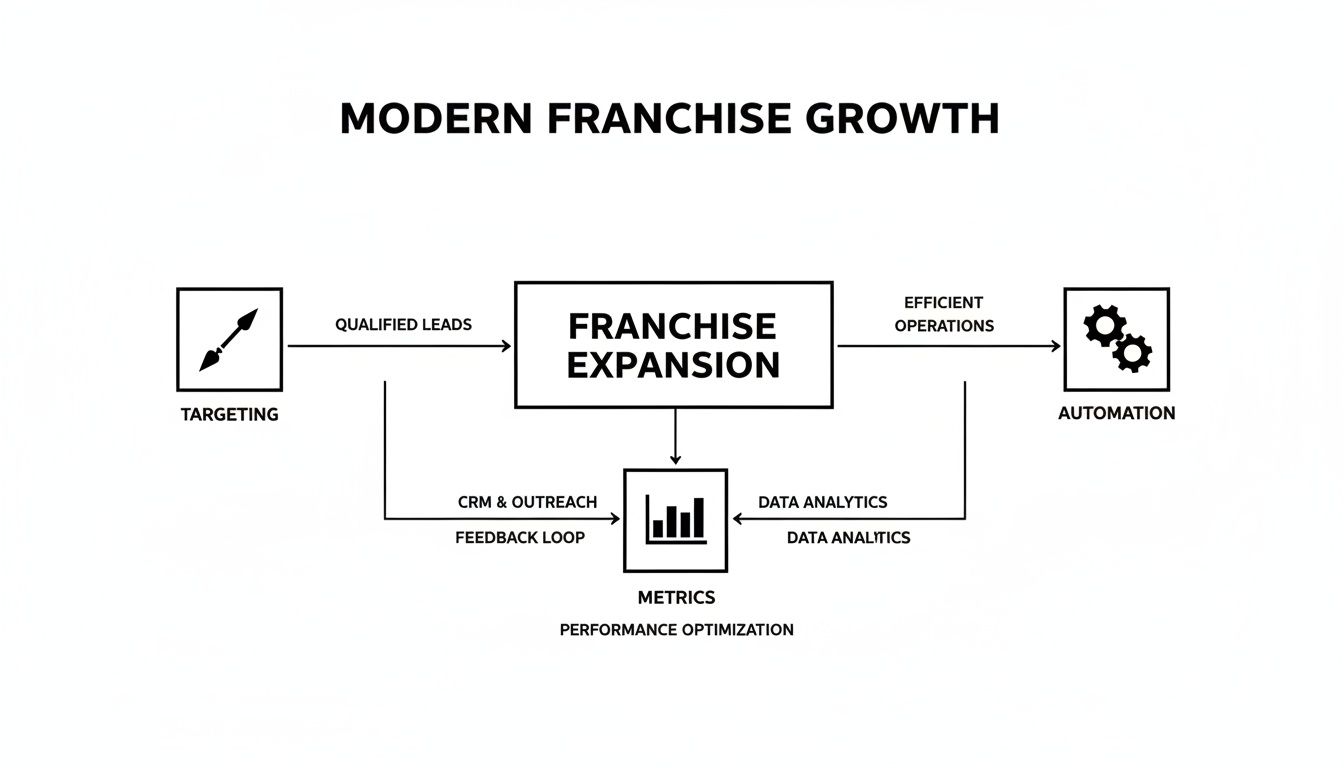
As you can see, successful expansion isn't about one magic bullet. It's a complete system where targeted outreach, automated qualification, and data-driven decisions work in concert to create a reliable pipeline of new franchisees.
Old Tactics vs. a Modern Strategy
To build a truly predictable growth engine, you have to understand the fundamental differences between the old playbook and the new one. The traditional model was built on quantity, while the modern approach is engineered entirely around candidate quality.
This shift in mindset impacts everything you do, from the first contact with a potential owner to the day they sign their franchise agreement. We explore these concepts in much greater detail over on our franchise growth strategy blog.
To put it in perspective, here's a clear comparison of how the two models stack up operationally.
Franchise Growth Models Old vs New
The table below breaks down the core differences between the traditional "wide net" approach and the modern, targeted "spear" strategy. The contrast in goals, channels, and metrics is stark.
| Metric | Traditional Model (The Wide Net) | Modern Model (The Spear) |
|---|---|---|
| Primary Goal | Generate the highest volume of leads possible. | Book appointments with qualified, high-intent buyers. |
| Main Channel | Franchise portals and broad digital ads. | Direct outreach and proprietary professional networks. |
| Key Metric | Cost Per Lead (CPL). | Cost Per Qualified Appointment and Cost Per Award. |
| Sales Team Focus | Sifting through unqualified inquiries. | Conducting strategic conversations with vetted candidates. |
This isn't just theory; the numbers back it up. The modern, qualification-first approach is driving real results across the industry.
The franchising sector in the U.S. is on track to grow from 498,234 establishments in 2017 to over 832,521 by late 2025—a massive 67%+ increase. This growth isn't happening by accident. It's fueled by sophisticated strategies like digital qualification and targeted regional development that consistently deliver higher-quality candidates. This rapid expansion proves that the brands positioned for long-term success are the ones with the most efficient, quality-focused systems.
Defining Your Ideal Franchisee Profile
Smart franchise growth strategies all start with one fundamental question: who are we actually trying to sell to? Before you spend a dime on marketing or outreach, you have to get crystal clear on the answer. This goes way beyond simple demographics. We're talking about building a data-rich Ideal Franchisee Profile (IFP).
Think of the IFP as the DNA of your perfect business partner. It spells out their financial capacity, professional background, personal drive, and the kind of operational mindset that will let them thrive in your system. For established franchisors focused on multi-unit growth, this profile almost always points to high-net-worth executives, seasoned managers, and serial investors.
These are the people who have both the capital and the sophisticated leadership skills to scale effectively. Nailing down your IFP is like installing a high-powered filter on your pipeline. It stops the casual "tire-kickers" from ever getting through, which makes your entire sales process dramatically more efficient.
Analyze Your Top Performers
The absolute best place to find the DNA for your IFP is within your own system. Your top-performing franchisees are living, breathing proof of what it takes to win. It's time to put them under a microscope to find the common threads that lead to success.
Don't stop at their old job titles. You need to dig into the qualities that make them so good at what they do.
- Financial Acumen: What's their typical net worth and liquid capital? Did they have experience managing a P&L or securing business financing? For many top-tier brands, these candidates have a net worth of $1M+ and substantial liquidity.
- Operational Experience: Have they managed large teams or overseen complex projects? Look for a track record of executive leadership or previous entrepreneurial wins.
- Psychographic Traits: What really drives them? Is it the desire for more autonomy, a passion for building a legacy, or a strategic move to diversify their investment portfolio?
When you find these commonalities, you can build a composite sketch of the person who is already wired to succeed with your model. This takes all the guesswork out of your recruitment and lets you focus your energy where it counts.
Map the Candidate Journey and Triggers
Here's something most people miss: your best candidates probably aren't scrolling through franchise portals. They're usually successful professionals in the middle of a major career shift, and understanding that journey is the key to finding them at just the right time.
The most qualified franchise candidates are almost always passive. They're C-suite executives, VPs, or seasoned entrepreneurs who just had a major liquidity event or are finally getting fed up with the corporate grind. Your IFP has to account for these transition triggers so you know where and how to find them.
These "triggers" are pivotal moments that push an accomplished person to look for their next big thing. It could be a corporate merger that makes their position redundant, a successful exit from a previous business, or just the realization that they want more control over their future.
Once you know what these triggers are, you can stop waiting for candidates to find you. Instead, you can proactively connect with them on professional networks or through specialized partners where they're already quietly exploring their options. This kind of proactive outreach is how modern franchise development is done—it ensures you get in front of the best people before your competition even knows they're looking.
Mastering Go-To-Market Channels for High-Value Buyers

Once you've built a crystal-clear Ideal Franchisee Profile (IFP), the real work begins: figuring out where these elite candidates actually spend their time. This is where so many established franchisors trip up. They'll have a perfect profile on paper, but then they'll shout into the void, broadcasting it on channels where their target audience simply isn't listening.
For premium brands, this means it's time to move beyond the crowded, low-intent world of traditional franchise portals and broad-stroke pay-per-click (PPC) ads. Sure, those channels generate a high volume of clicks, but they often flood your pipeline with undercapitalized prospects and casual "window shoppers." This reactive approach forces your development team to waste precious hours on dead-end qualification calls instead of having strategic, high-value conversations.
A modern approach to franchise growth strategies flips this entire model on its head. It's about proactively engaging qualified buyers in the professional spaces they already know and trust.
Shifting From Inbound Noise to Outbound Precision
To connect with the executives, senior managers, and serial investors you're looking for, you have to meet them on their home turf. This requires a calculated shift away from waiting for leads to come to you and toward actively seeking out the right people. Think of it as the difference between hoping a fish swims by and knowing exactly where the best fishing spots are.
This outbound approach is built on a few core pillars:
- Direct Outreach on Professional Networks: Platforms like LinkedIn are absolute goldmines for identifying individuals who match your IFP, from their job title and company history right down to their recent career transitions.
- Leveraging Proprietary Databases: Getting access to curated lists of high-net-worth individuals and business owners gives you a direct line to people who have the verified financial capacity to invest.
- Partnering with Appointment-Setting Specialists: Working with a firm that specializes in identifying and qualifying high-net-worth buyers can deliver a steady stream of pre-vetted appointments straight to your calendar.
These channels ensure that when your phone rings, you're talking to someone who not only has the financial means but also the professional background and genuine motivation to seriously consider a franchise investment. You can learn more about how this fundamentally changes the sales cycle by reading our in-depth analysis on why the traditional franchise lead generation model is broken.
The goal is to transform your sales process from reactive to proactive. Instead of your development team spending 80% of their time sifting through unqualified inquiries, they can dedicate that energy to building relationships with candidates who are already a great fit. This single shift can dramatically shorten your sales cycle and increase your close rate.
The Power of Pre-Vetted Conversations
Just think about the impact on your team's efficiency. When every single appointment is with a person who has already been financially and motivationally pre-vetted, the entire dynamic of the first call changes. You can skip the tedious screening questions and dive right into what matters: your brand, the business model, and how it aligns with their personal and professional goals.
This is the core value of working with a dedicated appointment-setting partner. Services like Franchise Fast Track, for instance, don't just generate leads; they book meetings with verified high-net-worth candidates who are actively exploring business ownership. For established franchisors, this delivers a predictable, high-quality pipeline that fuels sustainable expansion.
This focused approach also has a positive ripple effect on the broader economy. When effective franchise growth strategies connect the right capital with the right opportunities, real job creation follows.
In fact, franchise employment is forecasted to surge by 1.8% in 2026, adding more than 156,000 net new jobs to approach a total of 8.9 million positions nationwide. It's a clear reminder that a targeted growth strategy doesn't just accelerate your brand's growth—it also contributes to widespread economic stability and opportunity.
Fine-Tuning Your Franchise Sales Process
Getting a steady stream of ideal candidates is a huge win, but it's only half the job. The real work—and where empires are built—is in closing those deals. When your pipeline is full of high-intent, pre-qualified appointments, it completely changes the game for your development team. They can stop acting like gatekeepers and start being the strategic advisors you hired them to be.
This shift means your team gets to skip all the tedious front-end screening. From the very first phone call, they're diving into high-level conversations. The discussion isn't, "Can you afford this?" but rather, "Is this the right strategic addition to your business portfolio?" It's a subtle change that makes a world of difference, building trust faster, shortening sales cycles, and letting your team focus on what they do best: building relationships and awarding franchises.
When you're only talking to pre-vetted candidates, the entire process feels less like a sale and more like a collaboration. You're not just selling a franchise; you're building a business future together.
Structure a High-Impact Discovery Day
Think of your Discovery Day as the main event. It's not just a tour of your headquarters anymore. For the sophisticated investors you want to attract, this is a mutual due diligence session. They are there to get a feel for your leadership, your culture, and the real strength of your operations. To make it count, you need to put together an experience that directly answers the questions a seasoned professional will have.
An optimized Discovery Day should always include:
- Executive Access: Make sure your C-suite is there and actively participating. A high-net-worth individual wants to look your CEO in the eye and feel confident in their vision and leadership.
- Operational Transparency: Pull back the curtain on your support systems, technology, and supply chain. You have to prove the infrastructure is there to back up their ambitions for growth.
- Franchisee Validation: Set up honest, candid conversations with your top-performing multi-unit owners. For experienced candidates, insights from their peers are often more valuable than anything you can say.
This isn't about a flashy presentation. It's about showing them you have a well-oiled machine and a culture built on true partnership. That's what an experienced businessperson will recognize and respect.
Communicate Unit Economics with Transparency
Let's be blunt: savvy investors don't care about your glossy marketing brochures. They live and die by the numbers. Your approach to communicating unit economics has to be direct, transparent, and incredibly detailed. Your Franchise Disclosure Document (FDD) is just the beginning of that conversation, not the end of it.
You have to be ready to go far beyond the Item 19 financial performance representations. High-caliber candidates will want to pick apart the P&L of a real location, get a deep understanding of the key cost drivers, and run their own models for different revenue scenarios. Being an open book here is your single greatest sales tool.
When you get into the financials, focus on giving context, not just data. Explain the "why" behind every number.
- Break Down Prime Costs: Clearly walk them through labor, cost of goods sold (COGS), and explain how those numbers might shift based on region or sales volume.
- Model Multi-Unit Scenarios: Show them the actual economic advantages of scaling to multiple units. This includes real-world efficiencies in things like management overhead and local marketing spend.
- Discuss Ramp-Up Periods: Be brutally honest about how long it typically takes a new unit to hit break-even and then profitability. This level of candor builds massive credibility.
Handling these conversations with confidence and total openness shows you respect their financial know-how and are ready for a serious partnership. By getting ahead of their questions and providing detailed, honest answers, you remove friction from the process and build the trust required to get a deal across the finish line.
Implementing Smart Territory and Recruitment Models
If you want to scale your franchise, you have to get two things right: where you plant your flags and who you choose to plant them. The most successful franchise growth strategies are built on smart territory selection and recruitment models that line up perfectly with your brand's ambitions and the Ideal Franchisee Profile (IFP) you've worked so hard to define.
It's not just about selling territories to anyone who will buy them. It's about strategically placing the right operators in the right markets to set everyone up for a win. For franchisors serious about rapid growth, this almost always means shifting focus to recruitment models that attract high-net-worth candidates capable of opening multiple locations.
Matching Recruitment Models to Your Growth Stage
The way you structure your franchise agreements sends a clear signal to the market. Each model attracts a very different kind of candidate, so it's critical to know which one to use and when.
-
Single-Unit Agreements: This is the classic franchise model and the perfect starting point for many. It's a great fit for new brands looking to build density or for attracting passionate owner-operators who want to be in their business every single day.
-
Multi-Unit Agreements: This is the real engine of modern franchise growth. You're not just selling a single unit; you're awarding an operator the rights to open several locations over a set timeline. This is how you attract sophisticated, well-capitalized investors—the exact executives your IFP targets—who think in terms of building a portfolio, not just buying themselves a job.
-
Area Development Agreements: Think of this as the next level up. Here, you grant an experienced partner exclusive rights to develop an entire market. These deals are reserved for your most proven, high-capacity operators who have the capital and infrastructure to completely own a territory.
When your recruitment model clicks with your IFP, something powerful happens. High-net-worth candidates are naturally drawn to multi-unit and area development deals because they match their financial firepower and ambition. For you, this translates into faster, more predictable growth across the board.
Using Data for Strategic Territory Mapping
So, you know who you're looking for and how you'll bring them on board. The last piece of the puzzle is where to send them. The days of picking territories based on a gut feeling or a pin on a map are long gone. Today, territory mapping is all about the data.
The most profitable franchise territories aren't just available—they're strategically chosen. A data-first approach to territory selection helps you avoid oversaturated markets and identifies "hidden gem" locations where your concept can thrive with less competition and strong consumer demand.
By digging into demographic, economic, and competitive data, you can scientifically prioritize markets with the highest probability of success. You're no longer guessing. You're looking at hard numbers on household income, population growth, local spending habits, and the competitive landscape to rank potential territories. This ensures you direct your best candidates to markets where they have the strongest chance of hitting their financial goals.
The latest economic trends show exactly where the momentum is. Projections indicate the U.S. franchise sector is on track to hit 845,000 total units by 2026. The Southeast, which already accounts for nearly 30% of all franchise locations in the country, is forecasted to see employment jump by 2.0%. Even more impressive, the Southwest is set to lead the nation with a 2.5% growth in establishments and a 2.8% increase in jobs. You can dive deeper into these national trends by checking out the 2026 franchising economic outlook. Aligning your expansion strategy with these high-growth regions means you're not just growing—you're riding a powerful economic tailwind.
Building Your Predictable Franchise Growth Engine
When you step back and look at all the pieces we've put on the table—from defining your ideal franchisee to mastering your go-to-market channels—a single, powerful idea emerges. Predictable growth isn't about getting lucky or chasing every single inquiry that comes your way. It's the direct result of building a well-oiled machine, one where every part is designed for precision and efficiency.
This is how you finally escape the chaos of high-volume, low-quality lead generation. It's about building a consistent, reliable pipeline of candidates who are already a great fit before they even speak to your team. The moment you stop reacting to a flood of unqualified leads and start engineering predictable outcomes, everything changes.
Your development team is finally freed from the soul-crushing cycle of sifting and disqualifying. They can pour their time and energy where it actually counts: building relationships, conducting smart due diligence, and guiding the right partners across the finish line.
Stop Chasing Leads and Start Building Your Network
Ultimately, the goal of this entire playbook is to fundamentally shift your team's focus. You want to move away from chasing a high volume of unqualified leads from portals and broad ad campaigns. The real work is having strategic conversations with pre-vetted, high-intent investors.
This is exactly where a dedicated, 'done-for-you' partner at the top of your funnel can be a game-changer. Imagine a service that handles all the heavy lifting of prospecting and initial qualification, delivering a steady stream of financially verified appointments directly onto your calendar. Your internal experts are then free to do what they do best: close deals.
Imagine your team's calendar filled with back-to-back meetings with executives and experienced entrepreneurs who have already been confirmed to meet your financial requirements. This isn't a fantasy; it's the operational reality for brands that fully commit to a qualification-first growth model.
Your Next Move Toward Predictable Scale
If you're a serious brand, tired of wasting time on dead-end inquiries and ready to have the right conversations, it's time to make a move. The strategies we've walked through are the blueprint for a system that truly delivers. And by integrating a high-intent appointment-setting service, you're essentially adding rocket fuel to that system.
This approach ensures every conversation is a productive step toward building your network with the high-caliber partners who will drive your brand's future. For those ready to go from chasing leads to building an empire, the next step is clear.
You can learn more about how Franchise Fast Track delivers high-intent, verified appointments for established brands seeking this kind of scalable growth. The path to predictable expansion starts with having the right conversations—and it's time to make sure your team is having them.
Common Questions About Growing Your Franchise

Even with the best playbook, some questions always come up when it's time to put these growth strategies into practice. Let's tackle some of the most common ones I hear from franchisors.
Why Shouldn't I Just Crank Up My Ad Spend on Franchise Portals?
It's tempting, I know. Turning up the dial on portal ad spend will definitely get you more leads, but it's a classic case of quantity over quality. This "spray and pray" approach usually floods your development team with inquiries from people who are undercapitalized, unmotivated, or just kicking tires.
The result? Your team wastes precious time sifting through noise instead of talking to serious buyers. A modern growth strategy flips this on its head by focusing on attracting and pre-qualifying the right people from the start, so your team's conversations are always with vetted, high-value prospects.
Is My Franchise Ready for a High-Intent Appointment Partner?
You're probably ready to bring in a partner if you have a proven concept with a minimum investment of at least $150K and you have ambitious, clearly defined unit growth goals. The biggest sign, though, is when your development team is spending more time qualifying leads than closing deals.
A few other telltale signs: your close rates from existing lead sources are consistently low, or you're backed by private equity and need to deliver predictable, scalable growth. A dedicated appointment partner is built for established brands that are ready for a steady stream of qualified candidates.
What KPIs Should I Actually Be Tracking for Franchise Development?
So many franchisors get stuck tracking vanity metrics like Cost Per Lead (CPL). It feels productive, but it doesn't tell you anything about the health of your sales engine. To really understand performance, you need to measure what actually drives results.
Here are the KPIs that truly matter:
- Cost Per Application: This shows how efficiently you turn initial interest into a formal application.
- Cost Per Qualified Appointment: This is the real cost of getting a meeting with a serious, vetted buyer.
- Lead-to-Close Rate: This number reveals the true effectiveness of your entire sales process, from first touch to signed agreement.
- Average Sales Cycle Length: This tells you how fast you can guide a qualified prospect through the pipeline.
Ultimately, your north-star metric should always be the Cost Per Franchise Awarded. That number cuts through everything else and shows you the true ROI of your development efforts. It's the ultimate benchmark for a successful growth strategy.
Ready to fill your calendar with pre-vetted, high-intent appointments? Franchise Fast Track delivers a consistent pipeline of financially verified candidates so your team can focus on what it does best—closing deals. Find out how Franchise Fast Track can build your predictable growth engine.
Ready to see results like these for your franchise?
Stop wasting money on leads that never close. Start getting hundreds of replies from high-net-worth professionals daily.