Franchising as a Business Model: What You Need to Know

Franchising is a business model where an established company, called the franchisor, licenses an individual or group, called the franchisee, the right to operate a business using the franchisor's brand, trademarks, and proven operating system. The International Franchise Association defines franchising as a contractual relationship that specifies products, brand support, and operational controls. In exchange for those rights, the franchisee pays an initial fee plus ongoing royalties and agrees to follow the franchisor's standards. The franchise agreement is the governing document that binds both parties. Understanding what franchising is as a business model gives you a clear picture of what you are actually buying before you commit a dollar.
What is franchising a business model, exactly?
Franchising is a licensing arrangement, but it goes far beyond a simple brand license. The IFA notes that every franchise is a license, but not every license is a franchise. That distinction matters because it determines the legal obligations and protections that apply to both parties. When a relationship qualifies as a franchise under U.S. law, the franchisor must comply with the FTC Franchise Rule and provide a Franchise Disclosure Document before any money changes hands.
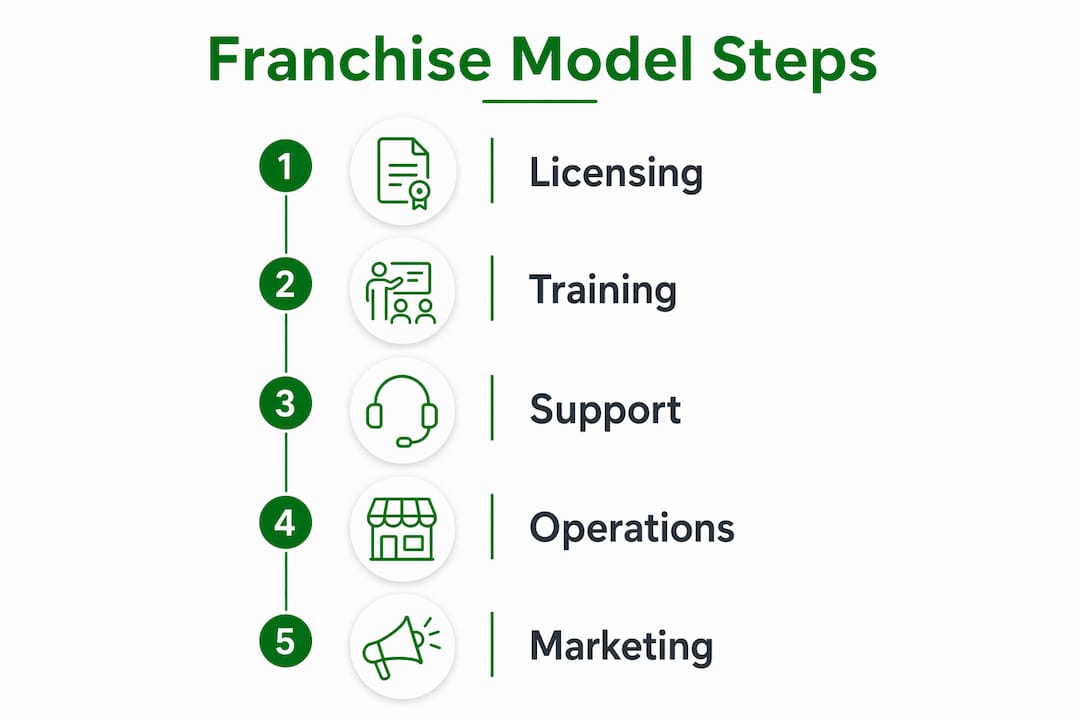
The franchise business definition centers on three parties: the franchisor who owns the system, the franchisee who operates a local unit, and the customer who experiences a consistent brand. The franchisor builds the playbook. The franchisee executes it locally. That division of responsibility is what makes the model scalable for franchisors and accessible for first-time business owners.

What are the key components of a franchise business model?
The franchise business model explained in its simplest form has five core components that work together as a system.
- The brand and intellectual property. The franchisor licenses its trademarks, trade dress, and brand identity to the franchisee. Customers recognize the brand regardless of which franchisee owns that location.
- The operating system. Franchising licenses a repeatable, proven system with training and controls built in. This is what separates a franchise from a simple trademark license.
- The franchise agreement. This is the legal contract that governs every aspect of the relationship, from fees and territory to marketing obligations and termination conditions. The ACCC lists fair terms and dispute resolution as core elements every agreement must address.
- The fee structure. Franchisees pay an initial franchise fee to enter the system, then ongoing royalties calculated as a percentage of revenue. The IFA explains these fees cover the licensing of the brand, system, and intellectual property. You can explore typical ranges in this franchise startup costs guide.
- Franchisor support. Training, marketing, and operational guidance are not optional extras. They are built into the model. Franchisors provide ongoing training and support to protect brand consistency across every location.
Pro Tip: Ask any franchisor you are evaluating to show you exactly what their training program covers and how long it lasts before you sign anything. Weak training is the single clearest signal of a weak system.
How does franchising work in practice?
The operational relationship between franchisor and franchisee follows a structured sequence from signing to opening to ongoing operations.
- Pre-sale disclosure. The franchisor provides a Franchise Disclosure Document at least 14 days before any agreement is signed or money is paid. This document covers 23 standardized items under the FTC Franchise Rule, including litigation history, fees, and financial performance representations.
- Agreement execution. Both parties sign the franchise agreement, which locks in territory rights, fee obligations, brand standards, and renewal terms. The franchise agreement is the most important document in the relationship.
- Initial training. The franchisee and key staff complete the franchisor's training program before opening. This typically covers operations, customer service, technology systems, and brand standards.
- Site selection and build-out. The franchisee selects a location, subject to franchisor approval, and builds or fits out the premises to brand specifications.
- Grand opening and ongoing operations. The franchisee runs day-to-day operations independently while the franchisor monitors compliance, provides field support, and enforces brand standards.
"The franchise model lets franchisors scale by expanding via independently owned franchise locations rather than company-owned units." — International Franchise Association
A relationship qualifies as a franchise under U.S. law when it meets three criteria: the franchisee uses the franchisor's trademark, the franchisor exercises significant control or assistance, and the franchisee pays at least $735 within the first six months. That threshold is lower than most people expect, which means some businesses operate as franchises legally without realizing it.
What are the benefits and challenges of franchising for franchisees?
Franchising offers a genuine middle path between starting from scratch and buying an existing business. The table below captures the core tradeoffs.
| Factor | Benefit | Challenge |
|---|---|---|
| Brand recognition | Customers already know and trust the brand | You inherit any negative brand reputation too |
| Proven system | Reduces startup guesswork and learning curve | You must follow the system, even if you disagree |
| Training and support | Franchisor provides structured onboarding and field support | Quality varies significantly between franchisors |
| Marketing | National or regional marketing funded by royalties | Local marketing spend may still be required on top |
| Costs | Clear fee structure with known upfront investment | Initial fees and royalties reduce profit margins |
The IFA cites brand recognition, proven business models, and ongoing support as the primary advantages for franchisees. Those advantages are real, but they come with a cost. Royalties typically run between 4% and 12% of gross revenue, paid every week or month regardless of profitability. That ongoing obligation changes the financial math compared to an independent business.
Franchise success is not guaranteed. The ACCC notes that the system's operational fit to the franchisee's specific location and management style is the critical variable. A McDonald's franchise in a high-traffic urban center performs very differently from the same brand in a low-footfall suburban strip mall. Location and operator quality drive outcomes more than the brand alone.
Pro Tip: Talk to at least five existing franchisees in the system you are evaluating. Ask them directly what they wish they had known before signing. Their answers will tell you more than any disclosure document.
How to evaluate and start a franchise business
Evaluating a franchise opportunity requires a structured process. Skipping steps here is where most buyers make costly mistakes.
- Read the FDD cover to cover. The Franchise Disclosure Document contains 23 items that reveal litigation history, franchisee turnover rates, financial performance data, and the full fee schedule. This FDD database guide explains what each section means and what red flags to look for.
- Review the franchise agreement with a franchise attorney. Never use a general practice attorney for this. Franchise agreements are specialized contracts, and the terms around renewal, termination, and territory protection require expert review.
- Understand the full financial picture. The initial franchise fee is only the beginning. Factor in build-out costs, working capital, equipment, and the royalty burden over your first three years of operation.
- Validate the franchisor's support claims. Ask for the training schedule, the field support frequency, and the technology systems provided. Promises made during sales presentations must be reflected in the actual agreement.
- Assess territory and competition. Confirm whether your territory is exclusive, what triggers a territory reduction, and whether the franchisor can open competing units nearby.
| Evaluation Step | What to Look For |
|---|---|
| FDD Item 19 | Financial performance representations from existing units |
| FDD Item 20 | Franchisee turnover rate over the past three years |
| Franchise agreement | Renewal terms, termination triggers, and transfer rights |
| Franchisor financials | Audited financial statements showing system stability |
| Franchisee interviews | Satisfaction with support, actual vs. projected revenue |
Reviewing both the franchise agreement and FDD as separate documents is critical. One governs your day-to-day obligations after signing. The other informs your decision before you commit. Treating them as interchangeable is a common and expensive mistake.
Key takeaways
Franchising works because it combines a proven operating system with independent local ownership, governed by a legally binding agreement that defines every obligation on both sides.
| Point | Details |
|---|---|
| Core definition | Franchising licenses a brand, system, and support network, not just a name. |
| Legal framework | The FTC Franchise Rule and FDD govern all U.S. franchise relationships before signing. |
| Fee structure | Franchisees pay an initial fee plus ongoing royalties covering brand and system access. |
| Due diligence | Reading the FDD and interviewing existing franchisees are non-negotiable evaluation steps. |
| Success factors | Location fit and operator quality drive outcomes more than brand recognition alone. |
Why franchising deserves more scrutiny than most buyers give it
I have spent years watching prospective franchise buyers fall in love with a brand before they understand what they are actually purchasing. The brand is the least important part of the transaction. What you are really buying is the operating system, the support infrastructure, and the franchisor relationship. Those three things will determine whether you succeed or struggle, not the logo on the door.
The most common misconception I encounter is that a recognized brand equals a safe investment. It does not. A franchise from a nationally known system can still fail at a specific location if the territory is oversaturated, the franchisee is undercapitalized, or the franchisor's support team is stretched too thin. The FDD tells you the turnover rate for a reason. If 30% of franchisees in a system have left in the past three years, that number is a warning, not a footnote.
What I respect about franchising as a path to business ownership is the transparency it forces. The disclosure requirements, the cooling-off periods in markets like Australia where franchisees can terminate within 14 days, and the standardized FDD structure give buyers more information upfront than almost any other business purchase. The problem is that most buyers do not use that information rigorously enough.
My advice is simple. Treat the FDD like a financial audit. Hire a franchise attorney who does this work every day. And talk to franchisees who left the system, not just the ones the franchisor puts on their reference list. The difference between a good franchise investment and a bad one is almost always visible in the data before you sign.
— Cody
How Franchisefasttrack helps serious franchise buyers and franchisors

Franchisefasttrack is built for the part of franchising that most platforms ignore: connecting franchisors with buyers who are actually qualified to close. The platform delivers appointments with verified high-income professionals earning between $150K and $500K annually, including executives, directors, and senior managers who are actively evaluating franchise ownership. That focus on buyer quality is why Franchisefasttrack reports a lead-to-close rate of 34%, which is significantly above industry norms. If you are a franchisor looking to grow your network with serious candidates, explore qualified franchisee lead generation through Franchisefasttrack. If you are a prospective franchisee, the franchisee database gives you access to verified contact data across the franchise development space.
FAQ
What is a franchise agreement?
A franchise agreement is the legally binding contract between franchisor and franchisee that governs fees, brand standards, territory rights, and termination conditions. It is the most important document in any franchising relationship and must be reviewed by a qualified franchise attorney before signing.
How is franchising different from licensing?
Franchising includes significant franchisor control or assistance and ongoing support, while a standard license simply grants permission to use intellectual property. The IFA states that every franchise is a license, but not every license is a franchise, and that distinction determines the legal protections that apply.
What does a franchisee pay to join a franchise system?
Franchisees pay an initial franchise fee to enter the system, then ongoing royalties as a percentage of gross revenue. Additional costs include build-out, equipment, working capital, and sometimes a required marketing fund contribution.
What is the Franchise Disclosure Document?
The Franchise Disclosure Document, or FDD, is a standardized pre-sale document required by the FTC that covers 23 items including fees, litigation history, franchisee turnover, and financial performance data. Franchisors must provide it at least 14 days before any agreement is signed.
Is franchising a guaranteed path to business success?
Franchising is not a guaranteed path to success. The ACCC notes that operational fit to the franchisee's specific location and management capability are the determining factors, and a recognized brand does not offset poor site selection or undercapitalization.
Recommended
- How to Franchise Your Business for Sustainable Growth | Franchise Fast Track Blog
- What Is a Turnkey Business: Franchisor's 2026 Guide | Franchise Fast Track Blog
- Franchise Growth Strategies for Sustainable Scale in 2026 | Franchise Fast Track Blog
- Advertising a Franchise: A Playbook for High-Income Buyers | Franchise Fast Track Blog
Ready to see results like these for your franchise?
Stop wasting money on leads that never close. Start getting hundreds of replies from high-net-worth professionals daily.