What Is a Franchise Lead Source Audit?
A franchise lead source audit is a structured evaluation of every channel, process, and data point that generates franchise leads, designed to identify which sources produce qualified buyers and which drain your marketing budget. Most franchise marketers track lead volume but skip the deeper question: where do closed deals actually come from? The industry term for this practice is "lead source attribution analysis," and a full audit wraps that analysis inside a broader review of CRM integrity, compliance, response processes, and qualification logic. Over 26% of franchise leads receive no response, even though the average lead costs about $90. That single finding makes the case for a formal audit better than any theory can.
What is a franchise lead source audit, and what does it cover?
A franchise lead source audit examines every point where a prospective franchisee enters your pipeline, from paid ads and franchise portals to referrals, events, and organic search. The goal is to answer three questions: where are leads coming from, how are they being handled, and which sources produce franchisees who actually sign agreements?
Mapping every entry channel
Start by listing every active lead channel. Paid search, social ads, franchise portal listings, broker networks, trade shows, email campaigns, and direct referrals each need a separate row in your audit. Many franchisors discover channels they forgot they activated, or portals still sending leads to an inbox no one monitors. Lead source diversification matters, but only when each channel is tracked and evaluated on its own merits.
Auditing CRM data for accuracy
CRM data quality is the backbone of any lead source evaluation. Lead source data inconsistencies, such as one channel labeled "Facebook," "FB Ads," and "Social" in three different records, break your analytics entirely. A CRM with more than 40% of leads marked "Other" or "Unknown" almost always has broken form configurations. Fix naming conventions before drawing any conclusions from your data.

Evaluating attribution models
Standard last-touch attribution gives full credit to the final channel a lead clicked before submitting a form. That model misses the reality that franchisors often overlook long anonymous research phases that precede a lead's first contact. A prospect may read your franchise disclosure document three times, visit your site from organic search, and then convert through a portal ad. Last-touch attribution credits the portal. Multitouch models distribute credit more accurately across the full journey.
Checking compliance status
Approximately 33% of franchise brands are non-compliant with TCPA regulations, which restricts how and when you can contact leads via SMS. Compliance failures reduce your follow-up options and expose you to legal liability. A thorough audit flags which lead sources collect consent correctly and which do not.
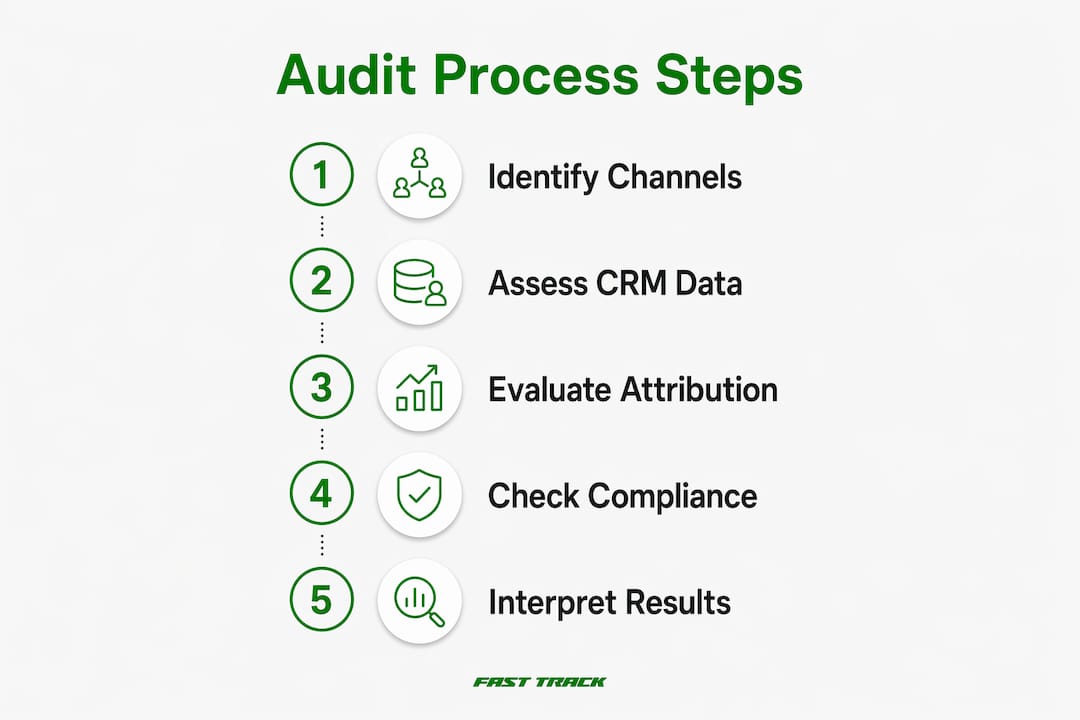
Pro Tip: Run your audit on a six-week cycle. A well-structured review covers CRM field audits, attribution model teardown, anonymous visitor overlays, and playbook rewrites. Skipping any phase reduces the audit's value significantly.
How to interpret audit findings to improve lead quality
Raw audit data tells you what happened. Interpretation tells you what to do about it. The gap between those two steps is where most franchise marketers lose momentum.
The most important finding in any franchise lead generation audit is your "dead zone." Silent leads with no score, no status, and no follow-up represent 30–40% of CRM records in a typical franchise pipeline. These leads represent real marketing spend with zero chance of return. Identifying and removing them clears your pipeline for leads that can actually convert.
Response time is the second critical variable. Failing to follow up within 72 hours drops conversion below 15%, while leads who attend a Discovery Day convert at 40–70%. The gap between those two numbers shows exactly what fast, personal follow-up is worth.
Use your audit findings to answer these questions about each lead source:
- Does this channel produce leads who meet your financial qualification criteria, including liquid capital requirements?
- What is the average time between lead submission and first contact for leads from this source?
- What percentage of leads from this channel progress past the initial qualification call?
- Are leads from this source self-selecting based on genuine interest, or responding to broad, untargeted messaging?
- Does this channel's cost per lead align with its cost per awarded franchise?
True franchise lead qualification evaluates financial fit, operational intent, and territory availability before any sales conversation begins. Audit findings that reveal a channel producing high volume but low qualification rates signal a targeting problem, not a sales problem.
Pro Tip: Sort your closed deals by lead source before you do anything else. The channel that produced your last five franchisees deserves more budget. The channel that produced 200 leads and zero closings deserves a hard look.
What role does technology and AI play in franchise lead source audits?
Technology does not replace the audit. It makes the audit's output more useful by acting on findings faster than any manual process can.
AI-powered lead qualification uses brand-specific criteria, such as liquid capital thresholds, operating experience, and geographic preference, to score every incoming lead automatically. AI qualification tools score and route leads based on these criteria, sending qualified prospects directly to a named sales representative while routing lower-fit inquiries into a nurture sequence. That routing logic only works when your audit has already established what a qualified lead looks like.
What technology reveals that manual review misses
Behavioral data tools overlay anonymous visitor activity on top of your CRM records. A lead who submitted a form after five site visits is fundamentally different from one who clicked a portal ad and filled out a form in two minutes. High-intent leads with five or more site visits show 2–3x higher win rates than low-visit leads. Flagging those leads for same-day outreach by a named sales rep is a direct application of audit findings.
Automation also addresses the response time problem. Strong lead management requires automated assignment rules, response time measurement, and follow-up sequence evaluation. Manual processes cause slow response and lost conversion potential. Audit findings that reveal a 48-hour average response time justify the investment in automated routing immediately.
Before deploying any AI scoring model, document your Ideal Customer Profile in writing. Brands must define clear ICP characteristics before AI scoring is relevant. Without that foundation, the algorithm scores against the wrong criteria and routes the wrong leads. Your audit is what produces that ICP definition.
Franchise Fast Track applies this principle directly. The platform delivers appointments with verified professionals earning $150K–$500K annually, which means the ICP is defined before the first lead enters the system. That approach reflects exactly what a well-executed audit recommends: qualify the audience before you spend on outreach. For franchisors exploring lead generation automation, the audit is the prerequisite, not the afterthought.
How does a lead source audit fit into your broader franchise development strategy?
A franchise lead source audit is not a one-time project. It is a recurring diagnostic that keeps your franchise development strategy aligned with where qualified buyers actually come from.
The table below shows how audit findings connect to specific development decisions:
| Audit Finding | Development Action |
|---|---|
| One channel produces 70% of closed deals | Reallocate budget toward that channel in the next quarter |
| Average response time exceeds 48 hours | Implement automated lead routing and same-day alert rules |
| 35% of CRM records have no source tag | Fix form configurations and enforce naming conventions |
| Portal leads convert below 10% | Reduce portal spend and shift to direct outreach channels |
| TCPA non-compliance on SMS follow-up | Audit consent collection and update opt-in language |
Audit results also inform territory management. A channel that generates strong leads in the Southeast but weak leads in the Midwest signals a targeting or messaging mismatch, not a product problem. Adjusting creative and channel mix by region is a direct outcome of granular lead source analysis.
Quality beats volume at every stage of franchise development. A pipeline of 500 unqualified leads costs more to manage than a pipeline of 50 qualified ones, and it produces worse outcomes. Franchisors who run regular audits consistently shift their focus from lead count to lead fit, which is the shift that drives actual growth.
Key Takeaways
A franchise lead source audit is the single most direct way to identify where your marketing budget produces franchisees and where it produces noise.
| Point | Details |
|---|---|
| Define every channel first | Map all lead entry points before drawing conclusions from CRM data. |
| Fix CRM data before analyzing | Inconsistent naming conventions make attribution reports meaningless. |
| Response time drives conversion | Following up within 72 hours is the difference between a 15% and a 70% conversion rate. |
| Dead-zone leads waste budget | 30–40% of CRM records typically have no follow-up, score, or status. |
| Audit informs AI, not the reverse | Define your Ideal Customer Profile through audit findings before deploying lead scoring tools. |
Why franchisors who skip audits keep making the same expensive mistakes
I have seen franchisors spend six figures on portal listings and paid ads, then blame their sales team when closings stall. The audit almost always tells a different story. The leads were never qualified to begin with, the CRM had three naming conventions for the same channel, and nobody had followed up with 30% of the pipeline.
The most common misconception I encounter is that a lead source audit is a marketing report. It is not. It is a diagnostic tool that touches sales, operations, compliance, and technology at the same time. When stakeholders from each of those functions are not in the room when findings are presented, the recommendations die in a slide deck.
The franchisors who get the most from their audits treat findings as a starting point for process change, not a grade on past performance. They ask "what do we fix first?" not "who is responsible for this?" That mindset shift is what separates brands that grow their franchise networks from brands that keep recycling the same unqualified leads through the same broken pipeline.
Run your audit before you increase your marketing budget. Spending more on a broken system produces more broken results, not more franchisees.
— Cody
How Franchise Fast Track supports your lead quality goals

Franchise Fast Track is built around the principle that lead quality determines development outcomes, not lead volume. The platform connects franchisors with verified high-income professionals earning $150K–$500K annually, delivering hundreds of qualified appointments each month with executives, directors, and senior managers who are actively evaluating franchise ownership. That pre-qualification removes the most expensive problem an audit typically uncovers: unqualified leads consuming your sales team's time. Franchisors working with Franchise Fast Track report a lead-to-close rate of 34%, which reflects what happens when the ICP is defined and enforced before the first conversation. If your audit has revealed a pipeline full of low-fit leads, Franchise Fast Track's franchise development marketing services offer a direct path to a higher-quality funnel.
FAQ
What is a franchise lead source audit?
A franchise lead source audit is a structured review of every channel that generates franchise leads, evaluating data quality, attribution accuracy, compliance, and conversion performance. The goal is to identify which sources produce qualified franchisee candidates and which waste marketing spend.
How often should franchisors run a lead source audit?
Franchisors should run a full lead source audit at least once per year, with lighter quarterly reviews of CRM data and response time metrics. Brands scaling into new territories or launching new channels benefit from more frequent reviews.
What is the biggest problem a franchise lead source audit typically uncovers?
The most common finding is a "dead zone" of leads with no follow-up, no score, and no status, representing 30–40% of CRM records in a typical pipeline. These leads represent real marketing spend with no path to conversion.
How does response time affect franchise lead conversion?
Failing to follow up within 72 hours drops conversion rates below 15%, while leads who attend a Discovery Day convert at 40–70%. Fast, personal follow-up is the single highest-leverage action most franchisors can take after completing an audit.
What is the role of AI in a franchise lead source audit?
AI does not conduct the audit. It acts on audit findings by scoring and routing leads based on ICP criteria such as liquid capital and operating experience. Defining those criteria through the audit process is what makes AI lead scoring accurate and useful.
Recommended
- Franchise Broker Lead Source Diversification Guide | Franchise Fast Track Blog
- Franchise Lead Generation: Qualified Franchisee Candidates for Serious Franchisors | Franchise Fast Track
- Franchise Lead Qualification: What It Means and Why It Matters | Franchise Fast Track Blog
- Franchise Lead Scoring System: A Franchisor's 2026 Guide | Franchise Fast Track Blog
Ready to see results like these for your franchise?
Stop wasting money on leads that never close. Start getting hundreds of replies from high-net-worth professionals daily.