Franchise Broker Lead Source Diversification Guide

Franchise broker lead source diversification is the practice of spreading lead generation across multiple channels so no single source controls your pipeline. Digital advertising drives 44% of closed franchise deals and brokers account for 43%, yet most franchise development teams still treat one of these as their primary engine. That concentration creates fragility. When a portal changes its algorithm or a broker network goes quiet, your entire deal flow stalls. The brokers and developers who build stable pipelines treat channel mix as a discipline, not an afterthought, and they back every decision with cost-per-lead data and conversion metrics.
What are the primary franchise broker lead sources in 2026?
The franchise development industry recognizes three dominant lead source categories: digital advertising, broker networks, and franchise opportunity portals. Each channel closes roughly a third to nearly half of all deals, which means no single channel has a monopoly on qualified buyers. Understanding what each channel delivers, and what it costs, is the starting point for any serious diversification effort.
Digital advertising, primarily Google Search and Meta, gives you direct control over targeting, budget, and messaging. The tradeoff is cost and complexity. Broker networks deliver pre-screened candidates with a built-in trust relationship, but you pay a referral fee and surrender control over the candidate experience. Franchise portals generate volume, but portal leads convert at lower rates than broker-sourced candidates, which affects your cost efficiency at every stage of the funnel.

76.7% of franchise development teams adjusted their channel budgets tactically in 2025. That figure tells you the industry has moved past "set it and forget it" channel management. The teams gaining ground are the ones treating their channel mix as a live variable, not a fixed line item.
| Lead source | Volume | Lead quality | Cost control | Broker control |
|---|---|---|---|---|
| Digital advertising | High | Medium | High | Full |
| Broker networks | Medium | High | Low | Shared |
| Franchise portals | High | Low to medium | Medium | Limited |
| Organic search / SEO | Medium | Medium to high | High | Full |
| Referral programs | Low to medium | High | High | Full |
How do you assess and balance lead sources for maximum ROI?
The first step is defining a commercially specific candidate profile. Operational, cultural, and financial fit matter more than the channel a lead came from. Without a clear profile, you cannot compare channels fairly because you have no consistent standard for what a qualified lead actually looks like.
Once your candidate profile is set, track five metrics for every channel:
- Volume: Raw number of inquiries per month
- Lead quality score: Percentage meeting your financial and operational criteria
- Conversion rate: Inquiries that reach the discovery day or franchise disclosure document stage
- Cost per lead (CPL): Total channel spend divided by qualified leads, not raw inquiries
- Pipeline velocity: Average days from first contact to signed agreement
Top franchise development teams target a CPL of around $350 for high-value leads. That benchmark gives you a concrete threshold for deciding when a channel is underperforming and needs budget reallocation.
AI-driven lead scoring has become the practical tool for making these comparisons at scale. AI captures buyer signals across channels and ranks leads by conversion probability, so your development team spends time on the candidates most likely to close. Budget allocation follows the data. A common starting split is 60% toward Google Search and 40% toward Meta Social, but that ratio should shift quarterly based on actual CPL performance, not habit.
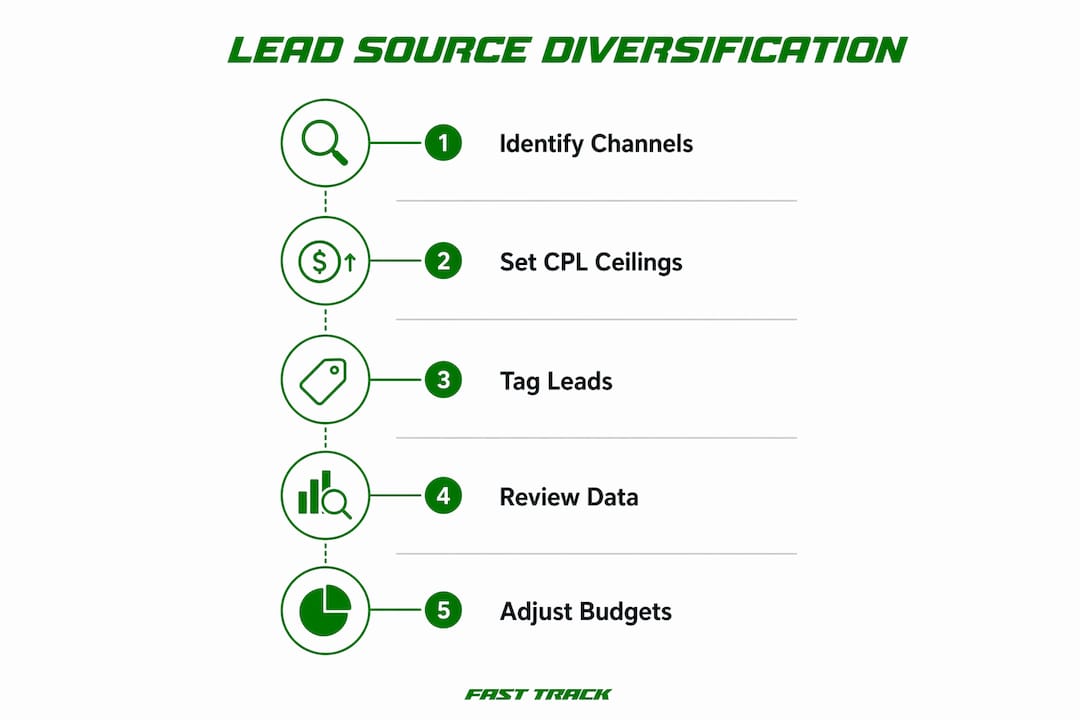
Pro Tip: Set a CPL ceiling for each channel before you launch. If a channel exceeds that ceiling for two consecutive months, cut its budget by 25% and reallocate to the channel with the lowest CPL and highest conversion rate.
Step-by-step tactics for implementing lead source diversification
Building a multi-channel lead generation system requires deliberate sequencing. Adding five channels at once creates noise. Adding them one at a time, with clear measurement in place, gives you clean data on what each channel actually contributes.
-
Audit your current channel mix. Map every lead source you used in the past 12 months. Record volume, CPL, and close rate for each. This baseline tells you where you are over-indexed and where you have no presence at all.
-
Add organic search as a first-party channel. Building first-party demand through your franchise development website reduces dependence on portals and brokers. Publish content that answers the questions serious franchise buyers search for, and capture those leads directly.
-
Launch a structured referral program. Referral and affiliate programs generate qualified leads at low cost because the referring party has already done a layer of vetting. Existing franchisees, accountants, and business attorneys are natural referral partners.
-
Apply geo-targeting to paid media. Two approaches work well. A cluster strategy concentrates spend in markets where you already have franchisee density, building brand recognition that lowers CPL over time. A strategic expansion approach targets new markets with high demographic fit for your candidate profile. Choose based on your current development goals.
-
Integrate marketing automation for lead nurturing. Most franchise buyers take 60 to 90 days from first inquiry to serious evaluation. Automated email sequences keep your brand present during that window without requiring manual follow-up on every contact.
-
Review and reallocate budgets quarterly. Most franchise programs spend $2,000–$8,000 monthly across three to five portals and generate 40–150 inquiries, with only 5–15% qualifying for serious evaluation. Quarterly reviews let you shift spend away from low-converting channels before they drain your annual budget.
| Tactic | Primary tool | Expected outcome |
|---|---|---|
| Organic search content | Franchise development website | Lower CPL, owned lead data |
| Paid search (Google) | Google Ads | High-intent leads, scalable volume |
| Paid social (Meta) | Facebook / Instagram Ads | Broad reach, retargeting capability |
| Referral program | CRM + partner outreach | High-quality leads, low cost |
| Marketing automation | Email platform + CRM | Improved pipeline velocity |
Pro Tip: Use your CRM to tag every lead with its source channel from the first point of contact. After 90 days, run a source-to-close report. The channel with the best close rate, not the highest volume, deserves the next budget increase.
Common pitfalls in franchise broker lead source diversification
The most common mistake franchise brokers make is treating portals and broker networks as their permanent foundation. Portal and broker leads represent rented demand. You do not own the relationship, the data, or the candidate experience. When those channels underperform, you have no fallback.
A second pitfall is chasing lead volume without tracking conversion. Franchise development failure is more often caused by poor pipeline conversion than by a shortage of leads. A broker who generates 200 inquiries a month but closes two deals is less effective than one who generates 80 inquiries and closes eight. Volume is a vanity metric without a conversion rate attached to it.
Defining clear candidate fit criteria, covering financial qualifications, operational capacity, and cultural alignment, and applying those criteria consistently across every lead source is the single most reliable way to protect your pipeline from low-quality volume.
Failing to adapt budgets dynamically is a third pitfall. 27.2% of franchise development teams increased broker spending in 2025, but the teams that gained the most ground were the ones reallocating based on CPL data, not simply adding spend. Throwing more money at a broken channel does not fix the channel.
Pro Tip: Apply the same candidate evaluation criteria to every lead, regardless of source. A lead from a referral partner and a lead from a portal should pass through identical qualification steps. Inconsistent standards create operational risk downstream.
Key Takeaways
Franchise broker lead source diversification succeeds when brokers combine first-party demand channels with broker and portal networks, track CPL and conversion by source, and reallocate budgets quarterly based on performance data.
| Point | Details |
|---|---|
| Channel mix drives stability | Relying on one source creates fragility; spread across digital ads, brokers, portals, and organic. |
| CPL benchmarks guide allocation | Target around $350 CPL and shift budgets quarterly when channels miss that threshold. |
| Candidate fit criteria come first | Define operational, financial, and cultural fit before evaluating any lead source. |
| Conversion rate outranks volume | A smaller pipeline with a high close rate outperforms a large pipeline with poor follow-through. |
| First-party demand reduces risk | Owning your lead data through organic search and referrals lowers dependence on rented channels. |
Why channel mix is the wrong place to start
Most brokers approach diversification as a channel problem. They ask which portals to add, which broker networks to join, and how to split their paid media budget. Those are legitimate questions, but they come second. The first question is always: who exactly are you trying to reach, and what does that person look like financially, operationally, and professionally?
I have watched franchise development programs add three new channels in a quarter and see their CPL rise because they were pulling in more unqualified volume across a wider net. The channels were not the problem. The candidate profile was too vague to filter effectively. When you tighten the profile first, every channel performs better because your qualification criteria do the work that channel selection cannot.
The trend toward AI-enabled lead scoring is genuinely useful, but only if the scoring model is trained on your actual closed deals, not industry averages. Generic lead scores tell you very little. A score built on your own historical data tells you which signals actually predict a signed agreement in your specific system.
Long-term, the brokers and developers who build the most durable pipelines are the ones investing in owned media. A franchise development website that ranks for the right search terms, a referral network that sends pre-vetted candidates, and an email list of warm prospects give you a foundation that no portal algorithm can take away. Rented demand has its place, but it should never be your primary engine.
— Cody
How Franchise Fast Track connects brokers with verified buyers
Franchise brokers who have tightened their candidate profile and built a multi-channel system still face one persistent challenge: finding verified, high-income buyers at scale without inflating CPL.

Franchise Fast Track delivers hundreds of monthly appointments with verified professionals earning $150K–$500K annually, including executives, directors, and senior managers actively evaluating franchise ownership. The platform's proprietary qualification system filters out unqualified volume before a lead ever reaches your sales team, which is how it reports a lead-to-close rate of 34%. For brokers building a diversified pipeline, Franchise Fast Track functions as a high-quality top-of-funnel layer that complements, rather than replaces, your existing channels. If your current mix is generating volume but not closings, that is the gap Franchise Fast Track is built to fill.
FAQ
What is franchise broker lead source diversification?
Franchise broker lead source diversification is the practice of generating franchise buyer leads from multiple channels, including digital advertising, broker networks, portals, organic search, and referrals, rather than relying on a single source. It reduces pipeline risk and improves deal flow stability.
Which lead sources close the most franchise deals?
Digital advertising closes 44% of franchise deals and broker networks close 43%, making them the two dominant sources. Franchise opportunity websites contribute to 33% of closed deals.
What is a good cost per lead for franchise development?
Top franchise development teams target a CPL of around $350 for high-value franchise leads. Programs spending $2,000–$8,000 monthly on portals typically generate 40–150 inquiries, with 5–15% qualifying for serious evaluation.
Why do franchise portals generate lower-quality leads?
Franchise portals attract broad audiences with limited pre-qualification, which means a high percentage of inquiries do not meet financial or operational fit criteria. Portal leads convert at lower rates than broker-sourced candidates, raising effective CPL even when raw inquiry volume looks strong.
How often should franchise brokers review their channel budgets?
Quarterly reviews are the standard for high-performing franchise development teams. 76.7% of franchise teams adjusted budgets tactically across channels in 2025, shifting spend based on CPL and conversion data rather than fixed annual allocations.
Recommended
- Franchise Lead Generation: Qualified Franchisee Candidates for Serious Franchisors | Franchise Fast Track
- Why Franchise Brokers Benefit From Verified Leads | Franchise Fast Track Blog
- Why Franchise Lead Generation Is Broken (And What Smart Franchisors Are Doing Instead) | Franchise Fast Track Blog
- Franchise Lead Scoring System: A Franchisor's 2026 Guide | Franchise Fast Track Blog
Ready to see results like these for your franchise?
Stop wasting money on leads that never close. Start getting hundreds of replies from high-net-worth professionals daily.