Franchise Lead Scoring System: A Franchisor's 2026 Guide
A franchise lead scoring system ranks and qualifies franchise prospects based on demographic criteria and behavioral engagement to focus sales efforts on the highest-quality leads. Without a scoring model, your development team spends equal time on a retired teacher with no liquid capital and a corporate director with $300,000 ready to invest. Combining engagement signals with demographic data can increase qualified lead rates by up to 43%. That single improvement changes the economics of your entire franchise development operation. Tools like HubSpot, Salesforce, and purpose-built franchise CRMs make this process repeatable and scalable.
What data signals power a franchise lead scoring system?
The strongest franchise lead scoring systems pull from two data categories: demographic criteria and behavioral engagement. Each category tells a different part of the story. Demographic data tells you who the lead is. Behavioral data tells you how serious they are right now.

Demographic scoring criteria
Demographic signals carry the most weight in any scoring model. Liquid capital available is the single most predictive variable. A lead with $200,000 in liquid assets scores higher than one with $50,000, regardless of how many emails they open. Timeline to invest matters almost as much. A lead who says "within 90 days" scores significantly higher than one who says "maybe next year." Territory availability also factors in. If a lead's target market is already awarded, their score drops regardless of financial strength.
Common point assignments look like this:
- Liquid capital $150,000+: 25 points
- Timeline to invest within 6 months: 20 points
- Territory available in target market: 15 points
- Prior business ownership experience: 10 points
- Annual income $150,000+: 10 points
Behavioral engagement signals
Behavioral signals reveal intent in real time. A lead who opens every email, watches your brand video twice, and visits the FDD page three times is showing buying behavior. That activity should push their score up automatically. Tracking engagement data like email opens, video views, and FDD page visits gives your scoring model a live pulse on lead intent.
Common behavioral point assignments:
- FDD page visit: 15 points
- Webinar attendance: 12 points
- Video view (75%+ completion): 10 points
- Email open: 5 points
- Website visit (franchise opportunity page): 5 points
Pro Tip: Avoid long upfront forms that ask for every qualification detail at once. Capture minimal information initially, then gather deeper qualification data through nurture sequences. This reduces friction and improves overall lead volume without sacrificing quality.
How do you structure lead scoring tiers and trigger actions?
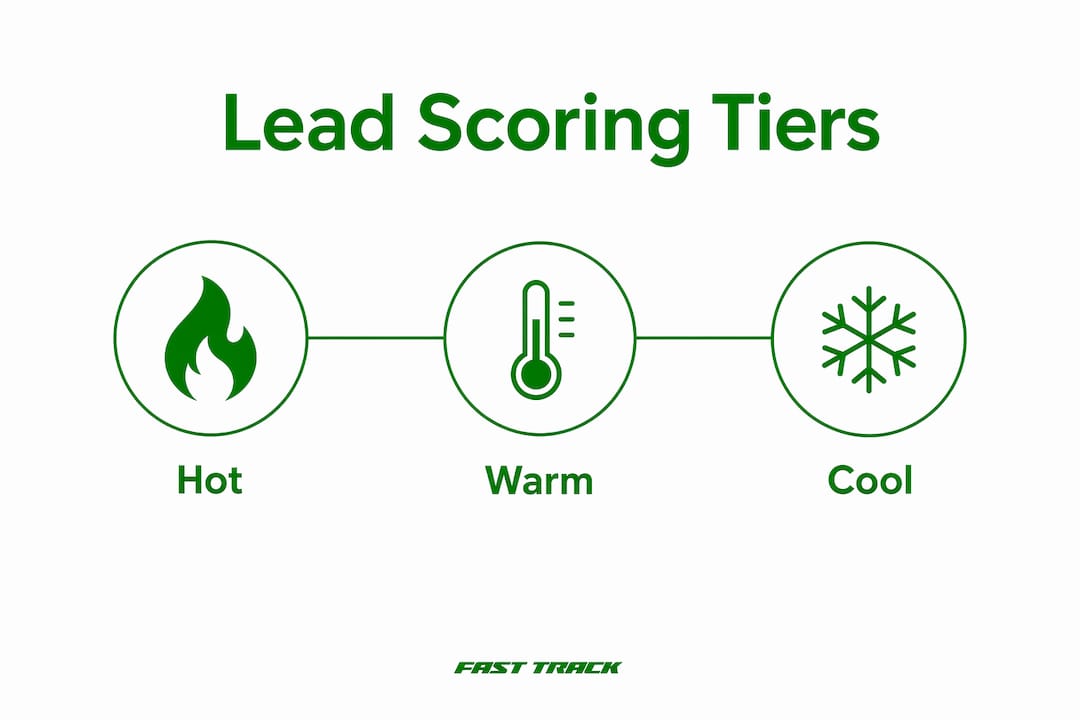
Standard franchise lead scoring segments prospects into three tiers: Hot (80+ points), Warm (50–79 points), and Cool (under 50 points). Each tier triggers a different follow-up workflow. This prevents your best reps from wasting time on leads who are not ready, while keeping every lead in a relevant communication track.
| Tier | Score range | Trigger action |
|---|---|---|
| Hot | 80+ points | Immediate rep notification, same-day call attempt |
| Warm | 50–79 points | Automated nurture sequence, rep follow-up within 48 hours |
| Cool | Under 50 points | Long-term educational drip, re-score after 30 days |
Hot leads get a phone call within the hour. Research consistently shows that sub-1-hour response times to high-intent candidates dramatically increase conversion rates. Warm leads enter a structured nurture campaign that continues to track engagement and update their score. Cool leads receive educational content about the brand, the investment, and the franchise model. If they re-engage, their score updates automatically.
The comparison above shows a clean separation of effort. Your top reps focus on Hot leads. Automation handles Warm and Cool leads until they earn a higher score.
Pro Tip: Review your tier thresholds quarterly. Seasonal demand shifts change what "high intent" looks like. A lead who scores 65 points in january may behave more like a Hot lead in march when franchise buying activity peaks. Adjust thresholds based on actual conversion data, not assumptions.
What technology tools implement lead scoring at scale?
CRMs with native lead scoring modules are the foundation of any scalable system. HubSpot and Salesforce both offer custom scoring rules that update lead scores automatically based on form submissions, email activity, and page visits. Both platforms support workflow automation that routes leads to the right rep or sequence the moment a score threshold is crossed.
The most effective setups combine several tools:
- CRM scoring module: HubSpot or Salesforce for score calculation and rep routing
- Email tracking: Integrated email tools that log opens and clicks back to the lead record
- Video engagement tracking: Platforms like Wistia or Vidyard that report watch percentage back to the CRM
- Website behavior tracking: CRM-connected tracking pixels that log page visits and time on site
- AI qualification agents: Automated conversation tools that engage leads before a rep touches them
Lead qualification belongs at the system level before any AI agent or rep engages. The system routes leads based on score criteria first. This prevents unqualified leads from consuming rep time and keeps your sales pipeline clean. An AI agent that talks to a Cool lead wastes resources. A system that routes only Hot leads to AI agents and reps produces consistent results.
AI-powered qualification trained on brand-specific data outperforms generic CRM defaults. Using your own historical franchisee data to train qualification models gives you a competitive advantage that generic tools cannot replicate.
Pro Tip: Integrate scoring with lead generation automation and speed-to-lead workflows. The moment a lead crosses the Hot threshold, the system should trigger a rep notification and an automated text or email simultaneously. Every minute of delay costs conversion probability.
How do you optimize and maintain your scoring model?
A franchise lead scoring system degrades over time if you do not maintain it. Scoring criteria that worked last year may not reflect current buyer behavior. Quarterly reviews keep the model aligned with your actual franchise sales goals.
Start with historical outcome data. Pull every lead that converted to a franchisee in the past 12 months and map their scores at the point of first contact. If most of your closed deals started as Warm leads rather than Hot leads, your Hot threshold may be set too high. Adjust it down and retest.
Track these four metrics consistently:
- Lead-to-close ratio by tier: Confirms whether Hot leads actually close at higher rates than Warm leads.
- Qualification accuracy rate: Measures how often scored leads match your actual franchisee profile.
- Average response time by tier: Tracks whether Hot leads receive the fast response they require.
- Disqualified lead categorization rate: Measures how thoroughly your team logs why leads were rejected.
Without disciplined DQ categorization, franchisors misread high lead volume as success. A pipeline full of Cool leads looks busy but produces no closings. Categorizing every disqualified lead by rejection reason reveals whether your lead sources are sending the wrong audience or your scoring model is miscalibrated.
Pro Tip: Focus on reducing franchise development cost per lead by tightening scoring weights on the criteria that correlate most directly with closed deals. Run this analysis every quarter and cut point values for signals that do not predict conversion.
What are the most common franchise lead scoring mistakes?
Most scoring failures trace back to a small set of repeatable errors. Recognizing them early prevents months of wasted development budget.
- Misaligned scoring criteria: Scoring based on generic buyer profiles rather than your actual franchisee history. If your top franchisees all had prior management experience, that signal should carry significant weight in your model.
- Ignoring behavioral data: Franchisors who score only on demographics miss the leads who are actively researching right now. A lead who visits your FDD page three times in one week is showing stronger intent than their income alone suggests.
- Slow response to Hot leads: Top franchisors target sub-1-hour responses to high-intent candidates. Waiting 24 hours to call a Hot lead drops conversion probability sharply.
- No territory segmentation: Scoring a lead highly when their target territory is already awarded wastes rep time and frustrates the prospect. Territory availability must be a scoring variable, not an afterthought.
- Relying on CRM defaults: Generic lead scoring templates built for B2B software sales do not reflect franchise buyer behavior. Custom models built on your own data consistently outperform defaults.
- Missing feedback loops: Without structured feedback loops that classify why leads were disqualified, you cannot diagnose whether your lead sources or your scoring model is the problem.
Fix scoring discrepancies by running a monthly audit. Compare scored leads against actual outcomes and adjust point values for any signal that consistently mispredicts conversion.
Key Takeaways
A franchise lead scoring system works only when demographic criteria, behavioral signals, and automated routing operate together as a single integrated process.
| Point | Details |
|---|---|
| Score on two data types | Combine demographic criteria and behavioral engagement for the most accurate lead ranking. |
| Use three scoring tiers | Hot (80+), Warm (50–79), and Cool (under 50) each trigger distinct follow-up workflows. |
| Respond to Hot leads fast | Sub-1-hour response to high-intent leads significantly increases franchise conversion rates. |
| Qualify at the system level | Route leads by score before any rep or AI agent engages to protect sales team efficiency. |
| Review thresholds quarterly | Adjust scoring weights based on actual closed-deal data to keep the model accurate over time. |
Why I think most franchisors implement lead scoring backwards
Most franchisors I see build their scoring model after they have already set up their CRM, their lead sources, and their rep workflows. That sequence produces a scoring system that fits the existing process rather than one that drives it. The result is a model that feels like a reporting tool instead of a routing engine.
The right sequence starts with your best franchisees. Pull their profiles, map what they had in common at the point of first inquiry, and build your scoring criteria from that data. Liquid capital, timeline, territory, and engagement behavior should all reflect what your actual closed deals looked like, not what a generic franchise sales template suggests.
Speed-to-lead is where I see the biggest gap between franchisors who close consistently and those who do not. A Hot lead who waits 18 hours for a call has already talked to two other brands. The scoring system only creates value if the routing automation acts on it immediately. Build the speed-to-lead workflow first, then layer scoring on top of it.
The franchisors who grow fastest treat their scoring model as a living document. They review it every quarter, adjust weights based on what actually closed, and cut criteria that do not predict conversion. That discipline is what separates a scoring system that drives growth from one that just adds complexity.
— Cody
How Franchise Fast Track delivers pre-scored, high-income franchise buyers
Franchise Fast Track is built specifically for franchisors who want to skip the scoring problem at the top of the funnel entirely. The platform delivers verified appointments with high-income professionals earning between $150,000 and $500,000 annually, including executives, directors, and senior managers actively seeking franchise ownership.
Franchise Fast Track reports a 34% lead-to-close rate across its buyer network. That figure reflects what happens when qualification happens before a lead ever reaches your sales team. The platform's franchise development services handle top-of-funnel screening so your reps spend time only on funded, pre-qualified buyers. If your current scoring model is still filtering out too many unqualified leads manually, Franchise Fast Track removes that problem at the source.
FAQ
What is a franchise lead scoring system?
A franchise lead scoring system assigns numerical values to leads based on demographic criteria and behavioral engagement to rank prospects by their likelihood to become a franchisee. Higher scores trigger faster, more direct follow-up from your sales team.
What score makes a franchise lead "hot"?
Hot leads score 80 or more points in standard franchise scoring models and trigger immediate rep notification and same-day contact. Warm leads fall between 50 and 79 points and enter structured nurture sequences.
How does lead enrichment improve franchise lead scoring?
Lead enrichment adds third-party data like income verification, business ownership history, and territory data to a lead record, making demographic scoring more accurate without requiring the prospect to fill out a long form upfront.
Why does speed-to-lead matter in franchise development?
Top franchisors target sub-1-hour responses to high-intent leads because conversion probability drops sharply with every hour of delay. A Hot lead contacted within 60 minutes is far more likely to advance through the sales process than one contacted the next day.
How often should franchisors update their scoring model?
Quarterly reviews aligned with actual closed-deal data keep scoring thresholds accurate. Seasonal demand shifts and changes in buyer behavior mean a model built in january may need adjustment by april to stay predictive.
Recommended
- Financing for a Franchise: Franchisor's 2026 Guide | Franchise Fast Track Blog
- Franchising Pros and Cons: A 2026 Guide for Franchisors | Franchise Fast Track Blog
- Franchise Lead Generation Automation for Franchisors in 2026 | Franchise Fast Track Blog
- A High-Performance Franchise Marketing Strategy for 2026 | Franchise Fast Track Blog
Ready to see results like these for your franchise?
Stop wasting money on leads that never close. Start getting hundreds of replies from high-net-worth professionals daily.