How to Reduce Franchise Development Cost per Lead

Reducing franchise development cost per lead is defined by one core discipline: measuring and optimizing Cost Per Qualified Lead (CPQL), not just raw Cost Per Lead (CPL). The average CPL rose to $351 in 2025, up from $271 in 2024, while the cost to secure a new franchisee climbed to $17,550. Those numbers signal that chasing cheaper leads without filtering for quality is a losing strategy. Platforms like WhatConverts and data sources like Franchise Insights confirm that franchisors who track CPQL alongside CPL consistently outperform those who optimize on volume alone. This guide gives you the metrics, channel benchmarks, and tactical moves to cut acquisition expenses without sacrificing lead quality.
How to reduce franchise development cost per lead: CPL vs. CPQL
Cost Per Lead is the total marketing spend divided by the number of leads generated, regardless of quality. Cost Per Qualified Lead, or CPQL, is total marketing spend divided by the number of leads that meet your defined qualification criteria, including ad spend, software tools, and personnel time. That distinction matters enormously in franchise development, where a single unqualified discovery call can consume two hours of a development director's time.
The problem with optimizing on CPL alone is that it rewards volume over value. A campaign generating 200 leads at $50 each looks better on paper than one generating 40 leads at $200 each. But if the first campaign produces zero qualified candidates and the second closes four franchisees, the math reverses completely. Typical franchisee conversion rates sit between 1% and 5%, which means a $20 CPL at 1% conversion still costs $2,000 per franchisee acquired.
Qualification stages matter here. Marketing Qualified Leads (MQLs) are prospects who have engaged with content or submitted a form. Sales Qualified Leads (SQLs) are those vetted by your development team as financially and operationally capable of owning a franchise. Accurate alignment of MQL and SQL definitions prevents false savings and reveals the true economics of your pipeline. If your marketing team counts every form fill as a lead and your sales team rejects 80% of them, your reported CPL is fiction.
- Define MQL criteria in writing: minimum liquid capital, geographic fit, and professional background
- Define SQL criteria separately: completed FDD review, confirmed financial qualification, and scheduled discovery day
- Recalculate CPQL monthly using only SQL-stage leads, not form fills
- Include personnel costs in your CPQL formula, not just ad spend
Pro Tip: Set a shared Google Sheet or CRM field where sales reps mark every lead as qualified or unqualified with a reason code. Feed that data back to your marketing team weekly. This single habit closes the gap between reported CPL and actual CPQL faster than any tool.
Which channels deliver the best lead-to-close ratios for franchisors?
Not all lead sources perform equally, and 2026 data on lead-to-close ratios makes the hierarchy clear. Referrals lead at 30%, franchise opportunity sites follow at 22%, and digital advertising sits at 20%. Within digital, PPC search performs best at 26%, franchise portals at 21%, and SEO at 18%. These numbers tell you exactly where to concentrate budget if closing franchisees is the goal.

Referrals are the highest-converting source because trust is already established before the first conversation. Existing franchisees, brokers, and professional networks deliver candidates who arrive pre-sold on the concept. The cost to activate referrals is low, but the infrastructure to generate them consistently requires deliberate effort. Broker-sourced leads, while expensive at $4,057 on average, still close at rates that justify the spend for many systems.
Digital advertising requires sub-channel thinking. Treating "digital" as a single budget line is one of the most common and costly mistakes in franchise development budgeting. PPC search captures active intent, meaning the prospect is already searching for franchise opportunities. Franchise portals deliver a pre-qualified audience but at higher CPLs. SEO builds long-term pipeline at lower cost per lead but requires six to twelve months before meaningful volume appears.
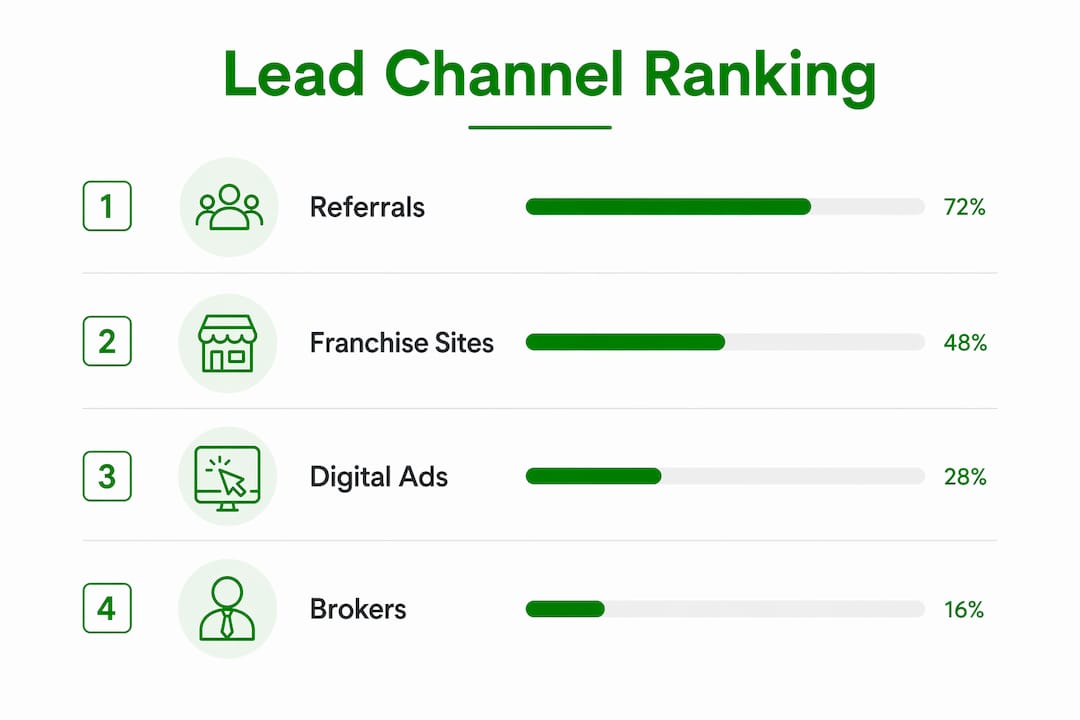
| Channel | Lead-to-close ratio | Relative CPQL | Best use case |
|---|---|---|---|
| Referrals | 30% | Low | Existing franchisee networks, broker programs |
| PPC search | 26% | Medium | Active intent buyers, geographic targeting |
| Franchise opportunity sites | 22% | Medium | Brand awareness plus qualified intent |
| Franchise portals | 21% | Medium-high | Targeted franchise-ready audiences |
| SEO and content | 18% | Low (long-term) | Sustainable pipeline at reduced cost |
Pro Tip: Before cutting any channel, pull its lead-to-close ratio, not just its CPL. A channel with a high CPL but a 25% close rate is more profitable than a cheap channel closing at 2%. Budget decisions made on CPL alone routinely defund your best performers.
One-third of franchisors reported higher CPL in 2025, and LinkedIn usage climbed to 52.2% of development teams despite rising costs on that platform. That pattern suggests franchisors are following channel trends rather than conversion data. The franchisors who outperform are the ones reallocating budget based on downstream results, not platform popularity.
How to track and measure franchise development spend accurately
Tracking is where most franchise development teams lose control of their costs. Only about half of franchisors currently track CPL, CPQL, and cost per sale with enough granularity to make informed budget decisions. The rest are flying without instruments.
Here is a practical tracking setup that connects marketing spend to closed deals:
- Implement a lead capture tool with source attribution. WhatConverts tags every inbound lead with its originating channel, campaign, and keyword. This eliminates the guesswork of asking prospects "how did you hear about us?" and gives you clean data for CPQL calculations.
- Build a CRM pipeline with qualification stage fields. HubSpot, Salesforce, or even a well-structured spreadsheet should track each lead from MQL to SQL to discovery day to signed agreement. Every stage transition should be timestamped.
- Create a weekly performance dashboard. Your dashboard should display CPL by channel, CPQL by channel, cost per discovery day, and cost per signed franchisee. These four numbers tell you everything about where your budget is working.
- Feed qualification signals back to ad platforms. Google Ads and Meta both support offline conversion imports. Upload your SQL and closed-deal data weekly so the platforms optimize toward leads that actually close, not just form fills.
- Audit your attribution model quarterly. First-touch attribution overstates the value of awareness channels. Last-touch overstates closers. A linear or time-decay model gives a more accurate picture of how channels work together.
Pro Tip: When you upload offline conversions to Google Ads, assign a conversion value equal to your average franchise fee. The platform will then optimize for revenue, not just lead volume, which shifts your traffic toward higher-intent searches automatically.
Common tracking pitfalls include counting phone inquiries separately from form fills, failing to deduplicate leads who submit through multiple channels, and never reconciling marketing data against the CRM. Each of these errors inflates your apparent lead volume and deflates your apparent CPQL, making your marketing look more efficient than it is.
Franchise lead generation strategies that lower costs without cutting quality
The most effective way to lower franchise lead costs is to gate your pipeline earlier. Qualification gating before discovery calls filters unqualified prospects before they consume sales resources, which directly reduces your effective cost per qualified lead. A short pre-qualification form asking for liquid capital, investment timeline, and geographic preference can eliminate 40% to 60% of unqualified submissions before a single call is scheduled.
SEO and content marketing deserve more budget allocation than most franchise development teams give them. A well-optimized franchise opportunity page targeting searches like "buy a category] franchise in [city]" generates leads at a fraction of PPC costs over a 12-month horizon. The [lead-to-close ratio for SEO sits at 18%, which is competitive with paid channels at a significantly lower long-term cost. The catch is patience. SEO does not produce results in 30 days, which is why it should run alongside paid channels rather than replace them.
Referral programs for existing franchisees are chronically underused. A structured program offering a cash incentive or royalty reduction for every franchisee referral that closes costs a fraction of broker fees and produces leads with the highest close rates in the industry. The franchise lead qualification strategies that perform best combine referral activation with a clear qualification checklist so referred candidates are pre-screened before reaching your development team.
- Gate every landing page with a minimum three-question pre-qualification form before showing contact details
- Run retargeting campaigns exclusively to prospects who completed the pre-qualification form, not all site visitors
- Build a broker relationship program with clear qualification criteria so brokers self-select better candidates
- Test one new channel per quarter with a fixed budget cap, measuring lead-to-close ratio at 90 days before scaling
- Audit landing page copy quarterly to confirm it speaks to financially qualified buyers, not general interest seekers
Pro Tip: Replace generic "Request Information" CTAs with copy that signals financial commitment, such as "Apply for Franchise Ownership." This single change typically reduces form volume but increases the percentage of submissions that meet minimum financial qualifications.
Cost-per-lead inflation will not reverse on its own. Active budget reallocation and channel mix optimization are the only reliable paths to lower acquisition expenses. Franchisors who treat their channel mix as a fixed annual decision rather than a monthly optimization exercise consistently overpay for leads.
Key takeaways
Reducing franchise development cost per lead requires tracking CPQL over CPL, allocating budget to channels with the highest lead-to-close ratios, and gating your pipeline with qualification criteria before leads reach your sales team.
| Point | Details |
|---|---|
| CPQL beats CPL | Calculate cost per qualified lead using SQL-stage data, not raw form fills, to see true acquisition economics. |
| Referrals close best | Referral leads close at 30%, the highest of any channel, making referral programs the most cost-efficient investment. |
| Track downstream, not just top-of-funnel | Build dashboards that show cost per discovery day and cost per signed franchisee, not just cost per lead. |
| Gate leads early | Pre-qualification forms before discovery calls cut unqualified volume and reduce effective cost per qualified lead. |
| Feed data back to ad platforms | Uploading offline conversion data to Google Ads and Meta shifts algorithmic optimization toward leads that close. |
Why most franchisors are measuring the wrong number
I have reviewed franchise development budgets where the team celebrated a 20% drop in CPL while their cost per signed franchisee quietly doubled over the same period. That is not a hypothetical. It happens because CPL is easy to report and CPQL requires sales and marketing to actually talk to each other.
The franchisors I see consistently lower their acquisition costs share one habit: they treat the signed franchise agreement as the conversion event, and they work backward from there. Every channel decision, every landing page test, every budget reallocation traces back to "what did this produce in closed deals?" That discipline is harder to maintain than it sounds, especially when a board wants to see lead volume numbers in a monthly report.
The other blind spot I encounter regularly is the assumption that cheaper leads are better leads. A franchisor who cuts CPL from $400 to $150 by shifting budget to broad social media campaigns often ends up with a development team drowning in unqualified inquiries. The real cost goes up, not down, because now you are paying your best salespeople to screen out noise instead of close deals. Checking why franchise lead generation is broken for many systems comes down to this exact pattern.
My recommendation is simple: report CPQL and cost per signed franchisee in every development meeting, every time. Make those the numbers your team is accountable for. CPL can be a diagnostic metric, but it should never be the scorecard.
— Cody
How Franchisefasttrack helps you connect with qualified franchise buyers
Franchisefasttrack is built specifically for the problem this article describes: too many unqualified leads consuming development resources, and not enough verified, high-income buyers reaching your pipeline.
The platform delivers appointments with verified professionals earning between $150K and $500K annually, including executives, directors, and senior managers actively evaluating franchise ownership. That pre-verification step means your development team spends time closing, not screening. With a reported lead-to-close rate of 34%, Franchisefasttrack's qualified franchisee leads directly address the CPQL problem by removing unqualified volume before it reaches your calendar. If you are serious about reducing lead acquisition expenses while improving close rates, this is the system built for that outcome.
FAQ
What is cost per qualified franchise lead?
Cost per qualified franchise lead (CPQL) is total marketing spend divided by the number of leads that meet your defined sales qualification criteria, including financial minimums and operational fit. It is a more accurate budgeting metric than raw CPL because it reflects only leads with genuine franchise ownership potential.
What is a realistic cost per lead for franchise development?
The average franchise CPL reached $351 in 2025, up from $271 in 2024, with broker-sourced leads averaging $4,057. Benchmarks vary significantly by channel and brand recognition, so comparing your CPQL against your own historical data is more useful than industry averages alone.
Which franchise lead generation channel has the highest close rate?
Referrals deliver the highest lead-to-close ratio at 30%, followed by franchise opportunity sites at 22% and digital advertising at 20%. Within digital, PPC search leads at 26%, making it the most efficient paid channel for franchise development.
How do I lower franchise lead costs without reducing lead quality?
Gate your pipeline with a pre-qualification form before scheduling discovery calls, reallocate budget toward channels with proven lead-to-close ratios, and build SEO content for long-term lower-cost lead generation. Feeding offline conversion data back to ad platforms also shifts algorithmic spend toward higher-intent prospects.
How many franchisors track cost per qualified lead?
Only 58% of franchisors track cost per lead at any level, and far fewer track CPQL or cost per signed franchisee with enough granularity to make data-driven budget decisions. That gap represents a significant competitive advantage for development teams that build proper tracking infrastructure.
Recommended
- Franchise Lead Generation: Qualified Franchisee Candidates for Serious Franchisors | Franchise Fast Track
- Why Franchise Lead Generation Is Broken (And What Smart Franchisors Are Doing Instead) | Franchise Fast Track Blog
- Franchise Fast Track vs GrowthMaster: Outbound Investors vs Lead Gen | Franchise Fast Track
- Franchise Development: Outsourced Top-of-Funnel for In-House Franchise Development Teams | Franchise Fast Track
Ready to see results like these for your franchise?
Stop wasting money on leads that never close. Start getting hundreds of replies from high-net-worth professionals daily.