Franchise Lead Generation Automation for Franchisors in 2026

Franchise lead generation automation is the use of centralized AI and marketing technology to capture, qualify, nurture, and convert franchisee prospects consistently across multiple locations without manual bottlenecks. Platforms like Vendasta and FranConnect have made this approach standard practice for franchise developers who need to move fast. Automated SMS outreach carries a 98% open rate, and responding to an inquiry within one hour increases conversion likelihood by 7x. For franchisors targeting high-income buyers, those numbers are not background noise. They are the difference between a closed deal and a cold lead.
What are the essential components of franchise lead generation automation?
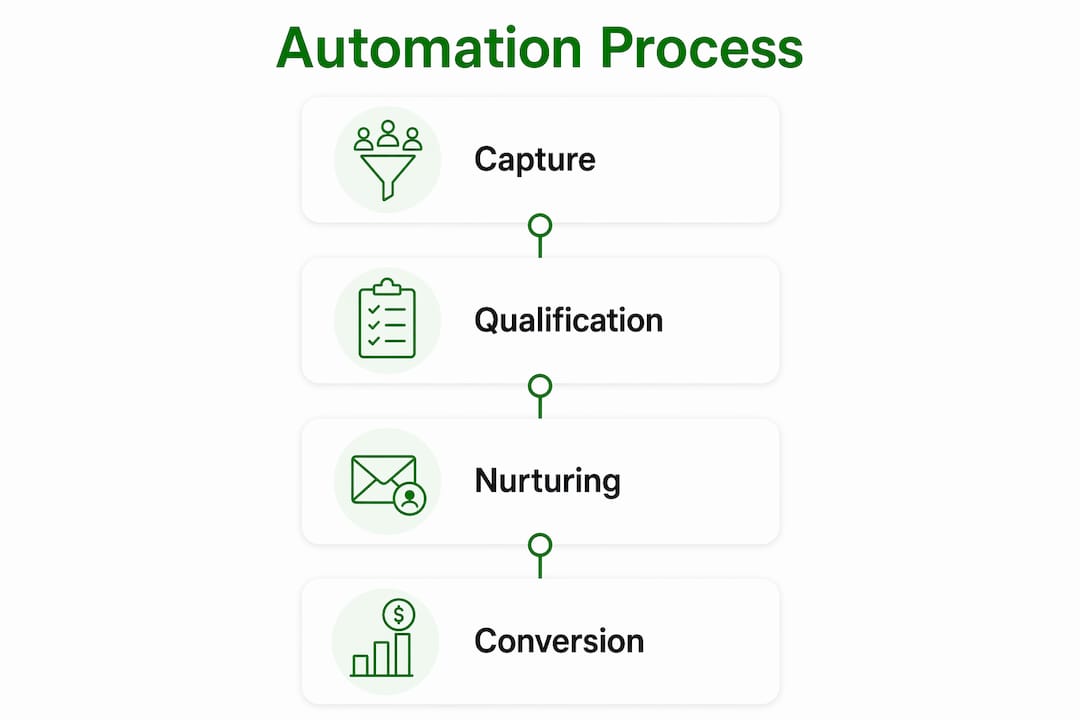
Franchise lead generation automation rests on four interconnected systems. Get all four working together and you have a machine that qualifies and books appointments without a developer touching every lead manually.
Centralized AI-powered lead capture is the entry point. This includes AI chatbots on your franchise development website, web inquiry forms with instant routing logic, and AI receptionists that handle inbound calls. Every inquiry, regardless of source, feeds into one pipeline. Centralized automation programs standardize lead capture across locations and eliminate the leakage that happens when individual franchisees manage their own follow-up.

Immediate multi-channel response is where most franchise developers lose deals. The moment a prospect submits a form or chats with a bot, an automated sequence fires across SMS, email, and sometimes a direct call. Speed is the variable that matters most here. A lead that waits 24 hours for a response is already talking to someone else.
AI lead scoring and qualification is the component that separates serious buyers from tire-kickers. AI-powered qualification reduces manual processing time by 70 to 80%, shifting evaluation from hours to minutes. Scoring algorithms pull in behavioral signals (pages visited, content downloaded, response time) alongside firmographic data like income range and professional background.
Pipeline routing and appointment scheduling closes the loop. Once a lead clears the scoring threshold, automation routes them to the right franchise development rep and books a discovery call without human coordination. This is where multi-step follow-up workflows prove their value. They persist until the lead engages or opts out, with full audit logs for compliance.
- AI chatbots and web forms for 24/7 lead capture
- Triggered SMS and email sequences firing within seconds of inquiry
- Behavioral and firmographic scoring to filter unqualified prospects
- Automated appointment booking integrated with rep calendars
- Network-wide dashboards showing location-level performance
Pro Tip: When evaluating automation platforms, prioritize those built specifically for multi-location franchises. Generic marketing automation tools lack the hierarchical permission structures that let franchisors control brand messaging while giving franchisees visibility into their own location data.
How to implement franchise lead generation automation across multiple locations
Rolling out automation across a franchise network requires a phased approach. Pushing a half-configured system to 50 locations at once creates inconsistency and franchisee resistance.
-
Build the franchisor-level playbook first. Define brand-approved messaging for every stage of the lead journey: initial inquiry response, qualification questions, objection handling, and appointment confirmation. This playbook becomes the foundation every location runs on. Without it, franchisees improvise and brand consistency collapses.
-
Configure AI chatbots and SMS sequences. Set triggers so that every new inquiry receives an automated response within 60 seconds. Vendasta's brand-approved SMS playbooks deploy network-wide from a single franchisor dashboard, which removes the need for each franchisee to manage their own messaging setup.
-
Set lead scoring thresholds aligned with your ideal franchisee profile. If you are targeting buyers earning $150K or more annually, your scoring model should weight income verification signals, professional title, and prior business ownership history. Integrating AI qualification with FranConnect preserves your existing development workflows while layering intelligent scoring on top.
-
Deploy centralized dashboards with location-level visibility. Franchisors need a top-level view of total leads, conversion rates, and response times. Franchisees need visibility into their own pipeline without access to network-wide data. Hierarchical permission structures make this possible without a custom build.
-
Pilot with three to five locations before full rollout. Select locations with engaged franchisees who will provide honest feedback on messaging quality and lead volume. Use pilot data to adjust scoring thresholds and sequence timing before scaling.
-
Integrate with your existing CRM. Automation that runs outside your CRM creates data silos. Every lead interaction, score update, and appointment booking should write back to the central record.
| Implementation phase | Key action | Success metric |
|---|---|---|
| Playbook development | Write brand-approved scripts for all touchpoints | 100% message compliance across locations |
| Automation configuration | Set up SMS and email triggers with scoring rules | Sub-60-second first response time |
| Pilot testing | Deploy to 3-5 locations and collect performance data | Lead-to-booking rate baseline established |
| Full network rollout | Activate all locations with centralized dashboard | Network-wide adoption rate above 90% |
Pro Tip: Treat your lead scoring thresholds as a living configuration, not a one-time setup. Dynamic scoring adjustments based on franchisee feedback and market conditions consistently improve qualification accuracy over time.
What are the most effective automated lead nurturing workflows for franchise development?
Lead nurturing in franchise development is the process of maintaining structured, personalized contact with prospects from first inquiry through signed agreement, using automated sequences that respond to lead behavior rather than calendar schedules. The most effective workflows do not treat all leads the same.
Segmenting prospects into hot, warm, and cold categories is the starting point. AI scoring and dynamic content routing direct hot leads to immediate rep outreach while warm and cold leads enter longer nurture sequences. This keeps your development team focused on buyers with the highest purchase intent instead of manually sorting through every inquiry.
A proven nurture sequence for franchise development typically runs across three channels:
- Day 1: Automated SMS within 60 seconds of inquiry, followed by a personalized email with franchise overview content
- Day 2-3: AI-powered follow-up SMS asking a qualifying question about investment timeline or location preference
- Day 5: Email with a franchisee success story or earnings disclosure document teaser
- Day 8-10: Direct call attempt by a development rep, supported by AI call notes from prior interactions
- Day 14+: Re-engagement sequence for non-responders with a different value proposition angle
AI conversational automation handles inbound SMS replies by understanding natural language, answering FAQs, and scheduling discovery calls without human intervention. This matters because prospects often respond to automated messages outside business hours. A system that can qualify and book a call at 10 PM on a Saturday captures deals that a manual process loses.
Re-engagement automation for cold leads deserves more attention than most franchise developers give it. A lead that went quiet after the initial inquiry is not necessarily disqualified. A 30-day pause followed by a fresh angle, such as a new territory availability or a financing option, reactivates a meaningful percentage of cold contacts.
Compliance and brand consistency across all automated communications are non-negotiable. Every message in every sequence must reflect franchisor-approved language. Automation platforms designed for multi-location franchise networks balance central brand control with enough local flexibility to maintain franchisee adoption.
How do franchisors measure success in franchise lead generation automation?
Measurement is where most franchise automation programs stall. Franchisors deploy the technology, see some improvement, and then stop optimizing because they are not tracking the right numbers.
The four KPIs that matter most are response time, lead-to-booking rate, lead quality score distribution, and opt-out rate. Benchmarking these metrics at the location level reveals which franchisees are underperforming on adoption and which automation sequences are generating friction. A location with a high opt-out rate usually has a messaging problem, not a lead quality problem.
| KPI | What it measures | Red flag threshold |
|---|---|---|
| First response time | Speed of initial automated contact | Over 5 minutes |
| Lead-to-booking rate | Percentage of leads that schedule a discovery call | Below 15% |
| Opt-out rate | Leads removing themselves from sequences | Above 8% |
| Location adoption rate | Franchisees actively using the automation system | Below 80% |
Common problems in franchise automation programs fall into three categories. Inconsistent franchisee adoption happens when the platform is too complex or the value is not clearly communicated. Message fatigue occurs when sequences are too aggressive in frequency or too generic in content. Data quality issues arise when lead sources feed incomplete records into the scoring system, producing false positives that waste rep time.
Troubleshooting starts with location-level reports. If one location consistently underperforms on lead-to-booking rate, the issue is usually in the first two touchpoints of the sequence. A/B testing subject lines, SMS copy, and call-to-action phrasing in those early messages typically produces measurable improvement within two to three weeks.
Pro Tip: Use automation performance data for resource planning, not just optimization. If your lead-to-booking rate is stable but your lead volume is growing, you can forecast when your development team will need additional capacity before it becomes a bottleneck.
Key takeaways
Franchise lead generation automation works because speed, AI scoring, and multi-channel nurturing operate together to convert high-income buyers before competitors can respond.
| Point | Details |
|---|---|
| Speed drives conversion | Responding within one hour of inquiry increases conversion likelihood by 7x. |
| AI scoring cuts manual work | AI qualification reduces lead processing time by 70 to 80%, freeing reps for high-value conversations. |
| Segmented nurturing outperforms batch messaging | Hot, warm, and cold lead paths with personalized content produce higher close rates than generic sequences. |
| Location-level measurement is required | Benchmarking KPIs by location identifies adoption gaps and messaging problems before they compound. |
| Scoring thresholds must evolve | Treating lead scoring as a dynamic configuration improves qualification accuracy as market conditions shift. |
Why I stopped treating automation as a set-it-and-forget-it system
After working with franchise networks of varying sizes, the pattern I see most often is this: a franchisor invests in automation, sees an initial lift in lead volume, and then watches performance plateau six months later. The technology did not fail. The configuration did.
The franchisors who consistently close high-income buyers treat their automation system the way a good sales director treats their team. They review the numbers weekly, adjust messaging based on what is actually resonating, and update scoring thresholds when the market shifts. The ones who set it up once and walk away are leaving deals on the table.
The other thing I have learned is that franchisee adoption is the real implementation challenge, not the technology. A platform that is technically perfect but ignored by 40% of your network is a partial solution at best. The franchisors who solve this invest time upfront in showing franchisees exactly what the system does for them, not just for the franchisor. When a franchisee sees that automation fills their calendar with pre-qualified appointments, adoption takes care of itself.
My honest recommendation for 2026: start with a high-performance franchise marketing strategy that puts automation at the center, pilot it with your most engaged franchisees, and iterate fast. The compounding effect of a well-tuned automation system over 12 months is the closest thing to a structural competitive advantage in franchise development.
— Cody
How Franchisefasttrack delivers qualified buyers through automation
Franchisefasttrack is built for franchisors who are done sorting through unqualified inquiries. The platform's proprietary system delivers appointments with verified high-income professionals earning between $150K and $500K annually, targeting executives, directors, and senior managers who are actively evaluating franchise ownership. The reported lead-to-close rate of 34% reflects what happens when automation targets the right buyers from the start rather than filtering bad leads after the fact. If you are running a franchise development program and want qualified franchisee candidates delivered at scale, Franchisefasttrack provides the turnkey system to make that happen. You can also explore the full franchise development offering to see how outsourced top-of-funnel automation integrates with your in-house team.
FAQ
What is franchise lead generation automation?
Franchise lead generation automation is the use of AI-powered tools and marketing technology to capture, score, nurture, and convert franchisee prospects across multiple locations without manual intervention at each step. It combines chatbots, automated SMS and email sequences, and AI lead scoring into a single pipeline.
How does automated SMS improve franchise lead conversion?
Automated SMS carries a 98% open rate and responding within one hour of inquiry increases conversion likelihood by 7x. AI-powered two-way SMS handles replies, qualifies prospects, and books discovery calls without requiring a human rep to be available.
What is lead nurturing in franchise development?
Lead nurturing in franchise development is the process of maintaining structured, automated contact with prospects from initial inquiry through signed franchise agreement, using behavior-triggered sequences across SMS, email, and phone. Segmenting leads into hot, warm, and cold categories and routing them to personalized messaging paths produces the highest conversion rates.
Which platforms are used for franchise lead generation automation?
Vendasta and FranConnect are widely used by franchise developers for centralized lead management and automation. Vendasta handles network-wide SMS playbooks and analytics, while FranConnect integrates AI qualification into existing franchise development workflows.
How do you measure the success of a franchise automation program?
The four primary KPIs are first response time, lead-to-booking rate, opt-out rate, and location-level adoption rate. Benchmarking these metrics by location identifies underperforming franchisees and messaging sequences that need adjustment.
Recommended
- Franchise Lead Generation: Qualified Franchisee Candidates for Serious Franchisors | Franchise Fast Track
- A High-Performance Franchise Marketing Strategy for 2026 | Franchise Fast Track Blog
- Blog - Franchise Fast Track | Franchise Development Insights
- A Modern Guide to Online Marketing for Franchises in 2026 | Franchise Fast Track Blog
Ready to see results like these for your franchise?
Stop wasting money on leads that never close. Start getting hundreds of replies from high-net-worth professionals daily.