A Modern Guide to Online Marketing for Franchises in 2026
Online marketing for a franchise system is a unique beast. You're constantly juggling two very different goals: helping your franchisees attract local customers while simultaneously recruiting new, qualified owners to grow the brand. It's a delicate dance between maintaining a powerful, consistent national brand and giving individual owners the freedom they need to win in their own backyards.
Solving the Franchise Marketing Paradox
I like to think of a franchisor as a fleet commander and each franchisee as the captain of their own ship. The commander sets the destination, provides the maps, and designs the ships (the brand). They also supply the top-tier navigational tools (the marketing assets).
But at the end of the day, it's the captain who has to navigate the specific currents and weather of their local waters. They're the ones facing local competitors, sponsoring community events, and building a loyal customer base. A winning strategy gives every captain the tools to dominate their territory without letting the entire fleet drift off course.
This dual-audience challenge is the absolute core of online marketing for franchises. You're essentially running two distinct marketing machines at the same time:
- Customer-Facing Marketing: This is all about driving sales at the local level. The goal is to get people in the door of a specific store, booking a service with their neighborhood technician, or placing an order from their local franchise.
- Franchise Development Marketing: This is your investor-focused campaign, designed to sell the business model itself. You're targeting entrepreneurs, experienced executives, and others with the capital and drive to open their own location.
These two objectives couldn't be more different. They demand entirely separate messaging, channels, and ways of measuring success.
The Central Conflict: Brand Control vs. Local Agility
The most common friction point I see in franchise marketing is the classic tug-of-war between brand consistency and local relevance. The franchisor's job is to protect the brand's integrity, making sure a customer in Miami gets the same great experience as one in Seattle. That means keeping a tight grip on logos, messaging, and the overall brand voice.
But your franchisees are on the ground, and they need the agility to react to their local market. A promotion that crushes it in a busy city center might completely flop in a quiet suburb. Franchisees need to be able to run a special tied to the local high school's football game or sponsor a 5K for a community charity.
The smartest franchise marketing systems don't see this as a conflict—they see it as a partnership. They build frameworks that empower franchisees with pre-approved tools and creative templates, which allows for local customization inside brand-safe guardrails. This simple shift turns "control" into "enablement."
Getting this balance right is more critical than ever. The digital marketing franchise sector alone is projected to hit approximately $75 billion by 2025 and is expected to expand with a compound annual growth rate of around 15% through 2033. This incredible growth shows just how much opportunity is out there for franchise systems that truly master their marketing. Learn more about the factors driving this expansion and what it means for the industry.
To navigate this environment, you need a solid game plan. Developing a high-performance franchise marketing strategy is the foundation for scaling successfully in this competitive market. This guide will walk you through the specific tactics for both your national and local campaigns, helping you turn this marketing paradox into your biggest competitive advantage.
Unifying National and Local SEO
I've seen it happen time and time again: a franchise system's online marketing descends into chaos because everyone is pulling in a different direction. When individual franchisees are left to build their own standalone websites, they inevitably start competing against corporate—and even each other—for the same customers in nearby territories. It's a messy, expensive problem that weakens the brand for everyone.
The only way to win at online marketing for franchises is to work together under one unified structure. The most effective approach is what we call a "hub-and-spoke" model. Just picture a wheel: your main corporate website is the strong central hub, and each franchisee's local page is a spoke extending from it.
The corporate "hub" acts as the definitive home for your brand online. This is where you house the big-picture brand story, investor details, and general information about your products or services. By connecting all the local "spokes" back to this hub, you consolidate authority, making the entire brand more powerful in search results.
The "spokes" are where the local magic happens. These are the individual web pages or microsites for each franchise location. They're designed to give customers the specific information they're actually searching for, like store hours, local-only specials, and stories about how the franchisee is involved in their community.
This very structure is designed to solve the central challenge of franchise marketing: balancing the needs of the franchisor, the franchisees, and the end customer.
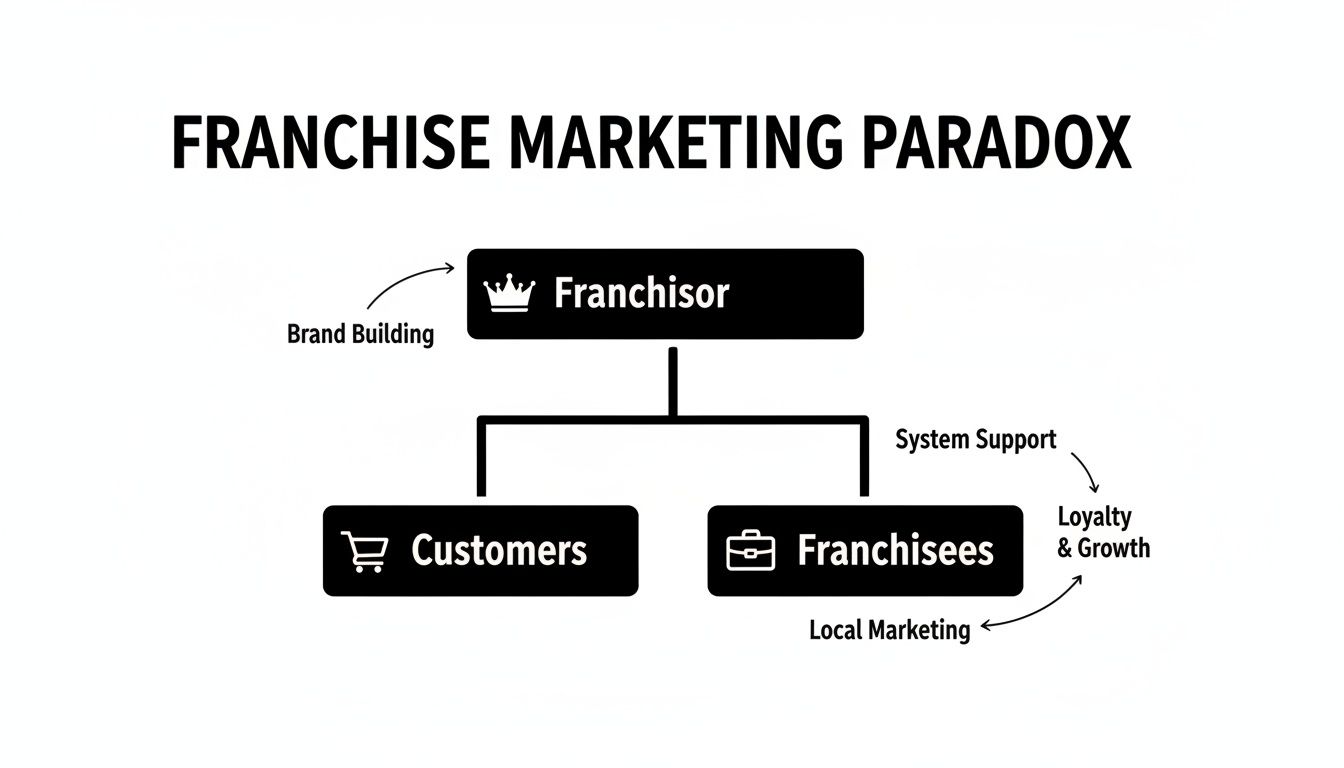
As the diagram illustrates, the franchisor has to serve two very different audiences—their franchisees and their customers. A smart marketing model has to support both, and a unified SEO strategy is the key.
Building Your Technical SEO Foundation
For the hub-and-spoke model to actually work, you have to get the technical details right. This goes way beyond just picking keywords. It's all about building your website in a way that Google can clearly understand the relationship between your national brand and all of its local outlets. A clean, logical URL structure is the first place to start.
For example, a simple and highly effective structure looks like this: yourbrand.com/locations/city-state. This format instantly signals to search engines that the page is for a specific geographic area, while also keeping it tied to your main, authoritative domain. It's a clean and scalable way to build brand equity.
The next piece of the puzzle is managing your Google Business Profiles (GBPs). This is non-negotiable. An incredible 46% of all Google searches are from people looking for local information. If your locations don't have optimized and active GBP listings, you're basically invisible to nearly half of your potential customers.
The best practice here is for the franchisor to use a central tool to manage every franchisee's GBP listing. This ensures everything from business categories to branding stays consistent. At the same time, it allows local managers the freedom to handle day-to-day tasks like updating hours, posting about local events, and responding to reviews. It's the perfect blend of national control and local agility.
Empowering Franchisees with Localized Content
With the technical foundation in place, you can shift your focus to what really connects with people: content. The idea is to create a content machine that wins at both the national and local levels. The franchisor sets the strategy and provides the tools, and the franchisees execute on the ground in their own communities.
Here's a practical way to split the work:
- Franchisor's Role (The Hub): Your job is to create big, authoritative "pillar" content. Think comprehensive guides about your industry, detailed breakdowns of your services, or resources for potential franchisees. This is the content that builds the brand's overall authority, which trickles down to benefit every single location.
- Franchisee's Role (The Spokes): Their job is to create hyper-local content that makes them a part of their community's fabric. This could be as simple as a blog post about sponsoring a local kids' soccer team, a case study featuring a well-known local business, or photos from a neighborhood street fair.
This approach prevents franchisees from accidentally competing with each other and ensures every piece of content has a clear job to do. When you give franchisees easy-to-use templates and a stream of fresh content ideas, you empower them to become the recognized experts in their own backyards. This synergy between the hub and its spokes creates a powerful competitive advantage that a standalone local business can't hope to match.
Targeting Your Dual Audiences with Paid Media
Running paid ads for a franchise is a unique challenge. You're essentially fighting on two fronts at once, and each requires a completely different battle plan. On one side, you have the day-to-day mission of helping franchisees bring customers through their doors. On the other, you're playing the long game: recruiting top-tier entrepreneurs to grow the entire brand.
Successful online marketing for franchises means you can't just run one set of ads and hope for the best. You need to master both local consumer advertising and national franchisee recruitment.
Think about a home services franchise. One ad campaign needs to convince a homeowner with a leaky faucet to book a service call right now. A completely separate campaign needs to convince a successful project manager that buying one of your franchise territories is a smarter career move than climbing the corporate ladder. The audience, the message, and the channels are worlds apart.
Driving Local Sales for Franchisees
When your goal is getting customers for a specific location, everything comes down to hyperlocal targeting. You need to reach people who are not just in the right city, but in the right neighborhood and, ideally, in the right frame of mind to buy. This is where platforms like Google Ads and Meta (for Facebook and Instagram) are invaluable.
Their geo-targeting tools let you draw a virtual "fence" around a franchisee's service area. Anyone inside that boundary becomes fair game for a timely, relevant ad.
Here's how that plays out in the real world:
- Geo-Fencing: You can target users within a tight 1- to 5-mile radius of a storefront. Think of an ad that pops up on someone's phone saying, "Happy Hour is on! We're just around the corner on Main Street. Get 20% off appetizers for the next two hours."
- Localized Ad Copy: Generic brand slogans don't build local trust. Instead, franchisees can run ads that mention a local high school football team, a popular park, or a neighborhood festival to create an instant connection.
- "Near Me" Search Ads: When someone searches for "emergency plumber near me," the ad for your local franchisee needs to be right at the top, complete with a map and a click-to-call button for immediate action.
A smart way to manage this is through a central Brand Ad Fund. Each franchisee contributes a small percentage of their revenue, and that pool gives you the budget to hire a top-notch agency and get better rates on media buys. It gives individual owners access to a level of marketing firepower they could never afford on their own.
Recruiting High-Quality Franchise Candidates
Now, let's pivot to franchise development. This isn't about casting a wide net; it's about precision spearfishing. Your target audience here isn't the general public. It's a very specific, often small, group of experienced professionals, executives, and entrepreneurs with the capital and drive to succeed.
For this, LinkedIn is your go-to platform. Its targeting capabilities are second to none for B2B and professional audiences. You can zero in on candidates by their job title, industry, seniority, or company size. For example, you could run a campaign that only targets VPs of Operations in the logistics industry who have expressed an interest in entrepreneurship. The message isn't about a discount—it's about financial independence, a proven system, and a better quality of life. Getting this part right is crucial, as so many franchise systems are plagued by low-quality leads. For a deeper look at this common problem, check out our guide on why franchise lead generation is broken.
This table illustrates the significant performance differences between various marketing channels for franchises, highlighting where budgets can be most effectively allocated for maximum return.
Franchise Marketing Channel ROI Comparison
| Marketing Channel | Average Marketing Budget Allocation | Average Return on Investment (ROI) |
|---|---|---|
| LinkedIn (Franchisee Recruitment) | 15% | 400% - 600% |
| Google Ads (Local Customer) | 30% | 300% - 500% |
| Meta Ads (Local Customer) | 25% | 250% - 450% |
| Local SEO | 15% | 200% - 400% |
| Email Marketing | 5% | 1000% - 1200% (with established list) |
| Content Marketing/Organic Social | 10% | 150% - 250% (long-term) |
As you can see, channels like LinkedIn and Email Marketing can deliver an outsized return when used for their specific strengths—recruitment and retention, respectively. This data underscores the importance of a blended, strategic approach rather than putting all your eggs in one basket.
Unlocking Lookalike Audiences
One of the most powerful tactics for franchisee recruitment is building lookalike audiences. It's a game-changer because it takes the guesswork out of finding your next star owner.
Think of it this way: you already know what success looks like in your system. You have a list of your top-performing franchisees—the ones who consistently hit their goals and grow their business. You can take that list and securely upload it to a platform like LinkedIn or Facebook.
The platform's algorithm then gets to work, analyzing thousands of data points to find common threads among your best people. It looks at their career paths, their skills, the groups they're in, and their online behavior. Finally, it builds a brand new audience of people who "look" just like your top performers.
You're no longer just targeting "entrepreneurs." You're targeting people with the exact digital DNA as your most successful partners. It's the closest thing to a crystal ball for franchise development, allowing you to focus your ad spend on people who are already primed to be a great fit.
Maximizing Your Content and Email Marketing ROI
It's easy to get sidetracked by the latest shiny objects in paid advertising or social media. But when it comes to online marketing for franchises, some of the most profitable channels are the ones we've had all along. Content, email, and SMS are often the most underappreciated parts of the marketing budget, yet they can deliver a staggering return when you get them right.
Think of your marketing mix like an investment portfolio. Paid ads are your high-growth stocks—they can bring in quick wins, but they're expensive and unpredictable. Content and email? They're your blue-chip assets. They are owned media, meaning you're in complete control, and they build value steadily over time, generating reliable returns long after you've made the initial investment.
You need both. A strong content engine builds your brand's authority, while a smart email strategy nurtures relationships on every level—from prospective franchisees to the loyal customers at your local stores.
The Unmatched Power of Direct Communication
While search engines and paid ads are great for getting in front of new people, nothing beats the ROI of talking directly to an audience that has already asked to hear from you. This is where email and SMS truly shine, consistently outperforming nearly every other channel.
In fact, email and SMS marketing deliver an incredible 595% average ROI for franchises, yet they typically receive only 4% of the total marketing budget. That performance breaks down to $36-$42 in revenue for every $1 spent, highlighting a massive opportunity for most franchise systems. If you want to dig deeper into the numbers, you can explore these franchise marketing ROI statistics.
The secret is building and managing separate lists for your two most important audiences. You need a national list at the corporate level to nurture potential franchisees and local lists that empower individual owners to drive repeat business from their own customers.
Making this work requires a smart, centralized system. The franchisor should manage the main database for franchise development, using it to send high-value content and investor updates. At the same time, you have to equip your franchisees with an easy-to-use email tool. This lets them collect customer contacts at the point of sale and send out their own local promotions and news.
A Two-Tiered Content Strategy Blueprint
Great franchise content marketing has to serve two very different masters: the franchisor trying to recruit new owners and the franchisee trying to win over local customers. You can't just create one piece of content and hope it works for both. The best approach is a two-tiered blueprint that defines who is responsible for what.
Corporate-Level Content (The Thought Leader)
At the corporate level, your content needs to focus on the big picture. The goal is to establish the entire brand as an industry leader and attract qualified individuals who are exploring franchise ownership.
- Whitepapers and Industry Reports: Develop in-depth guides covering the state of your industry, the financial advantages of your model, or performance data that proves your concept works.
- Founder Stories: People connect with stories. Create articles and videos that share the brand's origin, mission, and vision for the future.
- Franchisee Success Case Studies: Nothing is more powerful than social proof. Showcase your top-performing franchisees with detailed stories about their journey, from their initial investment to their current success. This is what gives prospective buyers real confidence.
Franchisee-Level Content (The Community Expert)
Your franchisees don't have time to be content creators. They need practical, localized materials that are simple to use. The franchisor's job is to build a library of customizable, brand-approved templates that owners can grab and go.
- Promotional Email Templates: Create ready-to-use emails for holidays, special offers, or new product launches that a franchisee can tweak and send in just a few minutes.
- Local Blog Post Outlines: Give them fill-in-the-blank blog posts on relevant local topics, like "5 Ways to [Solve a Common Customer Problem]" or "Why We Loved Sponsoring the [Local High School Team]."
- Customer Testimonial Kits: Provide simple instructions and templates to help them collect and share glowing reviews from their best local customers on their website and social media.
This two-tiered strategy creates a powerful synergy. The franchisor builds a strong national brand that lifts everyone up, while franchisees get the tools they need to become the go-to experts in their own backyards.
Upgrading Franchise Recruitment with AI
For as long as I can remember, franchise development has been a brutal numbers game. We've all seen it: teams drowning in thousands of leads from generic franchise portals, spending their days sifting through an ocean of "tire kickers" who were never really serious or financially qualified to begin with. This old-school approach burns out your most valuable asset: your development team's time.
The way forward isn't about getting more leads—it's about getting better appointments. This is a fundamental shift in thinking. We're moving away from just chasing clicks and toward orchestrating meaningful conversations with pre-vetted, high-intent candidates. And this is where modern analytics and AI-powered systems are completely changing the playbook for online marketing for franchises.
Just imagine knowing exactly who your ideal franchisee is and then being able to find more people just like them. Today's systems can chew through thousands of data points to pinpoint individuals who match your specific criteria—from net worth and professional background to the subtle online behaviors that show they're actively looking for an investment. This isn't science fiction; it's a data-backed strategy that's working right now.
Moving Beyond Portals to Precision Targeting
Franchise portals have always felt like fishing with a giant, hole-filled net. You get a ton of inquiries, but the percentage of truly qualified buyers is frustratingly low. This setup forces your sales team to spend most of their time acting as screeners, disqualifying people instead of building relationships and closing deals. AI-driven recruitment flips that entire model around.
Instead of just waiting for leads to stumble upon you, these systems go out and find potential candidates who are virtual clones of your best-performing franchisees.
- Behavioral Analysis: Sophisticated tools can spot the digital breadcrumbs people leave behind—like an executive who starts researching business ownership, engaging with financial articles, or making LinkedIn profile changes that hint at a career move.
- Profile Matching: We can build a detailed "ideal franchisee" avatar based on your current top owners. The system then finds lookalike audiences of other professionals who share a similar career path and financial footing.
- Predictive Scoring: Leads get scored automatically based on their likelihood to move forward, letting your team immediately focus their energy on the most promising conversations waiting to happen.
This change has a massive effect on your marketing budget and, more importantly, your results. Just look at the data: industry reports show digital marketing eats up 29% of franchise development budgets but only delivers a 20% close rate. Meanwhile, franchise development websites—which attract prospects with higher intent—get a 22% close rate from just 10% of the budget. If you want to dive deeper, the 2024 Annual Franchise Development Report has some fantastic insights. It all points to the same conclusion: quality, not quantity, is what really fuels growth.
The Final Filter: Verified Appointment Setting
Using AI to identify the right people is a huge first step. But the last piece of the puzzle—and honestly, the most critical—is turning that promising name into a confirmed meeting on your calendar. This is where verified appointment-setting services come in, acting as the ultimate quality-control checkpoint. They're the bridge between finding a great candidate and having a real conversation.
Think of it like a world-class concierge for your sales team. Instead of just tossing a name and an email over the fence, these services handle the initial outreach, personally verify the candidate's qualifications and seriousness, and only book a meeting when they've confirmed you'll be speaking with a high-net-worth individual who is ready to talk business.
With this process in place, your development team's calendar is filled only with high-value appointments. They can finally stop wasting their days on dead-end discovery calls and focus all their talent on what they do best: closing deals with people who are actually prepared to invest. This is how you make your growth predictable and scalable.
When you combine AI-driven prospecting with a human-verified appointment layer, you truly revolutionize your recruitment process. You go from a reactive, volume-obsessed model to a proactive, quality-driven strategy that will dramatically improve your close rate and accelerate your brand's growth. For a much deeper dive into building this kind of machine, check out our comprehensive guide to high-growth franchise development services.
Measuring What Matters for Franchise Growth

If you're not tracking your marketing, you're just throwing money at the wall and hoping something sticks. In the world of online marketing for franchises, data is the only way to prove what's working, make smarter decisions, and fuel genuine growth. But here's the tricky part: the numbers that a local franchisee obsesses over are wildly different from what the corporate development team needs to see.
Think of it this way: the franchisee is the star player on the field, focused on their immediate stats—yards gained, passes completed. The franchisor is the general manager in the skybox, watching the entire game unfold and making strategic decisions for the whole season.
Both are critical for winning, but they're looking at completely different scoreboards. That's why you need separate sets of Key Performance Indicators (KPIs) for each.
Franchisee Metrics for Local Success
For a franchisee running their local business, success is all about what's happening right now, in their community. They need to see a direct connection between their marketing spend and the cash register. They couldn't care less about national brand sentiment; they just need to know if that recent Google Ad campaign actually brought paying customers through the door.
Their most important numbers are always tied to local revenue:
- Cost Per Lead (CPL): How much does it really cost to get a local customer to pick up the phone, fill out a form, or request a quote? This is ground zero.
- Local Conversion Rate: Of all the local leads you generated, what percentage actually became paying customers?
- Customer Acquisition Cost (CAC): This is the bottom line. Take your total local marketing spend for a month and divide it by the number of new customers you won. That's your CAC.
- Return on Ad Spend (ROAS): Did that $500 you spent on Facebook ads bring in $2,500 in sales? ROAS tells you exactly what you're getting back for every dollar you put in.
When franchisees have these numbers at their fingertips, they can clearly see the impact of their marketing efforts and feel confident in their investment.
Franchisor Metrics for Brand Expansion
At the corporate level, the perspective zooms way out. While local sales are important, the franchisor is playing a longer game focused on the brand's overall strength and, crucially, recruiting new franchisees. The KPIs here are all about the health of the entire system and the efficiency of the franchise development pipeline.
"Measuring success and allocating a budget are two sides of the same coin. To make wise budget allocation decisions, we must understand which efforts have been successful and which haven't." - Harvard Business School Professor Sunil Gupta
For the franchisor, a different set of numbers defines success:
- Brand-Level Engagement: This is the pulse of the brand. We're talking total website traffic, social media reach across all channels, and the volume of searches for your brand name. Is your brand's reputation growing?
- Cost Per Qualified Applicant: This isn't just about getting any lead; it's about getting the right one. This metric tells you exactly what you're spending to attract a candidate who actually meets your financial and experience requirements.
- Lead-to-Deal Conversion Rate: What percentage of those qualified applicants end up signing a franchise agreement? This is the ultimate report card for your franchise development team.
The Essential Tech Stack for Tracking ROI
Trying to track all of this with a jumble of spreadsheets is a recipe for disaster. A modern franchise needs a unified tech stack that creates a single source of truth for everyone—from the newest franchisee to the CEO.
Your toolkit should include:
- A Robust CRM: A good Customer Relationship Management platform acts as the brain of the operation, tracking every lead from the first click to the final handshake.
- Multi-Location Analytics: You need tools that can pull data from every single Google Business Profile and local franchisee webpage. This is how you spot high-performers and identify locations that need more support.
- Call Tracking Software: By assigning unique phone numbers to different marketing campaigns (like a postcard, a Google Ad, and a Facebook post), you can prove, without a doubt, which channels are making the phone ring.
By putting the right metrics—and the tech to track them—at the center of your strategy, you replace guesswork with a predictable, data-backed engine for growth.
Answering Your Top Franchise Marketing Questions
Even the best-laid marketing plans run into questions on the ground. When you're managing a whole franchise system, some specific challenges pop up again and again. Here are straight-to-the-point answers for the most common hurdles we see franchisors and their development teams face.
How Do We Control Brand Messaging with So Many Franchisees?
This is a classic balancing act, and it's the number one concern for most franchisors. The answer isn't about locking everything down; it's about giving your franchisees a well-stocked toolbox.
Build a central brand portal. Think of it as an online library packed with pre-approved marketing materials—everything from social media graphics and ad copy to customizable flyers. When you provide clear guidelines and easy-to-use templates, you empower franchisees to market effectively in their local area without going off-brand. It turns them into your greatest brand advocates, not a liability.
What Is the Single Most Important Metric for Franchise Development Marketing?
While you can track dozens of things, the one that truly matters is your "Cost Per Qualified Appointment." This metric cuts through the noise. It ignores vanity numbers like website clicks or raw leads and tells you exactly how much you're spending to get a real, scheduled conversation with a genuinely interested and vetted candidate.
A low cost-per-lead is a feel-good number, but it's worthless if those leads are duds. When you track the cost to get a fully qualified buyer on your calendar, you're measuring the true health of your recruitment engine. It's the clearest line you can draw between your marketing dollars and your sales pipeline.
Should Franchisees Run Their Own Social Media Accounts?
Absolutely, but they need a playbook. The most effective strategy is a two-pronged approach. The corporate social media accounts should focus on the big picture—national brand campaigns, major announcements, and high-level storytelling.
Then, let the local franchisee accounts handle what they do best: community engagement. These accounts are perfect for sharing customer photos, highlighting local staff, and promoting in-store events. To make it work, provide them with content pillars and templates to guide them. This gives you the best of both worlds—the power of a national brand combined with the authentic, local touch that builds real trust.
How Can We Fund a Robust Digital Marketing Program?
This is a big one, and the most successful franchises solve it with a Brand Fund or Marketing Fund. It's a simple and powerful model. A small, agreed-upon percentage of each franchisee's gross revenue, usually 1-3%, is collected into a central fund that the franchisor manages.
Pooling the money this way gives the entire system serious marketing muscle. It allows you to afford top-tier agencies, sophisticated software, and major advertising campaigns that no single owner could fund on their own. It's a collaborative way to lift the whole brand up.
Stop wasting time on low-quality leads and start filling your calendar with pre-vetted buyers. Franchise Fast Track delivers verified appointments with high-net-worth executives ready to invest. Book a call to see how we build your qualified pipeline.
Ready to see results like these for your franchise?
Stop wasting money on leads that never close. Start getting hundreds of replies from high-net-worth professionals daily.