Why Franchise Portals Generate Low-Quality Leads

Franchise portals generate low-quality leads because they attract top-of-funnel browsers who are researching dozens of brands simultaneously, not serious investors ready to commit capital. Platforms like FranchiseGator, Franchise Direct, and the Entrepreneur Franchise 500 directory deliver high inquiry volume, but only 5–15% of those inquiries ever progress to serious evaluation. That gap between inquiry count and conversion rate is where franchise development budgets quietly disappear. For franchisors spending $2,000–$8,000 monthly on portal listings, the math rarely works in their favor. Understanding why franchise portal leads underperform is the first step toward fixing the problem at its source.
Why franchise portals generate low-quality leads: the intent problem
The core issue with franchise portal leads is not volume. It is intent. Portal users are early-stage browsers who treat these directories the same way a job seeker treats a job board: submit as many inquiries as possible and see what comes back. A single user routinely requests information from 10 to 15 different franchise brands in one session, which means the inquiry your sales team receives is one of a dozen that person sent out that afternoon.
This behavior is not a flaw in the user. It is the natural result of how portals are designed. Broad search filters, low-friction inquiry buttons, and category-based browsing encourage exploration rather than commitment. The portal's business model depends on inquiry volume, not lead quality, so the incentive structure works directly against the franchisor's goal of finding serious candidates.

The result is a franchise lead generation issue that compounds over time. Sales teams receive hundreds of inquiries monthly, but most of those contacts have no defined investment timeline, no clear capital readiness, and no specific brand preference. They are curious, not committed. Engaging them requires significant time and resources, and most will never respond after the first contact.
Pro Tip: Before evaluating portal ROI, calculate your true cost per qualified lead, not cost per inquiry. Divide total portal spend by the number of leads that reached a discovery call. Most franchisors find the number is three to five times higher than they assumed.
- Portal users often submit inquiries across multiple industries, not just franchising
- Low-friction forms remove the natural self-selection that filters weak candidates
- Broad portal categories attract lifestyle browsers alongside serious investors
- High inquiry volume creates a false sense of pipeline health
How follow-up timing determines whether portal leads convert
Even when a portal delivers a genuinely interested candidate, the window to convert that person is extremely short. Contacting an inquiry within 60 minutes produces a 95% likelihood of conversion. Wait one week, and that probability collapses to 4%. This is not a minor performance gap. It is the difference between a live opportunity and a dead contact.
The problem is that most franchise development teams cannot realistically respond to every inquiry within 60 minutes. When portals generate 40 to 150 inquiries per month, the sheer volume creates CRM backlogs and manual triaging that slow response times dramatically. A sales rep who spends Monday morning sorting through 30 weekend inquiries is already too late for most of them.
CRM bloat from low-intent portal leads makes this worse. When a pipeline is filled with unqualified contacts, high-value candidates get buried. The operational cost of processing low-quality leads is not just time. It is the opportunity cost of the serious candidates who received a slow or generic response because the team was overwhelmed.
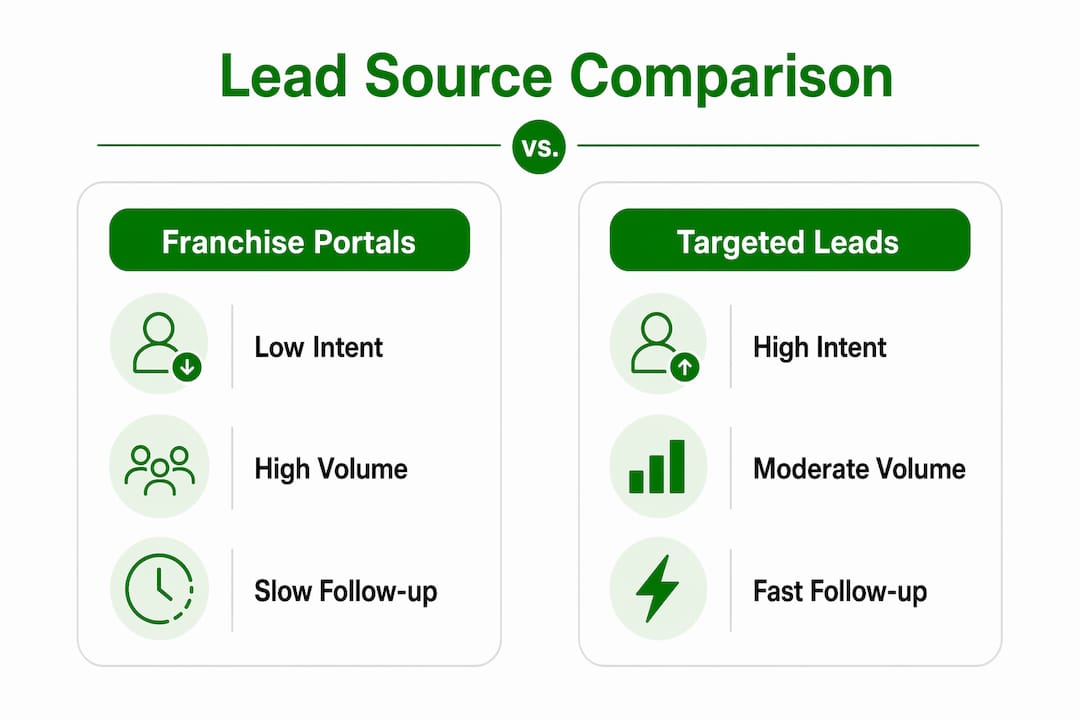
The practical implication is clear: poor quality franchise leads do not just lower conversion rates in isolation. They actively degrade the performance of your entire sales operation by consuming the capacity needed to serve better candidates quickly.
Does adding more form fields actually improve lead quality?
The instinctive response to poor portal lead quality is to add friction: longer forms, more qualifying questions, financial disclosure requirements upfront. This approach consistently backfires. Increasing inquiry form length alienates well-capitalized, serious prospects who expect a professional experience, not an interrogation.
High-net-worth executives and senior managers evaluating franchise ownership are accustomed to being courted, not screened. When they encounter a 15-field inquiry form asking for net worth, liquid capital, and territory preferences before they have even seen a franchise disclosure document, many simply leave. The candidates who complete lengthy forms are often those with more time than money, which is the opposite of the profile most franchisors want.
Lead quality is a strategy problem, not a form design problem. The fix happens upstream, in how you position your brand, who you target, and what educational content you put in front of prospects before they ever reach an inquiry form. Franchisors who deploy strategic webinars and educational content marketing attract candidates who have already self-selected based on genuine interest and financial alignment.
Pro Tip: Replace your gated inquiry form with a short discovery call booking link. Serious candidates will schedule. Browsers will not. This one change can cut inquiry volume by 60% while improving the quality of every conversation that follows.
Better upstream strategies include:
- Targeted LinkedIn content aimed at executives in specific income brackets
- Webinars that explain investment requirements and operational expectations before inquiry
- Clear messaging about minimum investment levels on all marketing materials
- Brand storytelling that attracts operators, not just curious browsers
Franchise portals vs. targeted lead generation alternatives
Not all lead sources carry the same quality profile. Industry-specific franchise portals consistently produce more qualified leads than broad-reach directories because they attract candidates who have already narrowed their search to a specific sector. A healthcare franchise portal visitor is more likely to be a serious candidate than someone browsing a general directory with 400 categories.
Beyond niche portals, franchisors are increasingly turning to targeted LinkedIn campaigns, curated professional databases, and AI-powered lead qualification systems to improve lead quality at the source. AI models trained on brand-specific data, including financial thresholds, territory constraints, and ideal franchisee profiles, can score and route leads in real time. This creates a compounding advantage: the system gets smarter with every interaction, and your sales team only engages candidates who meet defined criteria.
The table below compares the two approaches across the dimensions that matter most to franchise developers.
| Factor | Franchise portals | Targeted lead generation |
|---|---|---|
| Lead intent level | Low to moderate (top-of-funnel browsers) | High (pre-qualified by income or behavior) |
| Monthly inquiry volume | High (40–150 per month) | Lower but more consistent quality |
| Cost per qualified lead | High due to low conversion rates | Lower when targeting is precise |
| Response speed requirements | Critical within 60 minutes | Managed through automated workflows |
| Scalability | Limited by portal algorithm and competition | Scales with data and AI refinement |
Targeted outreach through LinkedIn reaches executives, directors, and senior managers who are actively evaluating career transitions. These candidates arrive with financial context and professional credibility that portal browsers rarely carry. For franchisors focused on improving franchise lead quality, the shift from broad portals to targeted channels is the single highest-leverage change available.
How to improve lead quality after portal inquiries arrive
Even with better upstream targeting, some portal leads will always be part of the mix. The question is how to process them efficiently without letting low-quality contacts consume your entire development operation. The answer is a structured qualification system that separates serious candidates from browsers within 48 hours.
A practical rapid qualification process works in this sequence:
- Automated first response within 15 minutes. Use a CRM like HubSpot or Salesforce with automated email and SMS sequences triggered at inquiry submission. This preserves the critical response window without requiring a live rep.
- Financial and intent screening within 24 hours. Ask three questions: available liquid capital, investment timeline, and territory preference. Candidates who do not respond or who fall below financial thresholds move to a long-term nurture sequence automatically.
- Discovery call within 48 hours for qualified candidates. Move serious candidates to a live conversation quickly. Every day of delay reduces conversion probability.
- Segmented nurture workflows for non-qualified leads. Not every portal lead is worthless. Some are 12 to 18 months away from being ready. Automated educational sequences keep your brand visible without consuming sales team time.
- Quarterly pipeline review. Audit lead sources by conversion rate, not inquiry volume. Reallocate budget from underperforming portals to channels producing qualified candidates.
Building a strong franchise value proposition into every touchpoint also matters. Candidates who understand your investment tiers, support structure, and franchisee success rates before the discovery call arrive better prepared and convert at higher rates. Resources like this franchise advertising playbook offer tactical guidance for franchisors refining their messaging for high-income buyers.
Key takeaways
Franchise portals produce high inquiry volume but low conversion because they attract browsers, not buyers. Fixing this requires addressing lead intent at the source, not just improving follow-up processes.
| Point | Details |
|---|---|
| Portal intent is the root cause | Most portal users request info from 10–15 brands simultaneously, signaling research mode, not investment readiness. |
| Response speed is non-negotiable | Conversion likelihood drops from 95% to 4% when follow-up is delayed from one hour to one week. |
| Form friction repels quality candidates | Lengthy inquiry forms push away well-capitalized prospects who expect professional, trust-building experiences. |
| Targeted alternatives outperform portals | AI-powered qualification and LinkedIn outreach deliver pre-qualified candidates aligned with specific financial and territory criteria. |
| Qualification speed determines pipeline health | Rapid 48-hour screening separates serious candidates from browsers and protects sales team capacity. |
Why I think franchisors are solving the wrong problem
Most franchise developers I have observed respond to poor portal performance by doing more of the same: adding more portal listings, tweaking form questions, or hiring another sales rep to handle the volume. None of those moves address the actual problem, which is that portals are discovery tools, not conversion tools. They were never designed to deliver investment-ready candidates.
The franchisors who consistently outperform their peers have stopped treating portals as a primary lead source and started treating them as one signal in a broader qualification system. They invest in lead generation infrastructure that filters by income, professional background, and investment timeline before a single conversation takes place. They use educational content to pre-qualify candidates at scale. And they measure success by discovery call quality, not inquiry count.
The mindset shift matters as much as the tactical changes. When you stop optimizing for volume and start optimizing for candidate quality, every part of your development process gets sharper. Your messaging improves because you know exactly who you are talking to. Your sales team performs better because they spend time on real opportunities. And your close rate reflects the quality of the pipeline you built, not the luck of the portal draw.
— Cody
How Franchisefasttrack connects franchisors with serious buyers
Franchisefasttrack was built specifically for franchisors who are done paying for portal inquiries that never convert. The platform delivers hundreds of monthly appointments with verified professionals earning between $150K and $500K annually, including executives, directors, and senior managers who are actively evaluating franchise ownership. Unlike portal-based approaches that flood your CRM with unqualified contacts, Franchisefasttrack uses a proprietary qualification system to match franchisors with candidates who meet defined financial and professional criteria. The result is a reported lead-to-close rate of 34%. If you are ready to replace portal volume with qualified franchisee candidates, Franchisefasttrack is the direct path forward.
FAQ
Why do franchise portals produce so many unqualified leads?
Franchise portals attract early-stage browsers who submit inquiries to 10 to 15 brands simultaneously, signaling research behavior rather than investment intent. The low-friction design of portal inquiry forms removes the natural self-selection that filters serious candidates from curious ones.
How much does slow follow-up hurt franchise lead conversion?
Responding to a franchise inquiry within 60 minutes produces a 95% conversion likelihood, which drops to 4% if delayed by one week. High portal inquiry volumes create CRM backlogs that make fast follow-up structurally difficult for most franchise development teams.
Should franchisors use longer forms to improve lead quality?
No. Adding more fields to inquiry forms consistently repels high-net-worth candidates who expect professional, trust-building experiences. Lead quality improves through better upstream positioning, educational content, and targeted outreach, not through form gating.
What alternatives to franchise portals produce better lead quality?
Industry-specific portals, targeted LinkedIn campaigns, curated professional databases, and AI-powered qualification systems all produce higher-intent leads than broad-reach directories. These channels attract candidates pre-qualified by income, professional background, and investment timeline.
How quickly should franchisors qualify portal leads?
Serious candidates should be identified and moved to a discovery call within 48 hours of inquiry submission. Automated CRM workflows using tools like HubSpot or Salesforce can handle initial screening and segmentation without requiring manual review of every contact.
Recommended
- Why Franchise Lead Generation Is Broken (And What Smart Franchisors Are Doing Instead) | Franchise Fast Track Blog
- Franchise Lead Generation: Qualified Franchisee Candidates for Serious Franchisors | Franchise Fast Track
- A High-Performance Franchise Marketing Strategy for 2026 | Franchise Fast Track Blog
- Franchise Fast Track - The Only System Built To Deliver High-Income Franchise Buyers.
Ready to see results like these for your franchise?
Stop wasting money on leads that never close. Start getting hundreds of replies from high-net-worth professionals daily.