Lead Filtering Criteria for Franchise Development in 2026
Lead filtering criteria in franchise development are the financial, geographic, operational, and behavioral standards that determine whether a prospect qualifies to advance in your sales process. Without these standards, development teams waste hours on discovery calls with candidates who can never close. Franchise Fast Track reports a 34% lead-to-close rate by connecting franchisors exclusively with verified high-income professionals earning $150,000–$500,000 annually. That number is not an accident. It is the direct result of applying strict franchise lead qualification criteria before a single conversation takes place.
1. What are the four essential hard data points for filtering franchise leads?
Four hard criteria form the non-negotiable foundation of any franchise lead qualification system: verified liquid capital, total net worth, preferred territory, and timeline to open. Missing any one of these from your intake process guarantees unproductive discovery calls. These are not nice-to-have data points. They are the minimum gate every prospect must pass before your team invests time.
Verified liquid capital sets the floor. A candidate may express strong interest, but if their available cash falls below your minimum investment threshold, no amount of enthusiasm changes the math. Most single-unit franchise opportunities require $50,000–$250,000 in liquid capital, and your lead form should ask for this directly, not indirectly.

Total net worth matters because lenders evaluate it when candidates seek SBA financing. A prospect with $100,000 liquid but $1,500,000 net worth is a fundamentally different risk profile than one with the same cash and $200,000 net worth.
Preferred territory tells you immediately whether a viable unit is available. Filtering by geography at the inquiry stage prevents your team from investing hours in a candidate who wants a market you cannot offer.
Timeline to open separates browsers from buyers. A candidate who wants to open within 90 days requires a different response than one who is "just exploring." Automatic lead scoring built on these four filters prioritizes leads for immediate contact versus long-term nurture, protecting your team's capacity.
Pro Tip: Ask for liquid capital as a range with defined brackets on your lead form. Candidates self-select into the right tier, and you avoid the awkward financial conversation on the first call.
2. How do advanced franchise CRMs and buyer journey stages improve lead filtering?
Modern franchise management CRM platforms track leads across 8–12 stages of the buyer journey, from initial inquiry through signed franchise agreement. That structure lets your team filter by where a candidate actually is, not just where they say they are. A lead sitting at stage two for 45 days is a different priority than one who completed due diligence last week.
The buyer journey stages typically follow this sequence:
- Inquiry received — lead form submitted, initial data captured
- Initial qualification — hard criteria verified against minimum thresholds
- First discovery call — assessment of motivation, timeline, and fit
- Franchise Disclosure Document (FDD) sent — candidate enters legal review period
- Validation calls — prospect speaks with existing franchisees
- Discovery Day — candidate visits brand headquarters or flagship location
- Financial review — funding sources confirmed and documented
- Mutual evaluation — both parties assess final fit
- Franchise agreement issued — legal documents prepared
- Agreement signed — candidate becomes a franchisee
Filtering by engagement recency within this framework is where most teams leave money on the table. A candidate who opened three emails, attended a webinar, and completed their FDD review in the past two weeks ranks far above one who submitted a form six months ago and went silent. CRM automation flags these engagement signals automatically, so your team contacts the right person at the right moment rather than working a flat list.
3. Which behavioral and operational criteria beyond finance predict franchisee success?
Financial qualification is necessary but not sufficient. System adherence and operational fit predict long-term franchisee success more reliably than capital alone. A well-funded candidate who resists following brand standards becomes your most expensive problem within 18 months of opening.
The behavioral criteria that matter most include:
- Coachability. Does the candidate ask questions, take notes, and apply feedback? Or do they push back on every process with "but at my last company we did it differently"?
- Motivation source. Candidates driven by lifestyle flexibility and income replacement perform differently than those escaping corporate burnout. Neither is automatically wrong, but the motivation shapes how they respond to the hard early months.
- Risk tolerance. A candidate who has never owned a business and is investing their entire retirement savings carries a different risk profile than a serial entrepreneur adding a second revenue stream.
- Cultural alignment. Every franchise brand has a culture. Candidates who genuinely connect with the brand's mission stay engaged through the difficult ramp-up period.
"Operational experience can mask poor coachability. Top franchisees show specific personality patterns that go well beyond resume or net worth." — Albert Hermans, franchise development expert
Pattern matching candidate profiles against your most successful existing franchisees is the most reliable method for predicting who will thrive. Build a profile of your top five performers. Then compare every new candidate against that profile before advancing them past stage three.
4. What are effective strategies for disqualification and initial screening?
Disqualification is as important as qualification. Defining clear no-go criteria protects your team's time and keeps your pipeline honest. Most franchisors treat lead forms as passive data collection tools. The best development teams use them as active disqualification filters that immediately deprioritize candidates who fail hard criteria.
Apply these screening strategies in sequence:
- Build disqualification into the lead form. Ask for liquid capital range, preferred territory, and timeline on the first form. If a candidate selects a capital range below your minimum, route them to a nurture sequence, not your sales team.
- Structure the first discovery call as an assessment. First discovery calls should focus on disqualification, not selling. Open with three direct questions: What is your available capital? What territory interests you? What is your target opening date?
- Use transparency in marketing to pre-filter. Transparency in candidate standards during marketing reduces unproductive inquiries before they enter your funnel. State your minimum investment clearly in ads and landing pages.
- Track disqualification reasons. Log why each lead fails. If 60% of your leads fail on liquid capital, your marketing is reaching the wrong audience. That data tells you exactly where to adjust.
- Set a 72-hour contact rule. Deals are frequently lost in the first 72 hours after inquiry. Speed of response signals professionalism and keeps serious candidates engaged.
Pro Tip: Add a single sentence to your lead form that states your minimum investment requirement. Candidates who self-disqualify save you the call. Candidates who proceed despite reading it are signaling genuine intent.
5. Traditional filtering methods vs. AI-powered franchise lead qualification
The gap between manual qualification and AI-powered screening is widening fast. AI-powered screening tools evaluate candidates instantly against financial, operational, and territorial criteria, scoring leads with a traffic-light system for prioritization. Manual processes cannot match that speed or consistency.
| Criteria | Traditional filtering | AI-powered filtering |
|---|---|---|
| Speed of qualification | Hours to days | Seconds to minutes |
| Consistency | Varies by rep | Uniform scoring matrix |
| Data points evaluated | 3–5 per form | Financial, behavioral, territorial simultaneously |
| Follow-up automation | Manual scheduling | Autonomous dynamic follow-ups |
| Candidate dossier | Assembled manually | Delivered automatically to sales rep |
| Scalability | Limited by team size | Scales with lead volume |
AI-driven lead filtering can autonomously conduct dynamic follow-ups, gather clarifying data, and deliver a fully documented candidate packet to your sales rep before the first human conversation. That eliminates manual triage entirely. The practical result is that your development team spends time only on candidates who have already passed every hard filter.
6. How to adjust lead filtering criteria based on franchise development strategy
Filtering criteria are not static. They should shift based on your brand's growth stage, unit economics, and market conditions. A brand selling master franchise rights needs a fundamentally different filter than one selling single units at a $150,000 investment level.
Key adjustments to consider:
- Master franchise vs. single unit. Master franchise candidates require significantly higher net worth thresholds, multi-unit operational experience, and demonstrated team management history. Single-unit filters can focus more heavily on personal motivation and coachability.
- Investment tier alignment. Higher investment tiers demand stricter liquid capital verification. A $500,000 investment opportunity that accepts candidates with $75,000 liquid is setting both parties up for failure.
- Territory scarcity. When prime territories are limited, geographic filtering becomes a first-pass criterion rather than a secondary one. Filter by territory availability before evaluating any other factor.
- Market fluctuations. During economic uncertainty, prioritize candidates with diversified assets and lower debt-to-income ratios. These candidates are more likely to secure financing and complete the process.
- Tracking sourcing channels with the highest lead-to-close ratios lets you refine criteria continuously. If LinkedIn outreach produces candidates who close at twice the rate of portal leads, your filters should reflect the profile of that audience.
Continuous data analysis closes the loop. Refining your criteria based on actual close data reduces cost per qualified lead over time and improves overall funnel quality. The pre-qualified leads that consistently close share identifiable traits. Build those traits into your filters and update them quarterly.
Key takeaways
Effective lead filtering criteria in franchise development require verified financial data, behavioral alignment, and continuous refinement to produce candidates who close.
| Point | Details |
|---|---|
| Four hard criteria are non-negotiable | Liquid capital, net worth, territory, and timeline must appear on every lead form. |
| CRM stage tracking improves prioritization | Filtering by buyer journey stage and engagement recency outperforms flat lead lists. |
| Behavioral fit predicts success | Coachability and system adherence matter more than financials alone for long-term performance. |
| Disqualification protects team capacity | Clear no-go criteria and structured first calls keep your pipeline focused on serious candidates. |
| AI qualification scales what humans cannot | AI-powered scoring and automated follow-ups deliver fully vetted candidates before the first conversation. |
Why I think most franchise teams are filtering too late
The single most common mistake I see in franchise development is treating the first discovery call as the starting point for qualification. By that point, your team has already spent time scheduling, preparing, and showing up for a conversation that a well-built lead form could have ended in 30 seconds.
The teams that consistently outperform their peers treat every touchpoint before the call as a filter. The ad copy filters. The landing page filters. The lead form filters. The automated email sequence filters. By the time a candidate reaches a human, they have already self-selected through four or five gates. That is not cold or transactional. That is respectful of everyone's time.
The other thing I would push back on is the instinct to weight financials above everything else. I have watched well-funded candidates fail spectacularly because they could not follow a system. And I have watched candidates who scraped together the minimum investment build thriving multi-unit operations because they were coachable, motivated, and aligned with the brand. Financial capacity gets you in the room. Behavioral fit determines whether you stay.
Whoever makes franchise lead qualification easy, fast, and clear gains the competitive advantage in 2026. That means building your filters before the funnel, not inside it.
— Cody
How Franchise Fast Track delivers pre-filtered, high-income franchise buyers
Franchise development teams that rely on general advertising spend most of their time disqualifying leads rather than closing them. Franchise Fast Track solves that problem at the source.
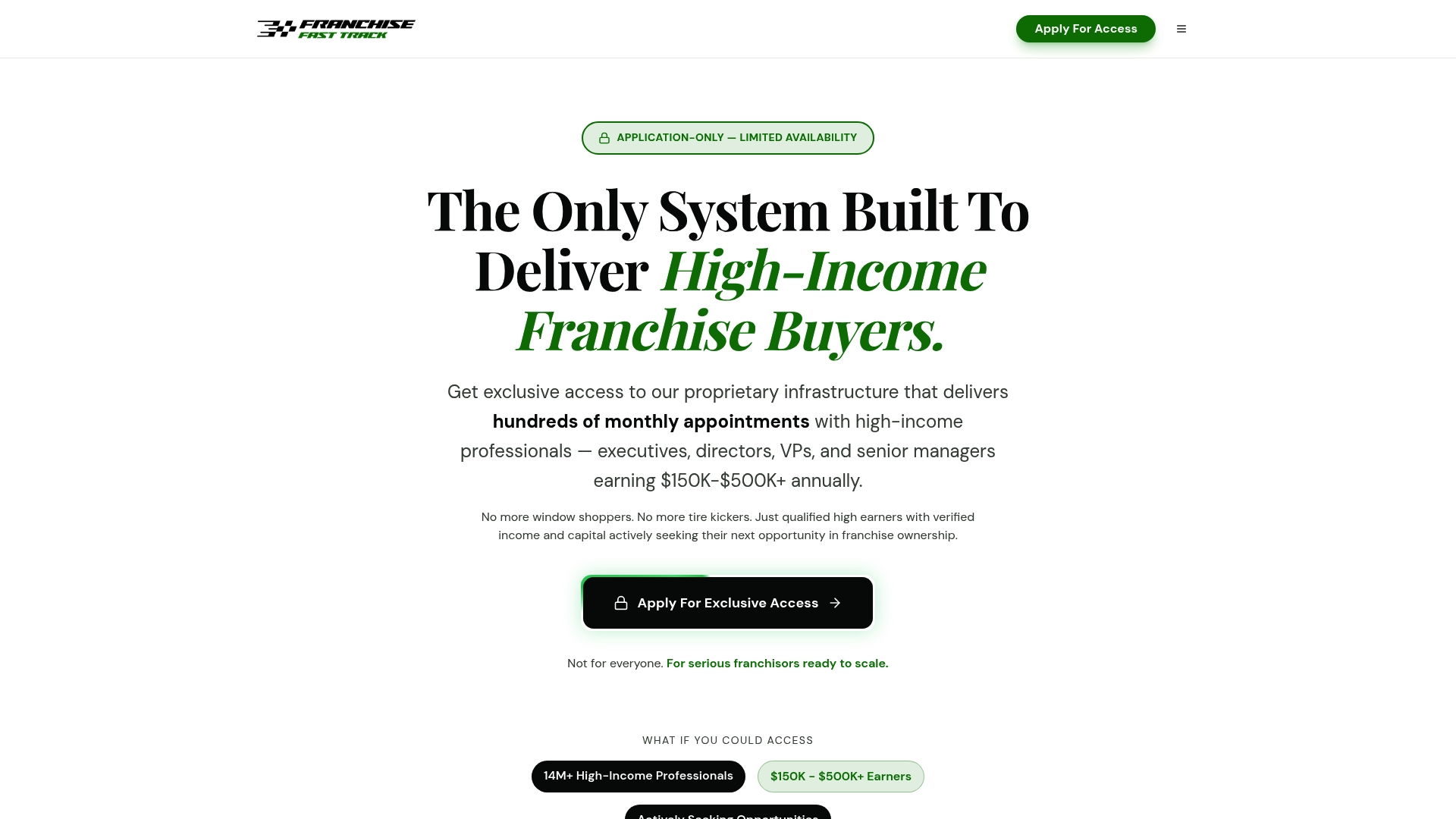
Franchise Fast Track's proprietary system delivers appointments with verified professionals earning $150,000–$500,000 annually, including executives, directors, and senior managers who are actively evaluating franchise ownership. Every candidate passes financial and professional screening before your team sees their name. The result is a franchise development pipeline built on qualified buyers, not raw inquiry volume. If your team is ready to stop triaging and start closing, Franchise Fast Track's lead generation platform connects you directly with the candidates who can actually sign.
FAQ
What are the most important lead filtering criteria for franchise development?
The four non-negotiable criteria are verified liquid capital, total net worth, preferred territory, and timeline to open. Filtering on these four points before the first call eliminates the majority of unqualified inquiries.
How do franchise CRMs improve lead qualification?
Advanced franchise CRMs track candidates across 8–12 buyer journey stages and filter by engagement recency, letting development teams prioritize candidates based on actual readiness rather than inquiry date alone.
Why is disqualification as important as qualification in franchise development?
Disqualification protects your team's time by removing candidates who cannot meet financial or operational thresholds early in the process, preserving resources for prospects who can close.
How does AI improve franchise lead filtering?
AI-powered tools score candidates instantly against financial, behavioral, and territorial criteria, automate follow-up communications, and deliver fully documented candidate profiles to sales reps before any human contact is required.
Should behavioral criteria carry the same weight as financial criteria?
System adherence and coachability predict long-term franchisee success more reliably than capital alone. The strongest candidate profiles combine financial capacity with demonstrated behavioral alignment to the brand's operating model.
Recommended
- Franchise Lead Generation: Qualified Franchisee Candidates for Serious Franchisors | Franchise Fast Track
- A High-Performance Franchise Marketing Strategy for 2026 | Franchise Fast Track Blog
- Franchise Lead Qualification: What It Means and Why It Matters | Franchise Fast Track Blog
- Financing for a Franchise: Franchisor's 2026 Guide | Franchise Fast Track Blog
Ready to see results like these for your franchise?
Stop wasting money on leads that never close. Start getting hundreds of replies from high-net-worth professionals daily.