How Franchise Ownership Fits Corporate Schedules: A Franchisor's Guide
Yes, franchise ownership fits a full-time corporate schedule — but only when three conditions are met: the brand supports a semi-absentee model, the owner hires a General Manager before handoff, and both parties plan around a dual-track launch that keeps W-2 income intact during ramp-up.
For franchisors, that means three concrete changes:
- Recruiting posture: Target executives earning $150K–$500K who are actively protecting their income, not replacing it.
- Training design: Offer compressed blocks and remote modules so FDD-mandated training doesn't require two weeks off work.
- Operational model: Require or strongly recommend a GM hire before the owner takes the keys.
Table of Contents
- How franchise ownership fits a corporate schedule — what franchisors must understand about executive buyers
- How do FDD obligations affect employed buyers?
- What is the dual-track strategy and how does it work in practice?
- Which franchise categories fit a corporate schedule?
- What operational setup makes semi-absentee ownership work?
- How should franchisors screen corporate executive candidates?
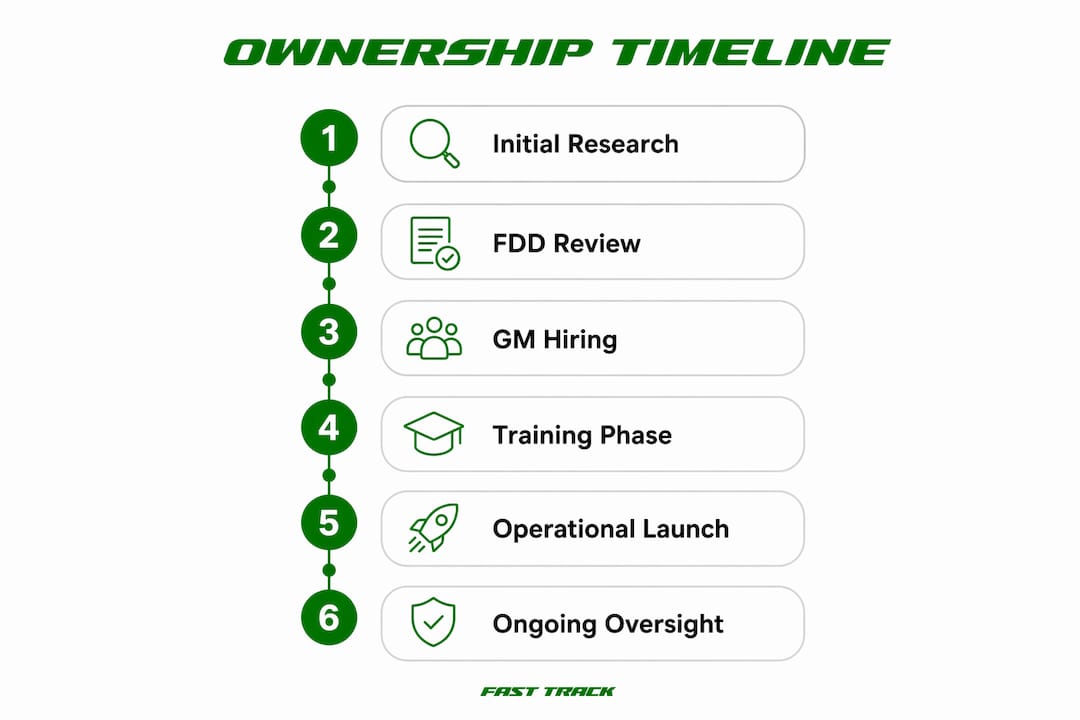
- Sample launch and handoff timeline for executive buyers
- What KPIs should executive owners track daily and weekly?
- How should franchisors recruit high-income corporate buyers?
- What metrics validate executive-targeted recruiting?
- What legal and contractual issues do corporate executives face?
- How should corporate owners coordinate with their employer?
- What does successful corporate executive franchise ownership look like?
- What challenges do corporate executives face managing both roles?
- How should franchisors adjust support structures for limited-availability owners?
- Key Takeaways
- The real gap in executive franchise recruiting
- Franchise Fast Track connects franchisors with verified executive buyers
- Selected sources and further reading
How franchise ownership fits a corporate schedule — what franchisors must understand about executive buyers
Corporate buyers are protecting what some advisors call Whole Body Wealth: salary, equity compensation, benefits, and a career trajectory that took years to build. They are not looking to quit. They are looking to add. That distinction changes everything about how you recruit them.
These buyers require predictable ramp timelines. They want evidence that a manager can run daily operations without them. They will time-block their research, validation calls, and discovery sessions around quarterly reviews and travel schedules. Franchisors that accommodate that cadence — offering evening calls, asynchronous FDD review, and verified case studies from other employed owners — consistently win higher-quality candidates than those who treat every prospect like a full-time buyer.
The IFA's 2026 Value of Franchising report, conducted by Oxford Economics, found that a majority of franchisees are first-time business owners, and a significant portion say they would not own a business at all without franchising. That population skews toward employed professionals who need a proven system precisely because they cannot afford to experiment.
How do FDD obligations affect employed buyers?
The Franchise Disclosure Document is non-negotiable. Every buyer, regardless of employment status, must receive the FDD at least 14 calendar days before signing. Training obligations, pre-opening checklists, and hiring milestones follow a fixed sequence that does not pause for corporate calendars.
Here is how franchisors can structure that sequence to reduce conflict:
- Deliver the FDD digitally and early. Give candidates the document before the 14-day clock starts so review overlaps with their existing schedule, not their vacation week.
- Compress initial training into long weekends or modular blocks. A five-day training program split across two three-day weekends is far more accessible than a consecutive week away from the office.
- Allow remote completion for non-hands-on modules. Compliance, brand standards, and financial reporting training can often be completed via video without violating FDD terms — confirm with your franchise attorney.
- Front-load GM hiring. If the owner's GM completes portions of operational training alongside them, the owner's required presence at the location drops significantly post-opening.
- Build a pre-opening checklist with explicit owner time estimates. Candidates need to see, in writing, that site build-out and vendor setup require roughly 10–15 hours of owner involvement per week. Ambiguity kills deals.
For a deeper look at FDD structure and obligations, the FDD guidance resource from Franchise Fast Track covers the key timelines development teams should communicate to candidates.
What is the dual-track strategy and how does it work in practice?

The dual-track strategy is straightforward: the executive keeps their corporate role and income while progressing through franchise development using focused, time-blocked research windows. Research confirms that success depends on the franchise model, capital structure, and GM hire — not on quitting the day job.
A practical time-allocation rule for executive franchise owners divides weekly oversight across four areas:
- Operations review (daily, 15–20 minutes): dashboard check, exception alerts, GM text or call.
- Financial oversight (weekly, 60–90 minutes): P&L snapshot, labor percentage, cash position.
- Marketing and growth (weekly, 30–60 minutes): campaign performance, local outreach, review responses.
- Administration (bi-weekly, 60 minutes): vendor coordination, compliance, franchisor reporting.
Semi-absentee owners typically commit roughly 10–15 hours per week when a strong GM is in place. That is a Saturday morning and two weekday evenings — manageable for most directors and VPs.
Pro Tip: Structure discovery calls at 7:00 AM or after 6:00 PM and send pre-read materials 48 hours in advance. Executives who show up prepared to those calls are your highest-intent candidates.
Which franchise categories fit a corporate schedule?
Not every franchise works for a 5-to-9 owner. Category selection is the single biggest predictor of whether a corporate executive succeeds or burns out.
| Category | Fits Corporate Schedule? | Why |
|---|---|---|
| B2B services (staffing, consulting, signage) | Yes | Weekday sales cycle; GM handles delivery |
| Membership/subscription fitness | Yes | Recurring revenue; manager-driven ops |
| Automated retail / vending | Yes | Minimal staff; remote monitoring |
| Home services (painting, restoration) | Conditional | Depends on crew size and dispatch model |
| Full-service restaurants | No | Real-time presence required; high labor |
| Drive-thru quick service | No | Peak-hour management demands owner proximity |
| Labor-heavy retail | No | Constant floor coverage; high turnover |
The attributes that predict success for employed owners are recurring revenue, low headcount, and manager-driven workflows. Categories where the owner is the product — or where a single absent shift creates a customer service crisis — are poor fits. For a broader breakdown, business categories suited to franchising covers this in more detail.
What operational setup makes semi-absentee ownership work?
The GM is the linchpin. Successful executive owners hire their General Manager before revenue flows, not after the first bad week. The GM should be trained alongside the owner during pre-opening, understand the brand's KPIs, and have clear authority to make operational decisions without a phone call.
Compensation structure matters as much as the hire itself. Top-performing semi-absentee owners tie a meaningful portion of GM pay to net profit, not just hourly wages. When the GM's income rises with the unit's performance, they act with owner-level alignment. A base salary plus a 5–10% net profit share is a common structure in service-based franchise categories.
The technology stack must support remote oversight: a cloud-based POS, real-time sales dashboards, remote scheduling software (tools like Deputy or Homebase work well), and security camera access. Without those signals, an executive owner is flying blind. Smart franchisees divide their time across operations, training, marketing, and administration — and that only works when the data is visible without being on-site.
How should franchisors screen corporate executive candidates?
Income verification is the starting point, not the finish line. A candidate earning $200K annually with $80K in liquid capital and two direct reports in their corporate role is a fundamentally different prospect than someone with the same income but no management experience.
Screen for these criteria in order:
- Verified income band ($150K–$500K): confirms liquidity for payroll cushion and investment.
- Delegation experience: prior management of people or budgets predicts GM oversight success.
- Time-availability window: can they commit 10–15 hours per week during ramp-up?
- Availability for compressed training: two long weekends within 60 days of signing.
- Early liquidity for payroll: three months of operating expenses in reserve, separate from the franchise fee.
Red flags worth disqualifying early: insistence on a fully absentee model with zero weekly involvement, no history of managing people or P&L, and inability to fund a payroll cushion beyond the initial investment. The types of franchise ownership models resource helps development teams explain the semi-absentee distinction clearly during screening calls.
Sample launch and handoff timeline for executive buyers
| Milestone | Owner Time Required | Franchisor Responsibility |
|---|---|---|
| FDD review and LOI (Weeks 1–3) | 8–10 hours | Deliver FDD, schedule validation calls |
| Financial qualification and signing (Weeks 4–6) | 4–6 hours | Confirm liquidity, countersign agreement |
| Site selection and lease (Weeks 6–14) | 6–8 hours | Provide site criteria, broker referrals |
| GM hire and training (Weeks 8–14) | 10–15 hours | Deliver training program; allow GM co-attendance |
| Pre-opening build-out and vendor setup (Weeks 10–16) | 8–10 hours | Project manage build; owner approves milestones |
| Soft open and first 30 days | 15–20 hours/week | Field support, daily check-ins |
| Weeks 8–14 (handoff to GM) | 10–15 hours/week | Weekly franchisor review call |
The critical window is Weeks 8–14. That is when FDD-mandated training, GM hiring, and site build-out overlap. Franchisors that stagger training modules across weekends and allow GM co-completion compress owner time requirements without violating disclosure obligations.
- Confirm training schedule in writing before signing, not after.
- Build a shared project tracker (Asana or similar) so the owner can monitor milestones asynchronously.
- Schedule the soft-open date around the owner's corporate calendar, not the other way around.
What KPIs should executive owners track daily and weekly?
Executive owners manage by dashboard. The reporting cadence should match how they already consume information at work: a daily snapshot, a weekly review, and a monthly P&L deep-dive.
Daily: Total sales vs. prior period, labor percentage, any exception alerts (voids, refunds, security flags).
Weekly: Average ticket, customer NPS or review score, cash position, GM scorecard against targets.
Monthly: Full P&L, royalty reconciliation, unit-level EBITDA, comparison to franchise system averages.
The GM scorecard is often overlooked. A one-page weekly summary from the GM covering staffing, customer issues, and top three priorities keeps the owner informed without requiring a 45-minute call. Tools like cloud POS platforms and CRM systems (Zoho is one option) can automate much of the daily and weekly data delivery.
How should franchisors recruit high-income corporate buyers?
Generic franchise portals reach general audiences. Reaching directors, VPs, and senior managers earning $150K–$500K requires a different approach entirely.
- LinkedIn account-based outreach: Target by title, industry, and income proxy (company size, seniority level). Message framing should lead with capital transparency and manager-first proof points, not lifestyle promises.
- Executive-focused events: Industry conferences, YPO chapters, and alumni networks surface pre-qualified candidates who are already thinking about ownership.
- Employer partnership programs: Some franchisors have piloted outreach through HR departments at large employers offering financial wellness or career transition resources.
- Referral networks: Existing franchisees who came from corporate roles are credible validators. A 15-minute call with a current owner who held a VP title closes more deals than any brochure.
Message framing for this audience should always include: dual-track timeline clarity, FDD review window, GM model proof, and a verified case study from a current employed owner. For lead generation strategies that apply specifically to service-based franchise development, the mechanics of outbound sequencing translate directly to executive candidate pipelines.
What metrics validate executive-targeted recruiting?
Franchisors running executive-targeted pipelines should expect different conversion metrics than general lead programs. The 5-to-9 owner model treats ownership as a strategic investment, which means longer consideration cycles but higher close rates once the candidate reaches discovery day.
Franchise Fast Track's appointment-generation system reports a lead-to-close rate of approximately 34% when targeting verified high-income professionals. That figure reflects income and intent verification before the appointment reaches the franchisor's calendar — meaning development teams spend time on candidates who have already cleared a financial and motivation screen.
When presenting these metrics in sales materials or FDD follow-ups, tie them to specific candidate criteria: income band, management background, and category fit. A 34% close rate on verified $200K+ earners with delegation experience is a materially different claim than a 34% rate on unfiltered portal leads.
What legal and contractual issues do corporate executives face?
Two issues come up consistently and are often underestimated. First, many corporate employment agreements include non-compete or conflict-of-interest clauses that could restrict ownership in adjacent industries. An executive at a national retailer, for example, may be contractually prohibited from owning a competing retail franchise. Candidates should review their employment agreement with an attorney before signing a franchise agreement.
Second, passive ownership structures matter for tax and liability purposes. Owning a franchise through an LLC or S-Corp rather than as a sole proprietor affects how income is reported, how liability is structured, and whether the investment appears on a personal credit report. The right entity structure varies by state and personal tax situation. This article is general information, not legal or tax advice — candidates should confirm their specific situation with a qualified attorney and CPA.
Franchisors can reduce friction here by providing a one-page checklist of questions candidates should ask their own counsel before signing. That gesture builds trust and accelerates the legal review phase.
How should corporate owners coordinate with their employer?
Most executives do not tell their employer they are buying a franchise, and most do not need to. The franchise operates as a separate legal entity. Unless the employment agreement requires disclosure of outside business interests, there is no automatic obligation to inform HR.
That said, practical coordination matters. Training blocks, soft-open weeks, and the first 30–60 days of operation will require some flexibility. Executives who have banked goodwill with their managers and have a track record of delivering results tend to navigate this without conflict. The ones who struggle are those who try to hide the time commitment entirely and end up underperforming at both.
The cleanest approach: treat the franchise like any other personal investment. Keep it separate, manage it during off-hours, and let the GM handle anything that would otherwise require a mid-day phone call.
What does successful corporate executive franchise ownership look like?
The pattern that appears consistently among successful 5-to-9 owners is not a particular industry or investment size. It is a mindset shift: from technician to executive. The owner stops doing operational tasks and starts reviewing performance data, coaching the GM, and making capital allocation decisions.
A director-level professional in financial services who owns a B2B staffing franchise is a real archetype in this space. They spend Sunday evenings reviewing the weekly P&L, take a GM call on Wednesday morning before their corporate standup, and handle vendor contract renewals on Saturday. The franchise runs Monday through Friday without them. That outcome is not accidental. It is the result of hiring the right GM, choosing a category with recurring revenue, and building a reporting cadence that fits how they already work.
The corporate leaders who prepare most carefully clarify their income and time targets before selecting a category, build liquidity before signing, and run time-blocked validation calls during their research phase. Franchisors that support that preparation process — rather than rushing candidates toward a close — build longer-term franchisee relationships and lower turnover.
What challenges do corporate executives face managing both roles?
The most common failure point is not time. It is the assumption that a good hire solves everything. A GM who lacks clear KPIs, authority, and a profit incentive will default to calling the owner for every decision. That erodes the executive's corporate performance and the franchise's operational consistency simultaneously.
The second challenge is the ramp-up window. Weeks 8–16 are genuinely demanding. Site build-out, GM training, vendor setup, and pre-opening marketing all compete for the owner's limited availability. Franchisors that do not actively project-manage this window leave executive owners exposed to delays and cost overruns that could have been avoided.
Finally, capital timing creates stress. The franchise fee and build-out costs are paid before revenue starts. An executive who has not reserved three to six months of operating expenses beyond the initial investment will feel financial pressure that bleeds into both roles.
How should franchisors adjust support structures for limited-availability owners?
The support model most franchisors built assumes an owner who is on-site daily. That model does not serve executive buyers. Adjustments worth making:
A dedicated field support contact who is available outside standard business hours — even one evening call per week — signals that the brand understands its executive franchisee base. Asynchronous communication protocols (shared dashboards, weekly written summaries from the franchisor's field team) reduce the need for real-time availability. Pre-built GM training curricula that the franchisor delivers directly, rather than routing through the owner, reduce the owner's coordination burden during the critical pre-opening window.
Franchisors that have built scalable support systems for part-time owners consistently report lower franchisee turnover and higher unit-level performance in their semi-absentee cohort.
Key Takeaways
Corporate executives can own and operate franchises alongside full-time roles when franchisors build semi-absentee support structures, require a GM hire before handoff, and recruit through verified executive pipelines.
| Point | Details |
|---|---|
| Semi-absentee time commitment | Successful executive owners typically invest 10–15 hours per week when a strong GM is in place. |
| Category selection is decisive | B2B services, membership models, and automated retail fit corporate schedules; full-service restaurants and labor-heavy retail do not. |
| GM hire before handoff | Hiring and training a GM before the owner takes operational control is the single most reliable predictor of semi-absentee success. |
| FDD timeline planning | Franchisors should compress training into long weekends and allow remote module completion to fit executive calendars without violating disclosure obligations. |
| Franchise Fast Track pipeline | Franchise Fast Track delivers verified appointments with $150K–$500K+ professionals and reports a ~34% lead-to-close rate for franchisors targeting executive buyers. |
The real gap in executive franchise recruiting
The conventional wisdom says executive buyers are hard to close because they overthink. That is not the problem. The problem is that most franchise development teams present the same discovery process to a VP of Operations that they present to a first-time buyer with no management background. Those two people need completely different conversations.
The VP already understands P&L, delegation, and capital allocation. What they need is evidence: a GM model that has actually worked, a training schedule that does not require two weeks off, and a verified case study from someone who looks like them. When franchisors build that evidence package and deliver it through channels where executives actually spend time, the consideration cycle shortens and the close rate climbs.
The dual-track model is not a compromise. For the right candidate in the right category, it is the most rational path to business ownership available. Franchisors that recognize that and build their recruiting, onboarding, and support around it will consistently outperform those still waiting for a buyer who is ready to quit their job.
Franchise Fast Track connects franchisors with verified executive buyers
Reaching directors, VPs, and senior managers who are actively evaluating franchise ownership requires more than a portal listing. Franchise Fast Track delivers hundreds of pre-qualified appointments each month with verified professionals earning $150K–$500K+, with income and intent confirmed before the appointment reaches your calendar. The franchise lead generation system handles candidate sourcing, vetting, and booking so your development team focuses on closing, not prospecting.
The reported lead-to-close rate of approximately 34% reflects what happens when the top of the funnel is built around executive buyers specifically, not general audiences. If your current pipeline is producing unqualified leads that stall at discovery day, the fix is upstream. Book a call with Franchise Fast Track to see how the appointment-generation model works for your brand.
Selected sources and further reading
- IFA 2026 Value of Franchising Report — Oxford Economics analysis of franchise model benefits, franchisee demographics, and economic contribution.
- IFA Franchising Overview — FDD process, franchise agreement structure, and franchisor support obligations.
- Own a Franchise Without Quitting Your Job — Semi-absentee ownership conditions, capital structure, and GM requirements.
- The 5-to-9 Entrepreneur — Executive ownership model, time-blocking cadence, and investor mindset framework.
- How Corporate Leaders Prepare to Buy a Franchise While Employed — Pre-signing checklist, liquidity planning, and validation call structure.
- Franchise Fast Track Blog: Franchise Ownership for Executives — Operational playbook and time-allocation guidance for executive owners.
- Franchise Fast Track Blog: FDD Database Guide — FDD timelines and obligations for development teams.
- Franchise Fast Track Blog: Support Systems That Scale — Franchisor adjustments for part-time and limited-availability owners.
Recommended
- How to Become a Franchise Owner: Your Essential Guide | Franchise Fast Track Blog
- Franchise Ownership for Executives: A Strategic Guide | Franchise Fast Track Blog
- Franchise Ownership vs Management: A 2026 Guide | Franchise Fast Track Blog
- Franchising Pros and Cons: A 2026 Guide for Franchisors | Franchise Fast Track Blog
Ready to see results like these for your franchise?
Stop wasting money on leads that never close. Start getting hundreds of replies from high-net-worth professionals daily.