How to Develop a Franchise Support System That Scales
A franchise support system is the documented infrastructure of training, technology, field coaching, and compliance processes that franchisors use to keep every location performing to brand standards. Without it, franchisees fail at rates that damage the entire network. The industry term is "franchise support framework," and building one correctly requires decisions about staffing, software, legal disclosure, and onboarding before you award your next unit. This guide walks you through each layer, from AI-powered knowledge bases to FTC compliance, so you can develop a franchise support system that holds up as your network grows.
What core components make up an effective franchise support system?
A franchise support framework has six functional layers. Each one addresses a different failure point in the franchisee relationship.
| Component | Function |
|---|---|
| AI-powered knowledge base | Delivers instant answers to operational questions, reducing ticket volume |
| Marketing asset library | Provides brand-approved templates franchisees can deploy locally |
| Automated onboarding hub | Tracks training completion and flags gaps before launch |
| Performance dashboards | Gives leadership real-time visibility into unit-level metrics |
| Field coaching cadence | Delivers structured, scheduled support visits with scoring rubrics |
| Legal disclosure (FDD Item 11) | Documents all support obligations under FTC Franchise Rule 16 CFR 436.5(k) |

The knowledge base and onboarding hub do the heaviest lifting early. AI-powered support hubs can reduce franchisee support tickets by up to 80% by giving operators instant access to standardized resources. That reduction frees your field team to focus on coaching rather than answering the same questions repeatedly.
Performance dashboards close the loop. When leadership can see training completion rates, sales trends, and compliance scores in one view, they can intervene before a struggling franchisee becomes a closed location. The dashboard is not a reporting tool. It is an early warning system.
Pro Tip: Build your knowledge base around the top 20 questions your support team answers every week. Those questions reveal exactly where your operations manual has gaps.
How to create a structured onboarding and training process
Onboarding is where most franchise support frameworks fail. Franchisors hand over a manual, run a training week, and assume the franchisee is ready. They are not.
Best-in-class onboarding includes weekly check-ins for the first six months to confirm training is applied correctly and to catch problems early. That cadence is not optional for high-performing networks. It is the standard.
A three-phase structure works best for creating franchise systems with consistent results:
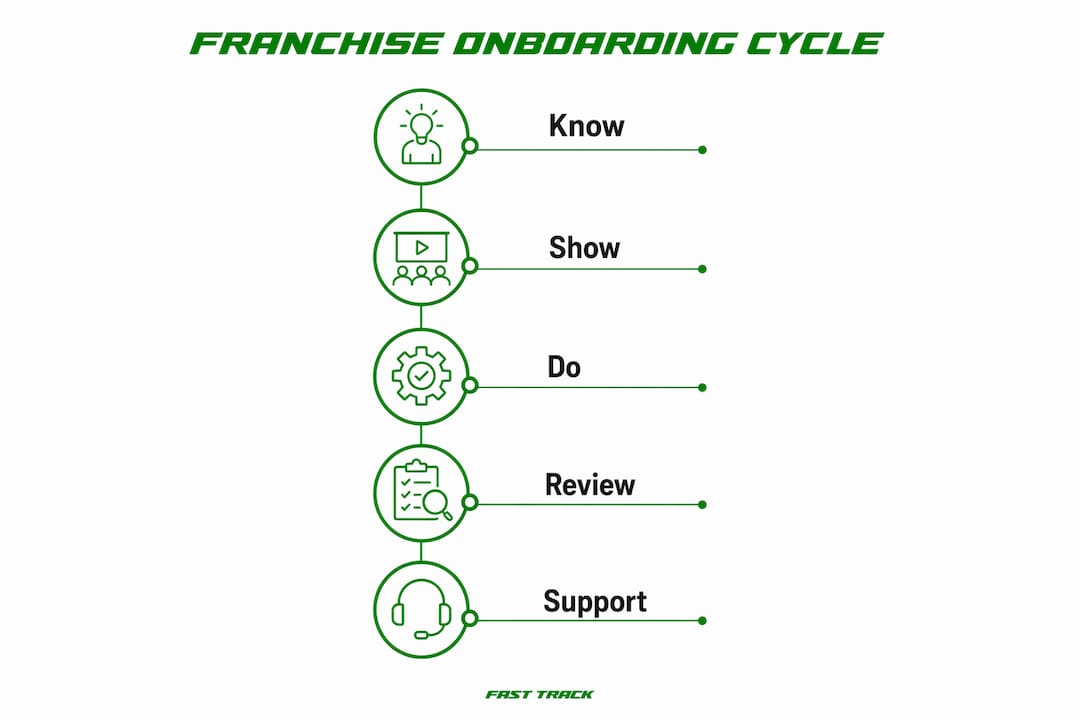
- Training week. Cover brand standards, POS operation, hiring protocols, and financial reporting. Use the "know, show, do, review" method: explain the concept, demonstrate it, have the franchisee execute it, then review their output before moving on.
- Implementation and support phase (weeks 2–12). A dedicated field consultant or opening team stays close. Weekly video calls review real numbers from the franchisee's first weeks. Tools like monday.com work well here for tracking task completion and flagging overdue items.
- Continuous coaching phase (months 3–6). Shift from hand-holding to accountability. Check-ins move from operational troubleshooting to performance coaching. The franchisee should be running the business. You should be reviewing the results.
The "know, show, do, review" cycle matters because adults retain skills through practice, not lectures. A franchisee who watches a video about inventory management will not apply it correctly under opening-week pressure. A franchisee who has practiced the process three times with a coach will.
Pro Tip: Record your training week sessions and add them to your knowledge base. New franchisees can revisit them, and your team avoids rebuilding content every cohort.
Structured franchise training programs that combine live instruction with documented follow-up produce measurably better franchisee performance than self-directed learning alone.
How do technology and AI improve franchise operational support?
Technology is the multiplier in any franchise management system. Without it, your support quality degrades as your unit count grows because human capacity does not scale at the same rate as your network.
Fragmented tools create inefficiency. A unified franchise operating system that integrates your POS, CRM, and LMS on a common data layer gives every stakeholder the same view of franchisee performance. That shared visibility is what makes real-time support possible. When a field consultant walks into a location, they should already know the unit's training completion rate, last three months of sales data, and any open compliance issues.
The core technology benefits for franchise operational support include:
- Smart escalation paths. The system routes questions to the right contact automatically. Operational questions go to field consultants. Legal questions go to compliance. Marketing requests go to the brand team.
- Real-time dashboards. Leadership sees which franchisees are trending down before the franchisee asks for help.
- Automated compliance tracking. The system flags expired certifications, missed training modules, and overdue field visits.
- Integrated communication logs. Every support interaction is recorded, creating an audit trail that protects both parties.
Technology must enable field teams by providing real-time training status and compliance data during support visits to maximize impact. A field consultant arriving without that data is working blind.
Pro Tip: Before selecting a franchise management platform, map every data point your field team needs during a visit. Buy the tool that surfaces those data points in one screen, not five.
What staffing models best sustain franchise growth?
Staffing is where growing franchisors make their most expensive mistakes. The founder handles support personally for the first 10 to 15 units. Then the network hits 25 units and the model breaks.
Support systems break down when founders can no longer provide hero-level personalized attention. Scalable success requires documented cadence and assigned roles before the network grows, not after. That means defining who owns what before you need them.
| Staffing model | Best for | Risk |
|---|---|---|
| Founder-led support | Networks under 15 units | Burns out founder; not transferable |
| Dedicated field consultants | Networks of 15–100 units | Requires clear role definition and financial literacy |
| Regional support managers | Networks over 100 units | Coordination complexity increases |
| Hybrid (tech + field) | Any size | Most cost-effective when tech is properly configured |
Field consultant benchmarks average about 30–34 units per consultant for effective, high-touch support. Beyond that ratio, visit frequency drops and franchisee satisfaction follows. Hire your next consultant before you hit the ceiling, not after.
Multi-unit franchisees demand enterprise-style operational consistency and cost efficiency. Single-unit operators need granular, hands-on guidance. Your staffing model must account for both. A field consultant managing a mix of single-unit and multi-unit operators needs different tools and different conversation frameworks for each.
Pro Tip: Document your support cadence in writing before you hire your first field consultant. The document becomes their job description and your quality standard.
For a deeper look at building sustainable franchise growth models that account for staffing and support scalability, the frameworks that work at 50 units are different from those that work at 200.
How to integrate legal compliance into your franchise support system
Legal compliance is not a separate workstream. It is built into the support system from day one.
FTC Franchise Rule 16 CFR 436.5(k) requires franchisors to disclose training programs in FDD Item 11 via a mandatory four-column table. That table must detail subject matter, classroom hours, on-the-job hours, and location for every training component. What you write in Item 11 is a legal promise. Your support system must deliver exactly what it describes.
The most common compliance failure is over-promising in the FDD and under-delivering in practice. Franchisors write aspirational support descriptions during the excitement of early growth, then fail to staff or fund them as the network scales. The result is legal exposure and damaged franchisee trust.
Key compliance requirements for your franchise support framework:
- Document every training program with the four-column format before filing your FDD.
- Review Item 11 annually and update it when your support model changes.
- Keep records of every field visit, check-in, and training completion for each franchisee.
- Align your operations manual with your FDD disclosures so both documents describe the same system.
The operations manual must be a live document updated quarterly, used as the source of truth for training, compliance, and field scoring. A static manual filed away after launch is a liability, not an asset.
Pro Tip: Draft your Item 11 descriptions based on what your support team can realistically deliver at 50 units, not what sounds impressive at 5. Realistic disclosures protect you legally and set franchisees up with accurate expectations.
Key takeaways
A franchise support system succeeds when it combines documented processes, technology, financially literate field staff, and FDD-aligned compliance before the network scales past the founder's personal capacity.
| Point | Details |
|---|---|
| Build before you scale | Document your support cadence and roles before awarding units beyond 15. |
| Use AI to reduce ticket volume | AI-powered knowledge bases can cut support tickets by up to 80%, freeing field teams for coaching. |
| Follow the three-phase onboarding model | Training week, implementation support, and continuous coaching produce consistent franchisee results. |
| Staff to the 30–34 unit benchmark | Assign one field consultant per 30–34 units to maintain high-touch support quality. |
| Align your FDD with your reality | Item 11 disclosures must match what your support system actually delivers, or you face legal exposure. |
Why most franchise support systems fail before they start
The honest truth about building a franchise support framework is that most franchisors design it around what they can do personally, not what the system can do without them. I have seen this pattern repeatedly. A founder who is brilliant at supporting franchisees creates a support model that only works because of their specific knowledge, relationships, and availability. The moment they step back, the whole thing collapses.
The fix is not hiring more people. The fix is documenting the cadence so that good support is a function of the system, not the individual. That means writing down exactly what happens at week one, week four, month three, and month six for every franchisee. It means defining what a field visit looks like, what gets scored, and what triggers an escalation.
The other mistake I see constantly is treating field consultants as brand police rather than business coaches. Field consultants need financial literacy to interpret unit economics and coach franchisees credibly. A consultant who can only check whether the logo is the right size is not delivering value. A consultant who can read a P&L and explain why labor costs are eating margin is worth every dollar.
The operations manual is the third piece most franchisors get wrong. They write it once, file it, and never touch it again. A manual that does not reflect current operations is worse than no manual at all, because it creates confusion about what the actual standard is. Treat it as a living document. Update it quarterly. Version-control it. Make it the single source of truth for everything your field team scores.
— Cody
How Franchise Fast Track helps you build and fill your franchise system
Building a support system is only half the equation. The other half is filling it with franchisees who are qualified, funded, and serious about operating to your standards.
Franchise Fast Track connects franchisors with verified high-income professionals earning between $150,000 and $500,000 annually, including executives, directors, and senior managers actively seeking franchise ownership. The platform delivers hundreds of appointments per month with pre-screened candidates, and franchisors report a lead-to-close rate of 34%. That means your support system gets filled with operators who have the financial capacity and professional background to follow your processes and succeed. Stop spending your field team's time on unqualified leads. Start building a network worth supporting.
FAQ
What is a franchise support system?
A franchise support system is the documented set of training programs, technology tools, field coaching processes, and compliance procedures a franchisor uses to help franchisees operate to brand standards. It covers everything from initial onboarding through ongoing performance coaching.
How often should franchisors check in with new franchisees?
Best practice calls for weekly check-ins during the first six months after a franchisee opens. That cadence confirms training is applied correctly and catches operational problems before they become costly.
What does FDD Item 11 require franchisors to disclose?
FTC Franchise Rule 16 CFR 436.5(k) requires franchisors to include a four-column table in FDD Item 11 covering training subject matter, classroom hours, on-the-job hours, and location for every program they offer.
How many franchisees can one field consultant support?
Field consultant benchmarks average 30–34 units per consultant for effective, high-touch support. Exceeding that ratio reduces visit frequency and lowers franchisee satisfaction.
How does AI improve franchise support?
AI-powered knowledge bases and automated support hubs can reduce franchisee support tickets by up to 80% by providing instant access to standardized answers. That reduction lets field teams focus on coaching rather than repetitive troubleshooting.
Recommended
- How to Franchise Your Business for Sustainable Growth | Franchise Fast Track Blog
- Franchise Growth Strategies for Sustainable Scale in 2026 | Franchise Fast Track Blog
- Franchise Growth Agency: Grow Your System With Funded Franchisees | Franchise Fast Track
- Effective Franchise Training Programs for Franchisors | Franchise Fast Track Blog
Ready to see results like these for your franchise?
Stop wasting money on leads that never close. Start getting hundreds of replies from high-net-worth professionals daily.