Types of Franchise Ownership Models: A 2026 Guide
Types of franchise ownership models classify how involved owners are, how many units they control, and what contractual rights they hold. The four primary structures are single-unit, multi-unit, area development, and master franchising. Each carries distinct investment requirements, management demands, and growth potential. Choosing the right model depends on your time availability, capital, and long-term goals. Understanding these structures before signing any agreement protects you from costly mismatches between your lifestyle and your business obligations.
1. Types of franchise ownership models: single-unit
Single-unit franchise ownership means you own and operate one franchise location. This is the most common entry point for new franchisees, and for good reason. It gives you full control, direct involvement, and the clearest path to learning the business before scaling.

Owner-operators in single-unit models typically work full time in the business, often 40 to 60 hours per week. Industries that favor this structure include quick-service restaurants, personal care services, and fitness studios. These sectors reward hands-on management and have lower initial capital requirements compared to multi-unit commitments.
From a legal standpoint, most single-unit owners form an LLC as their operating entity. Once net profit crosses $100,000 annually, an S-Corp tax election can save owners $10,000 to $40,000 per year in self-employment taxes. That single structural decision often pays for itself within the first year.
- Full-time owner involvement produces the highest operational control
- Single-unit models are the standard proof-of-concept stage for franchisors
- LLC formation is the baseline; S-Corp election adds tax efficiency at scale
- Quick-service and personal services are the most common single-unit industries
Pro Tip: Start single-unit even if your long-term goal is multi-unit ownership. Mastering one location teaches you the operational systems you will need to manage managers later.
2. Multi-unit and area development franchise ownership
Multi-unit ownership means you own and operate more than one franchise location, typically acquired over time as your first unit proves profitable. Area development agreements go one step further. They require you to open a defined number of units within a specific region on a contractual schedule. Missing that schedule can trigger penalties or agreement termination.
The involvement level for multi-unit owners shifts from operator to overseer. Most owners in this structure spend 15 to 20 hours per week managing general managers at each location rather than working the floor themselves. This is the semi-absentee model, and it requires hiring reliable, experienced managers before you expand.
Financing multi-unit growth is more complex than opening a single location. Lenders evaluate your existing unit performance, your management team, and your area development schedule. Brands in home services, commercial cleaning, and senior care are well suited to multi-unit expansion because their unit economics support the management overhead.
Entity structure becomes critical at this stage. The most effective approach is a holding company structure where a parent entity, often an S-Corp, owns separate LLCs for each franchise unit. This isolates liability, simplifies resale of individual units, and creates clean operating histories for each location.
- Confirm your first unit is profitable and operationally stable before signing an area development agreement
- Hire a general manager for your first location before opening your second
- Set up a holding company with subsidiary LLCs from the start, not after the fact
- Negotiate your area development schedule with realistic timelines, not optimistic ones
- Secure financing commitments before committing to a multi-unit schedule
Pro Tip: Most new multi-unit owners err by not structuring their portfolio with a holding company early. Restructuring later is expensive and disruptive. Build the right architecture before you sign your second agreement.
3. Master franchise ownership and area representation
Master franchise ownership grants you regional rights to a brand, plus the authority to recruit, train, and support sub-franchisees within your territory. You function as a mini-franchisor. You share royalties with the parent franchisor and take a portion of fees collected from your sub-franchisees.
Master franchisees have rights to sub-franchise their territory, provide training and ongoing support, and split royalties with the franchisor. This model suits experienced operators or investors with strong regional networks and business development skills. It is not an entry-level structure.
Area representation is a lighter version of master franchising. Area representatives recruit and refer prospective franchisees to the franchisor but do not take on full training and support obligations. They earn referral fees or reduced royalty splits without the full liability of a master franchisee.
- Master franchising requires substantial capital and prior franchise operating experience
- Area representation suits investors who want development income without full operational responsibility
- Both models appear most often in mature franchise systems expanding into new geographic markets
- Legal and tax compliance is more complex, often requiring entity pre-approval from the franchisor
- Global brands increasingly use hybrid structures combining master franchising with company-owned units for complex markets
Franchise systems typically stack these models sequentially as they mature. Single-unit proves the concept, multi-unit drives regional density, and master franchising handles distant or culturally distinct markets. Understanding where a brand sits in that progression tells you a great deal about what kind of partner they need.
4. How owner involvement levels shape your franchise structure
The three owner involvement levels cut across all franchise business structures. Owner-operator means full-time presence, typically 40 to 60 hours per week. Semi-absentee means 15 to 20 hours per week overseeing managers. Fully passive means 2 to 5 hours per week at board-level oversight.
Fully passive ownership is revenue-dependent, not brand-dependent. Passive models require annual unit revenue exceeding $1.5 million and total management salaries of $95,000 to $130,000 to sustain low owner involvement. A brand with strong unit economics but modest revenue cannot realistically support a passive structure without eroding the owner's income.
The involvement level you choose should match both your personality and your financial position. If you need the business to replace a salary immediately, owner-operator gives you the most control over that outcome. If you are building a portfolio alongside a career, semi-absentee works when you have the right management team in place first.
| Involvement Level | Weekly Hours | Unit Revenue Needed | Best Ownership Structure |
|---|---|---|---|
| Owner-operator | 40–60 hours | Any | Single-unit |
| Semi-absentee | 15–20 hours | $500K+ | Multi-unit or area development |
| Fully passive | 2–5 hours | $1.5M+ per unit | Multi-unit with strong management |
Pro Tip: Under-managing a franchise is the most common cause of early failure. Before choosing a semi-absentee or passive model, confirm the brand's unit economics support the management salaries you will need to pay.
5. Choosing the right franchise ownership model for your goals
The right franchise ownership option depends on four factors: time commitment, available capital, preferred industry, and geographic ambitions. Each factor narrows your realistic choices before you evaluate specific brands.
Time commitment is the most honest filter. If you have a full-time job you plan to keep, owner-operator single-unit models are not realistic. Semi-absentee structures require a minimum of 15 to 20 hours per week and a management team you trust. Fully passive requires both significant capital and a brand with the unit economics to support it.
Capital shapes your options just as directly. Single-unit investments typically range from $100,000 to $500,000 depending on the industry. Multi-unit area development agreements often require demonstrating capital reserves for all committed units upfront. Master franchise rights carry the highest entry cost but also the highest earning potential.
Entity structuring affects both your tax liability and your franchisor relationship. Franchise agreements often restrict the business entity types permitted and require pre-approval for structural changes. Build your entity architecture before you sign, not after. Changing structure post-agreement is expensive and sometimes prohibited.
- Single-unit: best for first-time owners, full-time involvement, lower capital
- Multi-unit: best for operators ready to scale with proven systems and management depth
- Area development: best for growth-oriented investors with regional market knowledge
- Master franchise: best for experienced operators with capital and business development skills
- Fully passive multi-unit: best for high-net-worth investors with strong management teams in place
A deep look at franchise profitability by ownership structure shows that the model itself does not determine success. Matching the model to your actual capacity does. The most common mistake is choosing a model based on the lifestyle it promises rather than the operational reality it requires.
Key takeaways
The best franchise ownership model is the one that matches your time, capital, and management capacity, not the one with the most appealing lifestyle promise.
| Point | Details |
|---|---|
| Single-unit is the standard starting point | Owner-operators gain full control and operational knowledge before scaling to additional units. |
| Multi-unit requires structure from day one | A holding company with subsidiary LLCs isolates liability and simplifies resale of individual units. |
| Passive ownership demands revenue scale | Units must generate over $1.5M annually to support the management salaries that make passive involvement viable. |
| Master franchising is not an entry-level model | It requires prior franchise experience, significant capital, and strong business development skills. |
| Entity structure affects tax and franchisor approval | Build your LLC or S-Corp architecture before signing any franchise agreement to avoid costly restructuring. |
What I have learned about picking the right ownership model
The biggest mistake I see prospective franchise owners make is choosing a model based on the outcome they want rather than the capacity they actually have. Someone reads about a semi-absentee franchise and pictures themselves checking in for a few hours on Fridays. What they miss is that the semi-absentee model only works when a trained, reliable general manager is already in place. That manager takes time to find, train, and trust.
The transition from single-unit to multi-unit is where most franchisees either build real wealth or burn out. The owners who scale well are the ones who treated their first unit as a management school, not just a revenue source. They documented processes, built bench strength, and resisted opening a second location until the first one ran without them.
Legal and entity structure is the most underestimated decision in the entire process. I have seen owners spend years in a suboptimal structure because they signed their franchise agreement before consulting a franchise attorney. Restructuring after the fact costs far more in legal fees and franchisor negotiations than getting it right at the start. The legal architecture of a franchise system should be established before any agreement is drafted or signed.
My honest advice: match the model to your life, not your ambitions. Your ambitions can grow into a bigger model. A model that does not fit your life will cost you both money and time you cannot get back.
— Cody
Franchise Fast Track: connecting serious buyers with the right systems
Choosing the right franchise ownership structure is only half the equation. The other half is finding a franchise system worth investing in, or if you are a franchisor, finding buyers who are actually qualified to operate at the level your model requires.
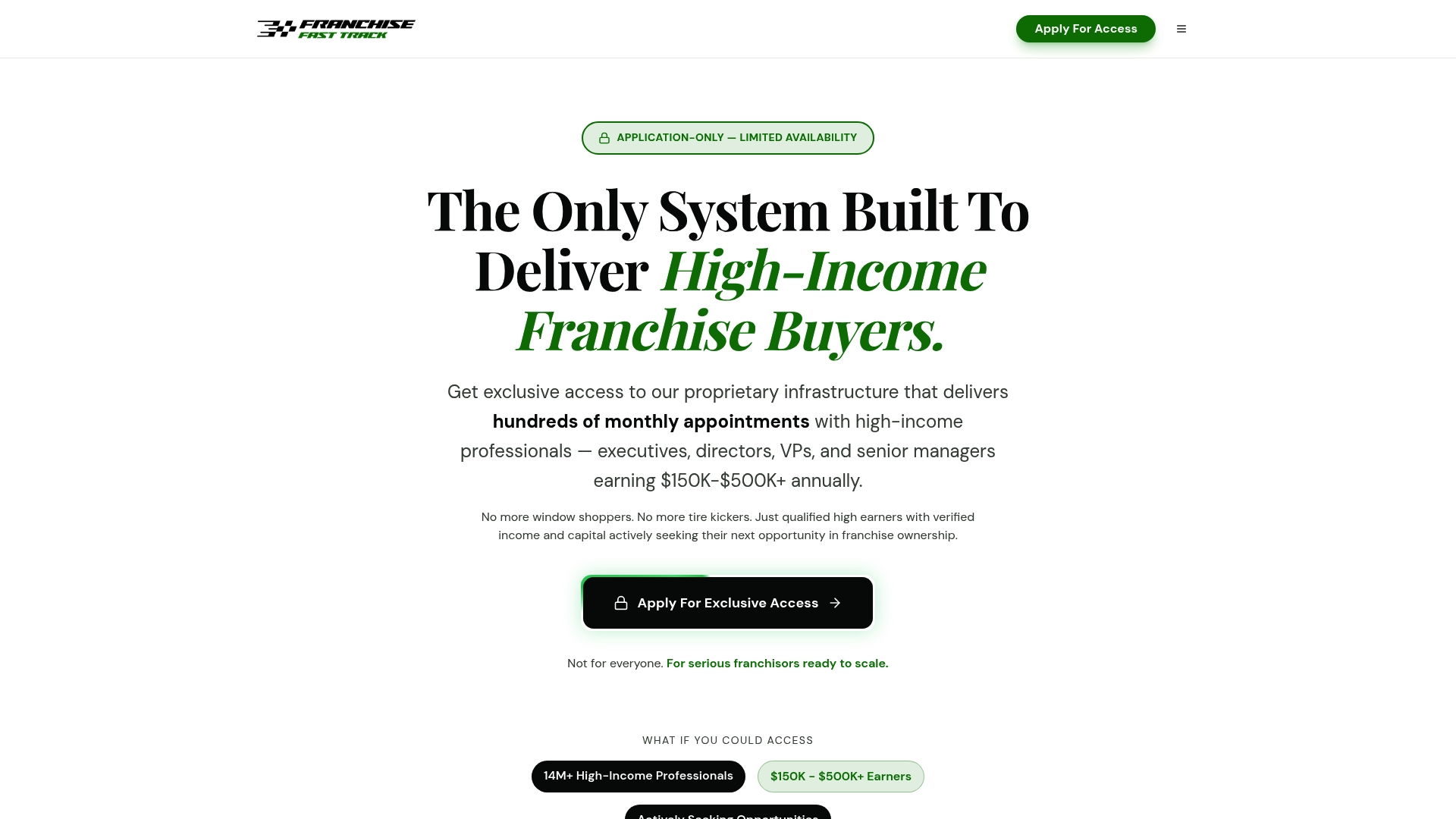
Franchise Fast Track delivers verified, high-income franchise buyers to franchisors through a proprietary outreach system. The platform connects franchise development teams with executives, directors, and senior managers earning $150,000 to $500,000 annually. These are buyers who understand multi-unit commitments, area development agreements, and the capital requirements that serious franchise ownership demands. Franchise Fast Track reports a lead-to-close rate of 34%, which reflects the quality of the buyer pool, not just the volume. If your franchise system is ready to grow, that is the kind of pipeline that moves the needle.
FAQ
What are the main types of franchise ownership models?
The four primary franchise ownership models are single-unit, multi-unit, area development, and master franchising. Each differs by unit count, contractual obligations, and the level of owner involvement required.
What is the difference between semi-absentee and fully passive franchise ownership?
Semi-absentee owners work 15 to 20 hours per week overseeing managers, while fully passive owners spend just 2 to 5 hours per week at a board-level role. Fully passive ownership requires unit revenue above $1.5 million annually to cover the management salaries needed to sustain that low involvement.
What entity structure works best for multi-unit franchise owners?
A holding company, often structured as an S-Corp, owning separate LLCs for each franchise unit is the most effective structure. This approach isolates liability per unit, simplifies resale, and provides clean operating histories for each location.
Who is master franchise ownership best suited for?
Master franchise ownership suits experienced operators with significant capital and strong business development skills. It is not an entry-level model. It requires recruiting, training, and supporting sub-franchisees within a defined territory while sharing royalties with the parent franchisor.
How do I know which franchise ownership model fits my goals?
Start with your honest assessment of weekly time availability, liquid capital, and management experience. Single-unit fits first-time owners with full-time capacity. Multi-unit fits proven operators ready to delegate. Master franchising fits experienced investors with regional market knowledge and capital to match.
Recommended
- Franchise vs Licensing: A Guide for Established Brands | Franchise Fast Track Blog
- Franchising Pros and Cons: A 2026 Guide for Franchisors | Franchise Fast Track Blog
- Financing for a Franchise: Franchisor's 2026 Guide | Franchise Fast Track Blog
- Blog - Franchise Fast Track | Franchise Development Insights
Ready to see results like these for your franchise?
Stop wasting money on leads that never close. Start getting hundreds of replies from high-net-worth professionals daily.