Franchise Ownership vs Management: A 2026 Guide
Franchise ownership is defined as legally owning and operating a business under a franchise agreement, while franchise management refers to running or supervising franchise operations without holding ownership rights. These two roles sit at opposite ends of the franchise participation spectrum, and confusing them is one of the most common mistakes prospective entrepreneurs make. The difference between ownership and management shapes your financial exposure, daily schedule, and long-term wealth potential. Understanding what is franchise ownership vs management before you commit to either path is the single most important step you can take.
What is franchise ownership vs management?
Franchise ownership and franchise management are not interchangeable terms. They describe fundamentally different relationships with a franchise business, and the British Franchise Association draws a clear line between them.
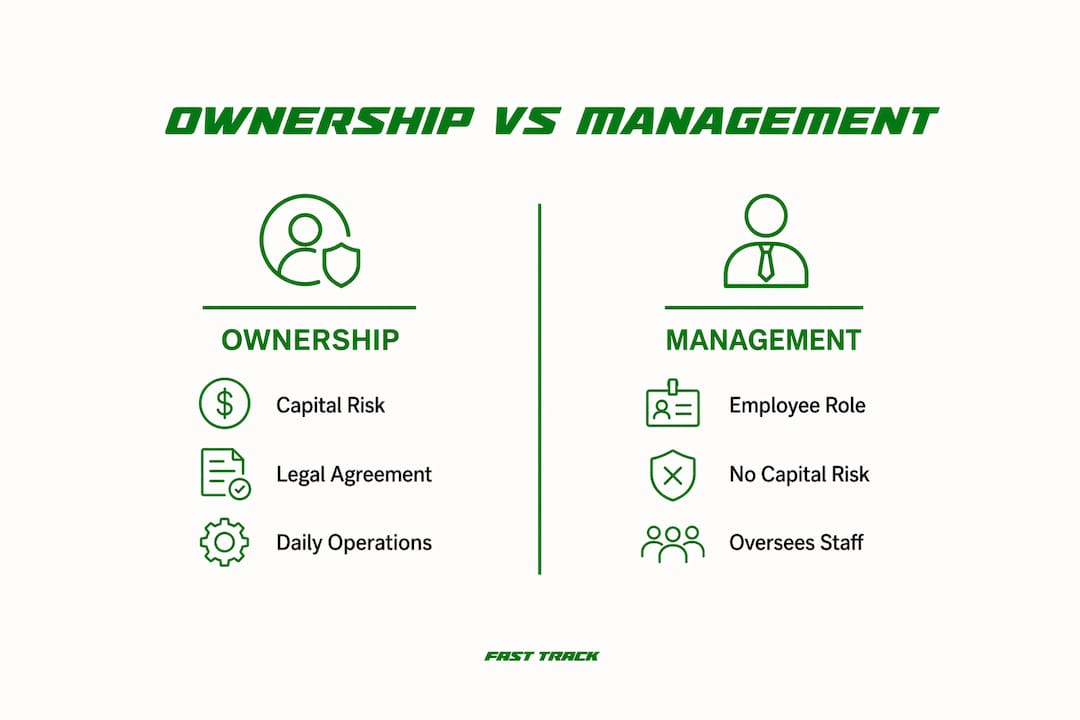
A franchise owner holds a legal agreement with the franchisor. That agreement grants the right to operate under the brand, use its systems, and sell its products or services. In exchange, the owner pays an upfront franchise fee plus ongoing royalties. Franchise agreements last 5 to 30 years, which means ownership is a long-term capital commitment, not a short-term role. That time horizon matters because it locks in your financial exposure for years.

A franchise manager, by contrast, does not own the business. A franchise manager is a corporate employee or contractor who supports franchisees with brand compliance, training, and performance analysis across multiple locations. Franchise managers handle compliance and performance on behalf of the franchisor, not on their own behalf. They carry no capital risk and hold no equity in the business they oversee.
The core distinction is ownership of risk. Owners put capital in and bear the consequences of profit or loss. Managers execute and advise, but the financial outcome belongs to someone else.
How do roles and responsibilities differ between owners and managers?
The day-to-day reality of each role looks very different, and that gap widens as the business grows.
Owner-operator franchises are hands-on in daily operations and customer service. The owner greets customers, manages staff schedules, handles vendor relationships, and resolves complaints. This model suits people who want direct control and are comfortable with a lower entry cost. The tradeoff is that the business depends heavily on the owner's personal presence.
Management franchise owners focus on strategic growth, staff oversight, and business development. They work on the business, not in it. Their week looks more like a general manager's calendar: reviewing KPIs, coaching team leaders, and planning expansion. This model suits former executives or senior managers who want to apply leadership skills rather than serve customers directly.
Corporate franchise managers occupy a third lane entirely. They are employees of the franchisor, not franchisees. Their job is to support the network, not to build personal wealth through ownership.
Key differences at a glance:
- Decision-making authority: Owners make final calls on hiring, pricing within brand guidelines, and local marketing. Managers advise but rarely decide.
- Financial risk: Owners absorb losses and collect profits. Managers earn a salary regardless of location performance.
- Time commitment: Owner-operators often work full-time in the business. Management franchise owners may work part-time once the team is in place.
- Exit value: Owners can sell their franchise. Managers cannot sell a position they do not own.
Pro Tip: If you are a former director or senior manager evaluating franchise options, ask the franchisor whether their model is structured for owner-operators or management franchisees. The answer changes everything about your investment thesis.
What are the main franchise ownership models?
Two primary franchise models define the ownership spectrum: owner-operator and management franchise. A third variation, semi-absentee ownership, sits between them. Understanding each model is central to franchise ownership explained properly.
Owner-operator model
The owner-operator works inside the business daily. This model often requires few or no staff initially, which keeps startup costs lower. The owner delivers the service, builds customer relationships, and handles most operational tasks personally. Scalability is limited without delegation. You can read a deeper breakdown of ownership model types to see how each one compounds over time.
Semi-absentee model
Semi-absentee franchise owners spend 15–20 hours weekly overseeing operations while hiring managers for daily tasks. This model requires a general manager on payroll, which adds $45,000–$65,000 in annual fixed costs. The owner steps back from daily service delivery but stays involved in hiring, finances, and performance reviews. This is the most common growth path for owner-operators who want to scale without buying a second location immediately.
Management franchise model
Fully passive ownership requires the owner to spend just 2–5 hours weekly, supported by multiple managers. Fully passive ownership requires management salaries totaling $95,000–$130,000 annually. That cost structure means the business must generate enough revenue to cover those salaries and still return a profit to the owner.
Semi-absentee and passive ownership models require franchises generating $600,000–$1.5M in annual revenue to remain profitable after paying management salaries. That revenue threshold is the filter that separates viable passive ownership from a money-losing experiment.
Pro Tip: Before choosing a semi-absentee or management model, ask the franchisor for average unit volume data across their network. If the median location earns below $600,000 annually, passive ownership will likely destroy your margins.
| Ownership model | Owner time per week | Key cost driver | Revenue needed for profitability |
|---|---|---|---|
| Owner-operator | 40–60 hours | Owner's own labor | Lower threshold |
| Semi-absentee | 15–20 hours | General manager salary ($45K–$65K) | $600,000+ annually |
| Fully passive | 2–5 hours | Full management team ($95K–$130K) | $1M–$1.5M annually |
What are the legal and financial differences between ownership and management?
The legal distinction between a franchise agreement and a management contract is not a technicality. It determines who owns the business, who bears the risk, and who collects the upside.
Franchisees are independent business owners under franchise agreements, unlike management contract holders who do not own the business. A franchise agreement grants territorial rights, brand usage, and operational systems. It also obligates the franchisee to pay royalties, meet performance standards, and operate within the franchisor's guidelines. The franchisee owns the business entity and can sell it, pass it to heirs, or use it as collateral.
A management contract, by contrast, gives the manager authority to operate a property or business on behalf of the owner. The manager earns a fee. The owner retains equity. This structure is common in hospitality, where hotel management companies run properties they do not own. Applying that logic to franchising means the management contract holder has operational authority but no ownership stake.
Misclassification between franchise and management agreements can create legal risks and operational misunderstandings. A person who believes they are a franchisee but has signed a management contract may discover they have no right to sell the business or renew the agreement. That distinction costs people real money. Always have a franchise attorney review any agreement before signing.
The financial obligations also differ sharply. Franchise owners pay initial fees that can range from tens of thousands to hundreds of thousands of dollars, plus ongoing royalties typically calculated as a percentage of gross revenue. Management contract holders earn a fee and carry none of that upfront cost. The tradeoff is that they also build no equity.
How do you decide between franchise ownership and management?
Choosing between ownership and management depends on your risk appetite, time availability, and career goals. There is no universally correct answer. The right model is the one that fits your actual situation, not the one that sounds most appealing in a brochure.
Work through these four questions before deciding:
- How much capital can you commit? Owner-operator models carry lower entry costs. Management franchise models require higher investment to support larger teams and infrastructure. Passive ownership requires enough capital to absorb management salaries while the business scales to profitability.
- How much time do you want to spend? If you want to stay in your current career while building a franchise asset, a semi-absentee or management model fits better. If you are ready to leave corporate life and run a business daily, owner-operator is the cleaner path.
- What is your exit strategy? Franchise ownership builds a saleable asset. If your goal is to sell the business in 7–10 years, ownership is the only model that creates that option. You can explore how to become a franchise owner for a practical step-by-step breakdown.
- What are your skills? Former executives and directors often thrive in management franchise models because the role mirrors what they already do. Hands-on operators who enjoy customer interaction often prefer the owner-operator model. Understanding the franchisee vs franchisor distinction also clarifies where your skills fit best.
Pro Tip: Evaluate your risk tolerance honestly before you evaluate any franchise opportunity. The risks of franchise investment vary significantly by model, and entering the wrong structure for your risk profile is the leading cause of franchisee regret.
Key Takeaways
Franchise ownership and management are legally and financially distinct roles, and selecting the wrong model for your goals and resources is the most preventable mistake in franchise entrepreneurship.
| Point | Details |
|---|---|
| Ownership means capital risk | Franchise owners hold legal agreements, pay royalties, and bear full financial risk and reward. |
| Management means no equity | Franchise managers and management contract holders operate businesses they do not own and cannot sell. |
| Revenue thresholds matter | Passive ownership requires $600,000–$1.5M in annual revenue to cover management salaries and remain profitable. |
| Model choice drives lifestyle | Owner-operators work 40–60 hours weekly; fully passive owners spend just 2–5 hours with the right team in place. |
| Legal review is non-negotiable | Misclassification between franchise and management agreements creates real legal and financial risk. |
What I have learned from watching people choose the wrong model
People consistently underestimate how much the ownership versus management decision shapes their daily life, not just their balance sheet. I have watched former executives buy owner-operator franchises because the entry cost was lower, only to find themselves working 55-hour weeks doing tasks they left corporate life to escape. The model fit the budget but not the person.
The management franchise model is genuinely underrated for high-income professionals. It mirrors the work they already know: hiring, coaching, reviewing performance, and building systems. The higher investment is real, but so is the alignment between the role and the person's actual strengths. The British Franchise Association's framing of "working on the business, not in it" is not just a slogan. It describes a fundamentally different relationship with your time.
The misconception I see most often is that passive ownership means no work. It means different work. You are managing managers, reviewing financials, and making capital allocation decisions. If you are not comfortable with that, the model will frustrate you as much as the wrong job would.
My honest advice: match the model to your skills first, your capital second, and your lifestyle goals third. Most people do it in reverse order and regret it.
— Cody
How Franchise Fast Track helps you find the right fit
Deciding between franchise ownership and management is easier when you have access to clear definitions and vetted opportunities in one place.

Franchise Fast Track connects high-income professionals earning $150,000–$500,000 annually with franchise opportunities that match their investment capacity and career goals. The platform's franchise glossary covers every term you need to understand before signing any agreement, from royalty structures to management contract definitions. For franchisors, Franchise Fast Track's franchise lead generation system delivers pre-screened buyers who already understand the difference between ownership and management, which means shorter sales cycles and a reported 34% lead-to-close rate. Whether you are evaluating your first franchise or scaling an existing portfolio, the platform gives you the tools to make an informed decision.
FAQ
What is the main difference between franchise ownership and management?
Franchise ownership means holding a legal agreement with a franchisor, bearing capital risk, and building a saleable asset. Franchise management means operating or supervising a franchise business without owning it or holding equity.
Can a franchise manager become a franchise owner?
Yes. Many franchise managers transition to ownership by purchasing a franchise unit directly. The skills overlap, but the financial commitment and legal obligations are entirely different.
How much does a management franchise typically cost?
Management franchises generally require a higher initial investment than owner-operator models because they need infrastructure and staff from the start. The exact figure varies by brand and sector and is not publicly standardized.
What revenue does a franchise need to support passive ownership?
Franchises using a semi-absentee or fully passive model need to generate $600,000–$1.5M in annual revenue to cover management salaries and remain profitable for the owner.
Is a franchise management contract the same as a franchise agreement?
No. A franchise agreement grants ownership rights, territorial access, and brand usage. A management contract grants operational authority without ownership, meaning the contract holder builds no equity and cannot sell the business.
Recommended
- Types of Franchise Ownership Models: A 2026 Guide | Franchise Fast Track Blog
- Franchising Pros and Cons: A 2026 Guide for Franchisors | Franchise Fast Track Blog
- Franchise vs Licensing: A Guide for Established Brands | Franchise Fast Track Blog
- Franchise Ownership for Executives: A Strategic Guide | Franchise Fast Track Blog
Ready to see results like these for your franchise?
Stop wasting money on leads that never close. Start getting hundreds of replies from high-net-worth professionals daily.