Franchisee vs Franchisor: What Each Role Really Means
A franchisor is the company or individual that owns a brand, trademark, and business system and licenses that system to others. A franchisee is the independent operator who pays for the right to run a business under that brand. Understanding what does franchisee vs franchisor mean is the first step any aspiring entrepreneur must take before signing a franchise agreement. The two roles carry completely different responsibilities, financial exposures, and legal obligations. Get them confused, and you risk entering a business relationship you did not fully understand.
What does franchisee vs franchisor mean in plain terms?
A franchise is a contract where a franchisor licenses a franchisee to operate a business under the franchisor's brand and system. This legal framework separates franchising from simple trademark licensing, which grants no control over how the business actually runs. In franchising, the franchisor's operating system travels with the brand. That distinction matters enormously for both parties.
The franchisor definition centers on ownership and control of the system. Think of McDonald's Corporation as the franchisor: it owns the Golden Arches, the menu engineering, the supply chain relationships, and the training playbooks. The franchisee is the local operator who opens and runs a specific McDonald's location using all of those assets. The franchisee owns the business at that location but does not own the system itself.

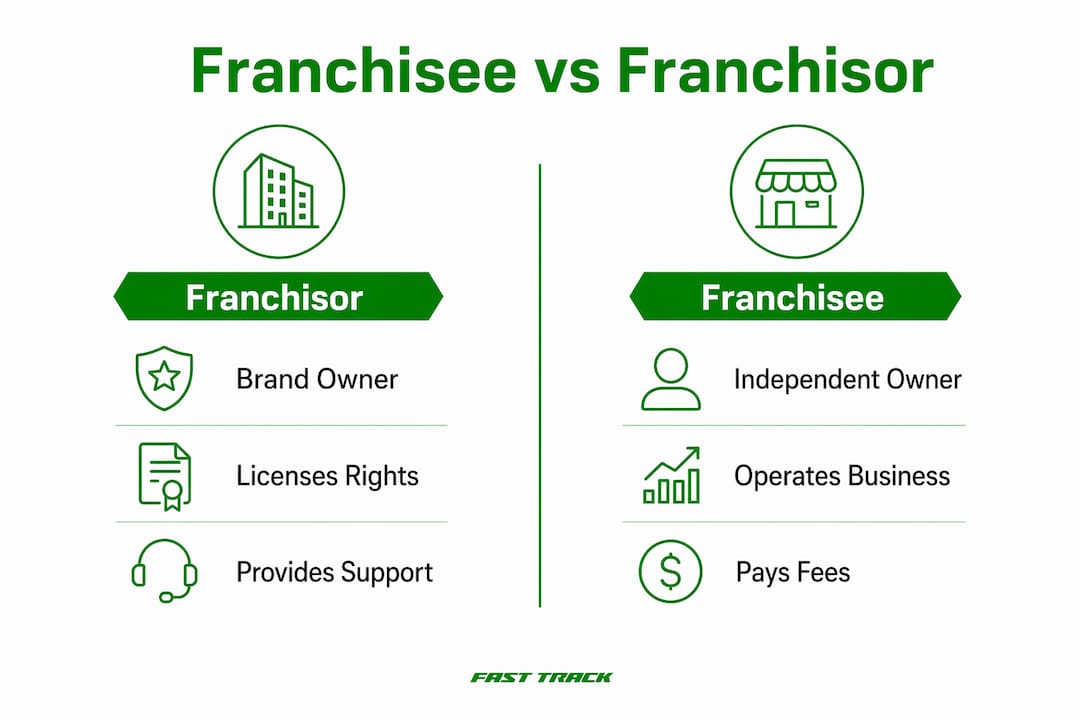
Franchisors own the brand including trademarks and the franchise system, and they license that system to franchisees. That licensing relationship is the core of every franchise arrangement in the United States.
What does a franchisor actually do?
The franchisor's role goes well beyond handing over a logo and a training manual. Franchisors are responsible for the entire operating model, brand standards, and legal compliance framework that franchisees plug into.
Key franchisor responsibilities include:
- Trademark and brand ownership. The franchisor controls all intellectual property and sets the standards every location must meet.
- Franchise Disclosure Document (FDD) preparation. Under the FTC Franchise Rule (16 CFR Part 436), franchisors must provide the FDD to prospective franchisees so buyers can compare offerings and make informed decisions.
- Training and onboarding. Franchisors deliver initial training programs covering operations, customer service, and brand standards.
- Ongoing support. Field consultants, marketing funds, and technology platforms are typically franchisor-managed resources.
- Brand marketing. National or regional advertising campaigns are funded and executed by the franchisor, often through a marketing fund that franchisees contribute to.
Franchisors provide brand assets, operating procedures, training, and ongoing support. That support structure is what justifies the fees franchisees pay.
Pro Tip: Before you evaluate any franchise opportunity, request the FDD and read Item 19 first. Item 19 contains financial performance representations and tells you what existing franchisees actually earn, not what the sales pitch promises.
The franchisor also carries the risk of brand reputation. One franchisee's food safety failure can damage every location in the network. That reality explains why franchisors enforce brand standards so aggressively.
What does a franchisee actually do?
A franchisee is an individual or entity granted a franchise who operates a business using the franchisor's brand and operating system. The franchisee pays fees and runs an independent business governed by the franchise agreement and disclosure requirements. Independent is the operative word: the franchisee owns the business at their location and is responsible for its success or failure.
Franchisee responsibilities in practice include:
- Capital investment. The franchisee funds the buildout, equipment, inventory, and working capital for their location.
- Franchise fees and royalties. An upfront franchise fee plus ongoing royalties (typically a percentage of gross sales) flow from franchisee to franchisor.
- Staffing and HR. Hiring, training, scheduling, and managing employees is entirely the franchisee's responsibility.
- Local marketing execution. While the franchisor runs national campaigns, the franchisee handles local outreach, community events, and location-specific promotions.
- Day-to-day operations. Opening and closing procedures, customer service, vendor relationships, and compliance with local regulations all fall on the franchisee.
Franchisees are independent business owners responsible for profit or loss. Franchisors do not assume the debts or operating losses of franchise locations. That legal separation is what makes franchising different from corporate employment.
Pro Tip: Review the franchise agreement with a franchise attorney before you sign anything. The agreement defines your territory, renewal rights, and exit options. These terms are negotiable far more often than franchisors suggest.
Many first-time franchisees underestimate the operational workload. Owning a franchise is not passive income. It is running a business with a defined playbook.
How do the roles compare side by side?
The difference between franchisee and franchisor becomes clearest when you put their responsibilities in direct contrast.
| Category | Franchisor | Franchisee |
|---|---|---|
| Brand ownership | Owns all trademarks and intellectual property | Licensed to use the brand, does not own it |
| System control | Sets all operating standards and procedures | Must follow the system; limited customization |
| Financial risk | Manages brand-level risk and system investment | Bears full local business risk including debt and losses |
| Revenue source | Royalties, franchise fees, and marketing fund contributions | Revenue from local sales minus all operating costs |
| Legal obligations | Must provide FDD; comply with FTC Franchise Rule | Must sign franchise agreement; pay fees on schedule |
| Support role | Provides training, field support, and marketing resources | Executes the system locally and manages the team |
| Liability | Not liable for franchisee debts or employee issues | Fully liable for local operations, staff, and customers |
The franchise agreement is the legal foundation of this relationship. It defines every term in the table above. Aspiring franchisees should treat the agreement as the most important document they will ever sign in business. For a deeper look at how franchise agreements shape roles, the legal and development context matters as much as the operational one.
One underappreciated dynamic: the franchisor controls the brand but cannot control every local interaction. The franchisee controls the customer experience but cannot control the brand's national reputation. Both parties depend on each other for long-term success.
How does U.S. franchise law affect both roles?
U.S. franchise law creates a structured framework that protects both parties, but it places most disclosure obligations on the franchisor.
-
The FTC Franchise Rule (16 CFR Part 436). This federal regulation requires franchisors to provide a complete FDD to every prospective franchisee before any agreement is signed or money changes hands. The FDD contains 23 standardized items covering the franchisor's history, litigation record, fees, financial performance, and franchisee obligations.
-
The 14-day waiting period. The FTC Franchise Rule mandates a 14-calendar-day waiting period between the first delivery of the FDD and the signing of any franchise agreement or payment. This window gives prospective franchisees time to review the document with legal and financial advisors. Errors in tracking this window can make agreements legally voidable.
-
Territory rights disclosure. Item 12 of the FDD discloses territory rights including exclusivity, restrictions, and franchisor reserved rights. Territory exclusivity directly affects franchise economics. A franchisee with an exclusive territory faces no internal competition. One without exclusivity may find the franchisor opening a nearby location or selling through competing channels.
-
State-level registration. Fourteen states require franchisors to register their FDD with state regulators before offering franchises. California, New York, and Illinois are among the most active registration states. Franchisees in these states receive an additional layer of protection.
-
Ongoing compliance. Franchisors must update the FDD annually and disclose material changes. Franchisees must comply with the franchise agreement's operational standards or risk termination.
The FDD is not just a legal formality. The FTC designed the disclosure system so buyers can compare franchise offerings side by side. A prospective franchisee who reads the FDD carefully gains a clear picture of what the franchisor has delivered to existing franchisees and what obligations they are taking on.
Key Takeaways
The franchisor owns and licenses the system; the franchisee operates independently within it, bearing full local business risk while following the franchisor's brand standards.
| Point | Details |
|---|---|
| Franchisor owns the system | The franchisor holds all trademarks and sets operating standards every franchisee must follow. |
| Franchisee bears local risk | Franchisees are responsible for profit, loss, staffing, and all local operating costs. |
| FDD is the key document | The FDD gives prospective franchisees 23 items of material disclosure before any commitment. |
| 14-day rule protects buyers | Federal law requires a 14-calendar-day review window after FDD delivery before signing. |
| Territory terms shape economics | Item 12 of the FDD defines exclusivity rights that directly affect a franchisee's revenue potential. |
The part most people get wrong about these two roles
Most articles on this topic treat the franchisor as the powerful party and the franchisee as the dependent one. I think that framing is backwards in practice.
The franchisor needs franchisees far more than the marketing materials suggest. A franchise system with poor franchisee performance collapses. Royalties dry up. The brand suffers. The franchisor's entire business model depends on franchisees succeeding locally. That interdependence is the real story of the franchisor vs franchisee relationship.
What I have seen repeatedly is that new franchisees enter agreements focused on the brand's strength and underestimate their own operational responsibility. They assume the system will carry them. It will not. The system gives you a playbook. Execution is entirely yours.
The FDD is where I tell every prospective franchisee to spend most of their due diligence time. Item 20 lists current and former franchisees with contact information. Call them. Ask what the franchisor actually delivers versus what it promises. That conversation is worth more than any sales presentation.
Franchisors who are serious about growth understand that qualified, well-capitalized franchisees are their most valuable asset. The best franchise systems I have observed are ones where the franchisor treats franchisee recruitment as a long-term investment, not a transaction.
— Cody
How Franchise Fast Track connects serious buyers with the right opportunities
Franchisors and prospective franchisees both face the same core problem: finding the right match. Most lead generation methods produce volume without quality.

Franchise Fast Track solves this by delivering appointments with verified high-income professionals earning between $150,000 and $500,000 annually, including executives, directors, and senior managers actively seeking franchise ownership. The platform's franchise lead generation system reports a lead-to-close rate of 34%, which reflects the quality of the buyer pool rather than sheer volume. Franchisors bypass unqualified inquiries and put their sales resources toward candidates who are funded and ready to move. For franchisors looking to grow their network with serious buyers, Franchise Fast Track is built specifically for that outcome.
FAQ
What is the simple difference between a franchisee and a franchisor?
A franchisor owns the brand and business system and licenses it to others. A franchisee pays for the right to operate a business under that brand and system.
What fees does a franchisee pay to a franchisor?
Franchisees typically pay an upfront franchise fee plus ongoing royalties calculated as a percentage of gross sales. Some systems also require contributions to a shared marketing fund.
What is the FDD and why does it matter?
The Franchise Disclosure Document is a federally required document containing 23 items of material information about the franchisor and franchise system. The FTC Franchise Rule requires franchisors to provide it before any agreement is signed.
Can a franchisor be held liable for a franchisee's debts?
No. Franchisees are independent business owners fully responsible for their own debts and operating losses. Franchisors do not assume liability for individual franchise location finances.
How long do I have to review the FDD before signing?
Federal law requires a minimum 14-calendar-day waiting period after the FDD is delivered before a franchisee can sign any agreement or make any payment.
Recommended
Ready to see results like these for your franchise?
Stop wasting money on leads that never close. Start getting hundreds of replies from high-net-worth professionals daily.