What Does Franchise Lead Attribution Mean for Franchisors?
Franchise lead attribution is defined as the practice of tracking and measuring every marketing touchpoint that influences a franchise candidate's progression from initial inquiry to signed agreement. Unlike single-channel lead tracking, attribution in franchising must account for a long, complex sales cycle where candidates traverse 8 to 12 pipeline stages before committing. That complexity makes attribution the most misunderstood and underused tool in franchise development. Franchisors who get it right spend less, close more, and stop guessing which channels actually produce franchisees. Franchise Fast Track reports a 34% lead-to-close rate by focusing exclusively on verified, high-income buyers, which is a direct result of treating attribution as a core operating discipline.
What does franchise lead attribution mean, and why does it matter?
Franchise lead attribution means assigning measurable credit to each marketing channel and interaction that moved a candidate closer to signing. The industry term for this practice is "marketing attribution," and in franchising it carries extra weight because the sales cycle is far longer than in most B2C or even B2B contexts.
A candidate who eventually signs a franchise agreement may have first seen a LinkedIn ad, then read a blog post, attended a webinar, spoken with a franchise consultant, and completed a discovery day. Each of those touchpoints played a role. Attribution tells you which ones mattered most, and by how much.

The importance of lead attribution for franchisors goes beyond curiosity. Without it, budget decisions default to gut instinct. Franchisors end up pouring money into high-volume channels that generate inquiries but never produce signed deals. Franchise lead tracking across all pipeline stages is the only way to connect marketing spend to actual revenue.
Franchise marketing analytics built on solid attribution data also give development teams a shared language. Sales and marketing stop arguing over which leads are "good" and start measuring candidate quality by the same standard: closed deals.
Why multi-touch attribution models are essential for franchise sales
Most franchisors start with first-touch or last-touch attribution because they are simple to implement. First-touch gives all credit to the channel that generated the initial inquiry. Last-touch gives all credit to the final interaction before signing. Both models fail to capture the multiple marketing influences spread across a months-long sales cycle.
Multi-touch attribution models distribute credit across all recorded touchpoints. The three most relevant models for franchise development are:
- Linear attribution: Divides credit equally across every touchpoint. Good for understanding overall channel participation.
- Time-decay attribution: Assigns more credit to touchpoints closer to the signing date. Useful when late-stage interactions like discovery days carry the most weight.
- Position-based attribution: Splits the majority of credit between the first and last touchpoints, with the remainder distributed across the middle. Works well when brand awareness and final conversion are both priorities.
Industry preference has shifted toward multi-touch models in 2026 for better budget decisions and cross-location analysis. That shift reflects a real operational need: franchisors running campaigns across dozens of markets cannot evaluate performance accurately with a single-touch lens.
Multi-touch models also reveal something first-touch and last-touch hide entirely: the role of brand-level campaigns versus localized efforts. A national podcast sponsorship may rarely appear as a first or last touch, but it shows up consistently in the middle of every high-converting candidate's journey. Linear and time-decay models surface that pattern. Single-touch models erase it.
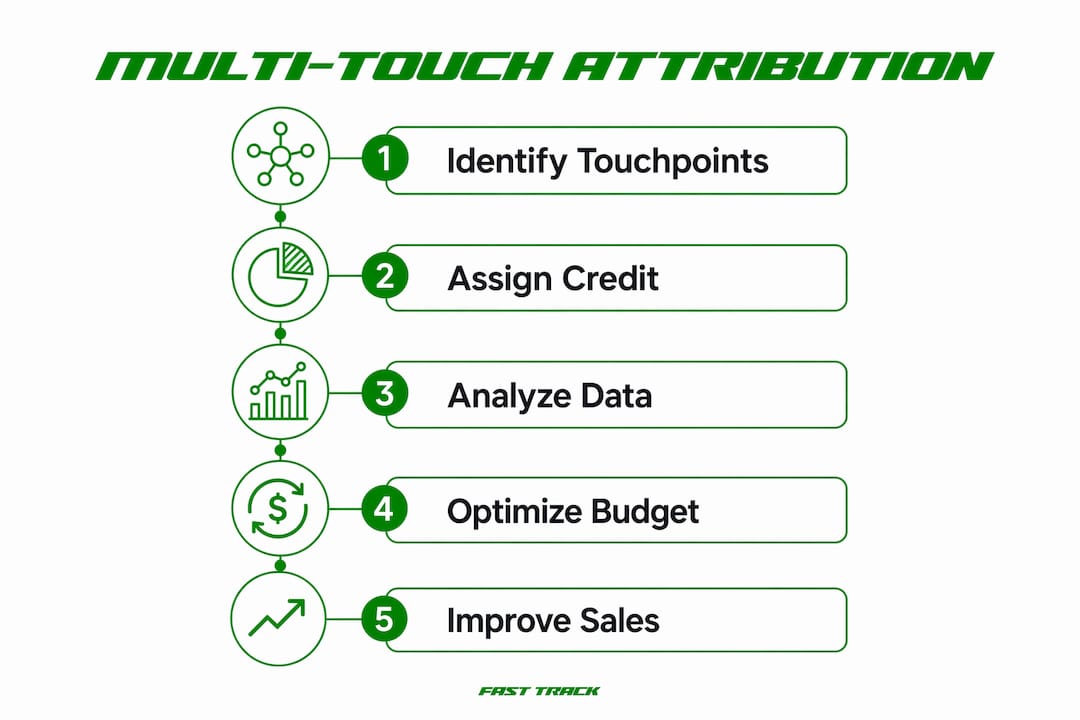
Pro Tip: Run a time-decay model alongside your current attribution model for one quarter. Compare which channels gain or lose credit. The differences will tell you where your budget is misallocated.
How does closed-loop attribution work in franchise development?
Closed-loop attribution connects CRM revenue and pipeline data back to the marketing campaigns that generated each lead. The loop closes when a signed franchise agreement is linked to the original marketing source and every touchpoint in between.
Without closing the loop, franchisors optimize for lead volume. With it, they optimize for lead quality. Integrating CRM revenue data back to marketing campaigns is the only reliable way to distinguish a high-volume, low-quality channel from a low-volume, high-quality one that actually drives expansion.
The practical steps for implementing closed-loop attribution in franchise sales are:
- Tag every lead at the source. UTM parameters, phone tracking numbers, and form source fields must be captured at the moment of first contact.
- Push source data into your CRM immediately. Every candidate record needs a complete touchpoint history attached from day one.
- Map pipeline stages to revenue milestones. Define which CRM stages represent meaningful progress: application submitted, discovery day completed, FDD issued, agreement signed.
- Connect signed deals back to their originating campaigns. Your CRM should allow you to filter closed deals by marketing source and calculate cost per acquisition by channel.
- Review the full funnel monthly. Closed-loop attribution is not a one-time setup. It requires regular review to stay accurate as campaigns change.
Franchise sales CRM software is what makes this process manageable at scale. Franchise development consultants often manage 30 to 100 active candidates simultaneously. Manual tracking at that volume produces errors and blind spots. Automation keeps the data clean.
Pro Tip: Build a CRM report that shows cost per signed deal by marketing channel, updated monthly. That single report will drive better budget decisions than any other dashboard you create.
Common pitfalls in franchise lead attribution and how to avoid them
The most common mistake franchisors make is tracking too many metrics at once. Tracking more than 20 KPIs dilutes focus and turns performance reviews into bureaucratic exercises. The fix is to anchor every attribution report to revenue-based metrics: cost per qualified candidate, cost per discovery day, and cost per signed agreement.
A second major pitfall is misattributing brand-level campaign results to local market performance. A national brand awareness campaign that lifts inquiry volume across all markets does not mean every local market is performing equally. Attribution models must separate brand-level lift from location-specific conversion rates.
A third pitfall is using generic automation sequences regardless of where a candidate sits in the pipeline. Automation must be pipeline-stage specific to engage candidates effectively. A candidate who just submitted an application needs different messaging than one who completed a discovery day three weeks ago and has gone quiet.
Treating every candidate the same regardless of pipeline stage is the fastest way to lose qualified buyers. Stage-specific follow-up, triggered automatically by CRM status changes, is what separates franchisors who close from those who chase.
Speed also matters more than most franchisors realize. Contacting leads within 60 seconds via automated outreach correlates strongly with higher discovery process conversion rates compared to manual follow-up. That window closes fast. Attribution data that identifies your fastest-converting channels should also inform how quickly your team responds to leads from those channels.
How to apply attribution data to improve marketing ROI
Attribution data is only useful when it drives decisions. The most direct application is real-time budget reallocation. When your closed-loop reports show that one channel produces candidates at $800 per signed deal while another costs $4,200 for the same outcome, the budget shift is obvious. The problem is that most franchisors review this data quarterly. By then, thousands of dollars have been spent on underperforming channels.
Tracking lead progression velocity is a second high-value application. Velocity measures how quickly candidates move from one pipeline stage to the next. A candidate who moves from inquiry to application in three days is behaving differently than one who takes three weeks. Attribution data layered with velocity data reveals which channels produce fast-moving candidates and which produce slow ones.
The table below shows how different attribution insights translate into specific decisions:
| Attribution insight | Decision it drives |
|---|---|
| Channel A produces 3x more signed deals per dollar | Shift budget from Channel B to Channel A |
| Candidates from webinars stall at discovery day | Add targeted follow-up sequence post-webinar |
| Drop-off spikes between application and FDD issuance | Investigate process delays or candidate quality issues |
| Brand campaigns lift inquiry volume but not close rate | Separate brand and performance budgets |
Pro Tip: Build a franchise performance dashboard that shows cost per stage, not just cost per lead. Cost per lead is a vanity metric. Cost per signed deal is the number that matters.
Franchise marketing analytics reach their full potential when the development team reviews attribution data weekly, not monthly. Weekly reviews catch budget waste early and allow stage-specific automation to be adjusted before a candidate goes cold.
Key Takeaways
Franchise lead attribution works when it connects every marketing touchpoint to signed deals through multi-touch models, CRM integration, and stage-specific automation.
| Point | Details |
|---|---|
| Multi-touch models are non-negotiable | First-touch and last-touch attribution erase the middle of the sales cycle where most franchise deals are won or lost. |
| Close the loop with CRM data | Linking signed agreements back to originating campaigns is the only way to measure true marketing ROI. |
| Stage-specific automation drives conversion | Generic drip campaigns lose candidates; CRM-triggered sequences matched to pipeline stage keep them engaged. |
| Revenue metrics beat volume metrics | Track cost per signed deal, not cost per lead, to make budget decisions that actually improve results. |
| Speed of follow-up is an attribution variable | Channels that produce fast-responding candidates deserve faster automated outreach to protect conversion rates. |
Attribution is an operating system, not a report
I have watched franchisors spend months building attribution dashboards and then check them once a quarter. That is the wrong mental model entirely. Treating attribution as a dynamic operating system rather than a static report is what separates brands that consistently outperform from those that perpetually debate which channel deserves credit.
The franchisors I have seen do this well share one habit: they make budget decisions based on last week's attribution data, not last quarter's. When a channel starts underperforming, they cut it within days. When a new channel shows early signals of high-quality candidates, they test it aggressively before the window closes.
The other misunderstanding I see constantly is conflating lead volume with lead quality. A channel that delivers 200 inquiries per month looks impressive in a report. A channel that delivers 20 inquiries and closes 7 of them is the one worth scaling. Attribution data makes that distinction visible. Without it, the 200-inquiry channel always wins the budget argument, even when it produces almost nothing.
My honest recommendation: build your attribution system before you scale your marketing spend. Scaling without attribution is like accelerating without a speedometer. You feel like you are moving fast, but you have no idea how fast, or in which direction.
— Cody
How Franchise Fast Track approaches lead attribution in practice
Franchise Fast Track was built around the principle that lead quality beats lead volume. The platform delivers verified, high-income franchise candidates earning between $150,000 and $500,000 annually, which means attribution starts with a pre-qualified pool rather than a broad, unfiltered inquiry base.
For franchisors who want to connect attribution data to a franchise development marketing system that measures results in signed agreements rather than clicks, Franchise Fast Track provides the infrastructure to do exactly that. The platform's focus on executives, directors, and senior managers actively seeking franchise ownership means your attribution reports reflect real buyer behavior, not noise. Franchisors looking to sharpen their lead generation strategy with pre-screened, high-income candidates can explore how Franchise Fast Track structures its pipeline for maximum conversion clarity.
FAQ
What does franchise lead attribution mean?
Franchise lead attribution means tracking and measuring every marketing touchpoint that contributes to a franchise candidate's progression from first inquiry to signed agreement. It assigns credit to each channel or interaction so franchisors can identify which marketing investments actually produce franchisees.
Why is multi-touch attribution better for franchise sales?
Franchise candidates typically move through 8 to 12 pipeline stages before signing, meaning multiple marketing interactions influence the final decision. Multi-touch models like time-decay and linear attribution capture that full picture, while first-touch and last-touch models miss most of it.
What is closed-loop attribution in franchising?
Closed-loop attribution connects signed franchise agreements back to the marketing campaigns and channels that originated each candidate. It requires CRM integration so that revenue data flows back to marketing records, enabling accurate cost-per-deal calculations by channel.
How many KPIs should franchisors track for lead attribution?
Franchisors should prioritize revenue-based metrics like cost per signed deal, cost per discovery day, and cost per qualified candidate. Tracking more than 20 KPIs dilutes focus and reduces the quality of budget decisions.
How does automation improve franchise lead attribution accuracy?
Pipeline-stage-specific automation sequences, triggered by CRM status changes, keep candidate data current and engagement consistent. Automated follow-up within 60 seconds of a new inquiry also correlates with higher discovery process conversion rates, making speed a measurable attribution variable.
Recommended
- Franchise Lead Qualification: What It Means and Why It Matters | Franchise Fast Track Blog
- Franchise Lead Generation: Qualified Franchisee Candidates for Serious Franchisors | Franchise Fast Track
- Franchise Lead Conversion Cost: What Franchisors Must Know | Franchise Fast Track Blog
- Franchise Lead Scoring System: A Franchisor's 2026 Guide | Franchise Fast Track Blog
Ready to see results like these for your franchise?
Stop wasting money on leads that never close. Start getting hundreds of replies from high-net-worth professionals daily.