Franchise Lead Conversion Cost: What Franchisors Must Know
Franchise lead conversion cost is defined as the total financial resources spent to turn a qualified prospect into a signed franchise agreement, covering marketing spend, staff time, and qualification efforts. Most franchisors track raw Cost Per Lead (CPL), but the more accurate metric is Cost Per Qualified Lead (CPQL), which captures the full picture including labor and process costs. Industry conversion rates in franchise sales run approximately 1–5%, which means a single franchise award can require hundreds of leads and thousands of dollars in development resources. Understanding what does franchise lead conversion cost mean gives you the financial clarity to budget smarter, qualify faster, and close more deals with less waste.
What does franchise lead conversion cost mean for your budget?
Franchise lead conversion cost is not a single line item. It is the sum of every dollar and hour spent from the moment a prospect shows interest to the moment they sign a franchise agreement. The industry term for the most accurate version of this metric is Cost Per Qualified Lead (CPQL), and it consistently outperforms raw CPL as a budgeting tool.

The gap between CPL and CPQL is where most franchisors lose money without realizing it. CPL counts every inquiry. CPQL counts only the leads that meet your financial, operational, and territory criteria. The right metrics for franchise sales are CPQL, cost per discovery call, and cost per signed agreement, not lead volume or raw CPL. Tracking only CPL is like measuring a restaurant's success by the number of people who walk past the window.
Here is what actually makes up your total franchise lead conversion cost:
- Marketing spend: Paid search, franchise portals, social media campaigns, and content production all generate leads at varying costs.
- Internal labor: Discovery calls, qualification interviews, and follow-up emails all consume staff time. Unqualified discovery calls consume roughly 2 hours of a development director's time per call. That cost rarely appears in a CPL calculation.
- CRM and software tools: Lead management platforms, email automation, and reporting dashboards carry monthly subscription costs that belong in your conversion math.
- Qualification effort: Financial screening, territory checks, and background reviews require dedicated personnel hours before a lead ever reaches a sales conversation.
Adding these components together gives you the true cost of franchise lead conversion, not just the advertising invoice.
How do lead quality and qualification impact conversion costs?
Lead quality is the single biggest driver of conversion cost. A raw lead is any inquiry. A qualified lead is a prospect who meets your financial minimums, fits your territory map, and has the operational capacity to run your model. The difference between the two is not just semantic. It is financial.
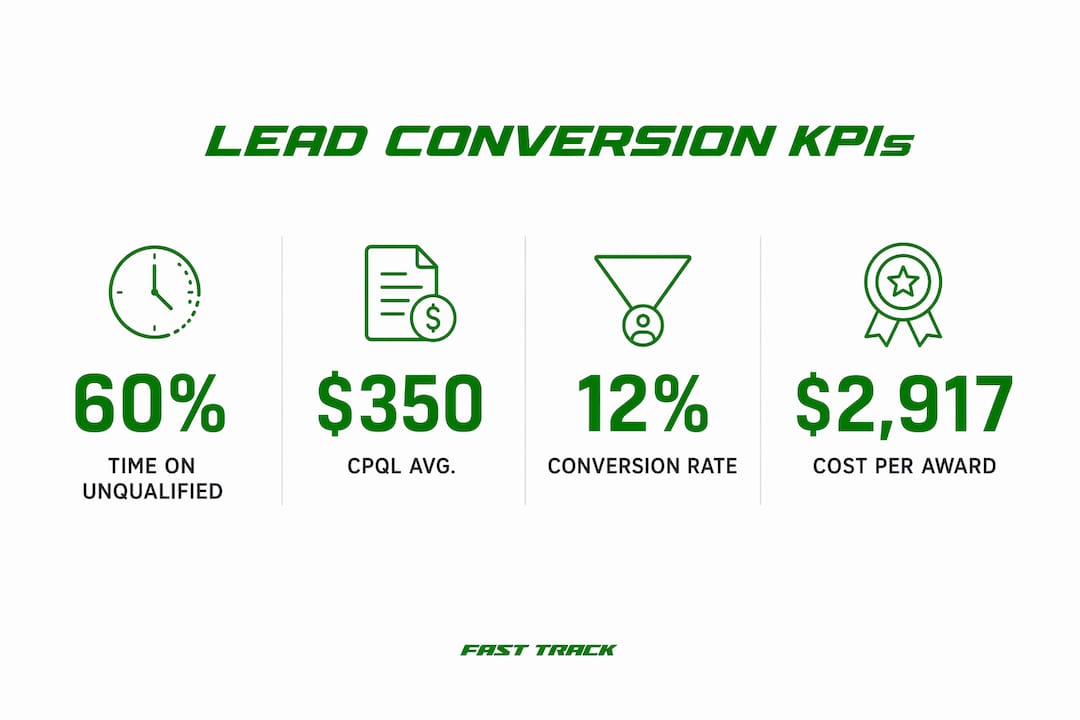
Franchise development teams spend over 60% of their time on leads that never qualify. That means the majority of your development team's working hours produce zero revenue. Every hour spent on an unqualified candidate is a direct cost with no return.
Speed compounds the problem. Contacting a franchise inquiry within 60 minutes produces a 95% conversion likelihood. Waiting one week drops that figure to 4%. Slow follow-up does not just lose deals. It inflates your cost per awarded franchise because you need more leads to hit the same number of closings.
Effective qualification filters include:
- Financial criteria: Minimum liquid capital, net worth thresholds, and access to financing.
- Operational fit: Prior management experience, time availability, and market knowledge.
- Territory alignment: Confirmed availability in the prospect's target geography.
- Intent signals: Specific timeline for opening, clarity on investment range, and prior research into your brand.
Pro Tip: Build your qualification checklist before the first discovery call, not during it. Franchisors who treat lead qualification as a prerequisite rather than a byproduct close deals faster and spend less per awarded franchise.
AI-driven lead scoring tools now automate much of this filtering. They assign scores based on behavioral signals, financial data, and engagement patterns, so your development team focuses time on the top tier of prospects rather than working through every inquiry manually.
What are typical franchise lead conversion costs and how do you benchmark them?
Benchmarks give your numbers context. Without them, a $400 CPL looks either excellent or alarming depending on your sector and conversion rate. CPQL in 2026 varies by sector: Fitness and Wellness runs $180–$350, Food and QSR runs $300–$550, and MedSpa runs $350–$650. These figures reflect qualified leads, not raw inquiries.
The conversion rate multiplier is where the real cost calculation lives. At a 12% conversion rate and a $350 CPQL, the cost per awarded franchisee lands near $2,900. At a 2% conversion rate with the same CPQL, that figure climbs past $17,000. The math makes clear why conversion rate matters more than lead price.
| Sector | CPQL Range | Typical Conversion Rate | Estimated Cost Per Award |
|---|---|---|---|
| Fitness and Wellness | $180–$350 | 8–12% | $1,500–$4,375 |
| Food and QSR | $300–$550 | 5–10% | $3,000–$11,000 |
| MedSpa | $350–$650 | 5–8% | $4,375–$13,000 |
| General Franchise | $150–$400 | 1–5% | $3,000–$40,000 |
A low CPL does not guarantee a low cost per award. A $100 CPL with a 1% conversion rate costs $10,000 per franchise sold. A $350 CPQL with a 12% conversion rate costs under $3,000. Quality beats volume every time in this math.
Pro Tip: Calculate your cost per discovery call and cost per signed agreement alongside CPQL. These three metrics together reveal exactly where your conversion funnel is leaking money.
How do you optimize franchise lead conversion cost through process and technology?
Reducing your cost per awarded franchise does not require spending less on marketing. It requires spending smarter and moving faster. The following steps address the most common cost inefficiencies in franchise development.
-
Respond within 60 minutes. Speed-to-lead is the highest-leverage action in franchise sales. A same-hour response multiplies conversion likelihood dramatically compared to next-day follow-up. Automate your initial response with a personalized email or SMS so no inquiry sits cold.
-
Align your marketing and sales teams on the ideal candidate profile. Marketing generates leads based on targeting criteria. If sales and marketing define "qualified" differently, leads pass through the funnel that never should have entered it. A shared candidate profile eliminates this disconnect.
-
Implement a lead scoring model. Brands that track source performance, lead quality scores, and conversion rates improve close rates and lower acquisition costs. A scoring model assigns numeric values to financial fit, engagement behavior, and territory match, so your team works the best leads first.
-
Use dashboards to monitor key metrics in real time. Tracking CPQL, cost per discovery call, and cost per signed agreement on a live dashboard lets you identify underperforming lead sources before they drain your budget. A franchise lead scoring system built around these metrics gives development directors a clear daily picture of pipeline health.
-
Diversify your lead sources with cost efficiency in mind. Franchise portals, paid search, outbound prospecting, and referral programs each carry different CPQLs and conversion rates. A balanced mix reduces dependence on any single channel and protects your budget when one source underperforms.
-
Automate qualification and follow-up sequences. Franchise lead generation automation handles initial screening questions, sends follow-up content, and schedules discovery calls without manual intervention. This cuts labor costs and keeps prospects engaged during the qualification window.
Key Takeaways
Franchise lead conversion cost is best measured by CPQL, not CPL, because CPQL captures the full expense of turning a qualified prospect into a signed franchisee, including labor, tools, and qualification time.
| Point | Details |
|---|---|
| CPQL beats CPL | Cost Per Qualified Lead includes labor and qualification costs that raw CPL ignores entirely. |
| Conversion rate drives total cost | A 2% conversion rate can push cost per award above $17,000 even at a moderate CPQL. |
| Speed-to-lead is critical | Contacting an inquiry within 60 minutes produces a 95% conversion likelihood versus 4% after one week. |
| Unqualified leads waste majority of time | Development teams spend over 60% of their hours on leads that never convert, inflating true costs. |
| Data tracking reduces waste | Monitoring CPQL, cost per discovery call, and cost per signed agreement identifies funnel leaks before they compound. |
Why most franchisors are measuring the wrong number
I have worked with enough franchise development teams to see the same pattern repeat. The conversation starts with "we need more leads." The real problem is almost always "we need better leads, faster follow-up, and a clear qualification process." Volume is not the answer when your team is already spending most of its time on prospects who will never sign.
The hidden cost of unqualified leads is the one that never shows up in a budget review. Two hours of a development director's time per unqualified discovery call adds up to weeks of lost productivity each quarter. When you multiply that across a team, the true cost of poor lead quality dwarfs the marketing spend that generated those leads in the first place.
The franchisors I have seen build sustainable development pipelines share one habit. They treat qualification as a gate, not a courtesy. They define their ideal franchisee in financial and operational terms before they spend a dollar on lead generation. Then they measure CPQL, cost per discovery call, and cost per signed agreement every single week.
Data-driven franchise development is not a trend for 2026. It is the baseline for any brand that wants to grow without burning through its development budget. The franchisors who resist tracking these metrics are essentially flying blind and paying for the privilege.
— Cody
How Franchise Fast Track reduces your cost per awarded franchise
Franchise development budgets get consumed fastest by unqualified leads and slow follow-up. Franchise Fast Track addresses both problems directly by delivering pre-screened, high-income franchise buyers rather than raw inquiries.
Franchise Fast Track uses a proprietary system to connect franchisors with verified professionals earning $150,000–$500,000 annually, including executives, directors, and senior managers actively seeking franchise ownership. The platform reports a lead-to-close rate of 34%, which reflects the impact of working with financially qualified candidates from the first contact. Franchisors bypass the top-of-funnel waste that inflates conversion costs and invest their development team's time in closing transactions. For franchisors ready to reduce their cost per awarded franchise, qualified franchise buyers are available through Franchise Fast Track's outsourced development model.
FAQ
What does franchise lead conversion cost mean?
Franchise lead conversion cost is the total expense of converting a qualified prospect into a signed franchisee, including marketing spend, staff labor, CRM tools, and qualification efforts. The most accurate version of this metric is Cost Per Qualified Lead (CPQL), not raw Cost Per Lead (CPL).
What is a typical franchise lead conversion rate?
Industry average franchise sales conversion rates run approximately 1–5%, with many brands closer to 2%. Lower conversion rates directly increase the cost per awarded franchise, which is why lead quality matters more than lead volume.
How do I calculate my cost per awarded franchise?
Divide your total CPQL by your conversion rate to get cost per awarded franchise. At a $350 CPQL and a 12% conversion rate, the cost per franchise awarded is approximately $2,900.
Why does speed-to-lead affect franchise conversion costs?
Contacting a franchise inquiry within 60 minutes produces a 95% conversion likelihood. Waiting one week drops that to 4%. Slow follow-up forces franchisors to generate more leads to hit the same number of closings, which raises the total cost per award.
What metrics should franchise development teams track?
The correct metrics are CPQL, cost per discovery call, and cost per signed agreement. Tracking only CPL and lead volume misses the labor and qualification costs that make up the majority of true franchise development expenses.
Recommended
- How to Reduce Franchise Development Cost per Lead | Franchise Fast Track Blog
- Why Franchise Developers Need Consistent Lead Flow | Franchise Fast Track Blog
- Franchise Lead Scoring System: A Franchisor's 2026 Guide | Franchise Fast Track Blog
- Franchise Lead Qualification: What It Means and Why It Matters | Franchise Fast Track Blog
Ready to see results like these for your franchise?
Stop wasting money on leads that never close. Start getting hundreds of replies from high-net-worth professionals daily.