How to Scale Your Business Through Franchising in 2026
Franchising is the fastest proven path to scaling a business without funding every new location yourself. Instead of raising capital for each unit, you recruit independent operators who invest their own money, follow your systems, and run their locations with the motivation of an owner. The result is a growth model that compounds: more units mean stronger brand recognition, better supplier terms, and a more attractive opportunity for the next wave of franchisees.
The core advantages of franchising for rapid scaling include:
- Lower capital outlay: Franchisees fund their own buildouts and working capital, freeing your resources for system development and brand building.
- Distributed management: Each franchisee is a motivated owner, not a salaried manager. That changes the operational dynamic entirely.
- Network effects: Every new location reinforces brand credibility and makes recruiting the next franchisee easier.
- Faster market penetration: You can enter multiple markets simultaneously rather than sequentially.
- Economies of scale: Purchasing power, marketing spend, and technology costs spread across a growing network.
The catch is that none of this works without the right foundation. Franchising a business that isn't ready, or recruiting franchisees who aren't the right fit, creates problems that are expensive and slow to fix. The strategies below address both the opportunity and the discipline required to execute it well.

Why franchising accelerates business growth faster than company-owned expansion
Franchising sidesteps the Penrose constraint, the well-documented limit on how fast a company can grow when it depends on its own managerial capacity and capital. Every company-owned location requires you to hire, train, and oversee a manager who has no ownership stake. Franchisees solve that problem by bringing their own capital and their own drive.

The math compounds quickly. A franchisor who opens two company-owned locations per year might franchise ten or twenty units in the same period, each funded by the franchisee. That's not just faster growth. It's a fundamentally different growth architecture, one where the system itself generates the resources for its own expansion.
Brand exposure accelerates in parallel. Each new location is a physical advertisement. Customers in a new market encounter the brand, trust builds, and that trust makes the next franchisee's location easier to open profitably. Franchising creates a virtuous cycle that company-owned models structurally cannot replicate at the same pace.
One underappreciated advantage: franchisees often know their local markets better than a corporate team ever would. A franchisee in Nashville understands the neighborhood, the competition, and the customer base in ways that translate directly into better site selection and stronger opening performance.
1. Lower capital requirements and shared financial risk
The most immediate benefit of franchising is that franchisees fund their own locations. You collect an initial franchise fee, typically ranging from $20,000 to $50,000 or more depending on the brand, and ongoing royalties without writing the check for construction, equipment, or working capital. That capital efficiency lets you reinvest in the system rather than in real estate.
Risk distribution matters just as much. If a company-owned location underperforms, the loss sits entirely on your balance sheet. When a franchisee's location struggles, the financial exposure is theirs. Your exposure is reputational, which is why franchisee selection and support matter so much.
2. Motivated local operators who outperform salaried managers
An owner-operator who has invested $150,000 or more into a franchise location shows up differently than a general manager earning a salary. The financial stake creates accountability that no employment contract replicates. Franchisees watch labor costs, customer satisfaction, and local marketing with the attention of someone whose livelihood depends on it.
This is the operational core of why franchising scales. You're not building a management hierarchy. You're building a network of entrepreneurs who are aligned with your brand standards because their success depends on those standards working.
3. Rapid market penetration and first-mover positioning
Franchising lets you enter multiple markets at once rather than waiting until one location is profitable enough to fund the next. A well-structured area development agreement, where a franchisee commits to opening multiple units in a defined territory over a set timeline, can establish your brand across an entire region before competitors recognize the opportunity.
First-mover advantages in franchising are durable. Once a franchisee has established relationships, a customer base, and local brand recognition, a later entrant faces a much steeper climb. Speed of market entry, funded by franchisee capital, is one of franchising's most underused competitive tools.
4. Proven systems and brand equity attract both customers and franchisees
A franchise system with documented operations, a recognizable brand, and verifiable unit economics is a fundamentally different product than a startup concept. Prospective franchisees are evaluating an investment, and they want evidence that the model works. Strong Item 19 disclosures in your Franchise Disclosure Document, which show actual financial performance data, are among the most powerful recruiting tools available.
Brand equity compounds over time. Each successful franchisee adds to the proof of concept, making the next sale easier. The brand becomes the asset, and franchisees pay for access to it.
5. Economies of scale in purchasing, marketing, and operations
A network of 50 franchise locations negotiates with suppliers from a position that a 3-unit company-owned chain cannot. Volume purchasing agreements reduce food costs, supply costs, and equipment costs across the entire system. Those savings flow to franchisee profitability, which makes the opportunity more attractive to the next candidate.
Marketing works the same way. A national advertising fund, built from franchisee contributions, creates brand campaigns that no single operator could afford independently. The network effect on marketing spend is one of the clearest financial advantages of scale.
6. Network effects that reinforce brand reputation and franchisee recruitment
Every franchisee who succeeds becomes a recruiting asset. Prospective franchisees talk to existing ones. A system where franchisees report strong returns and genuine support from the franchisor generates organic referrals that no advertising budget can replicate. The opposite is equally true: a system with unhappy franchisees develops a reputation that makes every subsequent sale harder.
Protecting unit economics and maintaining franchisee profitability isn't just the right thing to do. It's the mechanism that keeps the recruitment flywheel turning.
7. Accelerated growth through franchisee-funded expansion
The compounding effect of franchisee-funded growth is most visible in the numbers. A brand that opens its first franchise location in year one, builds a reputation for franchisee success, and recruits selectively can reach dozens of units within five years without taking on debt or diluting equity. That trajectory is structurally unavailable to company-owned models operating on the same capital base.
The key variable is franchisee quality. Ten well-selected franchisees who succeed create more growth momentum than thirty poorly matched ones who struggle.
Key strategies to scale and grow your franchise system
Scaling through franchising requires a sequenced approach. Rushing any stage creates problems that compound as the system grows.
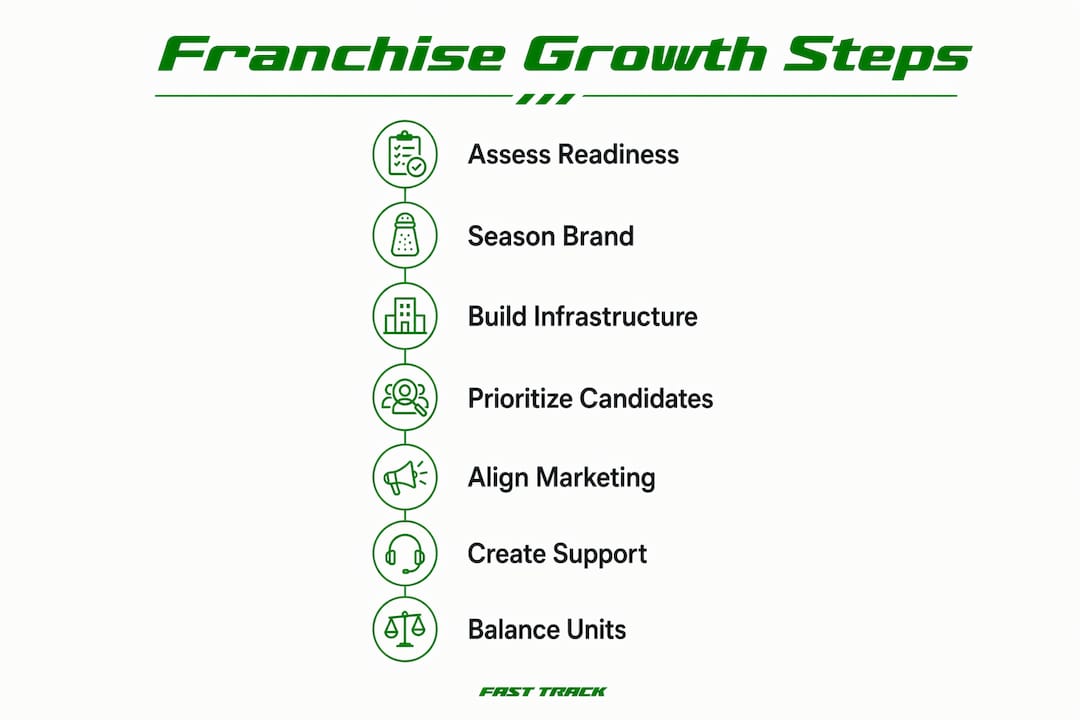
1. Assess your franchise readiness honestly
Readiness is not a feeling. It's a combination of evidence: proven unit economics, a replicable operating model, and a founder committed to the long-term demands of running a franchise system. Before any legal work begins, evaluate whether your model generates the profitability a franchisee needs after paying royalties and fees. If the numbers only work for the founder's original location, the model isn't ready.
Three questions cut through the noise: Can someone else run this without you? Do the financials hold up under conservative assumptions? Are you prepared to be a franchisor, not just a business owner?
2. Season the brand before franchising aggressively
Founders often mistake readiness for preparation. Spending 1–2 years refining operations, documenting procedures, and proving that results are repeatable across locations is not delay. It's the work that makes franchising viable. A franchise system built on a model that hasn't been tested beyond the founder's personal involvement is fragile from the start.
Use this period to build the documentation, training materials, and operational standards that franchisees will rely on. The operations manual written during this phase becomes the legal and operational backbone of the entire system.
3. Build the legal and operational infrastructure
The legal foundation of a franchise includes the Franchise Disclosure Document, the franchise agreement, trademark registration, and the formation of a separate franchise entity. The core legal process typically takes 90–120 days when the business is operational and the founder is actively engaged. That timeline assumes trademark clearance is underway and the operations manual is being developed in parallel.
Work with a qualified franchise attorney, not a general business lawyer. Franchise law is specialized, and errors in the FDD or franchise agreement create liability that surfaces years later.
4. Develop a candidate prioritization framework
Effective franchise growth requires shifting from lead volume to candidate quality. The four-part evaluation grid used by experienced franchisors covers territory availability, timing, financial capability, and behavioral fit. All four need to align before awarding a franchise. A candidate who passes three of four is not a good candidate.
Behavioral fit sits above the other three. A franchisee who follows systems, maintains brand standards, and communicates openly is more valuable than a well-capitalized one who improvises. The lead filtering criteria you apply early in the process determine the quality of your network for years.
5. Build marketing and recruitment around alignment, not volume
The strongest early franchisees often come from within the brand's existing orbit: loyal customers, employees, or people who encountered the concept and were drawn to it. These candidates already understand the value proposition and require less convincing. Chasing volume leads before the system is validated wastes resources and risks placing the wrong people in your first locations.
A focused franchise development marketing strategy targets candidates who match your buyer profile, whether that's owner-operators, semi-absentee investors, or multi-unit developers, rather than generating raw inquiry volume.
6. Create support systems before you need them
Franchise development is a professional engineering process. Support infrastructure, including real estate guidance, construction management, training programs, and ongoing coaching, must be built before you have franchisees who need it. Building support reactively, after franchisees are already open and struggling, is one of the most common and costly mistakes in franchise development.
The franchise support systems that scale well are documented, repeatable, and don't depend on the founder's personal involvement in every decision.
7. Balance company-owned and franchised units strategically
Maintaining a small number of company-owned locations serves two purposes. First, it keeps the franchisor connected to the operational reality of running the business. Second, it provides a testing ground for new products, processes, and marketing approaches before rolling them out system-wide. Franchisors who exit operations entirely often lose the credibility and insight that franchisees expect from their support team.
Common challenges when scaling through franchising
Franchising creates growth, but it also creates complexity. The challenges below are predictable. Knowing them in advance is the only real advantage.
- Consistency across locations: Every franchisee interprets standards slightly differently. Without clear documentation, regular audits, and a culture of accountability, brand standards drift. The operations manual and training program are the primary tools for preventing this.
- Premature franchising: Launching before the model is proven forces you to solve operational problems in public, with franchisees watching and losing confidence. The cost of rework after a premature launch almost always exceeds the cost of waiting.
- Legal and regulatory complexity: The FDD must comply with Federal Trade Commission requirements under 16 CFR Part 436, and additional state-level registration is required in roughly 14 states. Missing a filing or providing an outdated FDD exposes the franchisor to rescission claims and regulatory action.
- Franchisee behavioral misalignment: A franchisee who ignores brand standards, modifies the menu, or cuts corners on customer service damages the brand for every other location in the system. Behavioral alignment is harder to assess than financial qualification but more predictive of long-term success.
- Managerial bottlenecks: As the system grows, the franchisor's ability to personally oversee every franchisee disappears. Early investment in franchise management software that centralizes CRM, royalty reporting, and training tracking prevents the oversight gaps that create compliance problems.
- Reputation risk from poor franchisee selection: One franchisee who fails publicly, whether through poor service, financial collapse, or legal trouble, generates negative press that affects the entire system. Selective early recruitment protects the brand during its most vulnerable growth phase.
- Cost and time overruns in development: Franchise development costs vary widely. Many founders see core legal and strategy costs in the mid-five-figure range, with additional investment for operations manuals and training systems. Buying large generic service bundles from providers who aren't accountable for legal compliance is one of the most common ways founders overspend and underdeliver.
Essential legal and operational processes before you scale
The legal and operational foundation of a franchise system isn't optional. Every element below must be in place before you offer a franchise to anyone.
- Franchise Disclosure Document (FDD): The FDD is mandated by the FTC under 16 CFR Part 436 and must be provided to prospective franchisees at least 14 days before any agreement is signed or money changes hands. It contains 23 required items covering everything from the franchisor's background and litigation history to franchisee obligations and financial performance representations.
- Trademark registration: File with the United States Patent and Trademark Office early. Registration takes many months, and conflicts or refusals can delay your entire franchise launch. Your brand name and logo are the core assets franchisees are paying to use.
- Separate franchise entity: Create a distinct legal entity to serve as the franchisor. This entity issues franchises, collects fees and royalties, and holds the intellectual property. Keeping it separate from your operating business protects both sides.
- Operations manual: This document is the legal and operational baseline for the system. It covers pre-opening procedures, supply chain requirements, staffing standards, customer service protocols, and administrative requirements. Only the table of contents is disclosed in the FDD; the full manual is a confidential trade secret.
- Franchise agreement: The agreement defines the relationship between franchisor and franchisee, including fee structures, territory rights, term length, renewal conditions, transfer rights, and termination provisions. Every clause has long-term consequences.
- State registration: Approximately 14 states require franchisors to register the FDD before offering franchises. California, New York, and Illinois are among the most stringent. Missing a state filing is a serious compliance failure.
| Legal/Operational Step | Typical Timeline | Key Requirement |
|---|---|---|
| Trademark search and filing | Start immediately; 90–120 days to registration | USPTO federal registration |
| FDD preparation | 90–120 days with engaged founder | FTC 16 CFR Part 436 compliance |
| Franchise agreement drafting | Concurrent with FDD | Qualified franchise attorney |
| Franchise entity formation | 1–2 weeks | Separate from operating business |
| Operations manual development | 30 days | Covers all operational standards |
| State registration filings | Varies by state; allow 90–120 days | Required in approximately 14 states |
| Full legal launch readiness | 90–120 days total | All above steps complete |
The FDD components and their role in franchise development deserve careful attention. A strong Item 19 financial performance representation is one of the most effective tools for attracting qualified candidates and supporting SBA loan applications.
How to choose and support franchisees for sustainable growth
Franchisee selection is where franchise systems succeed or fail. The legal documents and brand systems matter, but the people you put in your locations determine everything that follows.
The four-part candidate evaluation grid
Experienced franchisors prioritize behavioral fit over financial qualification alone. The four-part grid below structures the evaluation:
| Evaluation Factor | What to Assess | Why It Matters |
|---|---|---|
| Territory | Is the desired territory available and viable? | Prevents conflict and sets realistic revenue expectations |
| Timing | Is the candidate ready to open within a reasonable window? | Delays after signing create operational and financial strain |
| Financial capability | Can they fund the investment and sustain operations through ramp? | Undercapitalized franchisees fail at higher rates |
| Behavioral fit | Do they follow systems, communicate openly, and align with brand values? | Strongest predictor of long-term brand consistency |
A candidate who checks three of four boxes is not ready. Awarding a franchise to someone who lacks behavioral alignment because their financials look strong is one of the most common and costly mistakes in franchise development.
Building support systems that retain franchisees
Support isn't a benefit you offer after the sale. It's the mechanism that protects your brand and your franchisees' investment. The training systems that scale well combine initial onboarding with ongoing coaching, real-time performance monitoring, and clear escalation paths when a franchisee is struggling.
Real estate guidance and construction management support are particularly valuable for new franchisees who have never opened a commercial location. Franchisors who systematize these functions reduce opening timelines and prevent the cost overruns that strain franchisee relationships before the location even opens.
Pro Tip: Your first five franchisees are your most important recruiting tool. Their success, their willingness to take calls from prospective candidates, and their public validation of the system will generate more qualified inquiries than any advertising campaign. Invest disproportionately in their success.
How targeting high-income franchise buyers accelerates your growth
The quality of your franchisee pipeline determines how fast you can grow without compromising brand standards. Franchisors who chase volume leads spend enormous time and resources on candidates who were never going to qualify, while the right candidates move on to other opportunities.
Targeting executives, directors, and senior managers with household incomes between $150,000 and $500,000 annually changes the entire development conversation. These candidates have the capital to invest without overextending, the professional discipline to follow systems, and the career experience to manage teams and operations. They're not buying a job. They're making a calculated investment decision, which means they evaluate your FDD, your Item 19, and your franchisee validation with the rigor of an investor.
Franchise Fast Track's proprietary system delivers appointments with verified high-income professionals in this income range, with a reported 34% lead-to-close rate. That figure reflects what happens when the top of the funnel is filtered for genuine qualification rather than raw inquiry volume. Franchisors who work with unqualified leads don't just waste time on calls that go nowhere. They also divert support resources toward candidates who ultimately don't close, leaving less capacity for the franchisees who do.
The shift from volume-based franchise lead generation to income-verified candidate targeting is one of the highest-leverage changes a growing franchisor can make. Fewer conversations, higher close rates, and better franchisees from day one.
Key Takeaways
Franchising scales a business faster than company-owned expansion by distributing capital, management, and market risk to motivated owner-operators within a proven, legally compliant system.
| Point | Details |
|---|---|
| Readiness before launch | Season the brand for 1–2 years and validate unit economics before offering franchises. |
| Legal foundation is non-negotiable | FDD preparation, trademark registration, and entity formation typically take 90–120 days when the business is operational and the founder is actively engaged. |
| Behavioral fit over financials | Franchisees who follow systems protect brand consistency better than well-funded ones who improvise. |
| Support infrastructure first | Build real estate, training, and coaching systems before franchisees need them, not after. |
| Target quality over volume | High-income, behaviorally aligned candidates close at higher rates and perform better long-term. |
Recommended
- Franchise Growth Strategies for Sustainable Scale in 2026 | Franchise Fast Track Blog
- Proven Franchise Growth Strategies for 2026 | Franchise Fast Track Blog
- Business Consulting Franchises: 2026 Guide for Franchisors | Franchise Fast Track Blog
- Financing for a Franchise: Franchisor's 2026 Guide | Franchise Fast Track Blog
Ready to see results like these for your franchise?
Stop wasting money on leads that never close. Start getting hundreds of replies from high-net-worth professionals daily.