Qualified Sales Leads: Frameworks and Best Practices
Only 2.3% of B2B website visitors become leads, and only 13% of marketing-qualified leads become sales-qualified leads, according to an industry synthesis of lead-quality benchmarks (lead-quality statistics). For United States franchisors with 50 or more locations, that gap means a portal inquiry should be treated as an unverified contact, not as a qualified sales lead.
The distinction matters across quick-service restaurants, home services, real estate brokerages, fitness and wellness, automotive services, health and beauty, retail, education, and senior care. The US franchise market has roughly 3,000 active franchise systems, 800,000 franchised establishments, and $800 billion in annual economic output, according to franchise industry market data. At that scale, franchise development teams don't need more names in a CRM. They need evidence that a candidate has the capital, authority, intent, and timing to justify a sales conversation.
Table of Contents
- What Counts as a Qualified Sales Lead
- Comparing BANT, CHAMP, MEDDIC, and GPCT
- Building a Two-Stage Qualification Filter
- Why Stale Lead Data Breaks Qualification
- Outbound vs Portals, Paid Ads, and Brokers
- Converting Qualified Leads Into Discovery Calls
- The Operating Standard for Qualified Sales Leads
What Counts as a Qualified Sales Lead
Only about 5% of leads are sales-ready when first generated, while the remaining 95% require further nurturing before direct sales engagement makes sense, according to lead-quality research. For franchise development teams, that split makes qualification a data-governance problem before it becomes a framework problem. A submitted form is an unverified record until its key fields have supporting evidence.
A qualified sales lead is a contact whose need, authority, financial ability, and timing have been verified before a discovery call is booked. A portal inquiry, email reply, or completed form demonstrates activity. It does not establish investment readiness.
The screening record should separate three signals:
- Financial capacity: Confirm liquid funds, net worth, and relevant income through documentation or a credible third-party source. Stated figures belong in the record as claims until they are verified.
- Decision-making authority: Record whether the contact controls the capital and can approve the investment, or whether another owner, partner, or financial decision-maker must participate.
- Specific intent: Capture the reason for action, such as a territory release, a planned career transition, or a competitor failure that changes local demand.
A portal inquiry listing $75k in liquid capital for a $250k QSR build-out fails the financial capacity check. It should route to verification, not to a discovery call. That routing decision protects calendar capacity while giving the candidate a clear path to provide missing evidence.
A contact that has not passed these checks remains a suspect record. The appropriate destination is verification or nurture, not a sales representative's discovery calendar. This distinction also keeps CRM reporting honest: inquiry volume measures response activity, while qualified-lead volume measures verified readiness.
The franchisee lead qualification process becomes dependable when the CRM stores evidence beside each qualification field, including its source, date, and verification status. BANT or CHAMP can organize the conversation later, but neither framework repairs incomplete or unsupported data. Their answers become useful only after income, capital, authority, and intent have been checked independently.
Support infrastructure can organize follow-up questions and response workflows when screening creates substantial communication volume. Teams comparing tools to find the best customer support software may improve that administrative layer, but software cannot convert an unverified statement into proof of readiness.
The operating definition is direct: a qualified lead has passed a readiness test, not merely an interest test. That standard separates a real franchise candidate from a portal inquiry and gives development teams a defensible basis for booking the next conversation.
Comparing BANT, CHAMP, MEDDIC, and GPCT
Frameworks organize questions, but they don't independently verify the answers. Franchise development teams should therefore judge BANT, CHAMP, MEDDIC, and GPCT against the same requirements: financial capacity, authority, need, intent, and timing.
BANT covers Budget, Authority, Need, and Timeline. It gives a development team a familiar structure, but “budget” is too blunt for franchise screening. A candidate can confirm access to money while still lacking sufficient liquid capital, acceptable net worth, or the financial resilience required by a specific concept.
CHAMP uses Challenges, Authority, Money, and Prioritization. It starts with the candidate's reason for considering a franchise, then tests whether that reason is important enough to support action. That order is useful for first-time franchise candidates because it distinguishes curiosity from a defined business objective before the discussion becomes centered on investment.
MEDDIC adds Metrics, Economic Buyer, Decision Criteria, Identify Pain, and Champion. Its detailed structure suits multi-stakeholder B2B transactions, especially where procurement, internal approval, and measurable business outcomes shape the deal. A single franchise candidate may not require the same emphasis on internal champions and corporate decision politics.
GPCT, covering Goals, Plans, Challenges, and Timeline, creates a lighter conversation for inbound interest. Its weakness is financial. The framework helps clarify motivation and timing, but it doesn't contain a strong verification hook for liquid capital or net worth.
| Framework | Primary strength | Franchise screening gap |
|---|---|---|
| BANT | Clear qualification structure | Budget doesn't equal verified capital |
| CHAMP | Surfaces challenges and prioritization | Money still requires independent proof |
| MEDDIC | Maps complex decision processes | Can overcomplicate a single-candidate model |
| GPCT | Lightweight discovery conversation | Lacks a built-in financial verification step |
For most franchise systems, CHAMP or a CHAMP and BANT hybrid provides the strongest starting point. CHAMP surfaces intent before income, while BANT adds an explicit timing check. Neither framework should advance a candidate without verification.
A structured franchisor 2026 lead scoring system can translate those answers into consistent routing rules. The framework supplies the questions. Data governance determines whether the answers deserve confidence.
Building a Two-Stage Qualification Filter
A single framework application doesn't create a reliable pipeline. A stronger design separates fit from operational readiness.
Stage one confirms fit
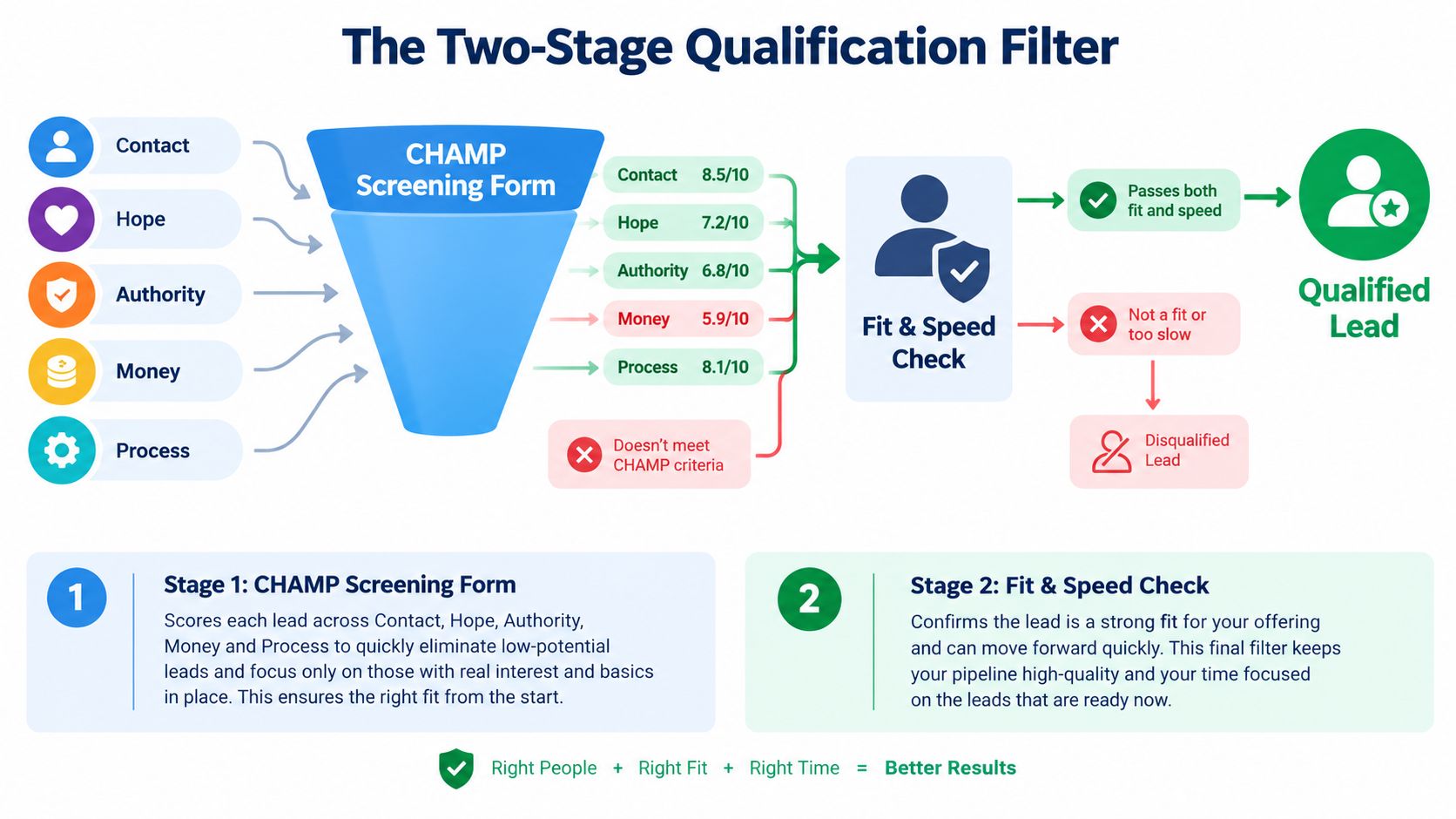
The first stage uses a structured CHAMP form. Each response should record evidence for the candidate's challenge, authority, money, and prioritization. The form should also capture target geography, relevant operating background, investment range, and the event that triggered the inquiry.
A useful workflow can score the record, but the score should never replace verification. A high engagement score based on email opens or repeated page visits doesn't confirm liquid funds. A candidate's stated income doesn't confirm available capital. Each important financial field needs a source, a date, and a verification status.
The benchmark guidance for qualified sales leads places healthy MQL-to-SQL conversion at 20% to 30%, SQL-to-opportunity conversion at 50% to 70%, and overall lead-to-close conversion at 1% to 5% (lead qualification benchmarks). These ranges support a practical conclusion: qualification should be managed as a quality-control system, not as a demand-generation vanity metric.
Stage two confirms speed
The second stage checks whether the candidate remains active enough for a sales conversation. Inbound leads should be qualified within 24 hours to preserve intent, according to the same industry guide. Response speed also matters sharply. Research cited in a 2026 sales benchmark reports a 10x drop in qualification success when response time exceeds five minutes, with a further 400% drop at 10 minutes versus five minutes (sales qualification benchmarks).
The operational gate can include:
- Response timing: The assigned development representative responds within the defined service window.
- Calendar behavior: The candidate selects a discovery slot and confirms attendance.
- Document readiness: The candidate provides proof of liquid funds and a current financial verification record before the call.
A candidate can have strong CHAMP answers and still belong in nurture if the speed gate fails. That isn't a rejection of the candidate. It's a recognition that the record isn't ready for a high-value sales appointment.
The filter is therefore a data pipeline, with evidence moving from capture to verification to routing. A checklist records activity. A pipeline shows whether the underlying record can support a revenue decision.
The Franchise Fast Track lead filtering guide provides a useful reference point for turning those principles into franchise-specific fields and routing criteria.
Why Stale Lead Data Breaks Qualification
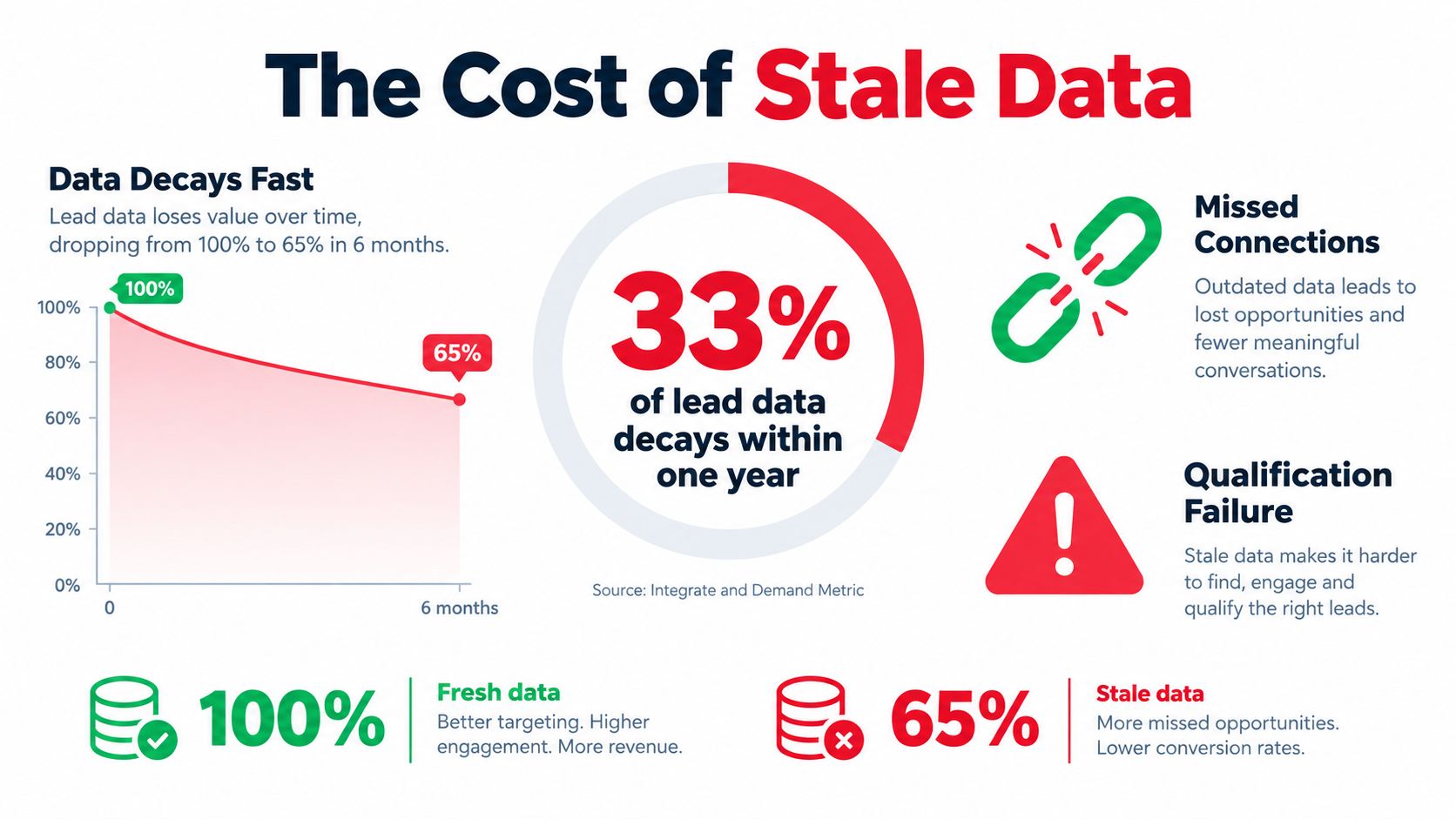
Nearly three quarters of respondents in an Integrate and Demand Metric report said their lead data was inaccurate, outdated, or non-compliant (lead data quality research). That finding changes the order of operations. Qualification doesn't begin with BANT or CHAMP. It begins with asking whether the record is trustworthy enough for either framework.
A stale employer record can misstate a candidate's current role. An old capital figure can make a financially weak candidate appear ready. A previous category preference can remain in the CRM after a life event changes the candidate's priorities. A reassigned phone number can connect a representative with someone who never expressed franchise interest.
Verification fields need ownership
Every high-value field should have four properties:
- Source: The document, database, or direct response supporting the value.
- Timestamp: The date the field was last confirmed.
- Confidence status: Verified, unverified, disputed, or expired.
- Owner: The person or workflow responsible for refreshing it.
Without those properties, a score can look precise while resting on obsolete inputs. The same CHAMP form can produce very different outcomes from one quarter to the next because the records have aged at different rates.
Email hygiene is one small part of that control layer. An Email Validation API can help identify invalid or risky addresses before a development team treats a response path as reliable. It doesn't verify capital or intent, but it can prevent contactability errors from contaminating performance reporting.
Data rule: A qualification score is only as reliable as the freshest evidence behind its most important fields.
For franchise development, the critical fields are more specific than generic B2B firmographics. They include liquid capital, net worth, income source, operating experience, role in the investment decision, target geography, category interest, and the trigger event behind the inquiry. The franchise development lead enrichment workflow should refresh those fields before a calendar invite is treated as a qualified sales conversation.
Outbound vs Portals, Paid Ads, and Brokers
The channel determines how much qualification work remains after the contact enters the CRM. Portals, Meta and Google paid ads, and broker referrals generally begin with an inquiry whose financial capacity and intent still need confirmation. Targeted outbound begins with a defined candidate profile, so the development team can control more of the data before a conversation is scheduled.
That distinction affects cost per qualified conversation, even when an inquiry appears inexpensive. A low-cost form fill can become expensive after a representative spends time calling, emailing, researching, and conducting a discovery meeting with a candidate who lacks the required capital or authority.
The available benchmark data shows that source quality changes expected pipeline yield. Overall lead-to-opportunity conversion is commonly placed at 5% to 20%, outbound at 3% to 10%, and referrals at 25% to 40%, according to a B2B conversion benchmark (qualified lead conversion data). Those figures aren't franchise-specific forecasts, but they support a relevant operating principle: acquisition source changes the quality distribution that sales receives.
| Channel | Avg Cost Per Inquiry | Qualification Rate | Avg Time To First Call |
|---|---|---|---|
| Targeted outbound | Depends on list construction and verification | Depends on verification depth | Controlled by campaign workflow |
| Franchise portals | Varies by portal and package | Often requires substantial post-inquiry screening | Controlled by portal response and rep follow-up |
| Meta and Google ads | Varies by audience, category, and auction conditions | Requires financial and intent verification | Controlled by form routing and response process |
| Broker referrals | Often tied to referral economics and eventual conversion | Depends on broker screening standards | Often affected by broker and franchisor handoffs |
The argument for outbound isn't that every outbound contact is qualified. It is that a franchisor can define the candidate universe before outreach, verify income and capital, and exclude obvious profile mismatches before the sales calendar is involved.
Franchise Fast Track operates in that data-first layer with a registry of 7,000+ franchise brands, 68,000+ FDDs, 31,000+ multi-unit franchisees, and 3.5 million classified franchise industry contacts. Its role as a franchise development partner and intelligence platform is most relevant when a franchisor needs verified candidate targeting rather than another undifferentiated inquiry stream. A broader franchise development guide for franchisors can help development executives compare channel design, staffing, and data requirements.
Converting Qualified Leads Into Discovery Calls
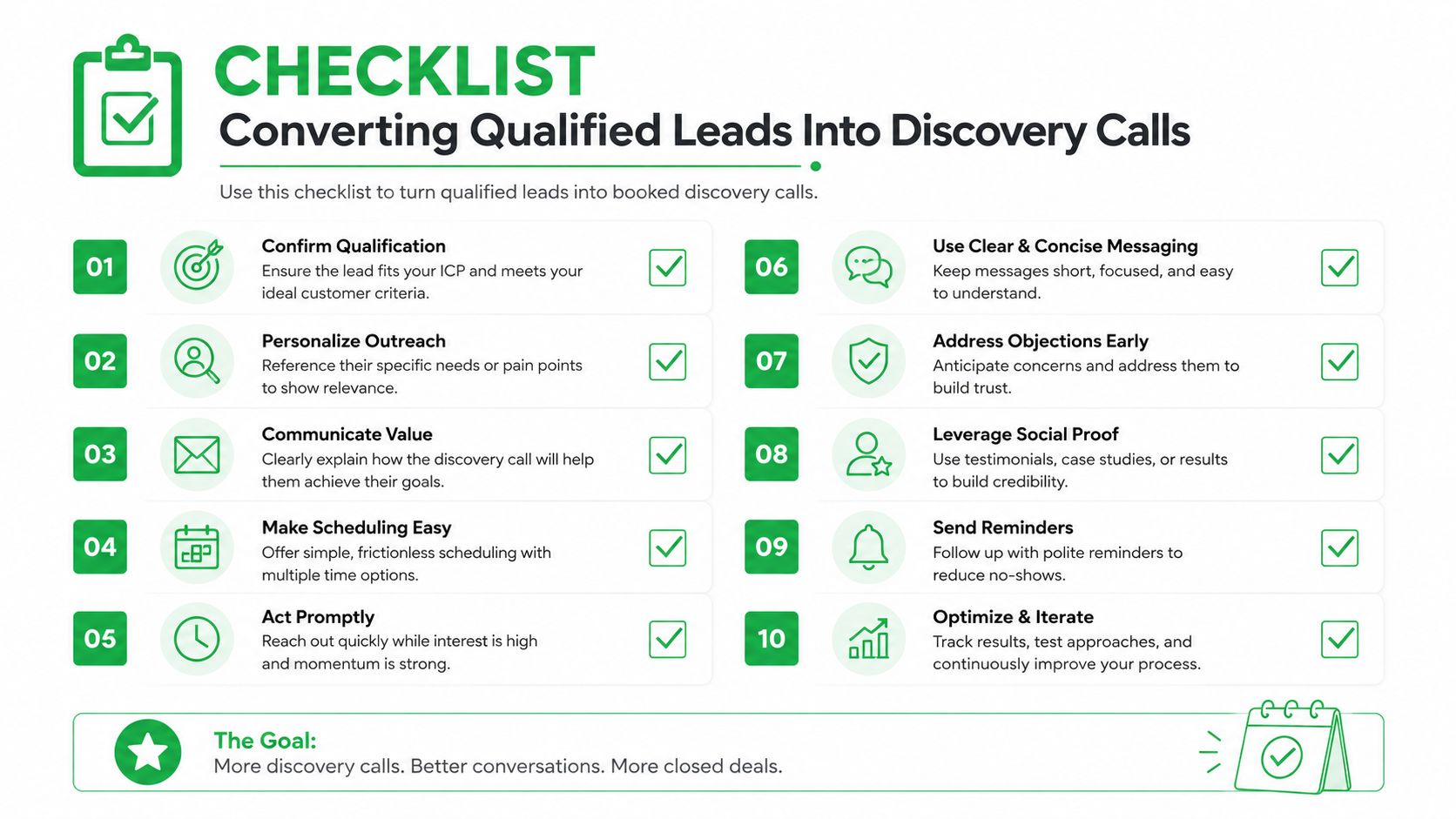
A qualified sales lead can still lose value during handoff. The discovery call should be the next controlled stage, not the point where the sales representative first discovers that the candidate's financial profile, geography, or decision role is unclear.
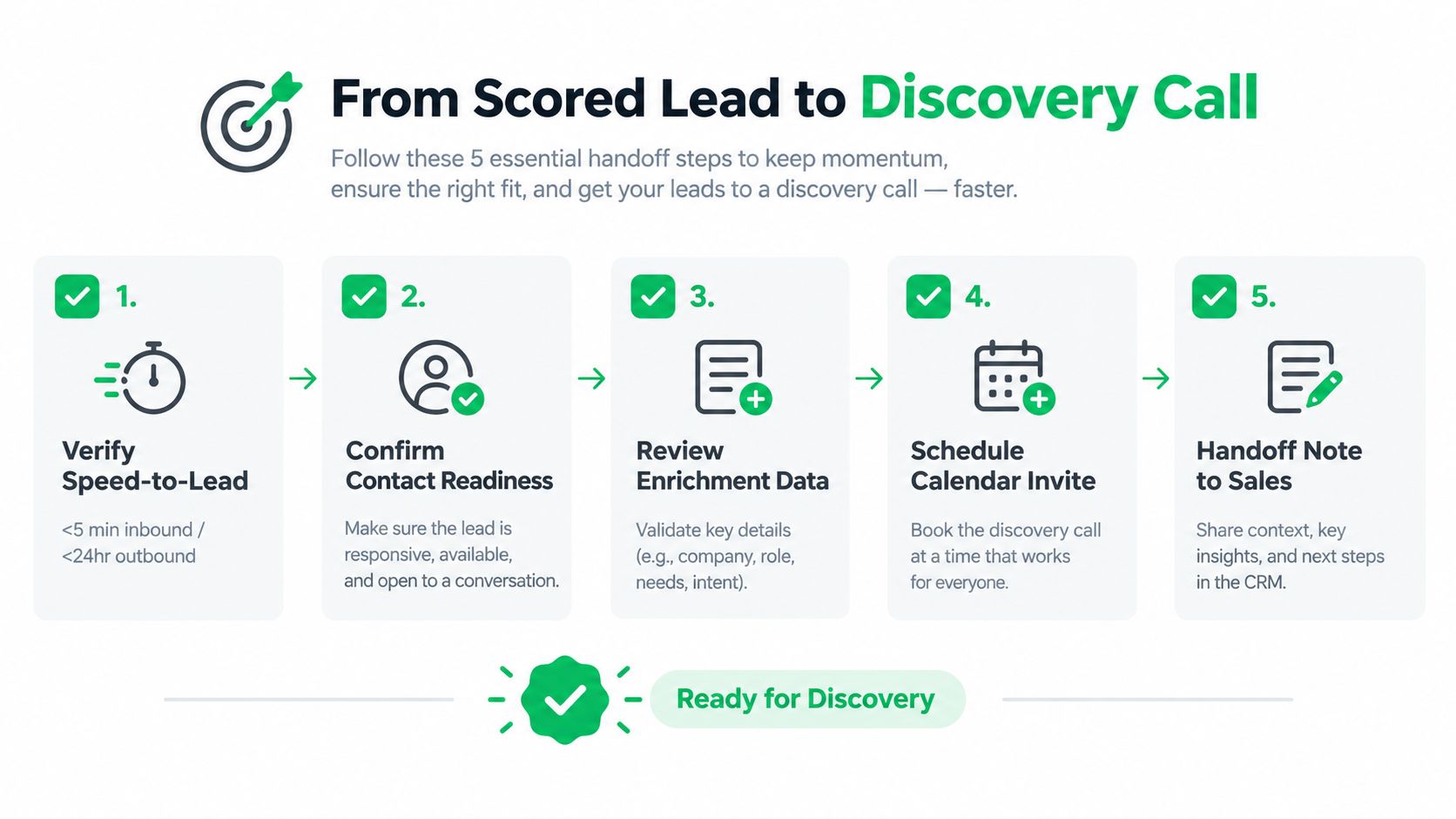
The first operating requirement is speed. Inbound records should receive a response within five minutes where the team can support it, while outbound warm-ups should be addressed within 24 hours, consistent with the qualification benchmarks cited earlier. The CRM should record response time rather than relying on a representative's memory.
The pre-call record
Before the calendar invite is finalized, the development team should confirm:
- Financial fit: Net worth, liquid capital, income source, and relevant credit information.
- Decision role: Whether the candidate is the economic decision-maker or which additional person must participate.
- Geography: Target metro, territory preference, and any known availability constraints.
- Profile fit: Operating background, category alignment, and capacity for the franchisor's model.
- Intent: The specific event or objective that prompted the inquiry.
The pre-call package should then match the candidate's stated interests. For a QSR candidate, that may mean a concise investment summary and territory context. For a home services, senior care, or education brand, the package may need to emphasize operating requirements, local market development, and the role of the owner.
A useful package includes the Item 7 investment table, a unit economics overview that stays within the franchisor's substantiated disclosures, and a territory map for the candidate's stated metro. The Federal Trade Commission identifies Item 7 as the FDD section for estimated initial investment, while Item 19 is the section for financial performance representations (FTC franchise buyer guidance).
Handoff discipline
Two avoidable failures appear repeatedly in franchise sales operations. Some candidates book without confirming by phone or message, while other discovery calls lack a named internal owner. Both failures create calendar volume without accountable progression.
Every qualified lead should enter the call with a named representative, a current score, a verification timestamp, a written reason for fit, and a next step logged on the same business day. The mechanic is unglamorous. That is why it works when teams apply it consistently.
The Operating Standard for Qualified Sales Leads
A franchise development team can reduce ambiguity by adopting one operating standard across marketing, development, and sales:
- Verify before scoring. Liquid capital and net worth should be independently confirmed before BANT or CHAMP determines sales readiness.
- Score before booking. The team should apply a defined threshold within the first response workflow, with records below the threshold routed to nurture rather than placed directly on a discovery calendar.
- Route quickly. Qualified leads should reach a named sales representative within 24 hours of form submission, consistent with the qualification guidance cited earlier.
The standard also needs a source-of-truth process for franchise information. Item 7 should anchor the initial investment discussion. Item 19 should be used only where the franchisor has made a compliant financial performance representation with reasonable factual support. The FTC states that franchisors aren't required to make a financial performance representation, but any such representation must appear in Item 19 and have written substantiation available when made (FTC Franchise Rule compliance guidance).
Item 20 can help teams review outlet growth and franchisee turnover, while Item 21 contains the franchisor's three most recent audited annual financial statements. Those sections don't qualify a candidate directly, but they give development teams a disciplined reference set when matching a candidate's expectations to the brand's disclosed information.
Operating standard: The headline KPI is cost per qualified discovery call, not cost per lead.
A franchisor can use an FDD database to compare Item 7 investment requirements across concepts and consult a multi-unit franchisee directory when evaluating operator backgrounds and potential market context. Teams that need additional sales capacity can also evaluate Hire SDRs as part of a broader response and qualification staffing model.
The strongest pipeline report should therefore show verified capital, authority, intent, response time, score, assigned representative, and discovery outcome. Lead volume remains a useful diagnostic, but it shouldn't be mistaken for sales readiness.
Franchise Fast Track combines verified franchisee candidate data with outbound recruitment and franchise industry intelligence for established brands with 50 or more locations. Franchise development executives can review the Franchise Fast Track overview to see how candidate verification, FDD data, and multi-unit operator research can support a pipeline measured by qualified discovery conversations rather than raw inquiries.
Ready to see results like these for your franchise?
Stop wasting money on leads that never close. Start getting hundreds of replies from high-net-worth professionals daily.