Book $150K–$500K Franchise Buyers in 30 Days with Lead Enrichment for Franchisors
Franchise lead enrichment means sourcing, verifying, and vetting high-income prospects, then converting that vetted pool into scheduled discovery appointments. Done right, it hands your development team a calendar full of pre-qualified conversations instead of a spreadsheet full of tire-kickers, and it fixes the two things that stall most franchise sales pipelines: slow follow-up and unverified financial fit.
TL;DR:
- Contacting leads within an hour of inquiry increases qualification chances almost sevenfold, significantly boosting your potential conversion rate.
- Verified, enriched pipelines achieve around a 34% lead-to-close rate, compared to low single digits without qualification.
- Implementing specific qualification filters—financial capacity, operational intent, and territory interest—can filter out unqualified prospects in minutes.
- Channel tracking by qualified-lead rate rather than inquiry volume reveals the most effective sources, often outperforming broad-based web forms.
- Outsourcing lead verification and appointment booking to a specialist can deliver hundreds of qualified appointments monthly, with lead-to-close rates around 34%.
Table of Contents
- What Franchise Lead Enrichment Actually Covers
- Why Enrichment Changes Your Unit Economics
- The Three Filters Every Franchisor Should Enforce
- Where High-Income Candidates Actually Come From
- How to Turn an Enriched Lead Into a Booked Appointment
- What to Measure and What "Good" Looks Like
- How Franchise Fast Track Executes This in Practice
- Handling Franchise Lead Data Legally and Responsibly
- A 30-Day Pilot Worth Running
- Get Verified Buyers on Your Calendar, Not Just in Your Inbox
- Sources
What Franchise Lead Enrichment Actually Covers
Franchise lead enrichment, as franchise development teams use the term, has nothing to do with CRM data-append services that bolt phone numbers or job titles onto an existing contact record. That's a data-hygiene function. This is a sourcing and qualification function, and the distinction matters because the two get conflated constantly in generic marketing content.
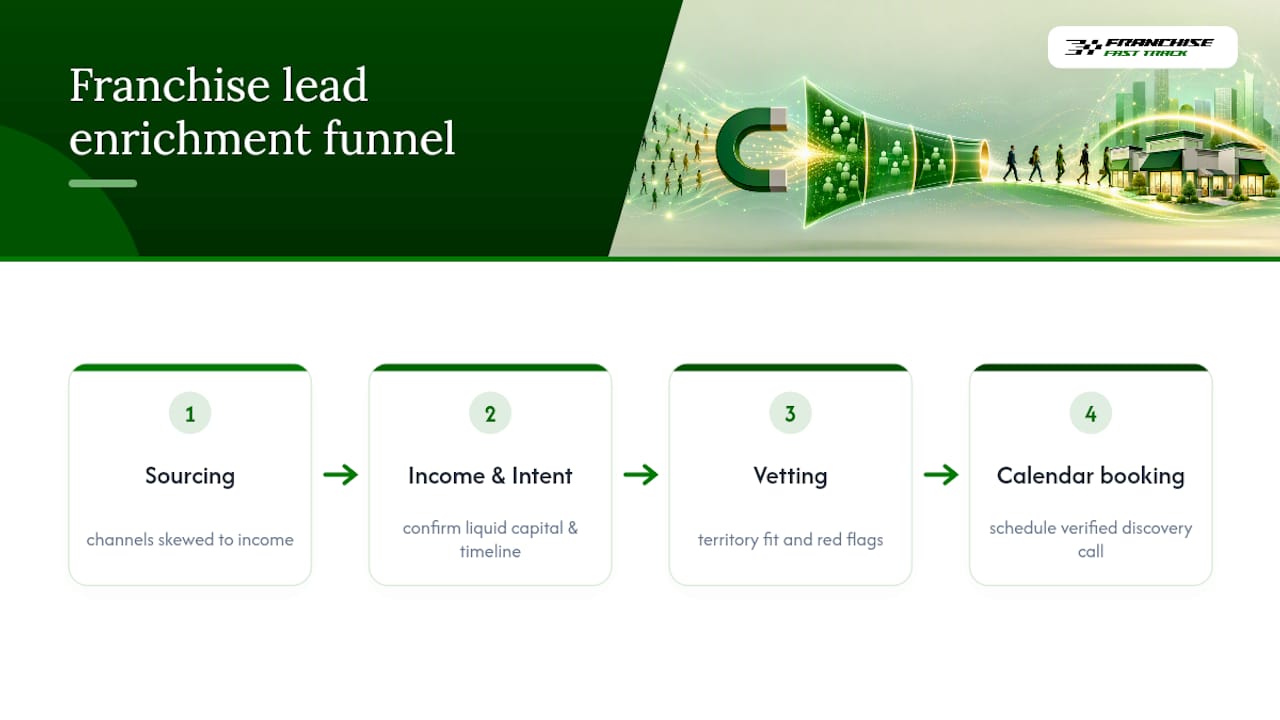
Real franchise lead enrichment has four moving parts. First, sourcing: finding candidates through channels that skew toward income and seriousness rather than raw volume. Second, income and intent verification: confirming a prospect actually has the liquid capital and the timeline they claim. Third, vetting: screening for territory fit, relevant experience, and red flags before a sales rep ever picks up the phone. Fourth, calendar booking: converting a verified fit into a scheduled discovery call, not just a warm lead sitting in a queue.
Skip any one of those four steps and you're back to running a call center for people who were never going to buy.
Why Enrichment Changes Your Unit Economics
The math behind lead enrichment is not subtle. Contact a franchise inquiry within an hour and it's almost seven times more likely to qualify than a lead you reach after 60 minutes have passed. Most development teams don't hit that window, not because their reps are lazy but because they're wading through unqualified inquiries to find the handful worth calling.
The 34% Benchmark: Franchisors running verified, enriched pipelines have reported lead-to-close rates around 34%, compared with the low single digits typical of unfiltered inquiry volume.
Industry benchmarks put leads-per-signed-agreement somewhere between 50 and 150 depending on brand and source quality. Enrichment doesn't just improve that ratio. It shrinks the number of discovery days your senior team burns on candidates who were never going to close, which is the real cost nobody puts on a dashboard.
The Three Filters Every Franchisor Should Enforce
Verification only works if it's specific. Vague qualification questions produce vague results. Here's what a tight screening gate actually asks:
- Financial fit: liquid capital of roughly $100,000 to $150,000 minimum for most brands, net worth appropriate to the total investment range, and a stated financing plan (cash, SBA loan, retirement rollover) rather than a vague "I'll figure it out."
- Operational intent: a realistic opening timeline (within 6 to 12 months, not "someday"), stated interest in single-unit versus multi-unit development, and any relevant management or ownership experience.
- Territory alignment: confirmed interest in an actually open territory, willingness to relocate if required, and no conflicting non-compete from a prior business.
Automated systems that check financial capacity, intent, and territory fit within minutes can route qualified leads straight to sales while nurturing the rest, which is the difference between a rep's day being productive or wasted.
Pro Tip: Ask financial questions in stages, not all at once. A prospect who balks at "what's your liquid capital" on question one of an inquiry form will often answer honestly once they've invested five minutes and feel some momentum.
Where High-Income Candidates Actually Come From
Not every channel produces the same caliber of buyer, and treating them as interchangeable is where most franchisors overspend for underwhelming results.
- Referrals and brokers convert at meaningfully higher rates than portal leads because the candidate arrives pre-warmed by a trusted third party, even though broker fees run higher per lead.
- Targeted paid social, particularly LinkedIn campaigns aimed at directors and senior managers by title and income bracket, tends to surface candidates who match the $150K to $500K income profile more consistently than open web forms.
- Selective portal placements still work, but only when paired with aggressive upfront screening, since portals generate the highest raw volume and the lowest average quality.
- Outbound to executives, direct contact with people actively in a career transition or nearing retirement from corporate roles, produces smaller volume but often the strongest financial fit.
The channel mix matters less than what you measure. Track each source by qualified-lead rate, not raw inquiry count, and you'll usually find one or two channels quietly outperforming the rest by a wide margin.
How to Turn an Enriched Lead Into a Booked Appointment
Sourcing and verifying a candidate accomplishes nothing if the process stalls before a call gets on the calendar. Here's the sequence that works:
- Capture with a stage-gated form. Ask minimal information on first touch (name, contact, general interest), then surface capital and timeline questions only once the candidate advances, keeping every interaction in one candidate record instead of scattered across tools.
- Score intent automatically. Financial capacity, timeline, and territory fit get scored the moment the form submits, before a human ever sees the lead.
- Assign and start the clock. Confirmed fits route to a specific rep immediately, with an SLA timer that flags anything untouched after 15 minutes.
- Send a calendar link, not a callback promise. Let the candidate book their own discovery call slot; it removes the back-and-forth that kills momentum.
- Confirm the appointment 24 hours out. A short pre-call touch (text or email) cuts no-shows meaningfully.
- Route near-fits to nurture, not to a rep. Candidates who are close but not ready go into an automated sequence with case studies and FAQs, freeing your senior team to focus only on confirmed appointments.
Pro Tip: Give your top rep the first-touch SLA, not your newest hire. The seven-times qualification lift from fast response only pays off if the person answering the phone knows how to keep a serious candidate engaged.
What to Measure and What "Good" Looks Like
Four numbers tell you whether your enrichment process is working: speed to first contact, qualified-leads-to-discovery rate, qualified-lead-to-sale rate, and leads-per-sale broken out by channel.
Benchmark Range: Qualified-leads-to-sale conversion typically runs 10% to 12% when qualification happens upstream, and disciplined qualification has been linked to an 18% increase in average unit economics as better-fit franchisees translate into stronger unit performance.
- Set a 30 to 60 day pilot window before judging any channel change.
- Compare qualified-lead rate, not raw volume, across sources before reallocating budget.
- Watch time-to-first-contact weekly; a slipping average usually predicts a slipping close rate a month later.
Tightening qualification almost always produces better ROI than spending more on top-of-funnel volume, since most of the wasted spend happens after the click, in the follow-up gap where good candidates go cold.
How Franchise Fast Track Executes This in Practice
Franchise Fast Track built its model around the exact gap most in-house teams struggle to close: verified financial fit, confirmed intent, and a calendar slot, delivered together instead of as three separate problems. The service sources and screens candidates earning $150K to $500K annually, executives and directors actively looking to own a franchise, then hands your team hundreds of appointments a month rather than an inbox of unscored inquiries.
Brands running this model report lead-to-close rates around 34%, a direct result of the proprietary verification layer filtering out unqualified traffic before it ever reaches a sales rep. Onboarding typically includes mapping your existing qualification thresholds and territory map onto the sourcing system, since screening trained on brand-specific data outperforms generic scoring every time.
Building this in-house takes real headcount, a proprietary scoring system, and months of tuning. A specialist partner compresses that timeline to weeks.
Handling Franchise Lead Data Legally and Responsibly
Franchise development involves collecting sensitive financial information: liquid capital, net worth, sometimes tax or funding details. That data carries real compliance weight, and franchisors who treat it casually expose themselves to unnecessary risk.
Start with consent. Every candidate providing financial or personal information should know explicitly what it's used for and who sees it, ideally through a clear disclosure at the point of capture rather than buried in fine print. State-level privacy laws in the US, particularly in California, Colorado, and a growing list of others, increasingly require disclosure and opt-out mechanisms even for B2B-adjacent data like franchise candidate records.
Storage matters as much as collection. Financial and identity data belongs in a secure, access-controlled system, not scattered across spreadsheets emailed between a marketing team and a development director. A single candidate record, accessible only to people actively working that deal, reduces both leak risk and the chance that a candidate's information sits untouched after they've gone cold.

The Federal Trade Commission's rules on deceptive practices also apply to how franchise opportunity itself is marketed and disclosed, separate from lead data handling, so development teams should keep those two compliance tracks distinct. And if you're working with an outside enrichment or appointment-setting partner, get clarity in writing on data ownership, retention periods, and deletion practices before candidate information ever changes hands. Vague vendor contracts around data handling are one of the most common blind spots in franchise development, and they're the easiest to fix upfront.
A 30-Day Pilot Worth Running
Most franchisors overthink this. You don't need a new tech stack to test whether enrichment works. You need thresholds, a funnel map, and a stopwatch.
Week one: write down your actual financial and territory qualification criteria, in numbers, not vibes. Week two: map every step from first inquiry to booked call, and find where leads currently die. Weeks three and four: run a speed-to-lead pilot on new inquiries only, contact within 15 minutes, and track qualified-lead conversion against your historical baseline.
Measure qualified leads, not raw inquiry counts. A jump in inquiries with a flat close rate tells you nothing except that your ad spend increased. If you want to compare notes on what a 30-day pilot should look like for your brand, Franchise Fast Track's team has run this exercise across dozens of franchise systems and is worth a conversation.
— Cody
Get Verified Buyers on Your Calendar, Not Just in Your Inbox
Building an in-house enrichment system means hiring for it, training a scoring model on your own historical data, and living through months of trial and error before it produces consistent appointments. Franchise Fast Track skips that runway. The service verifies income and intent, screens for territory fit, and books the discovery call directly onto your team's calendar, delivering hundreds of appointments a month with executives and directors earning $150,000 to $500,000 a year.
The outcome franchisors care about is simple: fewer unqualified calls, more signed agreements, and a pipeline built on verified fit rather than raw inquiry volume. If your current lead flow is producing plenty of names and not enough closings, start with the franchise lead generation service page to see how the qualification and booking process works, or explore the outsourced development option if you're weighing whether to build this in-house or hand it to a specialist. Either way, the next step is a conversation, not another quarter of guessing.
Sources
- Franchise Lead Qualification for Franchisors: Why Deals Are Lost in the First 72 Hours
- Franchise Lead Generation: Turning Enquiries Into Signed Franchisees
- How Many Leads Does It Actually Take to Close a Franchise Sale? · Iconic
- Franchise Lead Conversion Rate: Why Volume Stopped Working
Recommended
Ready to see results like these for your franchise?
Stop wasting money on leads that never close. Start getting hundreds of replies from high-net-worth professionals daily.