Franchise Sales Enablement: How to Book Verified Buyer Calls
Franchise sales enablement is the outbound engine that finds, verifies, and books appointments with franchise buyers who can actually afford the investment. Done right, it delivers a steady flow of Step-1 calls with executives, directors, and senior managers earning between $150,000 and $500,000 a year, not a pile of unqualified inquiries your development team has to sort through. Franchise Fast Track runs this system at scale, generating many appointments each month for franchisors and reporting a lead-to-close rate on the candidates it books that is notably higher than average.
Who benefits most:
- Franchisors expanding unit count through new franchise agreements
- Development directors tired of chasing leads who can't clear Item 7 minimums
- Brands that want fewer, better conversations instead of more form fills
Proof point: Franchise Fast Track's model centers on one metric that matters more than lead volume: a 34% lead-to-close rate among the appointments it delivers, driven by income and intent verification before a call ever hits the calendar.
Key Takeaways
Franchise sales enablement works when appointment quality, measured by lead-to-close rate and award conversion, replaces lead volume as the core success metric.
| Point | Details |
|---|---|
| Define "qualified" contractually | Put liquidity, territory match, and intent verification into the signed SOW, not a verbal promise. |
| Expect a real ramp period | Budget 4 to 8 weeks before appointment volume reaches steady state. |
| Own your data | Require data ownership and portability clauses so pipeline insights stay with you after the contract ends. |
| Track awards, not clicks | Cost per awarded franchise is the metric that reflects true program health. |
| Franchise Fast Track's benchmark | Delivers hundreds of appointments monthly with $150K to $500K earners and a reported 34% lead-to-close rate. |
Table of Contents
- How Does Franchise Sales Enablement Actually Work?
- What Is the Timeline From Kickoff to Steady Delivery?
- What Counts as a Verified High-Income Buyer?
- What Should Go in a Sales Enablement Contract?
- How Do You Run a 90-Day Pilot?
- What Metrics Actually Prove the Program Is Working?
- What Does Franchise Fast Track Actually Deliver?
- When Should You Bring in an Outside Partner?
- Ready to Pilot Verified Buyer Appointments?
- Sources
How Does Franchise Sales Enablement Actually Work?
The mechanics come down to four moving parts: who you target, where the data comes from, how candidates get verified, and how the meeting lands on a calendar.
- Targeting focuses on executives, directors, and senior managers rather than the general public, because this group has the liquid capital and career motivation franchise ownership requires.
- List-building pulls from curated data sources rather than scraped or purchased mass lists, which is what separates a franchise-specific vendor from a generic ad platform.
- Verification checks income and role claims, confirms real intent to invest, and screens for territory availability before a name ever reaches your sales team.
- Booking happens directly into your CRM and calendar, so the appointment shows up as a scheduled Step-1 call, not a raw contact record someone has to chase down.
Franchisors that lead with transparency around this process, rather than lifestyle-driven marketing, tend to attract investors who respond to operational proof over brand storytelling.
What Is the Timeline From Kickoff to Steady Delivery?
Most franchisors want to know one thing first: how long until this actually produces appointments. The honest answer is a ramp period, followed by a repeatable cadence.
- Weeks 1 to 2: ideal candidate profile confirmed, territory maps loaded, CRM and calendar integrations tested.
- Weeks 2 to 4: first outreach cadence launches against curated lists, with early responses used to tighten targeting.
- Weeks 4 to 8: appointment volume climbs toward steady-state as verification workflows stabilize and speed-to-lead tightens.
- Ongoing: territory logic and messaging get adjusted based on which segments convert past Step-1.
Reaching "hundreds of appointments monthly" isn't a switch you flip. It requires multiple simultaneous channels, a scoring layer that filters candidates before a human ever touches them, and a follow-up process fast enough that interested buyers don't go cold. Franchise development stacks built around AI scoring paired with sub-5-minute speed-to-lead consistently outperform slower, manual follow-up chains.
Pro Tip: Ask any vendor for their week-by-week ramp plan in writing before signing. A partner who can't tell you what happens in week 3 probably hasn't run this process enough times to know.
What Counts as a Verified High-Income Buyer?
"Qualified" needs a definition with actual numbers attached, not a vague promise. Here's what a contract-ready qualification standard typically includes:
- Financial thresholds: liquidity and net worth that clear the minimums in your Item 7, not just a self-reported income range.
- Territory availability: a binary filter. If the candidate's location isn't open, they don't advance, no matter how strong their financials look.
- Operational fit: relevant management experience, and for multi-unit brands, evidence the candidate can actually run more than one location.
- Engagement behavior: whether they show up for scheduled calls, respond to document requests, and move through the process without repeated rescheduling.
That last criterion gets overlooked constantly. A candidate with $400,000 in liquid assets who no-shows twice isn't a qualified lead, regardless of what their bank statement says. Franchise development teams that shift from funnel-volume thinking toward operator selection based on these exact filters consistently report cleaner pipelines and shorter sales cycles.
What Should Go in a Sales Enablement Contract?
Before signing anything, get these terms in writing. A verbal promise about "quality leads" means nothing once you're three months into a retainer.
- A signed statement of work with a qualified-lead definition, including specific fields: minimum liquidity, territory match, verified income range, and confirmed intent.
- Data ownership language that keeps candidate records and campaign insights with you, not the vendor, if the relationship ends.
- Ramp and exit clauses that separate the onboarding period from the performance period, so you're not paying full price for week-one output.
- Reporting and raw data access, including verification evidence you can audit, not just a dashboard summary.
Pro Tip: Ask to see a sample verification log before you sign anything. A vendor with a real process will show you exactly how they confirmed income and intent for a past candidate, with names redacted.
Watch for these red flags: leads shared across multiple franchise brands simultaneously, no territory logic in the targeting model, and vague answers about how verification actually happens. Contract exhibits that spell out territory and data clauses give you a template for what this language should look like in practice.
How Do You Run a 90-Day Pilot?
A pilot works best when someone internally owns each moving piece before the first appointment lands.
- Assign one person to handle follow-up on booked calls within hours, not days.
- Assign someone else to track weekly metrics: appointments booked, Step-1 show rate, and qualified cost per lead.
- Confirm who owns territory logic updates, since open territories change as existing franchisees expand.
- Integrate your CRM, calendar system, and call tracking before appointment volume ramps, not after.
Watch your Step-1 rate and calendar-to-Discovery-Day conversion weekly during the pilot. If either metric lags, adjust your ideal candidate profile or messaging before assuming the whole channel is broken. Curated-list outreach paired with a structured multi-touch cadence tends to move qualified candidates toward in-market meetings faster than single-channel outreach. If you're also running paid channels in parallel, regional messaging that respects brand standards helps keep multi-territory campaigns from sounding generic.
What Metrics Actually Prove the Program Is Working?
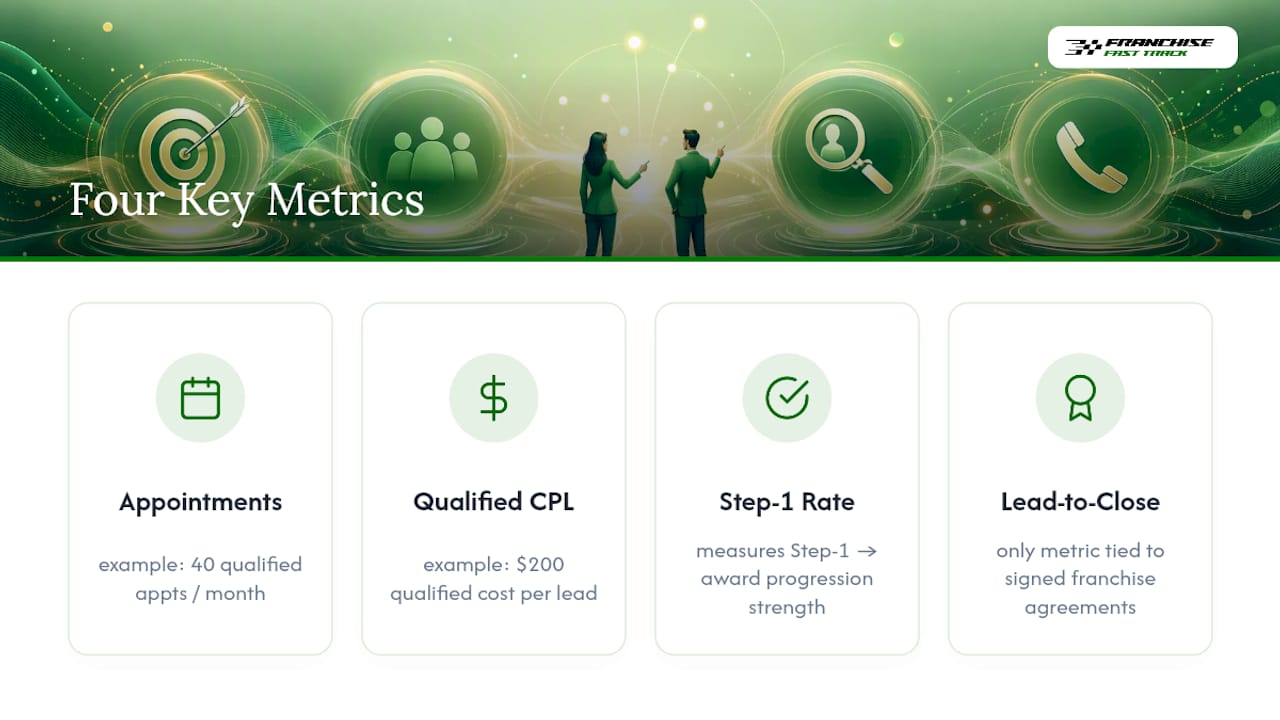
Four numbers tell you almost everything: appointments booked per month, qualified cost per lead, Step-1 conversion rate, and lead-to-close (award) rate. The last one is the only metric that matters to your bottom line, because it's the one tied to signed franchise agreements.

Back-of-envelope math helps here. If a vendor delivers 40 qualified appointments a month at a qualified CPL of $200, and your Step-1-to-award rate is strong, that's a substantial number of awards from that batch, at a blended cost far below what most brands spend chasing unqualified web leads. Run this math by investor tier, too. A candidate targeting a $500,000 investment behaves differently than one at $150,000, and blending those cohorts into one conversion number hides which segment actually drives your unit economics.
If your Step-1 rate is strong but awards stall out, the problem usually isn't lead volume. It's a mismatch between your qualification criteria and what actually predicts a successful operator, a distinction that gets lost when teams treat this as top-of-funnel lead scoring instead of buyer underwriting.
Track your cost per conversion against award numbers, not clicks, and the health of the program becomes obvious fast.
What Does Franchise Fast Track Actually Deliver?
Franchise Fast Track's numbers answer the quality-over-volume question directly: hundreds of verified appointments a month, targeted at professionals earning $150,000 to $500,000 annually, converting at a reported 34% lead-to-close rate. That combination addresses what franchise development teams often call the FranDev Paradox, where high lead volume and low close rates coexist because the leads were never underwritten for financial fitness in the first place.
Before signing with any appointment-setting partner, ask for:
- A sample verification log showing how income and intent were confirmed for a past candidate
- A territory match report proving candidates were screened against your open markets before booking
- A documented ramp timeline showing what volume to expect at week 4, week 8, and steady state
The gap between "we generate leads" and "we deliver verified, appointment-ready buyers" is the entire difference between a marketing vendor and a sales enablement partner. One fills a pipeline. The other fills a calendar with people who can actually sign.
When Should You Bring in an Outside Partner?
Internal teams can absolutely build this capability, but most don't have the time or the specialized data access to do it well while also running discovery days and franchise renewals. If your current pipeline is heavy on volume and light on awards, that's the signal to pilot an outside partner rather than tweak your existing funnel again.
My recommendation is specific: run a 60 to 90 day pilot with a written qualified-lead definition, a data ownership clause, and clear weekly KPIs, before committing to anything longer. Judge the partner on operator selection, not lead count. A vendor who can explain their territory logic in detail, unprompted, almost always outperforms one who leads with volume promises. That single conversation tells you more than any pitch deck will.
— Cody
Ready to Pilot Verified Buyer Appointments?
Franchise Fast Track exists for exactly the gap this article just walked through: the space between a full pipeline and a full calendar of qualified appointments. Instead of paying for clicks or unverified form fills, you get appointments with professionals already screened for income, intent, and territory fit, backed by a documented 34% lead-to-close rate.
If you're weighing a pilot, start by requesting sample verification evidence and a territory match report for your open markets. That's the fastest way to see whether the process holds up before you commit budget. Visit the franchise lead generation page to request a pilot proposal, or explore the franchisee directory to see the scale of verified operator data behind the system.
Sources
Recommended
Ready to see results like these for your franchise?
Stop wasting money on leads that never close. Start getting hundreds of replies from high-net-worth professionals daily.