Performance-Based Franchise Leads: A Guide for Franchisors
Performance-based franchise leads are worth pursuing if your average franchise deal value runs mid five-figures or higher and you need verified, high-income buyers instead of a bigger stack of unqualified names. The clearest path in is a 90-day pilot on a pay-per-qualified-held payment trigger, tracked against cost per closed deal, not cost per meeting. Vendors that verify income, title, and intent with a standard like BANT tend to convert better; Franchise Fast Track, for example, reports lifting lead-to-close rates to 34% with this approach.
Key Takeaways
Performance-based franchise lead programs work best when franchisors pay on a strict "qualified-held" trigger and measure cost per closed deal instead of cost per appointment.
| Point | Details |
|---|---|
| Match the trigger to your risk tolerance | Pay-per-qualified-held costs more ($600–$900) but transfers most no-show risk to the vendor. |
| Define "qualified" in writing | Require BANT-style verification fields and a documented handover sheet before you pay. |
| Track cost per closed deal | A pricier meeting with higher conversion often beats a cheap meeting that never closes. |
| Pilot before you scale | Run 90 days, expect real stability by week 6 to 12, and demand weekly QA reporting. |
| Benchmark against verified programs | Franchise Fast Track reports hundreds of monthly appointments with $150K–$500K earners and a 34% lead-to-close rate. |
Table of Contents
- What Are Performance-Based Franchise Leads?
- What Should a Qualified, High-Income Franchise Lead Look Like?
- Benefits and Risks of Pay-For-Performance Franchise Lead Models
- What KPIs and Benchmarks Should You Expect?
- How Do You Vet a Performance-Based Lead Provider?
- How Does Pricing and Contract Structure Typically Work?
- What's the Realistic Onboarding Timeline?
- What Results Should You Expect From a Verified Program?
- When Does Pay-For-Performance Actually Make Sense?
- Get Verified, High-Income Buyer Appointments With Franchise Fast Track
- Frequently Asked Questions
- Sources
What Are Performance-Based Franchise Leads?
Performance-based franchise leads are prospects a vendor is paid to deliver only after they clear a specific, contractually defined milestone, rather than simply appearing on a list. The three common commercial variants are pay-per-lead (cheapest, weakest verification), pay-per-appointment (a meeting gets scheduled), and pay-per-qualified-held (a vetted buyer actually shows up and meets defined criteria). The payment trigger is everything here. "Scheduled" just means a calendar invite went out; "held" means the buyer showed; "qualified-held" means they showed and matched your income, intent, and timeline criteria. That distinction is where most of the risk transfer either happens or quietly disappears.
Before a franchisor should be billed, a legitimate vendor typically:
- Builds and refreshes a targeted prospect list against your ideal buyer profile
- Runs a structured outbound cadence (calls, email, LinkedIn) over multiple touches
- Conducts a live qualification conversation, not just a form fill
- Books and confirms the appointment on your sales calendar
Pricing tracks directly with the strength of that trigger. Pay-per-qualified-held meetings typically run $600–$900, while anything priced under roughly $150 per appointment is usually too cheap for a vendor to have done real research or qualification.
What Should a Qualified, High-Income Franchise Lead Look Like?
A "qualified" lead needs a written definition, not a vibe. Before you sign, get the vendor to commit, in the contract, to verifying these fields for every appointment they charge you for:
- Income range or net worth proxy (Franchise Fast Track, for instance, targets buyers earning $150K to $500K annually)
- Current job title, with a preference toward executives, directors, and senior managers
- Liquid capital or identified funding source
- A stated intent signal and rough timeline to purchase
- A minimum meeting duration required for the appointment to count as "held"
- Geographic and territory eligibility for your available markets
Verification should combine a live qualification call with independent confirmation, such as cross-checking LinkedIn and a phone call, plus a pre-call confirmation message to cut no-shows. At handover, insist on more than a name and phone number. A real handover sheet should include verbatim qualification notes, outreach history, a contact verification timestamp, and recommended talking points for your development team. This kind of lead qualification documentation is what separates a usable appointment from a wasted one.
Benefits and Risks of Pay-For-Performance Franchise Lead Models
The upside is straightforward: you pay for outcomes instead of activity, which shifts no-show and dead-end risk onto the vendor instead of your development budget. It also lets you validate a new vertical, region, or buyer persona fast, without hiring and training an internal team first. Done well, it lowers your true cost per closed deal even if the per-meeting price looks steep on paper.

The trade-offs are real too. Per-unit costs run higher than cold, unverified leads. Some vendors recycle the same contact databases across multiple franchise clients, which quietly caps your addressable pool. Others sell you on a low headline rate, then bury the real cost in a retainer or minimum spend that behaves nothing like pure pay-per-appointment.
Watch for these red flags before signing anything:
- A vendor that won't define "qualified" in writing
- Promises of high volume in the first week (a sign they're not actually qualifying)
- No replacement policy for no-shows or bad-fit meetings
- Reluctance to share sample handover documents
Pro Tip: Bring your own verified prospect list into the engagement whenever you have one. Teams that supply their own clean, refreshed contact data see show rates rise 15 to 20 percentage points compared to vendor-sourced recycled lists.
What KPIs and Benchmarks Should You Expect?
Five numbers matter more than any others: meeting-held rate (show rate), lead-to-opportunity conversion, opportunity-to-award rate, cost per meeting, and cost per closed deal. Of those, cost per closed deal is the one that actually tells you whether the program is working. A vendor charging $800 per qualified-held meeting that converts to awards at twice the rate of a $300 vendor is cheaper in the metric that matters, even though the invoice looks bigger.
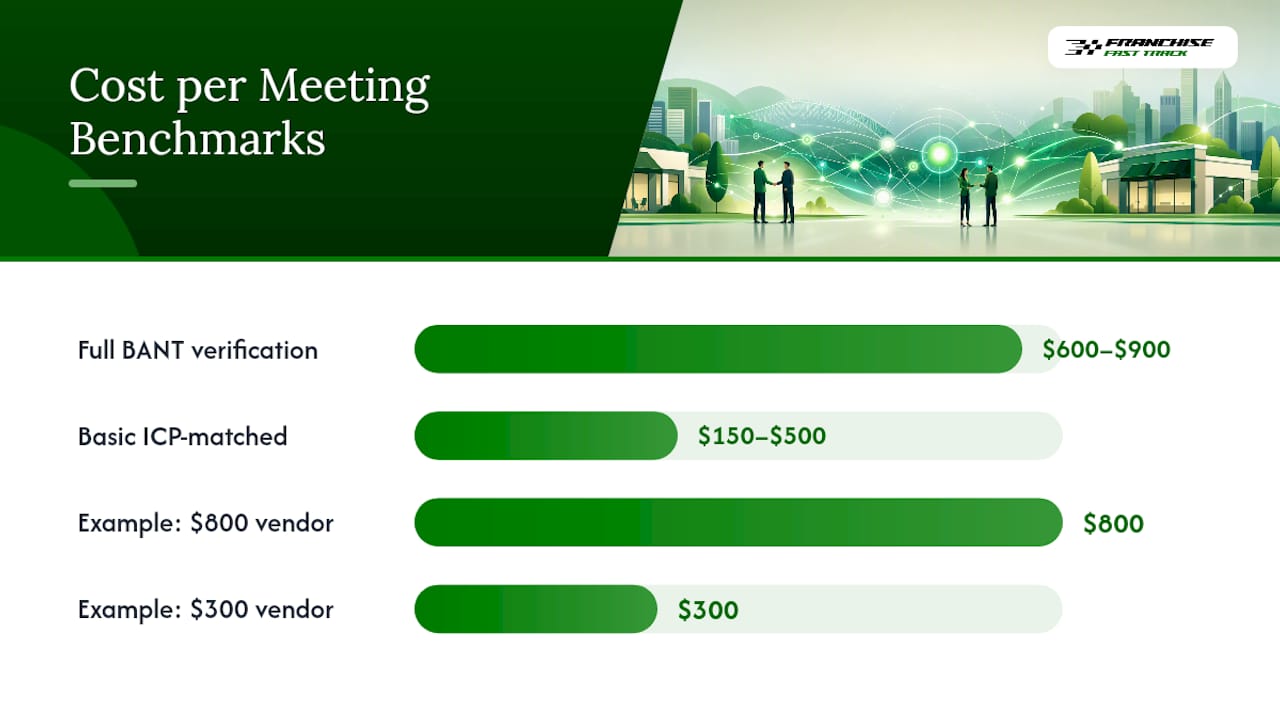
| KPI | What Good Looks Like |
|---|---|
| Meeting-held (show) rate | High for a properly verified program |
| Cost per qualified-held meeting | $600–$900 for full BANT-style verification |
| Basic or ICP-matched meeting pricing | $150–$500 depending on verification depth |
| Lead-to-close / award rate | Benchmark against 34% reported by Franchise Fast Track |
How Do You Vet a Performance-Based Lead Provider?
Work through this checklist before you sign anything:
- Does the proposal include a written definition of "qualified"?
- Is there a documented no-show replacement policy?
- Who owns the contact data after the contract ends?
- Is the engagement exclusive to your brand, or shared across competitors?
- Will they provide sample handover sheets before you commit?
- Can they show historical show-rate data, not just projected numbers?
- Will they provide references from franchisors in a comparable deal-size range?
On the discovery call itself, ask directly for historical show rates by month, a sample AE briefing document, and written confirmation of who owns the resulting contact list. Walk away, or at least slow down, if you hit any of these:
- They refuse to put a qualification definition in the contract
- They lean on recycled or shared prospect databases
- They guarantee a full calendar of appointments in week one
- They won't agree to a held-or-replace clause
How Does Pricing and Contract Structure Typically Work?
Pricing tiers roughly map to verification depth: pay-per-scheduled sits lowest and riskiest, pay-per-held sits in the middle, and pay-per-qualified-held commands the premium, usually $600–$900 per meeting for higher-income buyer segments. The negotiation actually happens around the payment trigger, the replacement policy for no-shows, whether there's a retainer floor stacked on top of per-appointment fees, and who owns the data when the contract ends.
Run the math before you negotiate. If your average franchise award is worth $40,000 and you close 1 in 4 qualified-held meetings, a $750 meeting costs you $3,000 per award, which is a fraction of what most in-house SDR programs cost per closed deal once salary, tools, and management time are counted. Fully loaded in-house SDRs producing 8 qualified meetings a month often run close to $1,250 per meeting, before conversion is even factored in.
- Start with a 90-day pilot, not a 12-month commitment
- Demand weekly QA reports on show rates and qualification accuracy
- Require handover documents as a contractual deliverable, not a courtesy
What's the Realistic Onboarding Timeline?
Setup follows a predictable arc:
- Weeks 0–1: align on your ideal customer profile and qualification script (BANT or equivalent)
- Weeks 2–4: outreach launches, sequences get optimized based on early response data
- Weeks 3–6: appointment flow stabilizes into a steady, predictable cadence
Most high-quality programs hit their real stride around week 6 to 12, not week one. Anyone promising full volume immediately is skipping the qualification work that makes the leads worth paying for.
On the integration side, you'll need CRM field mapping so verified data lands where your sales team can see it, clear calendar booking rules, a meeting confirmation template, and an AE handover document standard. One more thing that gets overlooked: speed to confirm matters. When a vendor books a meeting, have your AE confirm within hours, not days, since contact delay is one of the biggest silent killers of show rates.
What Results Should You Expect From a Verified Program?
Franchise Fast Track's model offers a useful reference point. The company delivers hundreds of appointments monthly with verified professionals earning between $150K and $500K a year, targeting executives, directors, and senior managers actively looking to own a franchise.
Track these against your own numbers:
- Appointments delivered per month
- Show rate on those appointments
- Lead-to-opportunity and opportunity-to-award conversion
Your own results will vary with deal size, territory count, and how tightly your ideal buyer profile is defined. A program built for $150K to $500K earners won't automatically transfer to a $40K franchise fee concept with a different buyer persona.
When Does Pay-For-Performance Actually Make Sense?
Pay-for-performance earns its keep when your deal size is high enough to absorb a $600 to $900 meeting cost and you need to validate a new market or persona fast. It works less well as a permanent substitute for a real internal sales motion. I'd treat performance-based appointment setting as a testing tool first: prove the model over 90 days, then decide whether to scale it, blend it with an in-house team, or negotiate down to a retainer once volume justifies it. Pro Tip: Never build your pipeline on a single vendor. Keep at least one proprietary, verified list running alongside any performance-based program so you're never fully exposed to one provider's data quality.
Get Verified, High-Income Buyer Appointments With Franchise Fast Track
Compared to running your own outbound team or gambling on a low-cost lead broker, Franchise Fast Track gives you appointments only with buyers who have already cleared income and intent verification, so your development team spends time closing instead of qualifying.
That's the entire pitch: fewer, better meetings, with the qualification work already done before your team ever picks up the phone. If you're weighing a 90-day pilot against building an internal SDR function, start by reviewing the franchise lead generation service page and get a breakdown of how the verification and handover process would work for your specific franchise concept.
Frequently Asked Questions
What's the difference between pay-per-lead and pay-per-appointment franchise leads? Pay-per-lead charges you for a contact record with minimal verification. Pay-per-appointment charges you only after a meeting is scheduled, and pay-per-qualified-held, the strongest version, charges you only after that meeting happens with a buyer who meets your defined criteria.
How much should I expect to pay for a qualified franchise buyer appointment? Fully verified, qualified-held meetings for higher-income buyer segments typically run $600 to $900 per meeting. Basic or lightly qualified meetings can run $150 to $500 depending on verification depth.
What show rate should I expect from a performance-based franchise lead vendor? Anything consistently under 60% signals a qualification or confirmation process problem worth investigating before renewal.
How long does it take to get quality appointments after signing a contract? Expect early weeks to focus on list building and profile alignment, with appointment volume stabilizing between week 6 and week 12. Vendors promising a full calendar in week one are usually skipping real qualification work.
Should franchisors use performance-based leads instead of hiring internal sales staff? Not necessarily instead of, but often before. Performance-based programs are a strong way to validate a new market or persona quickly, while a fully loaded internal SDR team can cost more per meeting once salary and management overhead are factored in.
Sources
A few resources worth opening if you're building out a vendor evaluation process or negotiating your first contract:
- Pay Per Appointment Lead Generation: 2026 Pricing Guide
Recommended
Ready to see results like these for your franchise?
Stop wasting money on leads that never close. Start getting hundreds of replies from high-net-worth professionals daily.