How to Match Clients to Franchise Opportunities in 2026
How franchise opportunity matching actually works
The best way to match clients to franchise opportunities is to assess three core pillars before looking at a single brand: financial reality, operating style, and lifestyle non-negotiables. Get those three right, and the shortlist practically writes itself. Skip them, and you're guessing, which is how people end up owning a business they resent within two years.

Franchise matching is not a personality quiz followed by a sales call. It's a structured process that maps a client's actual life, not their aspirations, to a business model they can realistically run and sustain. Professional assessments for fit typically take only a few minutes to complete, yet the data they surface drives every decision that follows.
The critical client factors that determine franchise fit:
- Financial capacity: liquid capital, total net worth, credit profile, and risk tolerance
- Operating style: hands-on daily operator, semi-absentee owner, or multi-unit investor
- Lifestyle requirements: hours per week, travel tolerance, family commitments, and desired income timeline
- Skills and background: management experience, sales aptitude, industry familiarity
- Geographic constraints: territory availability, local market demand, and commute limits
- Growth ambitions: single-unit lifestyle business vs. aggressive multi-unit expansion
Every step in the matching process flows from these six factors. A client who checks all the financial boxes but refuses to manage employees will fail in a staffing franchise no matter how profitable the brand looks on paper.
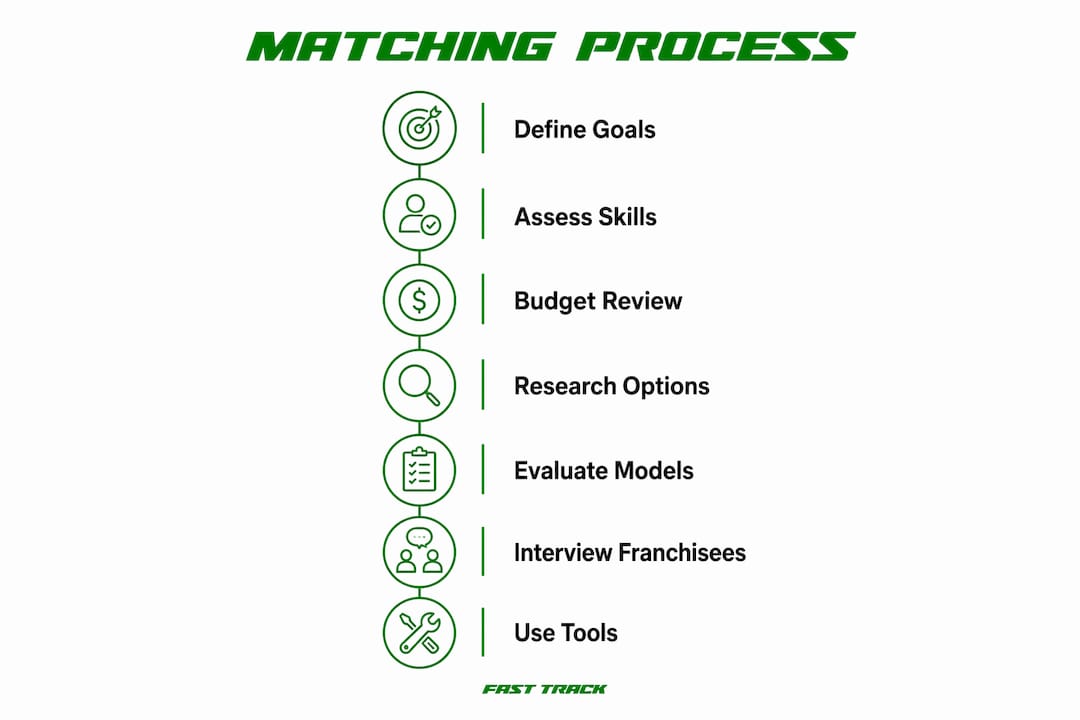
1. Define personal and professional goals first
Goals determine franchise type more than any other single variable. A client who wants to replace a substantial salary quickly needs a very different franchise than one who plans to build a portfolio over many years and eventually exit. Treating both clients the same way is one of the most common mistakes in franchise consulting.
Professional goals to clarify upfront include income targets, timeline to profitability, desire for business growth, and whether the client wants to eventually sell or pass the business on. Personal goals are equally important: work-life balance expectations, the need for creative control, community involvement, and whether the client wants to work alongside family.
Steps to clarify goals before shortlisting any franchise:
- Write down both a 12-month income target and a 5-year income target separately
- Identify whether the primary motivation is wealth building, lifestyle flexibility, or career transition
- Determine how many hours per week the client is genuinely willing to work, not just willing to say
- Clarify whether the client wants to be the face of the business or operate behind the scenes
- Rank the top three non-negotiables, the things they will not compromise on regardless of brand appeal
Pro Tip: Ask clients to rank their goals from most to least important before the first brand conversation. When a shiny franchise opportunity appears, that ranked list becomes the filter that prevents emotional decisions from overriding practical ones.
Short-term and long-term goals often conflict, and surfacing that tension early saves everyone time. A client who says they want passive income but also wants to be deeply involved in daily operations needs that contradiction resolved before any matching begins.
2. Assess skills, interests, and operating style for franchise compatibility
Skills assessment is where honest self-evaluation separates good matches from expensive mistakes. The goal is not to find a franchise that matches what a client has done before, but to find one that matches how they naturally operate and what they genuinely enjoy doing day to day.
Operating style breaks into three broad categories. Hands-on operators want to be present in the business daily, managing staff and serving customers directly. Semi-absentee owners prefer to hire a manager and check in a few times per week. Multi-unit investors want systems they can replicate across locations with minimal personal involvement in any single unit. Each model demands a completely different franchise structure.
Key questions and trait categories for skills and style assessment:
- Do you prefer managing people or managing processes?
- Are you comfortable with direct sales, or do you prefer a service-delivery role?
- How do you handle ambiguity and problem-solving without a corporate safety net?
- Do you have experience hiring, training, and retaining hourly employees?
- What industries genuinely interest you, not just financially but day to day?
- Are you energized by customer interaction, or do you prefer a B2B model with fewer relationships?
Personal fit is the leading indicator of long-term franchise success, ahead of brand profitability or market size. A client who hates managing teenagers will struggle in a fast-food franchise regardless of the territory's demographics. Matching interests to industry is not a soft consideration; it's a hard filter.
3. Understand financial requirements and conduct a budget assessment
Financial misalignment kills more franchise matches than any other factor. Clients routinely underestimate total investment costs by focusing on the franchise fee while ignoring working capital, build-out expenses, equipment, and the personal living expenses they need to cover during the ramp-up period.
The Franchise Disclosure Document is the authoritative source for financial requirements. The FTC requires franchisors to provide the FDD before any agreement is signed or any money changes hands. Item 7 of the FDD details the estimated initial investment range, and Item 19 contains financial performance representations, though not all franchisors choose to include Item 19 data.
Financial assessment components every client needs to work through:
- Liquid capital available: cash, savings, and accessible retirement funds (ROBS strategies apply here)
- Total net worth: determines eligibility for many mid-to-large franchise systems
- Credit score and borrowing capacity: SBA loans require a minimum credit score generally considered to be on the higher end
- Risk tolerance: how long can the client sustain the business without drawing a salary?
- Monthly personal burn rate: living expenses that must be covered during the ramp-up phase
- Contingency reserve: most advisors recommend 6 months of operating capital beyond the stated investment range
Financial reality check: The FDD must be received and reviewed before signing any agreement or paying any fee. Buyers who skip this step often discover undisclosed obligations after it's too late to walk away cleanly.
Pro Tip: Build a simple spreadsheet that separates the franchise investment into three buckets: initial fees and setup, working capital for the first 12 months, and personal living expenses for the same period. Clients who see all three numbers together make far more grounded decisions than those who only see the franchise fee.
Aligning budget to franchise category is straightforward once the numbers are honest. Home-based service franchises often require lower total investment than brick-and-mortar retail concepts. A client with $80,000 liquid should not be touring $500,000 restaurant franchises, no matter how much they love the brand. For a deeper look at evaluating franchise investments, the financial and operational criteria overlap more than most clients expect.
4. Research industry trends and available franchise options
Once goals, skills, and finances are mapped, the research phase narrows the universe of options to a workable shortlist. The U.S. franchise market includes thousands of active brands across various industries, so starting without filters is a fast path to decision paralysis.
Industry trend research matters because a franchise that thrived in 2019 may face structural headwinds in 2026. Home services, health and wellness, senior care, and B2B service franchises have shown consistent demand growth as demographic and lifestyle shifts accelerate. Food and beverage franchises carry higher investment requirements and thinner margins, which makes them a poor fit for first-time owners without restaurant experience.
Research sources and steps for building a shortlist:
- Review FDDs for franchises in your target categories, focusing on Item 20 (franchisee turnover) and Item 21 (financial statements)
- Consult franchise industry reports and the International Franchise Association's annual economic outlook
- Attend franchise expos to compare multiple brands in one setting and ask direct questions of brand representatives
- Use franchise consultant networks to access curated brand databases filtered by investment level and industry
- Cross-reference territory availability with local market data before committing time to any brand's discovery process
Franchise brokers and consultants often maintain access to extensive databases of franchise brands, which gives clients a broader view than searching independently. The FTC's consumer guidance notes that franchise brokers typically work for franchisors and are paid only when a sale closes, so understanding that dynamic is part of informed research.
5. Evaluate franchise business models and organizational culture
Not all franchise models are created equal, and the business model a client chooses will shape their daily life for years. A retail franchise with six employees and weekend hours is a fundamentally different business than a B2B consulting franchise with no storefront and a Monday-through-Friday schedule, even if both carry similar investment requirements.
Structured due diligence on the franchisor relationship and support systems matters more than brand name recognition. A well-known brand with poor franchisee support and a litigious relationship with its owners is a worse bet than a lesser-known brand with a strong training program and a collaborative franchise advisory council.
Business model evaluation criteria:
- Hours of operation: does the schedule match the client's lifestyle requirements?
- Staffing demands: how many employees does the model require, and what's the typical turnover rate?
- Level of owner control: how much can the franchisee customize operations vs. following a rigid system?
- Team vs. solo model: does the client want to build a team, or prefer a low-headcount operation?
- Revenue model: is income recurring, project-based, or transaction-driven?
- Franchisor support: what does training, marketing, and ongoing coaching actually look like in practice?
Pro Tip: Culture fit is harder to quantify than financials, but it's just as predictive of success. Ask the franchisor directly: "What happens when a franchisee disagrees with a system change?" The answer tells you more about the relationship than any brochure will.
A franchise's culture shows up in how franchisors treat underperforming owners, how transparent they are about system-wide challenges, and whether they actively solicit franchisee input. Clients who prioritize brand recognition over cultural alignment often find themselves locked into a 10-year agreement with a franchisor they don't respect.
6. Speak with current franchisees and verify opportunity information
Franchisee interviews are the single most underused tool in the matching process. Current owners will tell you things the FDD cannot: what the first year actually felt like, whether the franchisor delivered on its training promises, and whether the territory projections held up in the real market.
The FTC's consumer guidance explicitly recommends talking to current and former franchisees listed in the FDD before signing. Item 20 of the FDD contains a list of current and recently departed franchisees with contact information. Most buyers contact two or three; the ones who do thorough due diligence talk to ten or more across different markets and tenure levels.
Verification steps and key questions for franchisee interviews:
- Confirm territory availability and exclusivity terms with the franchisor directly, not just the broker
- Ask current franchisees: "Knowing what you know now, would you buy this franchise again?"
- Ask about the ramp-up timeline: how long before the business covered its own operating costs?
- Request contact information for franchisees who have exited the system in the past 24 months
- Review Item 20 of the FDD for franchisee turnover trends across the past three years
- Verify that financial performance representations in Item 19 reflect locations comparable to your target territory
No shortcut replaces this step. A client who skips franchisee interviews because the brand "feels right" is making a six-figure decision on marketing materials. The FDD review process and franchisee conversations work together; one without the other leaves critical gaps.
7. Use structured assessments and professional matching tools
Professional assessments bring structure to what is otherwise a subjective process. The best tools measure financial readiness, lifestyle compatibility, and operational fit simultaneously, producing a profile that can be matched against franchise categories rather than individual brands. This approach filters out poor fits before any brand conversation begins.
Digital franchise matching tools effectively narrow a large universe of options to a shortlist, but they work best as filters, not final answers. An AI-powered platform can rank 300 brands by fit score in seconds; it cannot tell you whether the franchisor's regional support manager actually returns calls or whether the brand's culture matches how a specific client operates under pressure.
Key components of a well-designed franchise assessment:
- Financial readiness score based on liquid capital, net worth, and risk tolerance
- Operating style profile: hands-on, semi-absentee, or investor model preference
- Lifestyle compatibility index: hours, travel, team size, and schedule flexibility
- Skills inventory: management depth, sales experience, and industry background
- Goal alignment score: income targets vs. franchise category typical earnings
- Personality and decision-making style, particularly relevant for franchise systems with strong cultural identities
Franchise failures are largely traced to a mismatch between owner temperament, lifestyle, and operating style rather than the franchise concept itself. That pattern is why structured assessments exist: to surface the mismatch before it becomes a financial loss. Consultants who identify deal-breakers early and are willing to tell a client "this isn't the right fit" provide more value than those who push toward a close regardless of alignment.
8. Why franchise culture and values deserve their own evaluation
Culture is not a soft add-on to the franchise evaluation process. It is the operating environment a franchisee will live inside for the duration of their agreement, which typically runs 10 years with renewal options. A client who values autonomy and transparency will struggle inside a franchise system that enforces rigid compliance and communicates top-down.
The franchisor-franchisee relationship functions best when it is treated as a structured business partnership rather than a licensing transaction. Franchise ownership built on a strong relationship with the franchisor and a clear sense of shared values tends to outperform ownership driven purely by brand profitability projections.
Concrete ways to evaluate culture before signing:
- Attend the franchisor's Discovery Day and observe how leadership interacts with prospective owners
- Ask the franchise development team how they handle franchisees who push back on system changes
- Review the franchise advisory council structure: do franchisees have a real voice, or is it advisory in name only?
- Read through Item 8 and Item 9 of the FDD, which detail franchisee obligations and restrictions, to understand how much control the franchisor retains
A franchise system where the top performers consistently renew their agreements and expand to additional units is a strong signal of cultural health. Turnover data in Item 20 of the FDD tells that story in numbers.
9. How to build a structured client assessment framework
A repeatable assessment framework turns franchise matching from an art into a process. Without structure, consultants rely on intuition and clients rely on emotion, which produces inconsistent results. A good framework captures the same data points from every client and applies the same scoring logic to every brand comparison.
The framework should move through four stages in sequence: discovery, profiling, shortlisting, and validation. Discovery gathers raw information through a questionnaire or interview. Profiling converts that information into a scored client profile across the six key dimensions covered earlier. Shortlisting applies the profile against a brand database to generate a ranked list of compatible opportunities. Validation involves franchisee interviews and FDD review to confirm that the shortlisted brands hold up under scrutiny.
A practical client assessment questionnaire covers:
- Current income, liquid assets, total net worth, and monthly personal expenses
- Desired income from the franchise in year one, year three, and year five
- Maximum weekly hours the client is willing to commit to the business
- Preference for B2B vs. B2C customer interaction
- Comfort level with managing employees (none, a few, or a large team)
- Industries the client finds genuinely interesting vs. merely acceptable
- Geographic territory preferences and any relocation constraints
- Timeline to opening and timeline to profitability expectations
Scoring each response against a weighted rubric produces a client profile that can be compared directly to franchise category requirements. This approach removes the bias that comes from a client falling in love with a brand before confirming it fits their actual life. For clients with an executive background, the franchise ownership roadmap adds useful context on how corporate skills translate to franchise operations.
10. Legal and contractual considerations in franchise agreements
The franchise agreement is a long-term legal commitment, and clients who treat it as a formality rather than a negotiation point often discover restrictive clauses after signing that they could have addressed or at least understood beforehand. The agreement governs territory rights, renewal terms, transfer conditions, and the circumstances under which the franchisor can terminate the relationship.
Every client should engage a franchise attorney before signing. This is not optional. A franchise attorney reviews the agreement specifically for clauses that deviate from industry norms, including unilateral amendment rights (where the franchisor can change the operations manual without franchisee consent), post-termination non-compete provisions, and renewal fee structures that differ from the initial agreement terms.
The FDD and the franchise agreement work together but are not the same document. The FDD is a disclosure document required by the FTC that must be provided at least 14 calendar days before signing or paying. The franchise agreement is the binding contract. Clients should read both in full, with legal counsel, before any commitment.
Key contractual terms to scrutinize:
- Territory exclusivity: is it protected, or can the franchisor open competing units nearby?
- Renewal terms: what are the conditions and costs for renewing at the end of the initial term?
- Transfer rights: can the client sell the franchise, and what approval process does the franchisor require?
- Performance requirements: what sales or operational benchmarks must the franchisee meet to stay in good standing?
11. Matching clients to franchise opportunities by location and market potential
Territory selection is one of the most consequential decisions in the franchise buying process, and it often receives less attention than brand selection. A strong franchise concept in a saturated or demographically mismatched market will underperform a weaker concept in a well-chosen territory.
Market potential assessment starts with demographic alignment. Every franchise has a customer profile, and the territory needs to contain enough of that customer type to support the business model's revenue projections. A senior care franchise needs a sufficient population of adults aged 65 and older within the service area. A children's tutoring franchise needs families with school-age children and disposable income.
Steps for evaluating geographic fit:
- Confirm territory availability with the franchisor before investing time in the discovery process
- Review the franchisor's territory definition: is it based on zip codes, population count, or a radius?
- Analyze local competition, both within the franchise system and from independent operators
- Check local zoning and permitting requirements for the business type
- Assess the local labor market: can the client realistically hire and retain the staff the model requires?
Population density, median household income, and local business climate all factor into territory viability. Some franchisors provide territory analysis tools or demographic reports as part of their discovery process; clients should request this data and verify it independently rather than accepting franchisor projections at face value.
12. Tools and resources for franchise comparison and scoring
Comparing franchise opportunities without a scoring framework produces a list of brands with no clear winner. A structured comparison tool forces clients to evaluate every option against the same criteria, which makes the eventual decision defensible rather than gut-driven.
The most useful comparison frameworks score each franchise across five dimensions: financial fit, operational fit, lifestyle fit, market fit, and cultural fit. Each dimension gets a weighted score based on the client's profile, and the total score ranks the shortlisted brands. This approach makes it immediately visible when a brand scores high on financials but low on lifestyle, which is a common mismatch pattern.
Resources that support franchise comparison and scoring:
- The FDD for each brand, specifically Items 5, 6, 7, 19, and 20
- Franchise consultant databases that include brand performance history and franchisee satisfaction data
- Franchise expos and Discovery Days for direct brand comparison in a compressed timeframe
- Independent franchise review platforms that aggregate franchisee feedback
- The Franchise Fast Track franchisee directory for connecting with current owners across brands
A scoring matrix does not make the decision; it structures the information so the decision is based on evidence rather than marketing. Clients who use a written comparison framework are far less likely to experience buyer's remorse after signing.
13. Post-match support and follow-up processes
The matching process does not end when a client signs a franchise agreement. The period between signing and opening, and the first 12 months of operation, are when the quality of post-match support determines whether the match actually works in practice.
Good post-match support includes access to the franchisor's training program, ongoing coaching from the consultant or advisor who facilitated the match, connections to financing resources if needed, and a clear escalation path when operational problems arise. Clients who feel abandoned after signing are more likely to struggle through avoidable early-stage problems.
A strong franchise support system from the franchisor side includes initial training, field support visits, marketing assistance, and a peer network of other franchisees. From the consultant side, post-match follow-up means checking in at 30, 90, and 180 days after opening to confirm the client is on track and to surface any issues before they compound.
Post-match follow-up steps that protect the client's investment:
- Confirm the client has completed all pre-opening training requirements
- Verify that territory setup, local licensing, and operational systems are in place before the launch date
- Schedule a 30-day check-in to review early revenue, staffing, and operational challenges
- Connect the client with the franchisor's franchisee peer network for ongoing support
- Review the first-year financial performance against the projections used during the matching process
The goal of post-match support is not to manage the client's business for them. It's to catch misalignments early, when they're still correctable, rather than letting small problems grow into reasons to exit the system.
Key Takeaways
Matching clients to franchise opportunities requires a structured, multi-stage process that prioritizes financial reality, operating style, and lifestyle fit before any brand is introduced.
| Point | Details |
|---|---|
| Three pillars drive every match | Financial reality, operating style, and lifestyle non-negotiables must be assessed before shortlisting any brand. |
| FDD review is non-negotiable | The FTC requires franchisors to provide the Franchise Disclosure Document before signing; Items 7, 19, and 20 are the most critical sections. |
| Franchisee interviews close the gap | Talking to 10 or more current and former owners reveals what the FDD and marketing materials cannot. |
| Structured scoring beats gut instinct | A weighted comparison framework across financial, operational, lifestyle, market, and cultural fit produces defensible decisions. |
| Post-match support determines outcomes | Check-ins at 30, 90, and 180 days after opening catch early misalignments before they become costly problems. |
Franchise Fast Track connects franchisors with the right buyers
For franchisors, the matching process only works when the buyers entering discovery are genuinely qualified. Franchise Fast Track delivers pre-screened franchise buyers who are verified high-income professionals earning between $150,000 and $500,000 annually, including executives, directors, and senior managers actively seeking franchise ownership. The platform's reported lead-to-close rate of 34% reflects what happens when the matching process starts with the right candidates rather than general leads. If your franchise development team is spending time on unqualified inquiries, Franchise Fast Track is built to fix that.
Recommended
Ready to see results like these for your franchise?
Stop wasting money on leads that never close. Start getting hundreds of replies from high-net-worth professionals daily.