Franchisors: Book Verified $150k–$500k Franchise Leads That Convert
To get franchise leads that convert, build a multi-channel pipeline that targets verified, high-income candidates, then respond within minutes and run every prospect through a strict qualification workflow. Franchise Fast Track's own pipeline reports a lead-to-close rate on appointment-set candidates that is notably higher than the low single digits typical of unfiltered portal traffic. The two moves that matter most right now: cut your response time to minutes, not days, and gate every lead behind a financial qualification step before a salesperson touches it.
TL;DR:
- Responding to leads within minutes and pre-qualifying all prospects significantly boost conversion rates, especially when screening is tied to financial gates upfront.
- Using multiple channels like portals, paid search, social media, and referral networks diversifies lead sources and helps filter high-income candidates more effectively.
- Implementing a structured qualification system with explicit financial criteria and proof of funds prior to discovery calls prevents wasted sales efforts on underfunded prospects.
- Continuous measurement of key metrics such as speed-to-contact, qualified leads, and lead-to-sign conversion enables ongoing improvements in lead generation and nurturing processes.
- Verified appointment setting with income confirmation and strict SLAs improves lead quality and shortens the path from inquiry to franchise award.
Table of Contents
- Top Lead Channels That Consistently Deliver Qualified Franchise Prospects
- Qualify and Filter Leads Before You Invest Sales Time
- Operate Faster: Speed to Lead, CRM SLAs, and the Handoff Process
- Budget Expectations and Key Performance Benchmarks
- Measurement and Continuous Improvement: The Pipeline You Must Run
- Publisher Perspective: Why a Managed, Appointment-Setting System Improves Lead-to-Close
- Legal and Compliance Considerations in Franchise Lead Generation Marketing
- Strategies to Create Compelling Franchise-Specific Marketing Messages
- Best Practices for Leveraging Franchisee Referrals to Generate Qualified Leads
- Using Data Analytics and Market Segmentation to Target Ideal Candidates
- Nurturing Candidates From Discovery Day Through FDD to Award
- Why Most Franchisors Get Lead Generation Backwards
- Get Qualified Franchise Appointments Without the Portal Guesswork
- Sources
Top Lead Channels That Consistently Deliver Qualified Franchise Prospects
Not every channel deserves equal budget, and the franchisors who scale fastest tend to run three or four channels at once rather than betting everything on one.
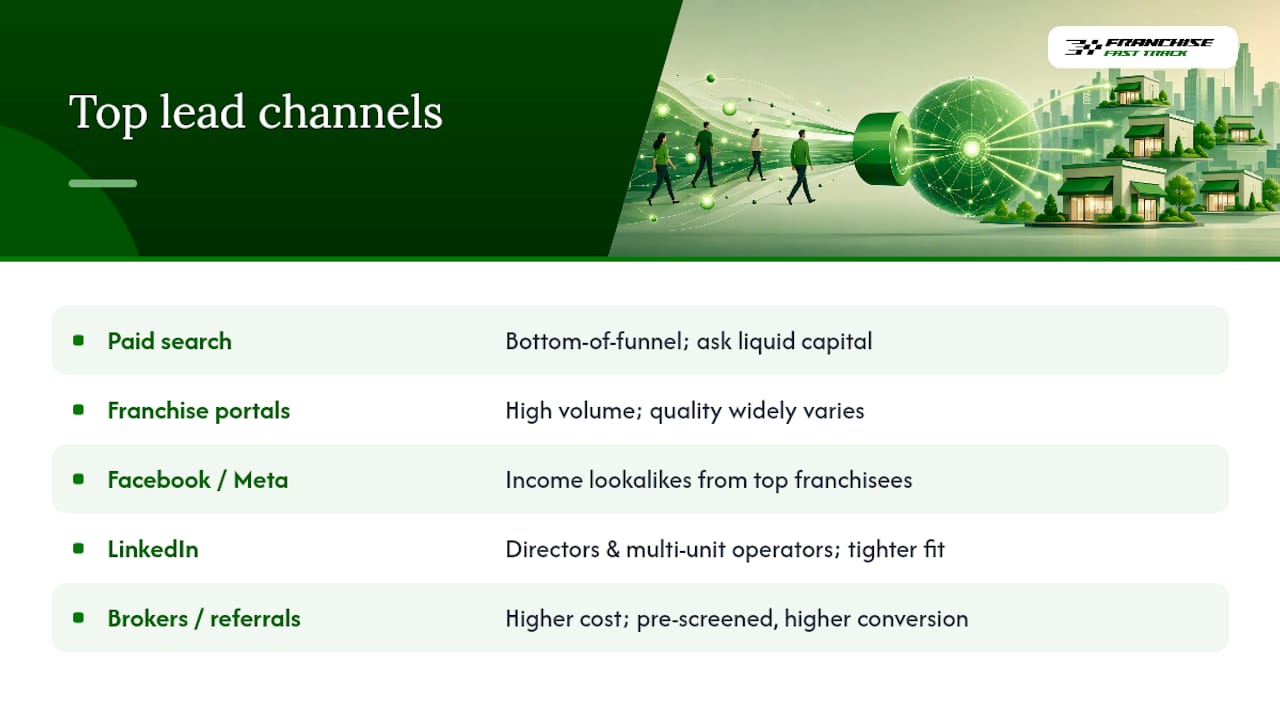
Franchise portals (FranchiseDirect, Franchising.com, FBR) still generate volume, but the leads skew casual. Optimize listings with real unit economics, a specific investment range, and a video, not a generic brochure PDF. Expect a wide spread in quality depending on the portal and category.
Paid search captures buyers already typing "franchise opportunities in [category]" or "own a [brand] franchise." Build landing pages around financial qualification rather than brand storytelling. This is bottom-of-funnel intent, so the page should ask for liquid capital before it talks about culture.
Facebook and Meta ads work best with income-based lookalike audiences built from your existing high-net-worth franchisee list. Layer in interest targeting around business ownership and investment, and exclude anyone who has already engaged with a competitor's franchise content.
LinkedIn is underused for this. Targeting Director-level and above, plus multi-unit operators already running other brands, surfaces candidates with both capital and management experience. It costs more per click than Facebook but the profile fit is usually tighter.
Video and YouTube content, especially founder interviews and franchisee testimonial series, builds trust before a prospect ever fills out a form. YouTube's reach across working-age demographics makes it a strong top-of-funnel channel for franchise discovery, even though it rarely drives direct conversions on its own.
Expos and webinars deliver a small number of highly motivated candidates. The mistake most franchisors make is treating the booth as the event. Follow up within 24 hours or the intent evaporates.
Brokers and referral networks cost more per lead but convert at a materially higher rate because the candidate has already been financially screened by the broker before you ever see the name.
Qualify and Filter Leads Before You Invest Sales Time
A structured qualification process, built around CRM workflows and clear financial gates, prevents motivated but underfunded candidates from consuming hours of your development team's time. The screening should happen before nurturing begins, not after.
Start with the form itself. Ask for liquid capital range, net worth, preferred territory, and timeline to purchase directly on the intake form or behind a gated brochure download. Anyone unwilling to answer those four questions rarely closes anyway.
From there, apply a simple scoring rubric:
- 0-2 points: Vague timeline, no capital disclosed. Route to a nurture sequence, not a call.
- 3-5 points: Capital range disclosed, timeline under 12 months. Schedule a discovery call.
- 6+ points: Proof of funds available, territory specified, timeline under 90 days. Fast-track to a live screening call within 48 hours.
Require proof of funds before a Discovery Day invitation goes out, not after. Automated pre-screen tools (chat-based qualifiers, calculator widgets that estimate required capital) catch false positives early and save your sales team from chasing candidates who were never going to qualify.
Pro Tip: Add a single "why now" open-text field to your intake form. The answer quality tells you more about real intent than any dropdown menu ever will.
For a deeper breakdown of scoring weights, Franchise Fast Track's guide on what franchise lead qualification actually means walks through the full rubric.
Operate Faster: Speed to Lead, CRM SLAs, and the Handoff Process
Response time is the single biggest lever most franchisors underuse. Responding to a franchise inquiry within minutes rather than hours or days substantially increases the odds of conversion, and yet most development teams still let leads sit overnight.
A workable SLA framework looks like this:
- Auto-acknowledge every inbound lead within 5 minutes via automated email or text.
- Complete a live screening call within 24 to 72 hours of first contact.
- Schedule Discovery Day within 14 days of a qualified screening call.
- Track every stage with CRM timers that flag SLA breaches to a manager automatically.
Your CRM needs SLA timers, evidence capture (recorded call notes, financial disclosures on file), automated confirmation emails, and built-in calendar booking so a candidate can self-schedule a screening call without a back-and-forth email chain. Tools built specifically for this, like Speed to Lead AI's automated engagement system, exist precisely because manual follow-up almost always lags. Calendar-booked appointments show up to the call at a far higher rate than "we'll call you" leads, which is the whole argument for building appointment-setting into the funnel rather than bolting it on afterward.
Budget Expectations and Key Performance Benchmarks
A franchisor spending on portals alone should expect a moderate cost-per-lead, but the lead-to-signed conversion rate is typically low. That math means CPL alone is a misleading number. A cheap lead that never closes costs more than an expensive one that does.
Digital ads targeting higher-intent buyers typically run $50 to $150 per lead but convert at a better rate because the audience is pre-filtered by income and interest. Broker-sourced candidates cost the most per lead yet convert at a significantly higher rate than other channels (https://leadsuitenow.com/blog/franchise-lead-generation-usa-2026), which is why many multi-unit operator strategies lean on brokers despite the higher sticker price.
To find your true cost-per-signed-unit, divide channel CPL by that channel's qualified rate and lead-to-sign conversion. Set a go/no-go threshold, then scale whatever clears it.
Measurement and Continuous Improvement: The Pipeline You Must Run
A minimal dashboard tracks five numbers: total volume, qualified-lead count, speed-to-first-contact, Discovery Day scheduling rate, and lead-to-sign conversion. Everything else is noise until those five are stable.
Run a standing A/B test checklist across:
- Landing page headline and financial-requirement placement
- Lead form length (four fields versus ten)
- Ad creative (founder-led video versus static testimonial)
- Follow-up sequence timing and channel mix
Scale winners in small increments, not by doubling spend overnight, and watch qualified rate as closely as raw volume when you do. Build a reallocation rule into the process: if a channel's qualified rate drops below your floor for two consecutive weeks, pause spend and re-diagnose before pouring more budget into it.
Publisher Perspective: Why a Managed, Appointment-Setting System Improves Lead-to-Close
Franchise Fast Track's model exists because generic portal leads and a managed appointment system solve fundamentally different problems. The platform reports delivering hundreds of verified appointments monthly with candidates earning a substantial income, alongside a lead-to-close rate significantly above what unfiltered lead volume typically produces, well above what unfiltered lead volume typically produces.
The gap comes down to verification. A portal lead is a name and an email. A verified appointment has already had income confirmed, intent screened, and a calendar slot booked before your team ever picks up the phone.
If you're evaluating an appointment-setting partner, check for:
- Documented income and net-worth verification, not self-reported claims
- Transparent reporting on appointment volume and show rates
- Written SLAs on response time and screening turnaround
- A calendar-booking system, not a "we'll pass you a phone number" handoff
That checklist separates real appointment-setting from a lead list with a better logo.
Legal and Compliance Considerations in Franchise Lead Generation Marketing
Franchise sales sit inside one of the more heavily regulated corners of marketing, and lead generation campaigns are not exempt just because they happen before a Franchise Disclosure Document (FDD) gets sent.
The Federal Trade Commission's Franchise Rule governs what a franchisor can claim in advertising before disclosure. Earnings claims, in particular, are a common trap: any specific revenue or profit figure mentioned in an ad, a landing page, or even a sales call must match what is disclosed in Item 19 of the FDD, or it becomes a legal liability. Several states, including California, New York, and Illinois, layer their own franchise investment laws on top of the federal rule, with registration and disclosure timing requirements that vary by state.
Lead capture forms also touch data privacy law. If your funnel collects personal financial information, California's CPPA rules and similar state privacy statutes may apply depending on where the candidate lives, not where your franchise is headquartered.
Practical compliance habits for a lead generation program: never state a specific income figure in ad copy unless it is backed by an Item 19 disclosure, keep a compliance reviewer in the loop on every landing page before it goes live, and train sales staff to redirect earnings questions to the FDD rather than answering informally on a discovery call. None of this replaces legal counsel, but building these habits into your marketing workflow now avoids a much more expensive conversation later.
Strategies to Create Compelling Franchise-Specific Marketing Messages
Generic franchise ads that lead with "be your own boss" get ignored because every competitor says the exact same thing. What actually moves qualified buyers is specificity: real unit-level numbers, a clear picture of what a typical week looks like, and messaging built around who the candidate actually is.
Buyer motivation varies enormously, and messaging should shift with it. An executive leaving corporate life wants proof they can replace their salary and maintain status. A semi-absentee investor wants management systems and a path to multiple units. Industry veterans want to know why your operating model beats what they already know. Treating all three the same way in a single ad flattens the pitch into something none of them respond to.
Franchise Fast Track's strategy tactics guide breaks down channel-specific messaging in more depth, but the core principle holds everywhere: replace vague lifestyle promises with concrete proof. Show real store-level revenue ranges (scoped correctly per your FDD), a franchisee's actual weekly schedule, and the exact capital and experience required to qualify.
Value propositions land harder when they answer one question directly: "Why this brand, for someone exactly like me, right now?" A landing page that answers that in the first ten seconds outperforms one that spends three paragraphs building up to it.
Best Practices for Leveraging Franchisee Referrals to Generate Qualified Leads
Existing franchisees are one of the most underused lead sources in the entire industry, and it's a mistake most development teams make out of simple neglect rather than strategy.
A formal referral program works better than an informal "let us know if you hear of anyone" ask. Offer a meaningful cash incentive, paid on signing rather than on lead submission, so franchisees only refer candidates they genuinely believe will succeed. Vague or unpaid referral asks produce a trickle of low-quality tips; paid, structured programs produce candidates who are pre-vetted by someone with skin in the game.
Franchisee testimonials and video interviews double as both referral bait and marketing content. A current operator's honest account of year one carries more weight with a prospective buyer than any brochure copy your marketing team writes, because the prospect can ask the franchisee follow-up questions directly.
Track referral-sourced leads separately in your CRM. Referral conversion rates typically run well above cold-channel averages, which makes the case for treating the program as a real budget line, not a favor you occasionally remember to ask for. A quarterly franchisee call specifically about referrals, separate from your regular operations check-ins, keeps the pipeline active instead of relying on memory.
Using Data Analytics and Market Segmentation to Target Ideal Candidates
Segmenting your candidate pool by motivation, not just demographics, changes which channels and messages actually perform. Executives seeking a career change, semi-absentee investors, and multi-unit operators behave differently at every stage of the funnel, and your data should reflect that from day one.
Start by tagging every lead source and every closed deal with a motivation category in your CRM. Over a few quarters, patterns emerge: maybe LinkedIn produces mostly executive-profile leads that take longer to close but sign larger territory packages, while Facebook produces investor-profile leads that close faster but at single-unit scale. Neither is wrong, but budget allocation should follow whichever pattern matches your current growth goal.
Overlay this with basic firmographic and geographic data. Territory demand, local income levels, and competitive density all affect which candidate profile is realistic for a given market. A franchisor targeting rural territories chasing executive-level income candidates is fighting the data; that market usually favors semi-absentee investors instead.
Run this segmentation analysis quarterly, not once a year. Buyer motivation and channel performance shift as your brand's market presence grows, and a segmentation model built during your first ten units rarely still fits at unit fifty.
Nurturing Candidates From Discovery Day Through FDD to Award
The gap between a qualified lead and a signed franchise agreement is usually measured in weeks of careful follow-up, not a single closing call.
Discovery Day should feel like a mutual evaluation, not a sales pitch. Candidates who arrive already screened and calendar-booked, rather than cold, tend to engage more seriously because they've already cleared the financial and intent bar before showing up. Use the day to introduce the operations team, current franchisees, and real unit-level financials, not just leadership.
Once the FDD goes out, the 14-day waiting period required in most states is not dead time. This is where candidates research on their own, talk to existing franchisees, and often get cold feet. A structured nurture sequence, check-in calls, answers to legal questions, an introduction to a nearby franchisee willing to talk candidly, keeps momentum without pressuring anyone past the disclosure window.
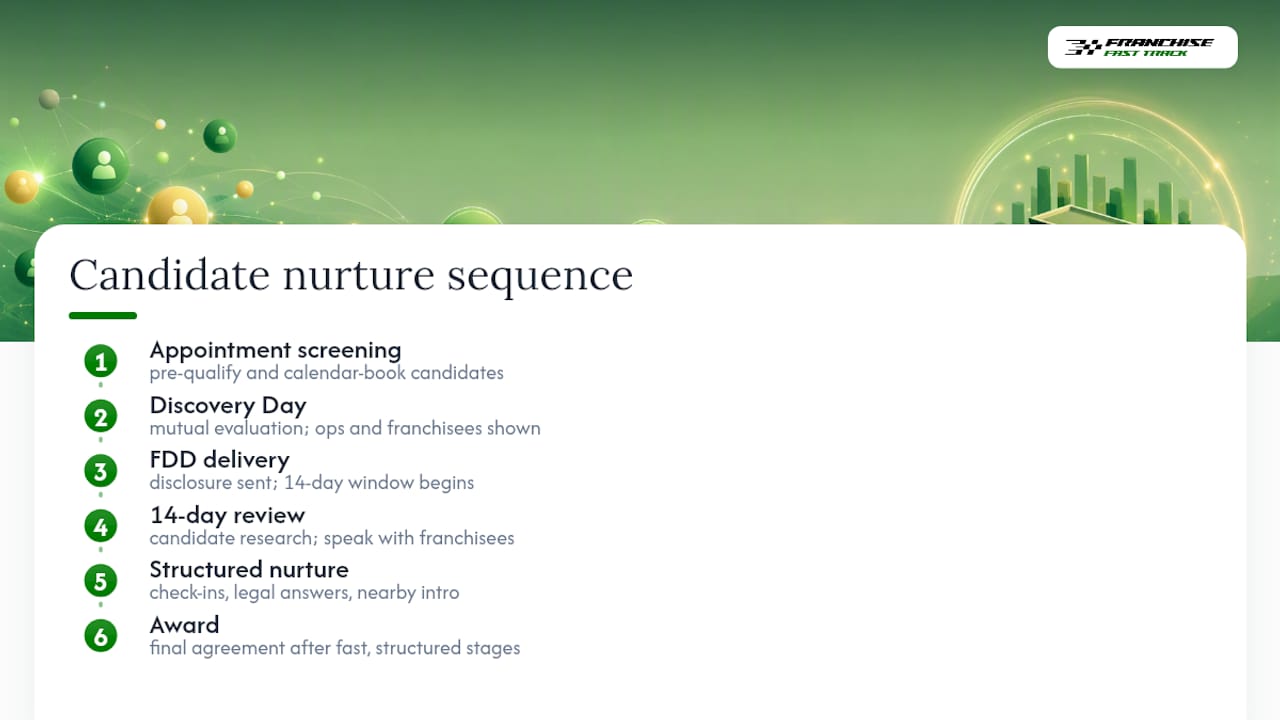
Award happens fastest when every prior stage was fast and structured. A candidate who waited three days for a screening call, then two weeks for Discovery Day, then radio silence during FDD review has had multiple chances to lose interest or find a competing opportunity. Franchise Fast Track's piece on why pre-qualified leads drive growth covers how appointment-based screening upstream shortens this entire back half of the funnel.
Why Most Franchisors Get Lead Generation Backwards
Most franchise development teams optimize for lead volume first and qualification second, and that ordering is exactly backwards. Volume feels productive. A dashboard showing 200 leads this month looks better than one showing 40, right up until the sales team burns three weeks chasing candidates with no capital and no real timeline.
The conventional advice, "cast a wide net, then filter," ignores the actual cost of filtering. Every hour a development rep spends screening an unqualified lead is an hour not spent moving a real candidate toward Discovery Day. Flip the order: qualify hard at the top with financial gates and verified intent, then nurture a smaller pool aggressively.
Speed compounds this. Teams treat response time as a nice-to-have when it's closer to the single highest-leverage fix available, cheaper than any new ad channel and faster to implement than any CRM overhaul. Fix the response clock and the qualification gate before you touch your channel mix. Everything else is optimization on top of a foundation that either holds or doesn't.
— Cody
Get Qualified Franchise Appointments Without the Portal Guesswork
Franchise Fast Track replaces the volume-and-hope model with verified, calendar-booked appointments, connecting franchisors directly with executives and senior managers earning $150,000 to $500,000 a year who have already been screened for income and intent. That's the practical difference between chasing 200 portal names and working a pipeline of appointments where the financial qualification is already done before the call.
The service handles the verification, the scheduling, and the pipeline setup, so your development team spends its time closing rather than filtering. If you're ready to see what a qualified, appointment-based pipeline looks like for your brand, visit the franchise lead generation page to request a pipeline review and see how the appointment volume and verification process would apply to your growth targets.
Sources
For deeper detail on the data and frameworks referenced above: franchise lead generation strategy guide, CPL and conversion benchmarks, CRM and qualification workflows, and lead response management practices.
- How to streamline franchise lead generation, qualification and nurturing
- YouTube global users age and gender distribution | Statista
Recommended
Ready to see results like these for your franchise?
Stop wasting money on leads that never close. Start getting hundreds of replies from high-net-worth professionals daily.