Why Franchise Developers Overspend on Bad Leads
The core reasons franchisors keep burning budget on the wrong prospects
Franchise developers overspend on bad leads for a handful of predictable reasons: they optimize for volume instead of fit, they measure the wrong things, and they rarely target the specific buyer profile that actually closes. The result is a pipeline that looks healthy on paper and bleeds money in practice.
Here is what drives it:
- Volume-over-quality thinking. When the goal is lead count, marketing fills the funnel with whoever clicks. Most of those people were never going to buy a franchise.
- Measurement gaps. Systems track form fills, not closed deals. Ad spend gets optimized toward the wrong signal.
- Weak qualification gates. Unfit prospects reach sales reps with no friction, consuming time that should go to real buyers.
- Ignoring pipeline conversion metrics. Without tracking lead-to-close rates by source, the true cost per qualified lead stays invisible.
- No income or professional verification. Targeting general audiences instead of verified high-income professionals floods the pipeline with contacts who lack the capital or commitment to close.
Table of Contents
- What poor lead quality actually costs you
- Why targeting verified high-income professionals changes the math
- Best practices to stop overspending on bad franchise leads
- The financial case for prioritizing qualified leads
- What a shift away from volume-based leads looks like in practice
- How to audit your existing lead generation spend
- Franchise Fast Track delivers the verified buyers your pipeline needs
- Key Takeaways
What poor lead quality actually costs you
The financial damage from low-quality leads runs deeper than most franchisors realize. Gartner research puts the average annual cost of poor data quality at $12.9 million per organization in lost productivity and bad decisions. That number is not abstract. It shows up in SDR salaries burned on dead-end calls, in AE quotas slipping because Tuesday went to a prospect with no budget, and in marketing teams celebrating MQL counts that sales will never close.
$12.9M — the average annual cost organizations absorb from poor data quality and low-quality leads, per Gartner research.
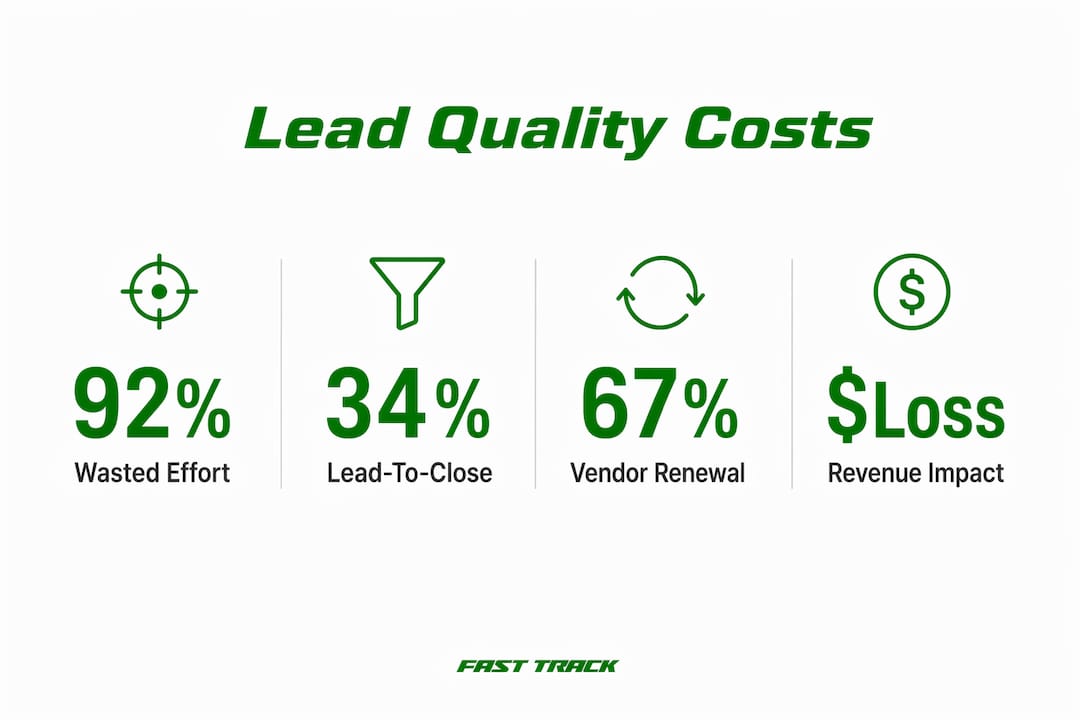
SDRs spend roughly 92% of their time chasing leads that do not convert, resulting in wasted salary and lost sales productivity. Sales reps can lose a significant portion of their productive hours on unqualified prospects, which erodes morale and inflates rep turnover. Replacing a single SDR incurs substantial recruiting and ramp costs.
Measurement failures compound the damage. Data from GrowthSpree found that the top two measurement failures account for 56% of Google Ads waste. Missing offline conversion tracking causes 25% (or $6.6 million) of budget waste because ad platforms optimize toward form fills rather than revenue. Broad match campaigns without negative keyword discipline cause 31% of spend waste while producing only 23% of SQLs.
The downstream effects compound fast:
- Inflated pipelines produce revenue forecasts that miss badly, eroding leadership trust in marketing.
- Marketing-sales misalignment grows when both teams work from different definitions of a qualified lead.
- Overstaffing follows bad forecasts, adding fixed costs that persist long after the pipeline problem is identified.
By contrast, Franchise Fast Track's proprietary system delivers a 34% lead-to-close rate by focusing exclusively on verified high-income professionals. That 34% rate illustrates the gap between volume-based lead generation and a qualification-first model.
Why targeting verified high-income professionals changes the math
The buyer profile matters more than most franchise developers admit. Executives, directors, and senior managers earning $150K–$500K annually have the capital, the decision-making authority, and the professional motivation to follow through on a franchise investment. Generic lead sources do not filter for any of those criteria.

Proprietary verification reduces invalid contacts before they ever reach a sales rep. Fewer invalid contacts means SDRs spend their time on conversations that can actually close, which compresses the cost per sales-qualified lead even when the cost per raw lead looks higher.
| Metric | Verified high-income leads | General volume leads |
|---|---|---|
| Lead-to-close rate | 34% | Industry average (significantly lower) |
| Income verification | $150K–$500K confirmed | Unverified |
| Buyer profile | Executives, directors, senior managers | Broad audience |
| SDR time efficiency | High (fewer dead-end calls) | Low (about 92% non-converting time) |
| Pipeline accuracy | Reliable | Inflated |
67% of organizations renew lead vendors without evaluating SQL conversion rates, risking continued overspend due to poor lead quality. That single habit locks franchisors into continued overspending on sources that look productive on a dashboard but contribute almost nothing to closed deals. Shifting the evaluation criterion from cost per lead to cost per SQL exposes which sources actually earn their budget.
Franchise Fast Track's franchise lead generation system is built around this principle. Hundreds of appointments per month with verified buyers, not form fills from curious browsers.
Best practices to stop overspending on bad franchise leads
Fixing costly lead acquisition errors requires changes at the measurement layer, the targeting layer, and the qualification layer simultaneously. Patching one without the others just moves the waste around.
- Audit every lead source for SQL conversion rate, not just CPL. Pull 90 days of data and calculate how many leads from each source became sales-qualified. Sources with high volume and low SQL rates are the first to cut or renegotiate.
- Configure offline conversion tracking. Connect your CRM to your ad platforms so Google and Meta optimize toward closed deals, not form submissions. Best-managed accounts cut waste from 49.8% to roughly 13.2% through measurement infrastructure improvements alone.
- Build a lead scoring model. Weight income level, professional title, liquid capital, and engagement depth. Route only leads above a defined threshold to your sales team. A franchise lead scoring system prevents unqualified contacts from consuming AE time.
- Apply negative keywords and audience exclusions aggressively. Broad match without discipline wastes budget on clicks that produce almost no SQLs.
- Use UTM parameters on every campaign. Without source-level attribution, you cannot identify which campaigns are generating real buyers versus noise.
- Speed up lead routing. Delays in contacting high-intent leads push prospects to competitors. High-income professionals evaluating franchise opportunities are often talking to multiple parties at once.
Pro Tip: Build a monthly feedback loop between your sales team and marketing. Have reps flag the lead sources and ad creatives that produce the worst conversations. That qualitative signal, combined with SQL conversion data, tells you where to cut budget faster than any dashboard.
- Outsource top-of-funnel to a verified lead source. When internal qualification infrastructure is immature, a system that delivers pre-verified, income-confirmed buyers removes the measurement problem at the source. Franchise Fast Track's outsourced franchise development model is built for exactly this scenario.
The financial case for prioritizing qualified leads
The math on volume-based lead generation eventually breaks every franchisor who runs it long enough. More leads without better qualification means more SDR time wasted, more AE quota slipping, and more pipeline data that cannot be trusted for forecasting.
- Overspending on bad leads stems from three compounding failures: volume-over-quality thinking, measurement gaps, and untargeted outreach.
- High-quality, verified leads improve pipeline accuracy and give sales teams conversations worth having.
- Measurement infrastructure, specifically offline conversion tracking and SQL-based vendor evaluation, is the fastest lever for reducing wasted ad spend.
- Franchise Fast Track's 34% lead-to-close rate demonstrates what happens when the buyer profile is verified before the first conversation.
- Fixing the lead quality problem reduces pipeline inflation, improves revenue forecasting, and lets franchise development teams scale without proportionally scaling headcount.
What a shift away from volume-based leads looks like in practice
The pattern is consistent across franchise development teams that have moved away from portal-heavy, volume-based lead generation. When a franchisor stops paying for raw lead count and starts measuring cost per SQL, the first thing that happens is the pipeline shrinks. That feels wrong until the close rate climbs and the sales cycle shortens.
One common scenario: a franchise developer running broad paid search campaigns with no negative keyword list and no offline conversion tracking. The dashboard shows hundreds of leads per month at an acceptable cost per lead. The sales team is working hard and closing almost nothing. When offline conversion data gets connected and SQL rates get calculated by source, it becomes clear that 80% of the budget is funding leads that never reach a second conversation. Cutting those sources and redirecting spend toward franchise digital signage solutions supporting brand consistency produces fewer total leads and significantly more closed deals. Cutting those sources and redirecting spend toward pre-qualified leads produces fewer total leads and significantly more closed deals.
The lesson is clear. A pipeline full of verified, income-confirmed buyers at lower volume outperforms a bloated pipeline of unverified contacts every time.
How to audit your existing lead generation spend
Run this process quarterly. It takes less time than a single wasted sales cycle.
- Pull all lead sources for the past 90 days. Include paid search, portals, brokers, organic, and any outsourced lead vendors. Log total leads and total spend per source.
- Tag every lead by outcome. Categorize each as: no response, disqualified, SQL, or closed. If your CRM does not support this, build a simple spreadsheet.
- Calculate cost per SQL by source. Divide total spend by the number of SQLs generated. This number, not cost per lead, is your real acquisition cost. Understanding franchise lead conversion cost at this level exposes which sources are actually viable.
- Identify your bottom two sources by cost per SQL. These are your immediate cuts or renegotiations.
- Check your offline conversion setup. If your ad platforms are not receiving closed-deal data, fix that before running another campaign. The platforms will optimize toward whatever signal you give them.
- Review audience targeting settings. Look for income filters, job title exclusions, and negative keyword lists. Gaps here are where unqualified traffic enters the funnel.
- Set a 30-day review cadence. Bad campaigns compound quickly. Monthly reviews catch problems before they become quarter-defining budget mistakes.
Franchise Fast Track delivers the verified buyers your pipeline needs
Most franchise developers have already tried the volume approach. The leads come in, the sales team works through them, and the close rate stays frustratingly low. The problem is not effort. It is the quality of the contact at the top of the funnel.
Franchise Fast Track connects franchisors directly with verified high-income professionals, executives, directors, and senior managers earning $150K–$500K annually, who are actively evaluating franchise ownership. The system delivers hundreds of qualified appointments per month, with a 34% lead-to-close rate that reflects what happens when income verification and professional qualification happen before the first call. No portal noise, no unverified form fills, no SDR time burned on contacts who were never going to buy. If your pipeline needs buyers who can actually close, see how the system works.
Key Takeaways
Franchise developers overspend on bad leads because they measure volume instead of SQL conversion rate, leaving the true cost of acquisition hidden until the damage is done.
| Point | Details |
|---|---|
| Volume thinking wastes budget | Optimizing for lead count fills pipelines with unfit prospects who consume sales resources without converting. |
| Measurement gaps amplify waste | Missing offline conversion tracking causes ad platforms to optimize toward form fills, not closed deals. |
| Verified buyers close at 34% | Franchise Fast Track's income-verified leads deliver a 34% lead-to-close rate versus significantly lower industry averages. |
| SQL-based audits expose real cost | Calculating cost per SQL by source reveals which lead channels actually earn their budget and which to cut. |
| Franchise Fast Track | Delivers hundreds of monthly appointments with verified high-income professionals, replacing volume with qualified pipeline. |
Recommended
- Why Franchise Lead Generation Is Broken (And What Smart Franchisors Are Doing Instead) | Franchise Fast Track Blog
- Franchise Development: Outsourced Top-of-Funnel for In-House Franchise Development Teams | Franchise Fast Track
- Why Franchise Developers Need Consistent Lead Flow | Franchise Fast Track Blog
- How to Reduce Franchise Development Cost per Lead | Franchise Fast Track Blog
Ready to see results like these for your franchise?
Stop wasting money on leads that never close. Start getting hundreds of replies from high-net-worth professionals daily.