Auditing Franchise Lead Generation Sources: A Guide
A franchise lead source audit is a structured diagnostic of every channel feeding your pipeline. It checks whether those leads are correctly tracked, whether they match your ideal franchisee profile, and whether they actually convert into signed agreements. Three objectives drive it: confirming source-to-close attribution, measuring lead quality against your ICP and SQL conversion rate, and finding the commercial constraints (bad data, weak contracts, dead channels) that quietly cap your growth.
Start this week with a sanity check. Pull your CRM's source field for the last 90 days and flag anything marked "unknown," "direct," or with an unusually high bounce rate.
- Confirm every lead record has a populated source field
- Flag sources with bounce rates above 40%
- Note any channel with zero SQL conversions in the period
Key Takeaways
A franchise lead source audit works when it ties every channel to signed agreements, not just raw lead counts.
| Point | Details |
|---|---|
| Start with a data check | Verify CRM source fields for the last 90 days before analyzing performance. |
| Map every channel completely | Missing even one entry point undermines the whole attribution picture. |
| Reconcile leads to closed deals | Multi-touch or revenue reconciliation beats single-touch for franchise sales cycles. |
| Set thresholds before reviewing | Flag reply rate, SQL conversion, and bounce rate against pre-set limits, not gut feel. |
| Consider verified appointment sources | Franchise Fast Track delivers pre-qualified buyer appointments with a reported 34% lead-to-close rate. |
Table of Contents
- What a Full Audit Covers: Mapping Every Entry Channel
- Auditing CRM and Data Integrity: Technical Checks to Trust Your Numbers
- Evaluating Attribution: How to Link Leads to Signed Agreements
- Compliance and Consent Checks to Include in the Audit
- How to Interpret Audit Findings and Prioritize Fixes
- Technology and AI: What to Use and What to Watch For
- Audit Cadence and Timelines
- The Step-by-Step Franchise Lead Source Audit Checklist
- What Franchise Development Practitioners Learn the Hard Way
- How Franchise Fast Track Speeds Up the Audit-to-Fix Cycle
- Sources
What a Full Audit Covers: Mapping Every Entry Channel
Before you can judge which sources work, you need a complete inventory of every door a prospect can walk through: paid search, paid social, franchise portals, brokers, PR and organic content, referrals, and trade show or event leads. For each one, capture the same core fields so comparisons hold up.
| Field | Why it matters |
|---|---|
| Source and UTM | Distinguishes paid campaigns from organic or referral traffic |
| Landing page | Reveals which offer or message attracted the lead |
| Cost | Enables cost-per-lead and cost-per-sale math |
| First touch / last touch | Shows the full journey, not just the last click |
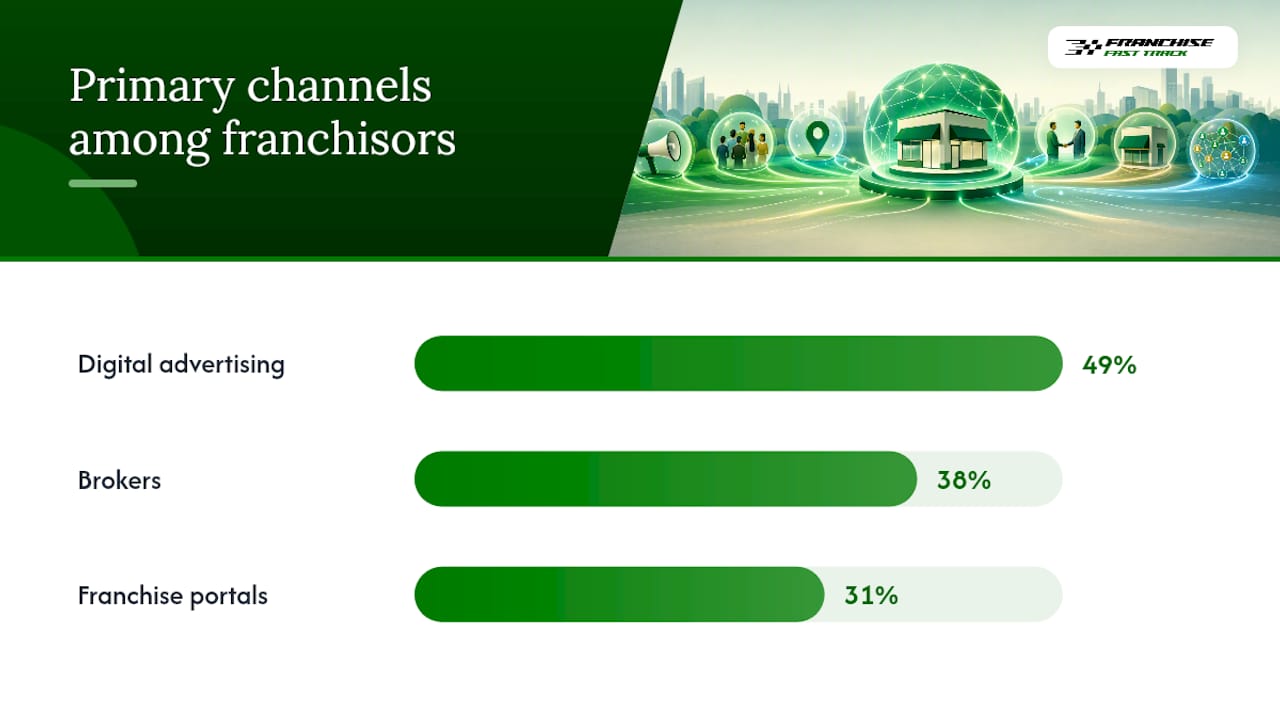
Digital advertising remains the primary source for 49% of franchisors, with brokers at 38% and franchise opportunity websites at 31%. That mix means most franchisors are relying on just three channel types for the bulk of their pipeline, which makes an incomplete inventory dangerous rather than just sloppy.
- List every active channel, including ones marketing "forgot" were still live
- Separate high-volume channels from high-value ones before judging either
- Watch for channels generating leads but zero attributed cost, a common sign of missing tracking
Pro Tip: Portals and brokers often generate volume that looks strong on a dashboard but produces few signed agreements. Cross-reference volume against SQL rate before deciding a channel is "working."
Auditing CRM and Data Integrity: Technical Checks to Trust Your Numbers
Every conclusion your audit produces is only as good as the data behind it. Before analyzing performance, run these technical checks:
- Confirm source fields are populated on 100% of records from the last two quarters
- Scan for duplicate contacts created by multiple import rules or double form submissions
- Verify timestamp consistency between form submission, first contact, and lifecycle stage change
- Check lifecycle stage logic. leads should not jump from "new" to "closed" without intermediate stages
- Pull abandoned form submissions and compare them against completed leads
- Export leads by source with created date, first-contact timestamp, and MQL/SQL flags
- Run a query isolating leads with no source field at all
- Check for duplicate import rules that silently double-count the same contact
Missing UTM parameters, misrouted contact forms, and stale records from six months ago are the three errors that corrupt more franchise lead audits than any strategic mistake ever does.
Evaluating Attribution: How to Link Leads to Signed Agreements
Single-touch attribution credits whichever channel touched the lead first or last. It's fast to calculate but misleads franchisors whose buyers research for months across multiple channels before applying. Multi-touch models spread credit across every interaction and fit franchise sales cycles better, though they require cleaner data to run correctly. Revenue reconciliation, matching every signed agreement back to its full touch history, is the most rigorous option and the one that should anchor your quarterly audit.
- Export all leads and all closed agreements for the audit period
- Match agreements to their originating lead record by contact ID, not name matching
- Resolve every "unknown" source before calculating channel-level ROI
- Reconcile the funnel math: cost per lead, then cost per SQL, then cost per closed sale
Your audit should produce a simple ROI matrix: cost per lead, cost per SQL, cost per sale, and pipeline value generated per $1,000 spent, broken out by channel. That table, more than any dashboard metric, is what should drive next quarter's budget.
Pro Tip: Never scale spend on cost-per-lead alone. Campaign audit frameworks flag broken conversion tracking or unreliable attribution as critical blockers that should halt any budget increase until fixed.
Compliance and Consent Checks to Include in the Audit
Data quality problems aren't just operational. they're liability. Every lead source needs a consent and contract review alongside the performance review, including checks on form-building and lead-qualification tools like HuperForms that integrate with CRMs.
- Confirm every lead capture form includes a clear opt-in and a linked privacy policy
- Verify cookie and consent banners are active on every landing page still driving traffic
- Document recorded permissions for phone and email outreach on each lead record
- Review portal and broker contracts for lead ownership terms
- Check for refund or replacement clauses covering invalid leads
- Confirm SLA language defines what counts as a "qualified" lead versus a raw contact
When a partner or portal repeatedly delivers invalid or misattributed leads despite documented complaints, escalate to a formal SLA breach conversation before renewing the contract.
How to Interpret Audit Findings and Prioritize Fixes
Not every problem your audit surfaces deserves immediate attention. Rank findings on an impact versus effort matrix that accounts for your actual constraints: sales team capacity, brand risk from a bad partner, and how much budget is exposed to a broken channel.
- Rank each finding by revenue impact first, then by effort to fix
- Flag anything touching more than 20% of pipeline value for immediate action
- Defer low-impact, high-effort fixes to the following quarter
Set thresholds before you start reviewing, not after you see the numbers. A reply rate under 15%, an SQL conversion rate below the 20 to 30% range considered healthy for verified franchise prospects, a bounce rate above 40%, or a cost per sale that's climbed without a corresponding rise in lead quality should all trigger an urgent flag.
- Data enrichment fixes: missing phone numbers, stale titles, unverified income brackets
- Creative fixes: retargeting messaging that attracts unqualified clickers
- Contract fixes: renegotiating or exiting underperforming portal or broker agreements
- Budget fixes: pausing channels that generate volume without pipeline contribution, a pattern LeadCaliber flags as the single most common source of wasted spend
Technology and AI: What to Use and What to Watch For
A workable audit stack covers five categories: your CRM, web analytics (GA4 with disciplined UTM tagging), an email verification tool, your form and landing page platform, and a dedicated attribution layer if your sales cycle spans months. Using GA4 and UTM discipline to trace channel value works only when every campaign is tagged consistently from launch.
AI genuinely helps with deduplication, flagging anomalies in reply rate trends, and speeding up attribution reconciliation across thousands of records. It also introduces new risks worth watching.
- Deduplication tools can merge legitimate separate leads if matching rules are too loose
- Anomaly detection flags statistical noise as a "trend" without human review
- Privacy-driven data restrictions (consent withdrawals, browser tracking limits) create gaps that automated tools misread as channel underperformance
Automation that quietly patches over a broken attribution model doesn't fix the problem. it just hides it more convincingly.
Audit Cadence and Timelines
Run a full audit quarterly, covering every channel, every CRM field, and full attribution reconciliation. Between full audits, run monthly health checks on the core metrics: reply rate, SQL conversion, and bounce rate by source.
| Trigger | Action |
|---|---|
| SQL conversion drops sharply | Immediate audit of that channel's data and creative |
| Bounce rate spikes | Immediate CRM and form check |
| Major platform algorithm change | Immediate reconciliation of affected channel spend |
- Assign one owner per audit area (CRM, attribution, compliance)
- Set a 10 business day turnaround for full quarterly audits
- Set a 48 hour SLA for triggered emergency audits
The Step-by-Step Franchise Lead Source Audit Checklist
Turn this into a project ticket and work it top to bottom every quarter, a cadence B2B audit frameworks across ten distinct focus areas also recommend.
- Discovery: List every live channel and confirm tracking is active
- Export: Pull leads by source, created date, first-contact timestamp, and MQL/SQL status
- Channel analysis: Calculate reply rate, SQL rate, and cost per sale for each source
- Reconciliation: Match closed agreements back to originating lead records
- Prioritization: Rank fixes by revenue impact using your impact versus effort matrix
- Remediation: Assign each fix an owner, due date, and expected impact
| Field | Sample entry |
|---|---|
| Owner | Marketing ops lead |
| Due date | 10 business days from audit close |
| Expected impact | Reduce cost per sale by targeting worst-performing portal |
Reading more on how to define a qualified franchisee lead before you start will make step 5 far more accurate.
Pro Tip: Build the remediation template as a recurring ticket, not a one-off document. The audit that gets skipped next quarter is the one that lived in a spreadsheet nobody reopened.
What Franchise Development Practitioners Learn the Hard Way
The most common audit surprise: a portal delivering hundreds of monthly leads with an SQL rate near zero, while a smaller referral channel quietly closes deals nobody was tracking.

Two shortcuts speed remediation. Pause the worst offender for 30 days and run a targeted paid search test with the freed budget, then compare results directly. It settles the debate faster than another month of dashboard-watching.
How Franchise Fast Track Speeds Up the Audit-to-Fix Cycle
Most of what an audit uncovers points to the same root problem: too many unqualified leads clogging the pipeline. Franchise Fast Track skips that problem at the source. Instead of feeding your CRM a mix of tire-kickers from a dozen unverified channels, it delivers direct appointments with prospects already verified for income between $150,000 and $500,000, cutting the reconciliation work your next audit would otherwise flag as a mess.

That verification step is also why the reported lead-to-close rate runs at 34%, well above what most franchisors see from broker and portal traffic alone. If your audit just confirmed that certain channels generate volume without revenue, this is the alternative worth testing against them. Explore the franchise lead generation program and see what a verified appointment pipeline would show up as in next quarter's audit.
Sources
- Examining the primary sources of franchise development leads
- B2B Lead Generation Audit: Find & Fix What's Killing Your Pipeline 2026
- Lead Generation Campaign Audit: 50 Checks Before Scaling
- B2B Lead Generation Audit: What to Check and Improve - LeadCaliber
Recommended
Ready to see results like these for your franchise?
Stop wasting money on leads that never close. Start getting hundreds of replies from high-net-worth professionals daily.