What Does Franchise Equity Mean for Serious Buyers
Franchise equity is the ownership stake a franchisee holds in the legal entity operating a franchised location — covering tangible assets, leasehold improvements, working capital, and the present value of that unit's cash flows. That's the whole definition. What makes it complicated for franchisors is the part buyers often misunderstand: franchisees own the operating business, not the brand, trademarks, or system IP. Those stay with the franchisor. When you're recruiting high-income buyers, that distinction needs to be front and center, because confusion about what's actually for sale is the fastest way to lose a qualified prospect.
- Franchise equity = ownership of the operating entity at the unit level (assets, cash flows, lease rights)
- Franchisees do NOT own the brand, core IP, or centralized systems
- Any transfer of that equity requires franchisor approval, which creates a conditional liquidity ceiling buyers must understand before they commit
Table of Contents
- What does franchise equity actually include at the unit level?
- How franchise equity differs from corporate franchise value
- How is a franchised unit's equity actually valued?
- What contractual limits cap equity and restrict liquidity?
- How equity gets diluted and how buyers typically finance a purchase
- What serious, high-income buyers want to see about unit economics
- Step-by-step: how franchisors should prepare a unit for sale
- Key Takeaways
- Why clear equity disclosures matter more than most franchisors realize
- Franchise Fast Track connects you with buyers who already understand the numbers
- Useful sources for franchisors and buyers
What does franchise equity actually include at the unit level?
The equity interest in a franchised unit breaks down into six concrete line items. Each one needs documentation before a serious buyer will engage.
- Operating entity ownership: The LLC or corporation holding the franchise agreement — this is what transfers in a resale.
- Physical assets and FF&E: Equipment, fixtures, vehicles, and inventory at fair market value.
- Leasehold improvements: Build-out costs capitalized on the balance sheet, valued at depreciated cost or replacement value depending on the buyer's approach.
- Favorable lease terms: A below-market rent relative to current rates adds real economic value, even though it doesn't appear as a line item on most P&Ls.
- Working capital and receivables: Cash on hand, prepaid expenses, and any accounts receivable that transfer with the entity.
- Present value of location cash flows: The capitalized value of trailing EBITDA or seller's discretionary earnings (SDE) — usually the largest single component.
What stays with the franchisor: the brand, trademarks, proprietary operations manuals, centralized customer databases, and any corporate-level technology platform. Buyers are purchasing access to the system, not ownership of it.
Pro Tip: For each component above, prepare a corresponding document before listing a unit: fixed-asset schedule, lease abstract, trailing 12–24 months of P&Ls, and a current inventory count. Buyers who receive a complete packet on day one close faster and ask fewer deal-killing questions.
How franchise equity differs from corporate franchise value
These two concepts get conflated constantly, and the confusion costs franchisors credibility with sophisticated buyers.
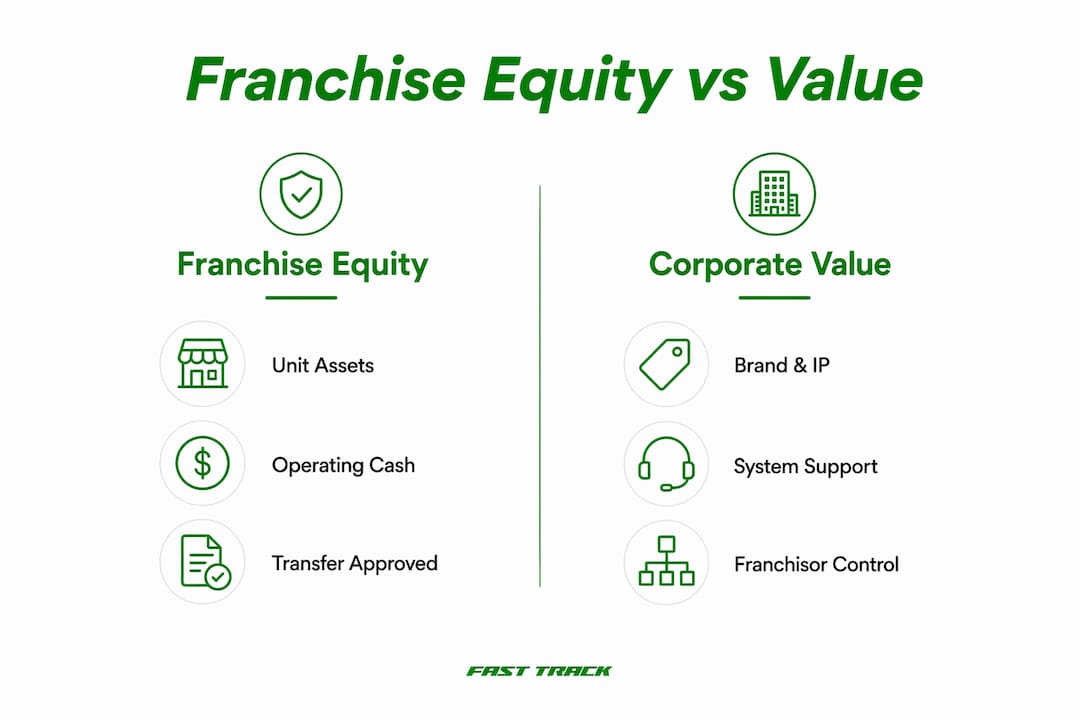
Unit equity is what a franchisee owns: the operating business, its assets, and its cash flows. Corporate franchise value, sometimes called franchise P/E, is something entirely different — it reflects the present value of a company's growth potential from opening new locations, not the economics of any single unit. A publicly traded franchisor's stock price incorporates franchise P/E; a unit resale does not.
A practical example: a single Subway location generating annual seller's discretionary earnings might sell for a multiple of that earnings figure, typically ranging around two to three times, as explained in restaurant stock valuation metrics. That has nothing to do with Subway's corporate valuation or brand equity. The buyer is purchasing that unit's cash flows and assets, subject to Subway's approval. Framing unit economics clearly, rather than gesturing at the parent brand's scale, is what resonates with executive-level buyers who run discounted cash flow models before they sign anything.
How is a franchised unit's equity actually valued?
Three approaches apply, and experienced valuers use all three as cross-checks before settling on a number.
Income approach is the most common for profitable units. The valuer calculates trailing SDE or EBITDA, applies a market-derived multiple (typically 2–4x for single-unit resales, higher for multi-unit packages), and arrives at enterprise value. Subtracting outstanding debt gives equity value. A discounted cash flow model works the same way but projects cash flows over the remaining franchise term and discounts them at an appropriate rate.

Asset approach applies when a unit is distressed or when cash flows are minimal. The valuer adjusts the book value of tangible assets — equipment, inventory, leasehold improvements — to fair market value. This often produces a floor price rather than a realistic sale price for a healthy unit.
Market approach uses comparable franchise resale transactions. Comps are harder to find than in real estate, but franchise brokers and industry databases carry enough data to bracket a reasonable range.
| Sale scenario | Best primary approach | Notes |
|---|---|---|
| Single profitable unit resale | Income (SDE multiple) | Cross-check with market comps |
| Multi-unit package | Income (DCF) | Adjust for management depth and territory value |
| Distressed or underperforming unit | Asset | Floor value; income approach may not apply |
Franchise-specific adjustments almost always reduce the headline number. Transferability discounts, franchisor approval risk, lease assignment costs, and required capital expenditures at transfer all come off the top. Certified business appraisers note that franchisor approval rights act like a liquidity ceiling on unit equity — the seller can't simply sell to the highest bidder.
A simple worked example: a unit with trailing seller's discretionary earnings valued at a mid-range multiple yields an enterprise value. After subtracting outstanding equipment financing and the transfer fee, the seller nets a reduced amount before closing costs. That's the equity the seller actually realizes.
Pro Tip: Valuers always request the FDD's historical performance claims (Item 19), trailing 12-month P&L, lease abstract, and royalty payment history. Have these ready before a buyer asks — gaps in this package are the single most common reason deals stall.
What contractual limits cap equity and restrict liquidity?
The franchise agreement and related legal documents create the real boundaries on what a buyer can purchase and when.
- Assignability clauses: Most agreements require franchisor consent before any ownership transfer. Without it, the sale is void.
- Transfer fees: Typically a flat fee or a percentage of the sale price, paid to the franchisor at closing.
- Franchisor approval of the buyer: The incoming buyer must meet financial, operational, and background criteria — a process that can take 30–90 days.
- Territory and noncompete restrictions: Existing covenants may limit where or how a buyer can operate, affecting the unit's value to certain acquirers.
- Lease assignment: The landlord must consent to assign the lease to the new entity. This is a separate approval track from the franchisor's and often runs concurrently.
On the accounting side, franchise rights are capitalized as intangible assets under ASC 952 and amortized over the shorter of the franchise term or asset useful life. That amortization reduces reported equity on the franchisee's balance sheet, which matters when buyers compare book equity to economic value.
How equity gets diluted and how buyers typically finance a purchase
Adding partners or outside investors to a franchised entity reduces each owner's percentage stake and reshuffles profit distributions and voting rights. The operating agreement governs these mechanics, but the franchise agreement adds another layer: most require franchisor approval for any ownership change above a threshold, often 10–25%. Equity dilution is a frequent oversight — vague operating agreement language can create approval hurdles at the exact moment a buyer wants to bring in a co-investor.
Buyers use four main financing structures. SBA 7(a) loans are commonly utilized for single-unit resales, potentially covering a large portion of the purchase price when the franchise brand is approved by the SBA. Conventional bank financing works for buyers with strong balance sheets and collateral. Seller financing, where the seller carries a note for 10–30% of the price, signals confidence in the unit's performance and often accelerates closing. Mezzanine or third-party investor structures appear in larger multi-unit deals and introduce the most complexity around franchisor approval.
Pro Tip: Standardize your transfer consent language to specify exactly which ownership changes trigger approval and what the timeline is. Ambiguity here is what causes deals to fall apart at the financing stage when a buyer's lender requires a co-guarantor or equity partner.
What serious, high-income buyers want to see about unit economics
High-income buyers — executives, directors, and senior managers evaluating franchise ownership — run the numbers before they take a meeting. They're not buying a job; they're underwriting an investment.
- Verified trailing 12-month EBITDA or SDE, reconciled to tax returns
- Cash-on-cash return calculation at the expected purchase price and financing structure
- Capex history and a clear picture of near-term equipment or build-out needs
- Lease term remaining, renewal options, and assignment process and timeline
- Royalty and fee compliance history (no arrears, no disputes)
- Seller transition support commitment (training period, customer introductions)
A one-page summary covering these six points — headline earnings, an earnings bridge showing add-backs, lease summary, and approval timeline — is what separates a listing that gets traction from one that sits. Franchise investment risks including market risk, operational risk, and franchisor performance should be disclosed clearly; buyers at this income level expect transparency, and surprises after LOI kill deals.
Pro Tip: Frame seller financing as a vote of confidence, not a concession. A seller willing to carry 15–20% of the note tells a high-income buyer that the seller believes in the unit's forward cash flows. That framing closes more deals than any marketing copy.
Step-by-step: how franchisors should prepare a unit for sale
Standardized documentation from the franchisor side reduces buyer uncertainty and shortens approval timelines.
- Verify transferability. Confirm the franchise agreement is assignable and calculate the exact transfer fee.
- Assemble financials. Collect 24 months of P&Ls and the last two years of business tax returns, reconciled to each other.
- Prepare asset documentation. Fixed-asset schedule with purchase dates and depreciated values; current inventory count.
- Create a lease abstract. Remaining term, renewal options, current rent, and landlord assignment process.
- Pre-qualify buyer requirements. Document the financial, operational, and background criteria the incoming buyer must meet.
- Set an approval timeline. Franchisor review typically runs 30–60 days; landlord consent adds another 15–30 days; lender underwriting runs concurrently. A realistic close window is 60–120 days from accepted offer.
Pro Tip: Assign a single internal point of contact at the franchisor for every resale. Buyers and their attorneys who can reach one person with authority move faster. Deals that bounce between departments stall and fall through.
Key Takeaways
Franchise equity is a unit-level economic asset — transferable only with franchisor approval, valued primarily on cash flows, and subject to contractual limits that every franchisor must manage proactively.
| Point | Details |
|---|---|
| Equity is unit-level only | Franchisees own the operating entity and its assets, not the brand or system IP. |
| Transferability caps liquidity | Franchisor approval rights and transfer fees create a ceiling on realizable equity at resale. |
| Three valuation approaches apply | Income (SDE multiple or DCF), asset, and market comps — each suited to a different sale scenario. |
| Documentation speeds closings | Standardized P&Ls, lease abstracts, and asset lists reduce buyer uncertainty and shorten approval timelines. |
| Franchise Fast Track | Connects franchisors with verified high-income buyers who are already underwriting unit economics before the first meeting. |
Why clear equity disclosures matter more than most franchisors realize
Most franchise development conversations focus on the opportunity — the brand, the system, the support. That's fine for early-stage interest. But when a buyer earning $300,000 a year starts asking about resale value, financing, and what they actually own, vague answers don't just lose the deal. They signal that the franchisor hasn't thought carefully about what they're selling.
Franchise Fast Track works with franchisors who are recruiting at the executive level, and the pattern is consistent: the franchisors who close the most qualified buyers are the ones who can hand a prospect a clean one-page equity summary on day two of the conversation. Not because it's legally required, but because it demonstrates that the system is well-run and that the buyer's investment is protected by clear processes. Transparent equity presentation isn't just ethical — it's a competitive advantage in a market where high-income buyers have options and the patience to wait for the right one.
Protecting franchise system integrity during transfers means the franchisor's approval process should be rigorous AND efficient. Slow approvals that drag past 90 days without a clear reason are the single most common deal-killer in qualified resales.
Franchise Fast Track connects you with buyers who already understand the numbers
Most lead-generation approaches send franchisors a list of names. Franchise Fast Track delivers verified appointments with professionals in the executive and senior management levels who are actively evaluating franchise ownership as a wealth-building vehicle, not a career pivot.
The platform's proprietary system generates hundreds of appointments per month, and franchisors using it report a lead-to-close rate of 34% — a meaningful lift over traditional advertising channels that funnel unqualified prospects into your development pipeline. If your unit equity story is solid and your documentation is ready, the right buyer is the only missing piece. Franchise Fast Track is built to find that buyer. Schedule a call to see how the system works for your brand.
Useful sources for franchisors and buyers
- International Franchise Association — Franchising Terms and Definitions: The IFA's plain-language glossary covers franchise agreements, royalty structures, and FDD requirements — the baseline vocabulary for any resale conversation.
- Franchise Ownership Guide: Grounds the definition of unit-level equity and clarifies what transfers with the operating entity versus what stays with the franchisor.
- NetSuite — Complete Guide to Franchise Accounting: Explains capitalization of franchise rights, amortization schedules under ASC 952, and how accounting standards affect reported equity — essential for buyers comparing book value to economic value.
- Simply Business Valuation — How to Value a Franchise Resale: Practical walkthrough of income, asset, and market approaches with franchise-specific adjustments — the most useful single reference for franchisors preparing a unit for sale.
- Investopedia — Franchise P/E Explained: Clarifies the distinction between corporate franchise value and unit-level equity — useful when buyers conflate brand scale with what they're actually purchasing.
- Franchise Interest Definition — Law Insider: Legal definitions of franchise interest and ownership stakes across different entity structures — helpful for attorneys and buyers reviewing operating agreements.
- Franchise Fast Track Glossary: Short definitions of equity interest, assignability, FDD, and related terms in plain language for franchisors and prospective buyers.
Recommended
Ready to see results like these for your franchise?
Stop wasting money on leads that never close. Start getting hundreds of replies from high-net-worth professionals daily.