What Does Franchise Agreement Term Mean for Buyers

A franchise agreement term is the fixed, legally defined period during which a franchisee holds the right to operate a franchise under a franchisor's brand, systems, and trademarks. This right is conditional, not permanent. The franchise agreement governs every operational detail, from fees and performance standards to termination triggers and exit conditions, making it the most critical document you will sign as a prospective franchise owner. Understanding what the term means, how long it lasts, and what happens at renewal separates informed buyers from those who get blindsided five or ten years in.
What does franchise agreement term mean in practice?
The franchise agreement term defines the authorized window during which you are permitted to operate under the franchisor's brand. Think of it as a conditional license, not a deed of ownership. You do not own the brand, the system, or the territory in any permanent sense. You hold the right to use them, provided you stay in compliance with every clause in the agreement.
The franchise agreement definition covers rights, obligations, fees, termination provisions, and transfer rules. The Franchise Disclosure Document (FDD) discloses background information before you sign, but the franchise agreement itself is what governs your day-to-day operations and legal exposure. The FTC Franchise Rule requires franchisors to provide the FDD at least 14 days before you sign any binding agreement. That window exists precisely because the terms inside carry long-term financial and legal consequences.

Understanding the franchisor and franchisee relationship is foundational here. The franchisor retains ultimate control over brand standards and renewal decisions. You operate within boundaries they set, and those boundaries can shift when your term ends.
How long are franchise terms, and what triggers renewal?
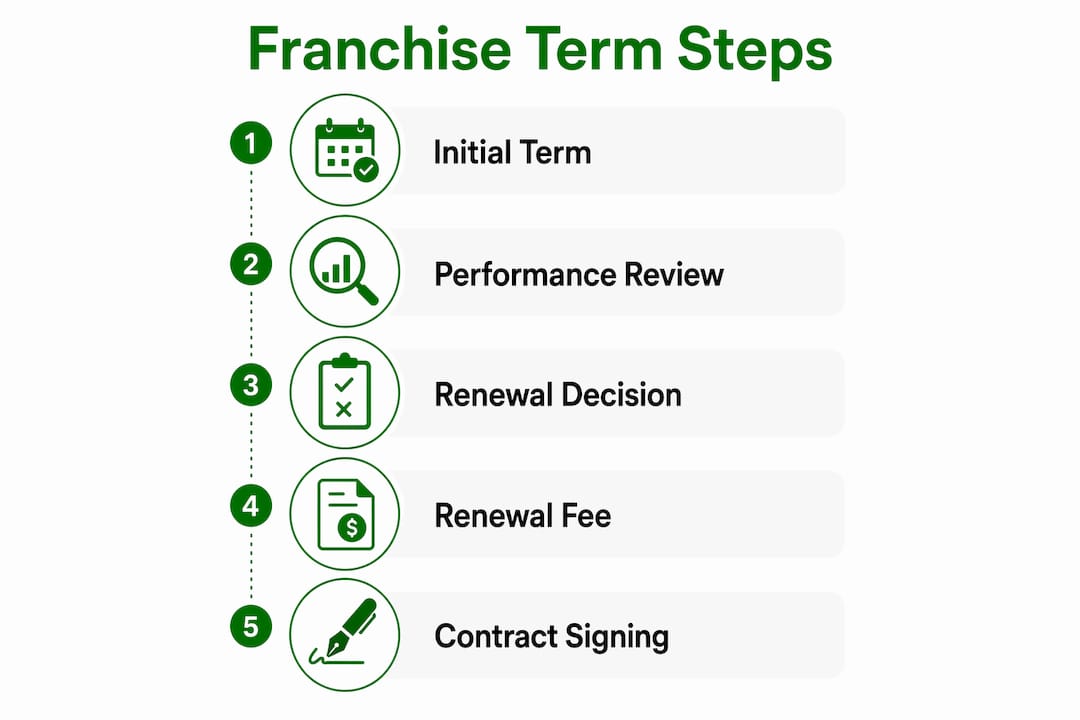
Initial franchise terms typically span 5 to 20 years, with 10 years being the most common structure. That duration is not arbitrary. It is designed to give franchisees enough time to recover their initial investment before the agreement requires renegotiation. Most agreements include one to three successive renewal options, but exercising those options is never automatic.
The table below shows how term lengths and renewal conditions typically compare across franchise categories:
| Franchise type | Typical initial term | Renewal options | Common renewal fee |
|---|---|---|---|
| Food and beverage | 10 years | 1 to 2 terms | 25% to 50% of current fee |
| Retail and service | 5 to 10 years | 1 to 3 terms | 50% to 100% of current fee |
| Healthcare and fitness | 10 to 15 years | 1 to 2 terms | 25% to 75% of current fee |
| Home services | 5 to 10 years | 2 to 3 terms | 25% to 50% of current fee |
Renewal typically requires paying a renewal fee ranging from 25% to 100% of the then-current franchise fee, which often translates to $5,000 to $25,000 in direct fees alone. Beyond the fee, you are usually required to sign the franchisor's latest form of agreement, which can include higher royalty rates, new operational mandates, and stricter compliance standards than your original contract contained.
Performance standards matter significantly here. Franchisors typically require that you have operated in good standing throughout the term, meaning no unresolved defaults, no pattern of customer complaints, and consistent adherence to brand standards. A single unresolved compliance issue can disqualify you from renewal entirely.
Pro Tip: Review Item 17 of the FDD carefully before signing. It discloses renewal, termination, and exit provisions in plain terms, and it is the single most revealing section for understanding what your rights actually are at the end of your term.
Is a franchise term ownership or a conditional license?
The distinction between ownership and a conditional license is the most misunderstood element of franchise agreement details. You are not buying a business in the traditional sense. You are purchasing the right to operate a business model under specific conditions for a defined period. That right can be revoked before the term ends if you breach the agreement.
Non-compliance can terminate franchise rights even before the term expires. Common "for-cause" termination triggers include:
- Failure to pay royalties or fees on time
- Repeated violations of brand standards or operating procedures
- Unauthorized transfer or subletting of the franchise
- Criminal conviction of the franchisee
- Failure to meet minimum sales or performance thresholds
When a term expires without renewal, the consequences extend beyond simply closing the business. Most franchise agreements include post-term non-compete clauses that restrict you from operating a competing business in the same territory for one to two years after expiration. Territory rights revert to the franchisor. Any customer data, systems access, and brand materials must be returned or destroyed.
"Franchise terms function as a conditional usage license that can terminate instantly upon breach, meaning long term spans are not guarantees of business longevity." — Franchise Reality Check
Read the termination and default sections of your franchise agreement before you read anything else. Those clauses define the real boundaries of what you own and what you can lose.
What are the true costs of franchise agreement term renewal?
Renewal costs are consistently underestimated by franchisees, and that underestimation directly erodes return on investment across the franchise lifecycle. The renewal fee itself is only the beginning.
Mandatory remodeling or "image compliance" requirements are standard in most renewal agreements. These upgrades bring your physical location in line with the franchisor's current brand standards, and the cost range is wide. Remodel mandates typically run from $50,000 to $500,000 depending on the brand, location size, and how much has changed in the franchisor's design standards since your original build-out.
The comparison below illustrates the full cost picture at renewal:
| Renewal cost category | Typical range | Notes |
|---|---|---|
| Renewal fee | $5,000 to $25,000 | 25% to 100% of current franchise fee |
| Mandatory remodel | $50,000 to $500,000 | Required to meet current brand standards |
| Technology upgrades | $5,000 to $30,000 | POS systems, software, digital infrastructure |
| Legal review | $2,000 to $8,000 | Reviewing updated agreement terms |
| Increased royalty rate | 0.5% to 2% additional | Applied to gross sales under new agreement |
Royalty rates under the new "then-current" agreement often increase at renewal. A 1% increase on $1 million in annual gross sales adds $10,000 per year to your operating costs. Over a 10-year renewal term, that is $100,000 in additional fees before accounting for any growth in revenue.
Comprehensive renewal cost modeling that includes fees, remodels, and technology upgrades is the only way to accurately assess whether renewing is financially sound versus exiting and redeploying capital elsewhere.
Pro Tip: Build a renewal cost reserve into your financial model from year one. Set aside a percentage of monthly revenue specifically for renewal expenses so the financial impact does not hit your cash flow as a single event.
How to manage your franchise term strategically from day one
The franchisees who navigate renewal successfully are those who treat it as a negotiation that begins before they sign the initial agreement, not after the term expires. Renewal negotiations are structurally one-sided in the franchisor's favor, but that leverage gap narrows considerably when you plan early and maintain strong performance throughout your term.
Follow these steps to protect your position across the full franchise lifecycle:
- Negotiate renewal terms before signing. Push for caps on renewal fees, advance notice requirements of at least 180 days, and language that limits the franchisor's ability to impose entirely new royalty structures at renewal.
- Understand the FDD renewal disclosures. The FDD database contains historical renewal data for the brand you are evaluating. Review how many franchisees have renewed versus exited in the past three years.
- Start renewal planning 6 to 12 months before term expiry. Late renewal notice leaves franchisees with limited options and no leverage. Early engagement gives you time to negotiate, budget for upgrades, and consult legal counsel.
- Maintain documented compliance throughout your term. Keep records of every inspection, training completion, and corrective action. A clean compliance record is your strongest negotiating asset at renewal.
- Engage a franchise attorney before signing any renewal agreement. The updated agreement is a new contract. Treat it as such. An attorney who specializes in franchise law can identify clauses that were not in your original agreement and negotiate modifications before you commit.
- Model your exit alongside your renewal. If renewal costs exceed the projected return from the next term, a structured exit or resale may generate better returns than renewing under unfavorable terms.
Learning from franchise growth strategies that account for renewal cycles gives you a realistic picture of total cost of ownership, not just the entry investment.
Key takeaways
A franchise agreement term grants conditional operating rights for a fixed period, and renewal is a negotiation controlled by the franchisor, not a guaranteed extension of your business.
| Point | Details |
|---|---|
| Term length and structure | Initial terms run 5 to 20 years; 10 years is the most common, designed for investment recovery. |
| Conditional license, not ownership | The term can end before expiry if you breach compliance standards or fail performance thresholds. |
| Renewal is not automatic | Renewal requires fees, updated contract terms, and franchisor approval of your compliance record. |
| True renewal costs | Remodel mandates alone can reach $500,000; model all renewal costs from the start of your term. |
| Negotiate before signing | Caps on renewal fees and advance notice requirements must be negotiated in the initial agreement. |
The part most buyers learn too late
Most prospective franchisees focus intensely on the entry costs and the brand's unit economics. They treat the 10-year term as a decade of stability, a period where they build equity and grow revenue without major disruption. That framing is understandable, but it is incomplete.
The term is not a guarantee. It is a probationary period with a renewal decision at the end that the franchisor controls. I have seen franchisees who built genuinely profitable locations discover at year nine that renewal would require a $300,000 remodel, a higher royalty rate, and a new agreement with stricter territory protections. They had not modeled for that. The choice became: absorb the cost, sell the business, or walk away.
The psychological weight of a long-term contract creates a false sense of security. Ten years feels like ownership. It is not. The conditional nature of the license only becomes real when renewal approaches and the power dynamic becomes visible. Franchisors hold the leverage at that moment because you have invested years of your life and hundreds of thousands of dollars into a business you cannot simply take with you.
The franchisees who come out ahead are those who treat the franchise agreement as a living document, not a one-time transaction. They negotiate hard before signing, maintain spotless compliance records, and start renewal conversations early enough to have real options. Due diligence at entry is not enough. You need a franchise attorney reviewing every renewal clause, and you need a financial model that accounts for the full lifecycle cost, not just the first few years.
— Cody
Ready to connect with the right franchise opportunity?
Understanding franchise agreement terms is the foundation of smart franchise ownership. The next step is finding a franchise opportunity that aligns with your financial goals and long-term plans.

Franchisefasttrack specializes in connecting high-income professionals with verified franchise opportunities through a proprietary system that delivers qualified appointments, not generic leads. Their franchise development platform focuses specifically on executives, directors, and senior managers actively evaluating franchise ownership, the same audience that approaches agreements with the due diligence they deserve. If you are serious about franchise ownership and want access to opportunities matched to your income profile and investment capacity, Franchisefasttrack is built for exactly that conversation.
FAQ
What does franchise agreement term mean?
A franchise agreement term is the authorized period during which a franchisee holds the legal right to operate under a franchisor's brand and systems. This right is conditional on meeting all contractual obligations throughout the term.
What does franchise renewal term mean?
The franchise renewal term is an additional operating period that begins after the initial term expires, subject to franchisor approval, payment of renewal fees, and signing an updated agreement. Renewal is an option, not a guaranteed right.
How long is a typical franchise agreement term?
Most franchise terms run 10 years, though initial terms range from 5 to 20 years depending on the brand and industry. Renewal options typically allow one to three successive terms of similar length.
Can a franchisor refuse to renew my franchise agreement?
Yes. Renewal is controlled by the franchisor and can be denied if you have unresolved compliance issues, failed to meet performance standards, or if the franchisor chooses not to continue operating in your territory. Review franchise agreement examples to understand how renewal refusal clauses are typically structured.
What happens when a franchise agreement term expires without renewal?
When a term expires without renewal, your right to operate under the brand ends immediately. Post-term non-compete clauses typically restrict you from operating a competing business in the same territory for one to two years, and all brand materials, systems access, and customer data revert to the franchisor.
Recommended
- Meaning of Franchisor and Franchisee: A Legal & Dev Guide | Franchise Fast Track Blog
- Franchise Fast Track vs Franchise Direct: Portal Leads vs Funded Buyers | Franchise Fast Track
- Franchise Fast Track vs Franchise Beacon: Recruitment vs Consulting | Franchise Fast Track
- Franchise Lead Generation: Qualified Franchisee Candidates for Serious Franchisors | Franchise Fast Track
Ready to see results like these for your franchise?
Stop wasting money on leads that never close. Start getting hundreds of replies from high-net-worth professionals daily.