Types of Franchise Financing Options for New Buyers
Most franchise buyers pull from seven pools of money: SBA loans (7(a), 504, or microloans), conventional bank loans, franchisor or preferred-lender programs, ROBS (401(k) rollover funding), equipment and asset-based loans, alternative online lenders, and personal capital from savings, home equity, or friends and family. Each fits a different job.
- SBA 7(a): best for franchise fees, working capital, and equipment when you want low down payments and long terms.
- SBA 504: built for real estate and heavy equipment purchases.
- Conventional bank loans: fastest path if your credit and existing relationship are strong.
- Franchisor/preferred-lender programs: quick approval since the lender already knows the brand.
- ROBS: taps retirement savings tax-free upfront, but carries compliance costs.
- Equipment/alternative lenders: speed over price.
- Personal funds: covers the equity injection most other loans require anyway.
Pro Tip: Most buyers stack two or three sources. A common combo is ROBS covering the required equity injection while an SBA 7(a) loan covers the rest.
Key Takeaways
Most franchise buyers succeed by combining an SBA-backed loan with a second source, such as ROBS or personal equity, rather than relying on a single financing type.
| Point | Details |
|---|---|
| SBA 7(a) covers the most ground | It funds franchise fees, equipment, and working capital with down payments around 10-20%. |
| SBA 504 fits real estate | Use it for fixed-rate financing on buildings and major equipment, not working capital. |
| Item 19 disclosures shape terms | Weak FDD performance data or an unlisted SBA brand can mean stricter underwriting. |
| Combine 2-3 sources | Pairing ROBS or savings with a bank loan reduces monthly debt service. |
| Match lender speed to urgency | Alternative lenders close in days but cost more than SBA or conventional loans. |
Where to Verify Franchise Financing Details
- SBA loan program pages for current rules and eligibility
- NMLS Consumer Access to confirm a lender's licensing
- FINRA to check any broker or investment advisor tied to funding
Table of Contents
- What Counts as Franchise Financing?
- What Are the Main Types of Franchise Financing?
- What Do Lenders Look for Before Approving Franchise Financing?
- What's the Step-by-Step Process for Getting Franchise Financing?
- How Do You Choose the Right Financing Mix?
- What Do Typical Franchise Funding Mixes Look Like?
- An Industry Perspective on Speed vs. Cost in Franchise Funding
- Frequently Asked Questions
- Sources
What Counts as Franchise Financing?
Franchise financing is the umbrella term for any capital used to open and run a franchise unit, and lenders split that capital into distinct buckets: the initial franchise fee, site build-out, equipment, real estate, and the working capital that carries you through royalties, marketing fees, and payroll before the location turns a profit.
- Franchise fee and initial training costs
- Leasehold improvements and build-out
- Equipment and signage
- Working capital runway (often 3 to 6 months of operating costs)
- Real estate, if you're buying rather than leasing
| Funding Bucket | Financing Types That Typically Cover It |
|---|---|
| Franchise fee | ROBS, personal savings, SBA 7(a) |
| Build-out and equipment | SBA 7(a), SBA 504, equipment loans |
| Real estate | SBA 504, conventional commercial mortgage |
| Working capital | SBA 7(a), lines of credit, personal funds |
Single-unit startup costs for many U.S. franchise concepts range from roughly $100,000 to well over $500,000 depending on the industry, which is exactly why buyers mix funding types instead of relying on one.
What Are the Main Types of Franchise Financing?
The types of franchise financing options break down into government-backed loans, conventional bank products, brand-specific programs, retirement-fund rollovers, asset-based lending, online lenders, and personal capital. Here's how each one actually functions.
SBA 7(a) loans are the workhorse of franchise funding. They can back up to $5 million and cover the franchise fee, equipment, and working capital in a single package. Down payments typically run 10% to 20% of the project cost, and approval usually takes 60 to 90 days once paperwork is complete. One catch worth flagging: lenders lean heavily on the franchisor's Item 19 financial performance disclosures in the FDD, and whether the brand appears on the SBA's franchise directory. Weak disclosures or an unlisted brand can mean tougher terms or an outright decline.

SBA 504 loans exist for a narrower purpose: real estate and major fixed assets. The structure pairs a Certified Development Company (CDC) loan with a private lender loan, and it's designed for long-term, fixed-rate financing rather than day-to-day working capital. If you're buying the building your franchise sits in, 504 usually beats 7(a) on rate.
Microloans fill the gap at the bottom, generally under $50,000, delivered through nonprofit intermediary lenders rather than banks. They suit a small service-based franchise or a top-off for equipment costs, not a full startup budget.
Conventional bank loans and lines of credit move faster than SBA products because there's no federal guarantee process to wait on. The trade-off is larger equity injections and a stiffer credit bar — banks want an existing relationship or a strong balance sheet before they'll move quickly.
Franchisor and preferred-lender programs can shortcut underwriting since the lender already understands the brand's economics. But in-house financing rarely covers the whole fee, and terms vary widely from one franchisor to the next. Some brands, as detailed in Franchise Fast Track's guide to franchisor financing, only extend financing to a portion of the initial fee, expecting the rest to come from a bank or personal funds.
ROBS (Rollover as Business Startups) lets you invest 401(k) or IRA funds into your franchise without triggering early-withdrawal penalties. It moves fast compared to loan underwriting, but it comes with ongoing compliance costs and real risk to retirement savings if the business underperforms.
Equipment and asset-based loans use the equipment itself as collateral, which works well for franchises with standardized gear, like a restaurant kitchen buildout. The Affordable Restaurant Service and Equipment franchise is a good example of a concept where this financing type does most of the heavy lifting.
Alternative and online lenders close in days rather than months, but you pay for that speed with higher rates and shorter terms. They're a reasonable bridge, not a primary source.
Personal funds, home equity, credit cards, and friends and family typically supply the equity injection that other lenders require before they'll release funds. Home equity lines carry real risk since your house backs the loan. Equity investors and seller financing, common in resale deals, dilute ownership but can close a funding gap without adding debt service.
Pro Tip: A frequent combo among buyers: ROBS funds the required equity injection, and an SBA 7(a) loan covers the remainder, keeping monthly debt service lower than an all-loan structure.
What Do Lenders Look for Before Approving Franchise Financing?
Lenders across every financing type check the same core things: personal credit (generally 680 or higher for SBA and bank products), relevant management or industry experience, a written business plan with realistic projections, and enough liquid capital to cover the equity injection.
- Personal and business credit reports
- Two to three years of tax returns
- A resume showing relevant management experience
- The franchise's FDD, especially Item 19 performance data
- Lease or purchase agreements for the location
- Equipment lists and vendor quotes
SBA loans add a layer banks and online lenders don't: they check size standards and whether the brand is listed in the SBA's franchise directory. A brand with thin Item 19 disclosures can face longer underwriting or worse pricing regardless of your personal credit.
What's the Step-by-Step Process for Getting Franchise Financing?
The path runs assess needs, gather documents, pick a lender, get prequalified, go through underwriting, then close. SBA loans generally take 60 to 90 days start to finish; conventional bank loans run 30 to 60 days; online and alternative lenders can fund in 1 to 14 days.
- Calculate total project cost using the FDD's Item 7 estimates
- Pull credit reports and assemble tax returns, resume, and business plan
- Contact the franchisor's preferred lenders or use SBA Lender Match
- Get prequalified with at least two lenders to compare terms
- Submit to underwriting, including appraisal or environmental review if real estate is involved
- Close and fund, coordinating timing with your franchise agreement signing
Budget for a down payment of 10% to 30% depending on the loan type, plus closing fees, appraisal costs if real estate is part of the deal, and SBA guarantee fees on 7(a) and 504 loans. Coordinate financing approval with your franchise agreement deadline. Signing before financing is locked in can trigger duplicate fees or a forfeited deposit.
How Do You Choose the Right Financing Mix?
Start with what the money needs to cover, then weigh cost of capital against timeline and how much ownership control you're willing to give up. A $150,000 single-unit service franchise might run entirely on an SBA 7(a) loan plus a modest equity injection. A $500,000 deal often blends ROBS for equity with a 7(a) loan for the balance. A $2 million multi-unit or real-estate-heavy deal frequently pairs SBA 504 for the property with 7(a) or conventional debt for equipment and working capital.
Ask every lender: what exactly does this loan cover, what's the required down payment, what collateral is expected, are there prepayment penalties, and how long will underwriting realistically take? Ask every franchisor: is there a preferred-lender list, does in-house financing cover the full fee or just part of it, and are there deferred-fee programs for qualified buyers? Concepts requiring larger upfront capital, like many restaurant categories, tend to need a wider mix of sources than a professional-services brand with lower build-out costs. Red flag: any franchisor unwilling to disclose Item 19 data or preferred-lender terms in writing.
What Do Typical Franchise Funding Mixes Look Like?
Industry practice shows SBA 7(a) financing typically forms the largest single piece of the stack, commonly paired with ROBS or personal equity for the required injection rather than carried alone.
| Project Size | SBA Financing | Equity Injection Source | Notes |
|---|---|---|---|
| $150,000 | majority via SBA 7(a) | Personal savings | Simple, single-source equity |
| $500,000 | majority via SBA 7(a) | ROBS rollover | Common combo per FranchiseVS |
| $5 million | SBA 504 (real estate) + 7(a) (equipment/working capital) | ROBS plus seller financing | Multi-source stack for larger builds |
An Industry Perspective on Speed vs. Cost in Franchise Funding
Franchise Fast Track works with franchisors who see financing readiness stall or accelerate every deal. Buyers earlier in a brand's growth often need to weigh a faster, pricier lender against a cheaper SBA process that adds weeks. Don't skip your own Item 19 review before you lock into either.
Frequently Asked Questions
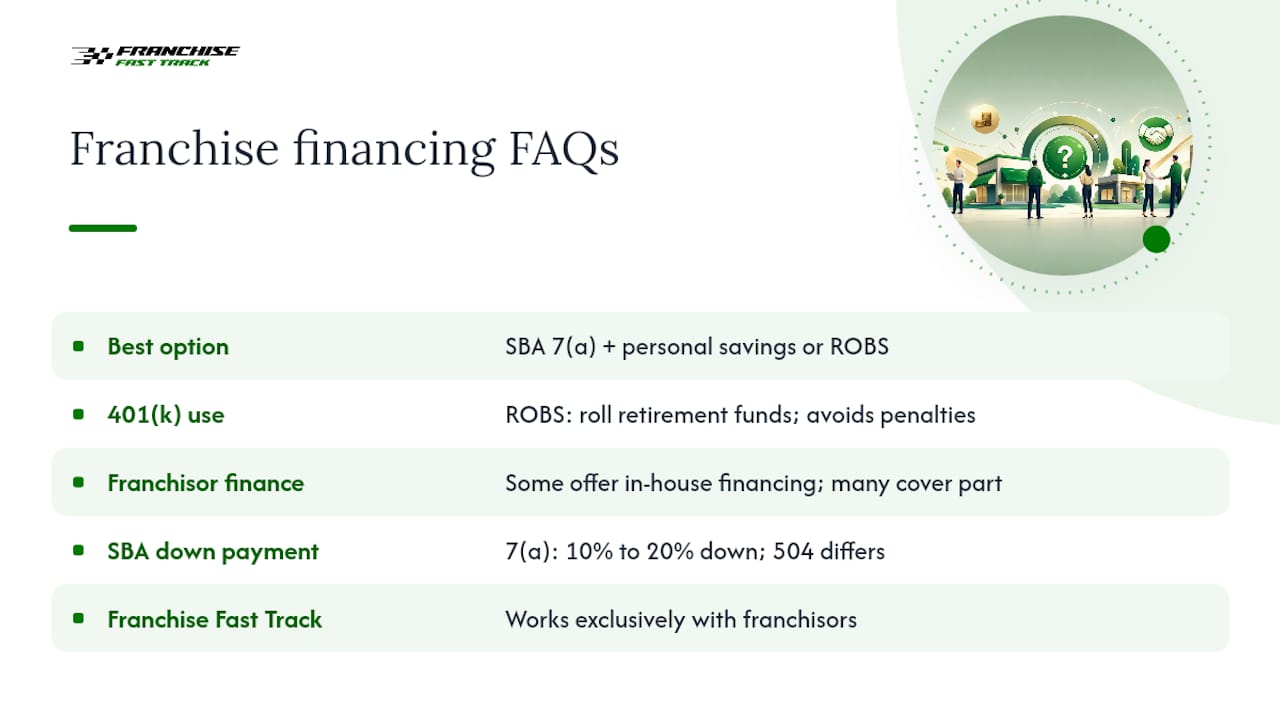
What's the best financing option for a first-time franchise buyer? An SBA 7(a) loan paired with personal savings or a ROBS rollover for the equity injection covers most first-time buyers' needs, since it bundles the franchise fee, equipment, and working capital into one loan.
Can I use my 401(k) to buy a franchise without penalties? Yes, through a ROBS structure, which lets you roll retirement funds into the business without triggering early-withdrawal penalties, though it carries ongoing compliance costs and puts retirement savings at risk if the business struggles.
Do franchisors always offer financing? No. Some offer in-house financing or a preferred-lender list, but many only cover a portion of the initial fee, so ask directly whether their program covers the full amount or just part of it.
How much down payment do I need for an SBA franchise loan? Down payments for SBA 7(a) loans generally run 10% to 20% of total project cost, while SBA 504 loans have their own structure tied to the CDC and private lender split.
Is franchise financing through Franchise Fast Track available to individual buyers? No. Franchise Fast Track works exclusively with franchisors to connect them with qualified, high-income buyers. Franchisors evaluating how to attract buyers who can secure financing can review Franchise Fast Track's lead generation services or the franchise development program for details on reaching verified candidates earning $150K to $500K annually.
This article is general information, not a substitute for advice from a qualified financial advisor. Consult a qualified financial professional about your own circumstances before acting on anything here.
Sources
- SBA — Loans
- SBA — Types of 7(a) loans
- Franchise financing options: How to fund your dream business | PNC Insights
- NMLS Consumer Access
Recommended
- Financing for a Franchise: Franchisor's 2026 Guide | Franchise Fast Track Blog
- Franchise Resale Opportunities: Your 2026 Buyer's Guide | Franchise Fast Track Blog
- Franchise Fast Track vs Franchise Direct: Portal Leads vs Funded Buyers | Franchise Fast Track
- Types of Franchise Ownership Models: A 2026 Guide | Franchise Fast Track Blog
Ready to see results like these for your franchise?
Stop wasting money on leads that never close. Start getting hundreds of replies from high-net-worth professionals daily.