Franchise Resale Opportunities: Your 2026 Buyer's Guide

A franchise resale opportunity is the purchase of an existing, operating franchise business transferred from a current franchisee to a new owner. Unlike starting a new franchise from scratch, buying a resale means you acquire trained staff, an active customer base, supplier relationships, and documented financial history from day one. Brands across industries, from Anytime Fitness and Great Clips to Subway and The UPS Store, regularly have units available for resale. For investors who want to skip the buildout phase and step into a business already generating revenue, understanding what a franchise resale opportunity involves is the first step toward a smarter capital decision.
How does a franchise resale differ from a new franchise?
The core difference between a franchise resale and a new franchise startup is cash flow timing. New franchise locations require a 6–18 month ramp-up period before reaching break-even. A resale generates revenue from the moment you take ownership. That distinction alone changes the financial calculus for most buyers.
The second major difference is the quality of financial data available. When you buy a new franchise, the franchisor provides pro-forma projections based on system averages. When you buy a resale, you analyze trailing 24-month sales data from the actual location, including local seasonality, customer patterns, and real operating costs. That is a fundamentally more reliable foundation for an investment decision.

Capital requirements also differ. Franchise resales trade at a 30–50 percent discount compared to the total cost of opening a new unit. That discount reflects older equipment and a partial remaining franchise agreement term, but it also means lower upfront investment for a business already producing income.
| Factor | Franchise Resale | New Franchise Startup |
|---|---|---|
| Cash flow timeline | Immediate | 6–18 months to break-even |
| Financial data | Actual trailing 24-month sales | Franchisor pro-forma projections |
| Upfront cost | 30–50% discount vs. new unit | Full buildout and startup costs |
| Staff and customers | Existing, trained, and retained | Recruited and built from scratch |
| Equipment | Used, may need replacement | Brand new |
Pro Tip: Request at least 24 months of profit and loss statements, tax returns, and point-of-sale reports before making any offer on a franchise resale. Sellers who hesitate to provide this data are a red flag.
What are the real benefits and challenges of buying a franchise resale?
The benefits of a franchise resale are concrete and measurable. An established customer base and local brand reputation are assets that take years to build organically. You inherit them on closing day. Supplier relationships, trained employees, and existing marketing presence all reduce the operational learning curve significantly.
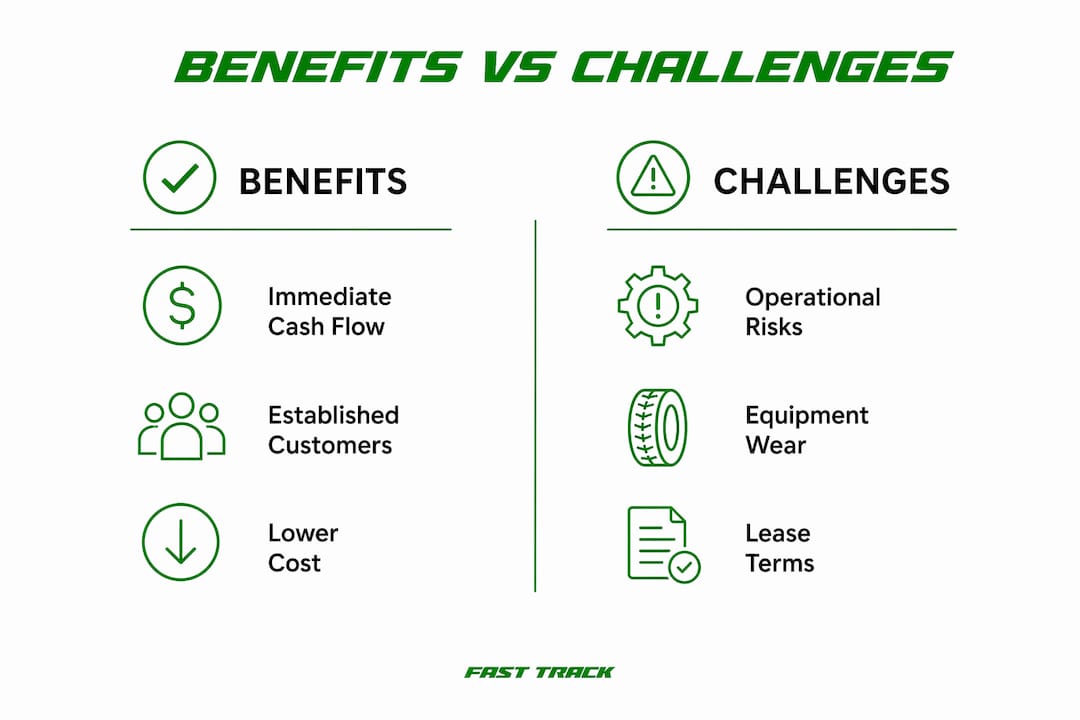
From a financing perspective, resales carry a structural advantage. SBA 7(a) loans are common for franchise resales because lenders prefer businesses with documented financial history over startups with projections. Seller financing is also available in many resale transactions, which reduces the upfront capital burden further.
The challenges are equally real and should not be underestimated.
- Equipment condition: Older units may require capital expenditure on equipment upgrades shortly after acquisition. Budget for this before closing.
- Remaining franchise term: A franchise agreement with only three years remaining limits your ability to recoup your investment. Review the Franchise Disclosure Document (FDD) Item 20 carefully.
- Lease terms: The location's lease may be near expiration or carry unfavorable renewal clauses. Confirm assignability and remaining term with the landlord.
- Staff stability: Key employees may leave during an ownership transition. Identify your top performers early and plan retention conversations.
- Cultural integration: The existing team has habits, expectations, and loyalty to the prior owner. Your ability to lead that culture is a direct driver of performance.
- Transfer fees: Franchisors charge transfer fees ranging from $5,000 to $25,000, governed by FDD Item 20. Factor this into your total acquisition cost.
Pro Tip: Commission an independent equipment appraisal and a lease review from a commercial real estate attorney before signing a purchase agreement. These two steps catch the majority of post-closing surprises.
How do you buy a franchise resale step by step?
The franchise resale process follows a defined sequence. Skipping steps or rushing the timeline is the most common mistake first-time resale buyers make. Here is the standard acquisition path:
-
Financial pre-qualification. Determine your investable capital, net worth, and financing capacity. Most franchisors require buyers to meet minimum liquid capital and net worth thresholds before approving a transfer. Review these requirements in the FDD before engaging with any seller.
-
Identify the opportunity. Resale listings appear through franchise brokers, franchisor development teams, and business-for-sale platforms. Franchisors are motivated to find qualified successors because unresolved resales risk territory closures. Well-capitalized buyers receive favorable consideration during the transfer process.
-
Request and review financial documents. Obtain trailing 24-month profit and loss statements, tax returns, payroll records, and point-of-sale data. Cross-reference these against the FDD Item 19 financial performance representations for the system.
-
Negotiate the purchase agreement. Work with a franchise attorney to review and negotiate the asset purchase agreement or stock purchase agreement. Address equipment condition, inventory valuation, lease assignment, and any seller representations and warranties. For context on what sellers consider during this phase, resources like how to sell your business offer useful perspective from the other side of the table.
-
Submit to franchisor for approval. The franchisor conducts a financial review, background check, and formal interview. This step is non-negotiable. No transfer closes without franchisor sign-off.
-
Complete mandatory training. Even experienced operators must complete the franchisor's transfer training program. This typically runs one to three weeks and covers brand standards, systems, and operational protocols.
-
Pay the transfer fee and close. Transfer fees range from $5,000 to $25,000 depending on the brand. At closing, ownership of the franchise agreement, assets, and operations transfers to you. The franchisor issues a new or assigned franchise agreement.
Becoming a franchise owner through a resale follows the same legal framework as a new unit award. The franchise ownership process requires the same FDD review period and legal protections regardless of whether the unit is new or existing.
Is a franchise resale the right investment for you?
A franchise resale is not the right fit for every buyer. The decision requires honest self-assessment across three dimensions: operational readiness, financial capacity, and leadership style.
Operationally, you are stepping into a business with existing momentum, both positive and negative. If the prior owner built a strong team and loyal customer base, your job is to preserve and build on that foundation. If the unit underperformed, you need the skills to diagnose and fix operational problems quickly. Buying a franchise resale requires leadership and operational management skills that differ from launching a new concept. The challenge shifts from concept validation to cultural integration and performance optimization.
Financially, you need liquidity beyond the purchase price. Working capital reserves, equipment upgrade budgets, and transition costs all require cash on hand. The immediate cash flow of a resale is an advantage, but it does not eliminate the need for financial cushion during the transition period.
Consider these questions before committing:
- Do you have the management experience to lead an existing team from day one?
- Is the franchise agreement term long enough to justify your investment and allow for renewal?
- Have you reviewed the franchising pros and cons specific to this brand and territory?
- Are you comfortable with the location, lease terms, and local market dynamics?
- Have you worked with a franchise attorney and a CPA experienced in franchise transactions?
The immediate cash flow and operational visibility of resales make them more capital-efficient and attractive for multi-unit buyers. If you plan to build a portfolio of franchise units, a resale is often the faster path to your second and third locations.
Key takeaways
Franchise resales offer immediate cash flow, verified financial data, and lower upfront costs compared to new franchise startups, but success requires leadership, thorough due diligence, and franchisor approval.
| Point | Details |
|---|---|
| Immediate revenue advantage | Resales generate cash flow from day one, skipping the 6–18 month ramp-up of new units. |
| Verified financial data | Buyers analyze actual trailing 24-month sales instead of franchisor projections. |
| Lower acquisition cost | Resales typically trade at a 30–50% discount versus opening a new franchise unit. |
| Franchisor approval is mandatory | Transfer fees of $5,000–$25,000 and mandatory training apply to every resale transfer. |
| Leadership drives outcomes | Success in a resale depends on managing existing staff and culture, not just capital. |
Why most resale buyers get this wrong
Most people researching franchise resales assume the hard part is finding the deal. It is not. The hard part is the 90 days after you close.
I have seen well-capitalized buyers acquire solid resale units and underperform within a year because they treated the business like a passive investment. They kept the prior owner's systems, avoided difficult conversations with underperforming staff, and assumed the existing momentum would carry them. It does not work that way. Franchise resales are not easier than new franchises. They require different skills, and the most critical skill is leadership under inherited conditions.
The buyers who succeed treat the first 60 days as a listening and assessment period. They meet every employee, review every operational metric, and build relationships with the franchisor's field support team. They do not blow up what works. They identify the two or three things holding the unit back and fix those first.
Due diligence also gets underestimated. I have watched buyers skip the independent equipment appraisal to save $1,500, then face a $40,000 HVAC replacement six months after closing. The franchise resale valuation must account for equipment condition, remaining lease term, and franchise agreement duration. If you are not working with a franchise attorney and a CPA who specialize in franchise transactions, you are negotiating blind.
The best resale buyers I have observed share one trait: they think like operators, not investors. They are not looking for a business to own. They are looking for a business to run and improve. That mindset is the single biggest predictor of resale success.
— Cody
Find your next franchise resale with franchise fast track
Knowing what a franchise resale opportunity involves is one thing. Finding the right one and getting in front of the franchisor as a credible, qualified buyer is another challenge entirely.
Franchise Fast Track connects serious buyers, specifically executives, directors, and senior managers earning $150K–$500K annually, with franchise opportunities that match their capital profile and goals. The platform's franchise lead generation system delivers verified, high-income buyer appointments directly to franchisors, which means resale sellers and franchisors see you as a pre-qualified candidate rather than a cold inquiry. With a reported lead-to-close rate of 34%, Franchise Fast Track gives capital-ready buyers a direct path to the opportunities worth pursuing. Reach out to Franchise Fast Track to start the conversation.
FAQ
What is a franchise resale opportunity?
A franchise resale opportunity is the sale of an existing, operating franchise unit from a current franchisee to a new buyer. The buyer acquires the business's cash flow, trained staff, customer base, and franchise agreement rather than building a new unit from scratch.
How much does it cost to buy a franchise resale?
Franchise resales typically trade at a 30–50 percent discount compared to opening a new unit, reflecting used equipment and remaining franchise agreement term. Transfer fees of $5,000–$25,000 are also required by the franchisor and must be factored into total acquisition costs.
What financial documents should i request for a franchise resale?
Request at least 24 months of profit and loss statements, tax returns, payroll records, and point-of-sale reports. Lenders and SBA 7(a) loan programs favor businesses with this documented financial history.
Do i need franchisor approval to buy a franchise resale?
Yes. Franchisor approval is mandatory for every franchise resale transfer and includes financial pre-qualification, a formal interview, mandatory training, and payment of a transfer fee. No transfer closes without the franchisor's written consent.
Are franchise resales a good investment?
Franchise resales offer immediate cash flow, verified financial data, and lower upfront costs than new units, making them capital-efficient for experienced operators. Success depends on leadership quality, thorough due diligence, and the ability to manage an existing team and culture from day one.
Recommended
- Blog - Franchise Fast Track | Franchise Development Insights
- Franchising Pros and Cons: A 2026 Guide for Franchisors | Franchise Fast Track Blog
- Franchise Growth Strategies for Sustainable Scale in 2026 | Franchise Fast Track Blog
- Franchisor's Guide: Home Improvement Franchises 2026 | Franchise Fast Track Blog
Ready to see results like these for your franchise?
Stop wasting money on leads that never close. Start getting hundreds of replies from high-net-worth professionals daily.