Leverage Corporate Skills in Franchise Ownership Recruiting
The fastest way to leverage corporate skills in franchise ownership growth is to stop treating executives like consumer leads and start running targeted, income-verified outbound appointments that speak to them as strategic buyers. The International Franchise Association has said as much for years: qualification should run on Capital, Capability, and Character, not enthusiasm. A well-run executive pipeline can produce significantly higher lead-to-close rates than generic funnels deliver.
Three moves to make this week:
- Rewrite your qualification gate to require verified income, current title, and stated ownership intent before a discovery call gets booked.
- Ask any appointment-setting vendor for a sample of their income-verification process, not just a lead count.
- Run a 30-day pilot with a hard KPI floor: appointments booked, show rate, and lead-to-close.
Key Takeaways
Franchisors who leverage corporate skills in franchise ownership recruiting by pairing income-verified outbound targeting with executive-tailored discovery conversations consistently outperform funnels built on volume alone.
| Point | Details |
|---|---|
| Qualify on the three Cs | Screen every candidate on capital, capability, and character before booking discovery calls. |
| Build a precise candidate profile | Require verified liquid capital, net worth, title, and ownership intent on every outbound list. |
| Prioritize targeted channels | Rank curated outreach, LinkedIn, and in-market meetings above broad portal traffic for premium concepts. |
| Demand KPI transparency from vendors | Require verified-income rate, show rate, and lead-to-close benchmarks in every contract. |
| Choose a vendor built for executives | Franchise Fast Track delivers verified appointments with $150K to $500K earners plus calendar hygiene and candidate briefs. |
Table of Contents
- Why Corporate Executives Are a Higher-Value Candidate Tier
- What Does an Ideal Executive Franchise Candidate Look Like?
- Which Outreach Channels Actually Reach Executives?
- How Should You Message Executives and Run Discovery Meetings?
- What Should an Appointment-Setting Vendor Deliver?
- What's a Realistic Timeline and Price Range for Executive Pipelines?
- How Do You Route Vendor Appointments Into Your Pipeline?
- How Do Corporate Leadership Skills Translate to Daily Franchise Operations?
- What Challenges Do Executives Face Moving Into Franchise Ownership?
- What Should Executives Expect to Invest Financially?
- How Should Executives Plan Long-Term Growth Within Franchise Ownership?
- Recommended Solution: Franchise Fast Track's Executive Appointment Pilot
- Frequently Asked Questions
- Sources
Why Corporate Executives Are a Higher-Value Candidate Tier
Executives bring skills that map directly onto franchise ownership: P&L fluency, vendor negotiation, operational scaling, and team leadership. Corporate leadership skills like budget management and strategic planning transfer almost one-to-one to running a franchise, according to Salonsbyjcfranchising, which is why many franchisors now build semi-absentee options aimed squarely at this group.
Qualification must be based on the three Cs, Capital, Capability, and Character, to ensure long-term system success rather than a quick signature.
This tier also compounds. Executives tend toward multi-unit deals, refer other executives from their own networks, and ramp faster because they've already run budgets larger than most single franchise units. That's a fundamentally different growth engine than chasing volume:
- Higher average investment size per signed agreement.
- Stronger referral quality from peer networks.
- Faster time to operational competence post-signing.
What Does an Ideal Executive Franchise Candidate Look Like?
Hand your vendors this exact profile instead of a vague "high-net-worth" request. Precision here is what separates a curated list from a rented one.
Mandatory qualification fields for any outbound list or appointment form:
- Liquid capital and total net worth, verified, not self-reported.
- Current role, title, and years in a P&L or operational leadership seat.
- Explicit statement of ownership intent and timeline.
- Geography and territory availability.
- Multi-unit appetite, since MUO acquisition require different targeting than single-unit recruitment.
For premium concepts, a reasonable qualification band looks like:
- Liquid capital requirements typically scale to franchise fee and build-out cost, often starting in the mid-six-figure range.
- Net worth requirements for multi-unit or master franchise conversations generally start at a substantial threshold to reflect investment size.
- Director-level or above, with direct budget or revenue ownership in their current role.
Vendors should validate income through documentation review, not a checkbox, and confirm role seniority through LinkedIn cross-referencing and direct conversation before a name ever reaches your calendar.
Which Outreach Channels Actually Reach Executives?
Rank your channels by fit, not by volume. Portals generate scale but convert at only 2 to 5% to a signed FDD, which is fine for entry-level concepts and weak for premium ones.
- Targeted outbound with strict filters. Curated lists built to the qualification profile above, not scraped databases.
- LinkedIn outreach. Higher cost per lead, but quality at the director-and-above level is exceptional.
- In-market meetings and industry events. Franchisors are shifting budget here because one-to-one, curated outreach beats broad top-of-funnel tactics for premium investments.
- Referrals and existing franchisee networks. Smaller volume, consistently higher fit.
- Broker-sourced introductions. Pre-screened, though margins get thinner as volume grows.
Tactical notes that matter more than most people realize:
- Sequence messages differently for executives: lead with unit economics, not lifestyle imagery.
- Use automated nurture sequences tailored by candidate tier rather than one generic drip campaign.
- Build creative around ROI and territory value for multi-unit prospects specifically.
Pro Tip: Send your first outreach message between 6:30 and 7:30 AM in the prospect's time zone. Executives check email before their calendar fills, and a message that lands before their assistant triages the inbox gets a materially higher response rate than the same message sent at 2 PM.
How Should You Message Executives and Run Discovery Meetings?
Executives will pressure-test your unit economics before they'll discuss lifestyle fit, so structure the conversation accordingly. Treat them as strategic buyers evaluating a capital allocation decision, because that's exactly what they're doing.
Discovery questions that surface real fit:
- Walk me through how you'd read this franchise's normalized cash flow statement.
- What's your appetite for single-unit ownership versus a multi-unit or area development agreement?
- What does your exit or succession plan look like in five to seven years?
- How much operational time can you realistically commit in year one versus year three?
Do this:
- Present a one-page normalized cash flow table before the second call.
- Answer risk questions directly, including failure rates and time-to-breakeven ranges.
- Reference the semi-absentee ownership model explicitly if their current job makes full-time operation unrealistic.
Avoid this:
- Lifestyle-first pitches ("be your own boss") aimed at someone already running a department.
- Vague ROI language without unit-level numbers.
- Rushing past their P&L questions to close on emotion.
What Should an Appointment-Setting Vendor Deliver?
Any vendor working your executive pipeline should verify income and intent before a name reaches your calendar, score candidates against capital, capability, and character, and hand you a written brief with every booked appointment. Screening for fit before sales conversations begin protects both the franchisor and the candidate.
Franchise Fast Track's model illustrates why these numbers matter in practice: sourcing appointments with executives, directors, and senior managers earning $150,000 to $500,000 annually, verified before booking, produces a materially different close rate than an unscreened lead list ever will.
Pro Tip: Require a "candidate brief" with every appointment, one page covering verified income range, current title, stated timeline, and territory preference. Sales teams that walk into a call blind close at a noticeably lower rate than teams with five minutes of prep material.
What's a Realistic Timeline and Price Range for Executive Pipelines?
Expect a rollout that looks roughly like this: kickoff and list-build in weeks one and two, first verified appointments landing by week three or four, and steady-state cadence by month two.
Pricing models fall into three buckets:
- Retainer. Predictable monthly cost, best when you need sustained volume over a full fiscal year.
- Pay-per-appointment. Lower risk for smaller development teams testing a new vendor.
- Hybrid or performance-based. A base fee plus bonuses tied to show rate or lead-to-close, which aligns vendor incentives with your actual outcomes.
Read up on how the franchisee onboarding timeline unfolds after a signed agreement, since procurement decisions should account for both funnel speed and post-signing ramp.
How Do You Route Vendor Appointments Into Your Pipeline?
A verified appointment that sits unrouted for three days is a wasted appointment. Build the handoff before the first name arrives, not after.
CRM handoff checklist:
- Attach the candidate brief, verified income documentation, and territory preferences to the CRM record before the meeting.
- Assign a named follow-up owner within one business day of booking.
- Log source attribution so vendor performance shows up cleanly in your pipeline reporting.
Routing rules worth setting as SLAs:
- Respond to a booked appointment confirmation within four business hours.
- Send calendar and meeting-prep materials at least 48 hours ahead.
- Route high-net-worth or multi-unit candidates directly to senior closers rather than a general nurture queue.
See our lead filtering criteria for a scoring template you can adapt directly into your CRM fields.
How Do Corporate Leadership Skills Translate to Daily Franchise Operations?
The skills that got an executive promoted are the same ones that make franchise operations run well, just applied at a smaller scale with more direct accountability. A regional sales director who managed quarterly forecasts can read a franchise's weekly flash reports without a learning curve. A supply chain manager who negotiated vendor contracts at scale walks into local vendor negotiations with leverage most first-time owners never develop.

Team building is where the gap shows up fastest. Executives accustomed to managing through layers of middle management often over-delegate in a five-person franchise unit, missing the on-the-floor detail that actually drives customer experience. The fix is deliberate: block calendar time for direct staff interaction weekly, not just P&L review.
Performance-review discipline transfers cleanly. Executives who ran formal quarterly reviews in the corporate world tend to build the same cadence into their franchise staff management, and that structure correlates with lower turnover in service-based concepts. Risk management instincts help too: an executive who's navigated a corporate budget cut knows how to protect margin during a slow season instead of panicking into discount promotions.
The strongest operators treat the franchise playbook the way they treated corporate SOPs: as a starting framework to execute with discipline, then optimize once the baseline is proven, not a suggestion to improvise around on day one.
What Challenges Do Executives Face Moving Into Franchise Ownership?
The biggest one isn't financial. It's the shift from having a support staff to being the support staff. An executive who had an assistant, an HR department, and a finance team suddenly handles scheduling, payroll questions, and vendor calls personally, at least for the first several months.
Second is patience with smaller numbers. A director who managed an eight-figure budget can feel oddly deflated reviewing a franchise unit's five-figure monthly revenue, even when the unit economics are healthy and the growth trajectory is sound. Franchisors who set this expectation explicitly during discovery, rather than letting it surface six months into ownership, see fewer disengaged owners.
Third is the operational learning curve. Strategic skill doesn't automatically translate to knowing how to run a specific point-of-sale system or manage a shift schedule. The semi-absentee model many franchisors now offer solves this by pairing the owner's strategic oversight with trained on-site management, letting the executive apply judgment without needing to master every operational detail personally.
Finally, letting go of hierarchy is harder than executives expect. Corporate decisions often move through committees and approval chains; franchise ownership demands fast, solo calls. Franchisors that build a 90-day onboarding check-in into the agreement, focused specifically on decision-making pace, help new executive owners adjust faster than a generic training manual ever will.
What Should Executives Expect to Invest Financially?
Total investment for a premium franchise typically spans franchise fees, build-out or equipment costs, working capital, and a liquidity buffer for the first six to twelve months of operation. Executives evaluating this against a corporate salary need to see the full picture, not just the headline franchise fee.
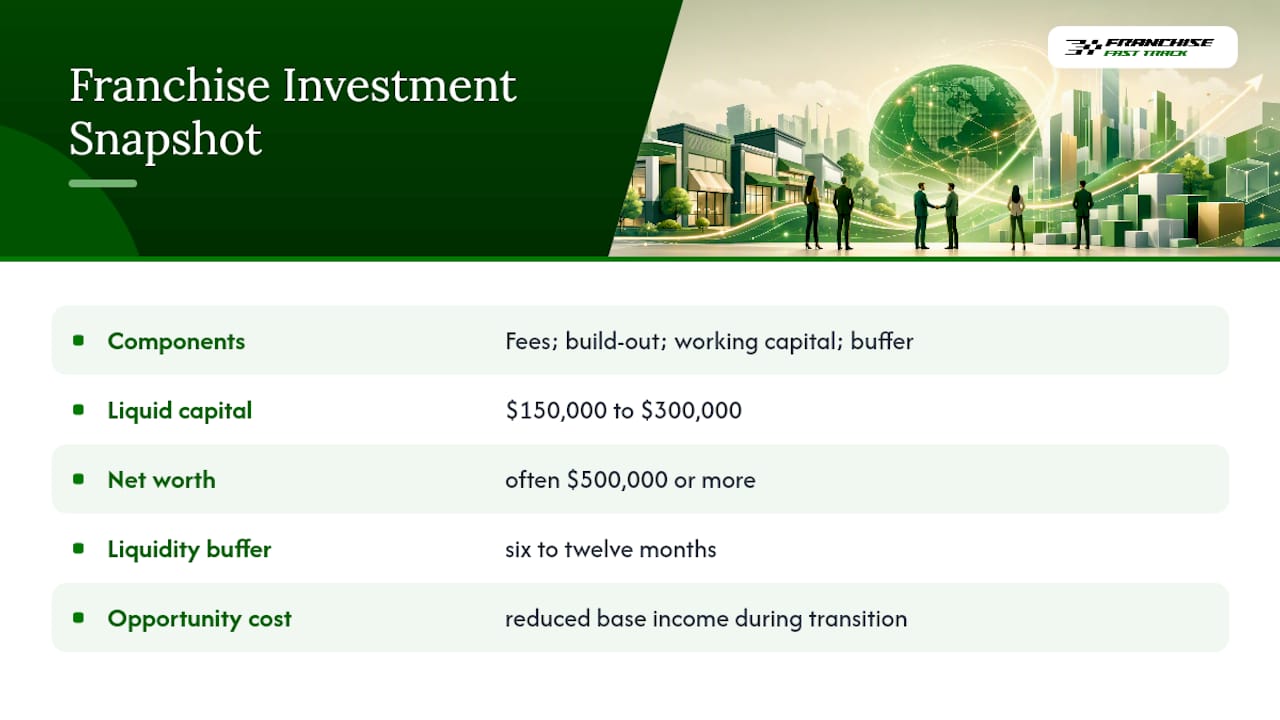
Liquid capital requirements in the $150,000 to $300,000 range are common for well-established, mid-market concepts, with net worth expectations running higher, often $500,000 or more for multi-unit or area development agreements. These aren't arbitrary gatekeeping numbers. They reflect what it actually takes to survive a slower-than-projected ramp period without the business or the owner's personal finances buckling.
Executives should also budget for the opportunity cost of reduced base income during the transition period, especially if stepping away from a corporate salary instead of maintaining semi-absentee involvement. Franchisors should be direct about this tradeoff during discovery rather than glossing over it. Executives who've already run budgets know how to model a cash flow gap; they simply need the real numbers to model it accurately.
For franchisors evaluating territory-level unit economics with a prospective multi-unit buyer, market sizing data from a source like Bizminer's industry benchmarking tools can strengthen the ROI conversation with concrete comparables rather than projections alone.
How Should Executives Plan Long-Term Growth Within Franchise Ownership?
The executives who get the most out of franchise ownership treat the first unit as a proof of concept, not the final destination. A single-unit owner who hits target margins within 18 to 24 months is the person a franchisor should be having a second-unit conversation with, not waiting for them to ask.
Career framing matters here too. Many executives entering franchise ownership are building an exit ramp from corporate life, not executing an immediate one. The semi-absentee structure lets them keep a current role while the franchise unit proves itself, then scale ownership involvement as the business (and their confidence in it) grows. Franchisors that map this growth path explicitly during onboarding, rather than assuming every owner wants the same trajectory, retain owners longer and convert more of them into multi-unit operators.
Succession and equity building deserve equal attention. An executive who's spent 20 years building someone else's company often frames franchise ownership around building a transferable asset, something with resale value or something to pass to family. Franchisors who address this directly in discovery, rather than treating it as a distant concern, tend to attract owners with a longer time horizon and a stronger commitment to operational quality from day one.
A Development Leader's Take on Recruiting Executives
Every executive we've placed successfully asked harder financial questions in the first call than most candidates ask in the third. The pattern that actually predicts long-term success isn't polish, it's whether they push back on the unit economics before they get emotionally attached to the idea. The pilots that fail are the ones where a development team skips that friction to close faster.
Recommended Solution: Franchise Fast Track's Executive Appointment Pilot
Everything in this playbook, income verification, executive targeting, calendar hygiene, and candidate briefs, is what Franchise Fast Track's franchise lead generation service delivers as a standard engagement, not an upsell. Franchise Fast Track sources appointments with verified executives, directors, and senior managers earning $150,000 to $500,000 annually, so your team stops spending discovery calls qualifying and starts spending them closing.
A pilot worth requesting in your next RFP should include: a defined appointment volume for the first 30 days, a verified-income sample before kickoff, a written candidate brief attached to every booking, and a lead-to-close benchmark you can measure against your current funnel. If your in-house team needs outsourced top-of-funnel support without losing control of the handoff, Franchise Fast Track's development integration is built for exactly that structure. Request a pilot scope and see the first verified appointments land within weeks, not quarters.
Frequently Asked Questions
How do corporate skills actually translate to franchise ownership success? Budget management, vendor negotiation, and team leadership map almost directly onto franchise operations, which is why franchisors increasingly target executives as a distinct, higher-value candidate tier rather than folding them into general lead flow.
What's a reasonable lead-to-close rate for an executive-focused franchise pipeline?
Should franchisors use retainer or pay-per-appointment pricing for executive recruitment? Retainers suit sustained annual volume needs, while pay-per-appointment reduces risk for teams testing a new vendor. Hybrid performance models work well when you want vendor incentives tied directly to show rate and close rate.
How long does it take to see the first verified executive appointment? Most engagements produce first verified appointments within two to four weeks of kickoff, with steady-state monthly cadence typically established by the second month.
What's the biggest mistake franchisors make when recruiting corporate executives? Pitching lifestyle benefits instead of unit economics. Executives evaluate franchise ownership as a capital allocation decision, so discovery conversations need normalized cash flow data and ROI specifics, not aspirational language.
Sources
- How to Attract C-Level Executives to Your Franchise - International Franchise Association
- Corporate Executive to Franchise Owner: A Guide
Recommended
- How to Advertise a Franchise to Capital-Ready Candidates | Franchise Fast Track Blog
- Franchise Recruitment: We Headhunt Funded Franchisees for Your Brand | Franchise Fast Track
- How Do I Become a Franchise Owner: A Franchisor's Roadmap | Franchise Fast Track Blog
- Franchise Ownership for Executives: A Strategic Guide | Franchise Fast Track Blog
Ready to see results like these for your franchise?
Stop wasting money on leads that never close. Start getting hundreds of replies from high-net-worth professionals daily.