How Franchises Generate Recurring Revenue in 2026

Recurring revenue in franchising is defined as the ongoing income a franchisor collects from franchisees at regular intervals, independent of any single transaction or new unit sale. The primary mechanism is the royalty fee, typically set at 4%–8% of gross monthly revenue, which means a single franchise unit generating $1 million annually produces $40,000–$80,000 in royalty income for the franchisor every year. That math compounds fast across a growing network. Beyond royalties, franchisors layer in technology fees, brand marketing fund contributions, and renewal fees to build a revenue base that does not depend on selling new franchises. Understanding how franchises generate recurring revenue is the foundation of every sound franchise business strategy.
How royalty fees drive recurring income in franchises
Royalty fees are the financial engine of every mature franchise system. Unlike the initial franchise fee, which is a one-time payment covering onboarding and licensing rights, royalties are ongoing payments calculated as a percentage of the franchisee's gross sales each month. The gross-sales basis is deliberate. It means the franchisor collects revenue whether or not the franchisee is profitable, which creates a stable income floor for the franchisor.
The standard range of 4%–8% may look modest on paper. Run the numbers across a network and the picture changes quickly. A system with 50 units each averaging $800,000 in annual sales at a 6% royalty rate generates $2.4 million in recurring royalty income per year. That figure grows proportionally with every new unit opened, without requiring the franchisor to sell anything new.

Royalties align franchisor success with franchisee performance because both parties benefit from higher gross sales. This alignment gives franchisors a direct financial incentive to invest in training, brand development, and operational support. A stronger brand drives higher franchisee sales, which drives higher royalty income. The structure is self-reinforcing.
Pro Tip: When modeling your franchise revenue, calculate royalty income at three unit counts: 30, 50, and 100 units. This shows you exactly when recurring royalties will cover your operating costs and when you cross into genuine profitability.
The table below illustrates how royalty revenue scales with unit count and average annual unit sales at a 6% rate.
| Units | Avg. Annual Sales per Unit | Royalty Rate | Annual Royalty Revenue |
|---|---|---|---|
| 10 | $800,000 | 6% | $480,000 |
| 30 | $800,000 | 6% | $1,440,000 |
| 50 | $800,000 | 6% | $2,400,000 |
| 100 | $800,000 | 6% | $4,800,000 |
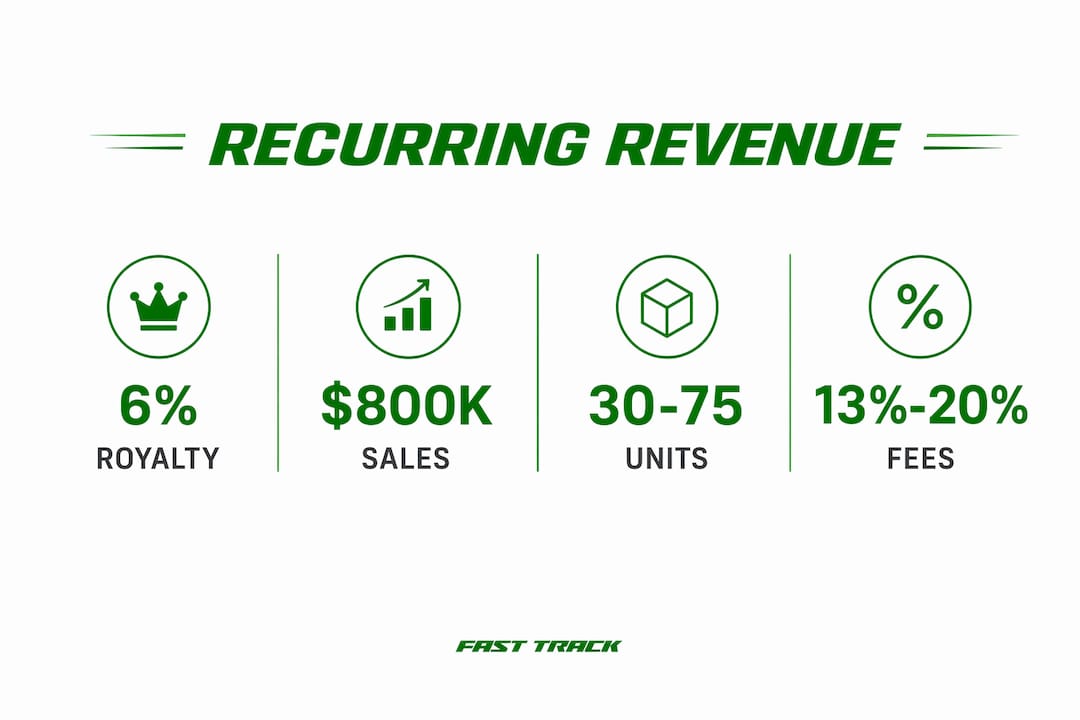
Reaching royalty self-sufficiency requires 30–75 open units, the point at which recurring royalty income covers the franchisor's operating costs without relying on initial franchise fee revenue. Systems below that threshold are still largely dependent on selling new franchises to fund operations. That dependency is fragile. Franchisors who understand this threshold plan their growth timelines and capital requirements accordingly.
What lifecycle fees add to recurring revenue beyond royalties
Royalties are the largest recurring income source, but mature franchise systems do not stop there. They build additional recurring fee layers that compound total income and fund specific operational functions.
The most common lifecycle fees include:
- Technology fees: Platform and software fees typically run $200–$500 per month per unit, covering point-of-sale systems, scheduling tools, and reporting platforms. Across 50 units, that generates $120,000–$300,000 in annual recurring income.
- Brand marketing fund contributions: Franchisees contribute 1%–3% of gross sales to a centralized marketing fund. These funds are legally restricted to brand promotion and cannot be used for franchisor operating expenses, but they fund national advertising that benefits every unit.
- Transfer fees: When a franchisee sells their unit to a new owner, the franchisor charges a transfer fee of $5,000–$10,000. This is not monthly recurring revenue, but it recurs predictably as the network matures and ownership changes hands.
- Renewal fees: At the end of a franchise agreement term, renewal fees often amount to 25%–50% of the current initial franchise fee. A franchisor with a $50,000 initial fee collects $12,500–$25,000 per unit at renewal.
When you add all recurring fees together, total fee load can reach 13%–20% of gross sales across royalties, marketing contributions, technology fees, and local advertising requirements. That figure matters enormously for franchisee profitability modeling. Franchisors who ignore the cumulative burden risk building a system where franchisees cannot sustain healthy unit economics, which ultimately undermines the royalty base.
The Item 6 disclosure in the Franchise Disclosure Document provides a full accounting of all recurring fees. Serious franchisors treat Item 6 as a design document, not just a legal requirement. Every fee listed there should have a clear operational purpose and a corresponding benefit delivered to franchisees.
Effective franchise digital marketing also depends on well-funded brand marketing contributions. When franchisees see their marketing fund dollars producing measurable results, compliance with contribution requirements improves and the system strengthens.
How service and membership models improve revenue predictability
Service-based franchise models generate recurring revenue at the customer level, not just the franchisor level. Weekly or monthly service agreements, such as commercial cleaning contracts, lawn care programs, or fitness memberships, create a predictable revenue baseline that smooths cash flow across seasonal fluctuations. That predictability flows upward. When franchisees have stable monthly revenue, their royalty payments to the franchisor become equally stable.
Membership programs take this further. Franchise brands that shift from discount-focused promotions to value-based memberships build a committed customer base that pays monthly regardless of whether they use the service every week. A fitness franchise charging $49 per month per member across 500 members per location generates $24,500 in monthly recurring customer revenue per unit before any walk-in sales. That floor makes the business far easier to operate and scale.
Building a service or membership model that holds requires four operational commitments:
- Consistent service quality. Subscribers cancel when quality drops. Franchisors must build training systems and quality audits that catch problems before customers notice them.
- Active customer engagement. Loyalty programs, check-in communications, and milestone rewards keep members engaged between service visits and reduce passive churn.
- Route and territory efficiency. Service franchises that group customers geographically reduce travel time and labor costs, which improves unit margins and supports franchisee retention.
- Clear cancellation and retention protocols. Every franchisee needs a defined process for handling cancellation requests, including a retention offer and a feedback capture step.
Pro Tip: Track monthly recurring revenue per unit as a separate metric from total unit sales. Franchisees with high recurring revenue ratios are your most stable operators and your best candidates for multi-unit expansion.
Recurring revenue models reward operational discipline, not passive income. Franchisees who treat subscriptions as automatic revenue without maintaining service quality see churn rates climb quickly. The franchisor's job is to build systems that make consistent execution the path of least resistance.
Practical strategies for franchisors to maximize recurring revenue
Building a recurring revenue franchise system requires deliberate design at every stage. The following strategies separate franchisors who achieve financial stability from those who remain dependent on new unit sales.
Scale past the royalty self-sufficiency threshold. The 30–75 unit milestone is not arbitrary. Below it, initial franchise fees subsidize operations. Above it, royalties fund the system independently. Every growth decision should be evaluated against how it accelerates reaching that threshold.
Design fee structures that balance onboarding recovery with long-term cash flow. Pure royalty-only or pure initial-fee-only models both fail to sustain franchisor growth. The initial fee covers recruitment and onboarding costs. Royalties fund ongoing support, brand development, and system improvement. Both are necessary. Franchisors who underprice initial fees to attract buyers end up subsidizing onboarding from royalty income, which starves the support function.
Invest in the support systems that protect royalty income. A franchise support system that scales protects recurring revenue by keeping franchisees profitable and engaged. Training programs, field support visits, technology platforms, and peer networks all reduce franchisee failure rates. Every unit that closes is recurring royalty income permanently lost.
Track data at the unit level to forecast and protect revenue. Franchisors who monitor individual unit sales trends, customer retention rates, and fee payment histories can identify struggling units before they fail. Early intervention is far cheaper than recruiting a replacement franchisee.
The comparison below shows how two franchise revenue approaches differ in stability and growth potential.
| Approach | Revenue source | Stability | Growth ceiling |
|---|---|---|---|
| Initial-fee dependent | New franchise sales | Low | Limited by sales capacity |
| Royalty-driven recurring | Ongoing unit performance | High | Grows with network size |
Key Takeaways
Franchises that build recurring revenue through royalties, lifecycle fees, and membership models create financial systems that grow in value with every unit added to the network.
| Point | Details |
|---|---|
| Royalties are the core engine | Fees of 4%–8% of gross sales generate predictable income independent of franchisee profit margins. |
| Lifecycle fees compound income | Technology, marketing, transfer, and renewal fees add significant recurring revenue beyond headline royalties. |
| Membership models stabilize cash flow | Value-based memberships reduce seasonal volatility and improve franchisee unit economics. |
| Scale to 30–75 units for self-sufficiency | Below this threshold, franchisors depend on new unit sales rather than royalty income to fund operations. |
| Operational discipline protects revenue | Training, quality control, and data tracking prevent unit failures that permanently eliminate royalty income. |
The part most franchise guides skip entirely
The conversation about recurring revenue in franchising almost always focuses on the royalty percentage. Pick the right number, the thinking goes, and the income takes care of itself. That framing misses the point entirely.
What I have seen consistently is that the franchisors who build genuinely stable recurring revenue are the ones who treat their franchisees' unit economics as their own problem to solve. If a franchisee's margins are too thin to sustain royalty payments comfortably, the franchisor eventually feels that pain through late payments, system exits, and refranchising costs. The royalty rate is almost irrelevant if the underlying unit is not healthy.
The other thing worth saying plainly: recurring revenue in franchising is not passive income. It requires constant investment in the support infrastructure that keeps franchisees performing. The franchisors who cut support costs to improve short-term margins are borrowing against their own royalty base. I have watched systems do this and regret it within two to three years when franchisee satisfaction drops and unit closures accelerate.
Patience is the real competitive advantage here. A franchisor who reaches 50 well-supported, profitable units has built something genuinely valuable. One who reaches 100 units with half of them struggling has built a liability. The recurring revenue model rewards the long game, and the entrepreneurs who understand that from the start are the ones who build systems worth owning.
— Cody
How Franchise Fast Track helps franchisors build their recurring revenue base
Recurring royalty income only grows when qualified franchisees open and operate successful units. The bottleneck for most franchisors is not the fee structure. It is finding the right buyers in the first place.

Franchise Fast Track delivers hundreds of monthly appointments with verified high-income professionals earning $150K–$500K annually, specifically executives, directors, and senior managers who are actively evaluating franchise ownership. The platform's franchise lead generation system bypasses unqualified leads entirely, connecting franchisors directly with buyers who have both the capital and the motivation to open and operate units successfully. With a reported lead-to-close rate of 34%, Franchise Fast Track gives franchisors the top-of-funnel volume needed to reach royalty self-sufficiency faster. Serious franchisors use it to stop waiting for the right buyer and start building the network that makes recurring revenue real.
FAQ
What is the typical royalty fee range in franchising?
Royalty fees typically range from 4%–8% of a franchisee's gross monthly revenue. A unit generating $1 million annually produces $40,000–$80,000 in recurring royalty income for the franchisor at those rates.
How many units does a franchisor need to live off royalties?
Most franchise systems require 30–75 open units to reach royalty self-sufficiency, the point where recurring royalty income covers franchisor operating costs without relying on new franchise sales.
What fees beyond royalties contribute to recurring revenue?
Technology fees ($200–$500 per month per unit), brand marketing fund contributions (1%–3% of gross sales), transfer fees, and renewal fees all add recurring income on top of royalties.
How do membership models help franchises generate recurring revenue?
Membership programs create a predictable monthly revenue floor at the customer level, which stabilizes franchisee cash flow and makes royalty payments to the franchisor more consistent across seasons.
What is the total recurring fee load a franchisee typically pays?
Total recurring fees, including royalties, marketing contributions, technology fees, and local advertising, can sum to 13%–20% of gross sales in sophisticated franchise systems.
Recommended
- Proven Franchise Growth Strategies for 2026 | Franchise Fast Track Blog
- Franchise Expansion Revenue Forecasting: 2026 Guide | Franchise Fast Track Blog
- Franchise Growth Strategies for Sustainable Scale in 2026 | Franchise Fast Track Blog
- What Is the Franchise Fee? Definition & 2026 Insights | Franchise Fast Track Blog
Ready to see results like these for your franchise?
Stop wasting money on leads that never close. Start getting hundreds of replies from high-net-worth professionals daily.