Franchise vs Real Estate Investment: Positioning for HNW Buyers
Investor-minded buyers don't want a lifestyle pitch. They want to see the numbers, the ramp, and the exit. The single biggest shift franchisors need to make in 2026 is treating franchise ownership as an active cash-flow asset, evaluated against real estate the way a portfolio manager would, not sold as a career change with better hours.
Three moves matter right now:
- Segment your lead flow so investor buyers and career-changers never hit the same funnel.
- Publish unit economics by quartile, not brand-wide averages, before diligence even starts.
- Route outbound appointment-setting at verified high-income professionals instead of waiting for portal traffic.
Franchisors using Franchise Fast Track report a 34% lead-to-close rate on appointments with buyers earning $150,000 to $500,000 annually, built on verified income and intent rather than self-reported interest.
Key Takeaways
Franchisors win high-income investor buyers by proving unit economics upfront and routing outbound appointments through verification, not by softening the pitch.
| Point | Details |
|---|---|
| Segment your funnel | Route investor buyers and career-changers into separate nurture tracks from the first touch. |
| Lead with quartile data | Publish unit economics by quartile, staffing models, and ramp curves before diligence starts. |
| Reframe the comparison | Position franchise ownership as active cash flow that funds passive real estate allocations. |
| Qualify capital early | Capture liquid capital, net worth, and involvement level before scheduling Discovery Day. |
| Use verified outbound | Franchise Fast Track delivers verified appointments with $150K to $500K earners at a 34% lead-to-close rate. |
Table of Contents
- Franchise vs Real Estate Investment Comparison: Who Are Your Buyers?
- How Do Investor Buyers Compare Franchise and Real Estate Returns?
- What Messaging Actually Works With Sophisticated Investors?
- What Proof Do Investor Buyers Need Before They'll Talk?
- How Should Nurture Tracks and Discovery Day Differ for Investors?
- Which Channels Actually Reach HNW and Executive Buyers?
- What Should Your Qualification Checklist Capture?
- How Does Verified Outbound Turn Investor Interest Into Signed Deals?
- Practitioner Note: Selling to Asset Managers, Not Owners
- Ready to Fill Your Pipeline With Verified Investor Buyers?
- Frequently Asked Questions
- Sources
Franchise vs Real Estate Investment Comparison: Who Are Your Buyers?
The franchise vs real estate investment comparison your prospects run in their heads isn't abstract. It's a specific calculation about capital, time, and control, and it varies wildly by buyer type. Multi-unit portfolio investors want diversification and a management layer they don't have to build themselves. Semi-absentee investors want cash flow without daily involvement. Family-office gatekeepers evaluate franchises the same way they'd underwrite a commercial property fund, and they answer to a principal who never sees your Discovery Day.

None of these buyers respond to the same message that works on a career-changer looking for independence after a layoff. Franchise Marketing News's analysis of multi-unit development found that franchisors recruiting asset managers alongside owner-operators need separate funnels and separate diligence packs, because the two groups are evaluating fundamentally different questions.
How Do Investor Buyers Compare Franchise and Real Estate Returns?
Investor-minded prospects don't ask "franchise or real estate?" as a binary. They ask which asset does what job in a portfolio, and that's where a smart franchisor reframes the conversation entirely.
Real estate tends to win on appreciation and passive holding. It requires less operational involvement, and the tax treatment on depreciation is well understood by every wealth advisor in the room. Franchise ownership tends to win on active cash flow, especially in the first three to five years, when a well-run unit can throw off distributions real estate simply can't match at comparable capital outlay. The tradeoff is obvious: more time, more operational risk, but faster and higher cash return on invested capital.
- Cash flow timeline: franchises can reach positive cash flow in 12 to 24 months; real estate often takes longer to outpace debt service.
- Liquidity: real estate is generally easier to partially liquidate (refinance, sell a unit); a franchise territory is closer to an all-or-nothing exit.
- Scalability: multi-unit franchise agreements scale operational leverage faster than acquiring additional properties one at a time.
Pro Tip: Stop positioning franchise ownership as competing with real estate. Position it as the active engine that generates the capital investors then deploy into passive real estate holdings. That framing removes the objection instead of arguing against it.
What Messaging Actually Works With Sophisticated Investors?
Investor buyers don't respond to "be your own boss." They respond to predictability. Your messaging needs three pillars: unit economics they can model, a staffing plan that proves the business runs without the owner behind the counter, and a clear scalability and exit path.
Sample headlines by tier work differently. For portfolio investors: "Model your returns before you call us. Unit economics by quartile, available on request." For semi-absentee buyers: "Built to run without you in the building 40 hours a week." For family-office gatekeepers: "Territory maps, resale history, and ownership structure, sent before the first call."
Franchise Marketing News's research on brand positioning found that brands emphasizing operational predictability over founder story or lifestyle narrative attract fewer leads but convert a much higher share of them into experienced, well-capitalized operators. That's a trade worth making. A strategic guide for executives considering franchise ownership can anchor this messaging in outbound sequences and landing pages aimed at that exact buyer.
- Segment by tier: UHNW and family-office prospects get white-glove, advisor-mediated outreach; emerging affluent buyers get self-serve content with faster CTAs.
- Never lead with "flexible hours" or "be your own boss" in copy aimed at anyone managing a seven-figure portfolio.
Pro Tip: If your homepage hero image shows a smiling owner behind a counter, you're speaking to career-changers. Swap it for a data visualization of unit economics and watch who self-selects into your pipeline.
What Proof Do Investor Buyers Need Before They'll Talk?
Sophisticated buyers evaluate a franchise the way an analyst evaluates a REIT. They want quartile-level unit economics, not brand averages that hide a bottom quartile of struggling units, staffing models at maturity, ramp-up curves showing time to breakeven, Item 19 highlights, resale and transfer multiples from actual past deals, and territory maps that show real, unclaimed whitespace.
| Document | What it should show | Format |
|---|---|---|
| Unit economics | Revenue and EBITDA by quartile | Ranges with confidence bands |
| Ramp-up curve | Months to breakeven, by cohort | Line chart with median and range |
| Staffing model | FTEs at maturity, owner hours required | Table by role |
| Resale history | Multiples on recent transfers | Range, not single average |
Brands that can't produce this package within a week signal weak scalability to anyone who's ever underwritten a deal, according to Franchise Marketing News's analysis of investor evaluation criteria. Reviewing your own FDD's Item 19 presentation before a diligence pack goes out catches the gaps before a prospect does.
Pro Tip: Build the diligence pack once, as a standing PDF, and send it before the first call, not after. It filters out unqualified prospects for free.
How Should Nurture Tracks and Discovery Day Differ for Investors?
Investor buyers and career-changers need parallel tracks from the first form fill, not a shared sequence that splits later.
- Route by intake answer (capital available, intended involvement) into separate email and call sequences.
- Send the diligence pack to investor-track leads before scheduling a call.
- Front-load Discovery Day with unit economics and site selection criteria, not brand history.
- Offer a validation call with a top-quartile operator, not just the founder.
- Follow up within 48 hours with territory maps and financing structure options.
- Pre-Discovery-Day packet: FDD summary, quartile P&L, staffing model, territory availability.
- Post-Discovery-Day packet: reference operator contacts, resale history, next-step timeline.
- Rep checklist: confirm capital range, confirm involvement level, confirm decision timeline before booking the call.
Which Channels Actually Reach HNW and Executive Buyers?
Portals work for career-changers who are actively browsing. They rarely reach the multi-unit operator or the executive who's never typed "buy a franchise" into a search bar. Reaching that buyer means going where their advisors already operate.
- UHNW and family office: advisor referral programs, targeted account-based outreach, private introductions.
- VHNW: LinkedIn outbound to executives, editorial adjacency in business press, franchise-focused webinars.
- HNW: territory-specific outbound campaigns, verified appointment-setting services.
- Emerging affluent: portals, franchise expos, self-serve content with fast CTAs.
- Outbound sequences should reference specific territory availability, not generic "join our brand" copy.
- Luxury real estate marketing research shows UHNW and family-office buyers rely heavily on advisors and private networks, meaning gatekeeper influence often matters more than direct-to-buyer ad spend.
- Outbound, territory-led outreach also reaches multi-unit operators who never touch a franchise portal, since they aren't actively browsing.
What Should Your Qualification Checklist Capture?
Every intake form should capture liquid capital, net worth, target territory, time horizon, intended involvement level (owner-operator versus semi-absentee), and financing plan before a rep ever discusses royalty structure.
- Confirm liquid capital and net worth against your minimum thresholds.
- Confirm target territory and whitespace availability.
- Confirm intended involvement: full-time owner-operator, semi-absentee, or portfolio addition.
- Confirm financing plan (cash, SBA loan, portfolio liquidation).
- Flag red flags before scheduling Discovery Day.
- Red flag: no clear exit plan or resale expectation.
- Red flag: unit performance that depends heavily on one owner's personality rather than a repeatable system.
- Red flag: no documented resale or transfer history to point to.
Franchise Intelligence Group's persona template makes the point plainly: "qualified investor" means nothing without a hard capital threshold attached to it. Track qualified-conversation-to-signing rate, not raw lead volume, as your core development KPI. A published minimum investment and liquidity guide gives reps a consistent bar to qualify against.
How Does Verified Outbound Turn Investor Interest Into Signed Deals?
Franchise Fast Track's approach shows what this looks like in practice: targeted outbound by territory, income and intent verification before a call is ever booked, a validation call, then Discovery Day, then a signed agreement. Franchisors using this system report hundreds of verified appointments monthly with professionals earning $150,000 to $500,000, and a 34% lead-to-close rate on those appointments.
- Territory selection comes first, so outreach never wastes a qualified prospect on a closed market.
- Verification happens before scheduling, not during the sales call.
- Development teams should track appointments per month, lead-to-close percentage, and average sales cycle length as standing benchmarks.
The reason this works isn't volume. It's that every appointment already cleared the capital and intent bar a rep would otherwise spend weeks confirming.
Practitioner Note: Selling to Asset Managers, Not Owners
Selling to an asset manager is a different skill than selling to a first-time owner. The asset manager already knows how to read a P&L; they're testing whether you do too.
Pro Tip: Be the person in the room who has the numbers memorized, not just printed. That's what separates a qualified conversation from a pitch meeting.
Ready to Fill Your Pipeline With Verified Investor Buyers?
Building diligence packs and segmented funnels solves half the problem. The other half is getting verified, high-income prospects into the pipeline in the first place, without your team burning weeks confirming capital and intent on unqualified leads. Franchise Fast Track handles that front end directly: territory-targeted outbound, income and intent verification, and calendar-booked appointments with professionals earning $150,000 to $500,000 annually, delivered at volume every month.
If your current lead flow is mostly portal traffic and referrals, this is the fastest way to add a second channel built specifically for investor buyers. Visit the franchise lead generation page to request a pilot campaign and see verified appointment volume for your brand's target territories.
Frequently Asked Questions
How does a franchise vs real estate investment comparison change for high-income buyers? High-income buyers evaluate franchises for active cash flow and real estate for passive appreciation. The strongest positioning treats both as complementary, not competing, parts of a portfolio.
What proof do investor buyers expect before scheduling a call? Unit economics by quartile, staffing models, ramp-up curves, and resale history, ideally packaged and sent before the first conversation.
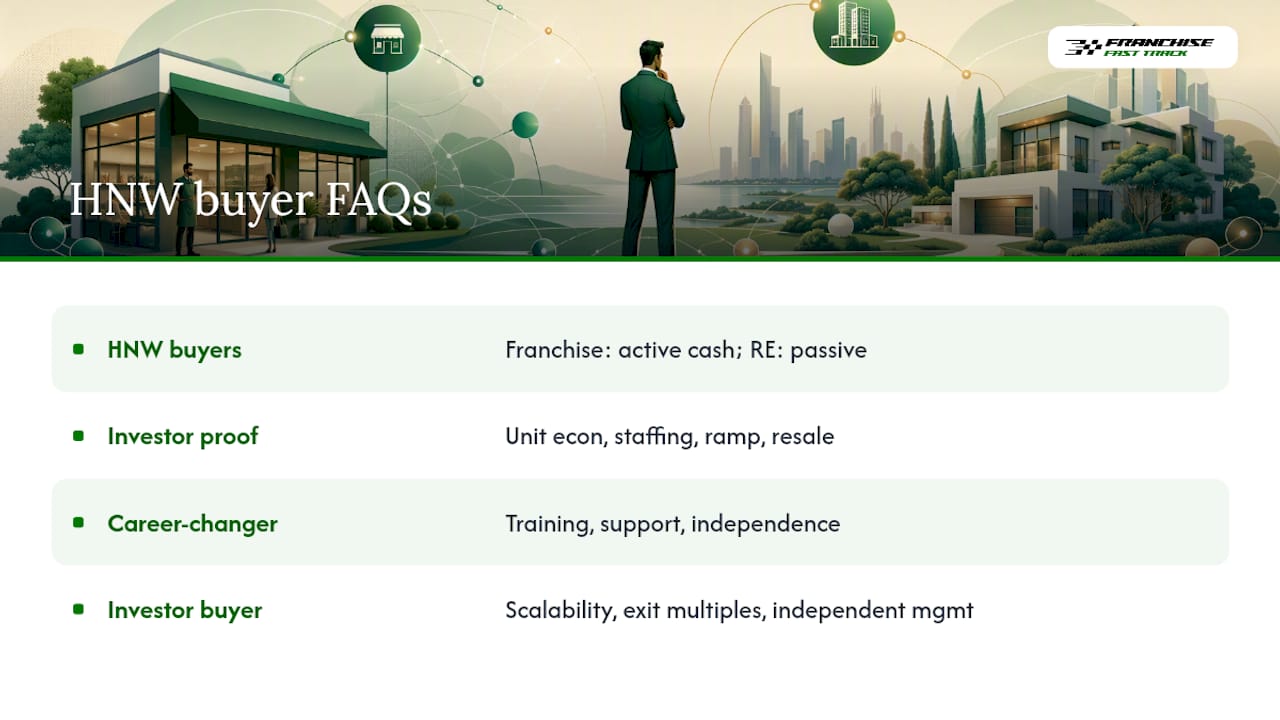
How is a career-changer buyer different from an investor buyer? Career-changers want training, support, and independence. Investor buyers want scalability, exit multiples, and a management structure that doesn't depend on them personally.
What's the fastest way to reach verified high-income franchise buyers? Territory-targeted outbound with income and intent verification built in, rather than waiting on portal traffic or referrals alone.
Sources
- Are You Recruiting a Franchisee or an Asset Manager? - Franchise Marketing News
- Luxury real estate marketing strategy - Bullseye Strategy
- Franchise Buyer Persona Template: Ideal Franchisee | FIG
Recommended
- Why High-Income Professionals Buy Franchises | Franchise Fast Track Blog
- Franchise Fast Track vs FranNet: Exclusive Recruitment vs Broker Network | Franchise Fast Track
- Franchise Resale Opportunities: Your 2026 Buyer's Guide | Franchise Fast Track Blog
- Franchise Fast Track vs Franchise FastLane: Outbound Engine vs Full FSO | Franchise Fast Track
Ready to see results like these for your franchise?
Stop wasting money on leads that never close. Start getting hundreds of replies from high-net-worth professionals daily.