Franchise Value Proposition: One Proof Point Per Claim for Franchisors
A franchise value proposition is the specific, provable answer to the question every serious candidate asks: what will owning this franchise get me, and how do you know? The best-practice fix most franchisors skip is simple: state the candidate's financial and lifestyle outcome, then attach one verifiable proof point (an FDD disclosure, a KPI, a real franchisee metric) to every claim you make.
TL;DR:
- Providing specific, verifiable proof points for each candidate outcome increases the quality of prospects and improves conversion rates.
- Disclose realistic earnings, detailed operational support, and documented demand to build trust and meet legal compliance expectations.
- Differentiate with precise numbers, local market validation, and address industry-specific weaknesses, rather than vague claims or generic support statements.
- Use testing methods like pilot appointments and validated testimonials to refine your value proposition before scaling messaging system-wide.
- Ensure all claims match disclosures in the franchise disclosure document and legal standards to avoid regulatory risks and strengthen trust.
Table of Contents
- What Is a Franchise Value Proposition, and Why Does It Matter?
- The Core Elements Candidates Actually Weigh
- How to Craft or Refine Your Franchise Value Proposition
- How Do You Validate Claims So Prospects Actually Trust Them?
- Communicating the FVP Across the Recruitment Funnel
- What Verified Appointments Reveal About FVP Performance
- Standing Out From Competing Franchise Opportunities
- Legal and Compliance Guardrails for Your Messaging
- Common FVP Mistakes and Quick Fixes
- Turn Your FVP Into a Recruitment Advantage
- Sources
What Is a Franchise Value Proposition, and Why Does It Matter?
A product's unique selling proposition tells a customer why to buy a burger or a haircut. A franchise value proposition (FVP) tells a candidate why to invest $200,000 and five years of their life. Those are different sales, and treating them the same is why so many franchise marketing strategy efforts fall flat.
Candidates aren't comparing your burger to another burger. They're comparing a career change against staying employed, and weighing risk against a specific personal outcome: income replacement, more control over their schedule, or a business to hand to their kids. The International Franchise Association's 2026 research found franchised businesses post stronger pay progression and higher sales and employment than non-franchised businesses, which is exactly the kind of industry-level proof that makes franchising credible as a path to entrepreneurship in the first place.
A recruit-ready FVP needs to address:
- The financial outcome (realistic earnings, not aspirational ones)
- The operational safety net (training, systems, support)
- The lifestyle trade the candidate is actually making
The Core Elements Candidates Actually Weigh
Most FVPs list features. Candidates are scoring investment advantages, and they score them in roughly this order.
- Financial clarity. Average unit volume, a realistic earnings range, total investment, and an honest payback timeline. Vague ranges read as evasive.
- Operational support. Training programs, operations manuals, supplier relationships, and group purchasing power that actually lowers cost of goods.
- Brand demand. Evidence customers already want what you sell, not just that you want franchisees.
- Quality-of-life and purpose. Schedule flexibility, exit potential, or mission fit, but only when backed by real staffing models.
- Resilience and transparency. How the system adapted during shocks like the pandemic, and whether you disclose the hard numbers candidates need to see.
FranConnect's guidance on refining a franchise value proposition singles out performance, adaptability, and trust as the three levers that move serious candidates, ahead of glossy branding.
Pro Tip: Never present a lifestyle claim (like "get your weekends back") without naming the staffing model that makes it operationally true. That single-sentence gap is where most FVPs lose credibility with experienced buyers.
How to Craft or Refine Your Franchise Value Proposition
Building a candidate-focused FVP isn't a branding exercise. It's closer to a product spec, and it takes the same discipline.
- Segment your candidate personas and rank them by fit. A former operations manager with $250,000 in liquid capital behaves nothing like a first-time investor.
- Write one candidate outcome statement per persona. Name the financial target, the lifestyle shift, and the timeline.
- Assign a single measurable proof point to every promise. No claim ships without evidence behind it.
- Build channel-specific message packages. Your website hero, your email drip, and your discovery-day script each earn the promise differently.
- Test before you scale. Use discovery days and even mystery shopping to confirm the candidate experience matches the public message.
When testing, change one variable at a time, whether that's the headline, the proof point, or the testimonial, so you know which change moved the needle. Track two layers of results:
- Early-stage engagement: click rates, discovery-day signups
- Late-stage conversion: discovery-day-to-offer rate, actual close rate
Franchisors who name the outcome and then attach a specific proof point tend to attract higher-quality prospects, not just more of them. That distinction should shape every message package you build.
How Do You Validate Claims So Prospects Actually Trust Them?
Every FVP claim needs a paper trail, and the FDD is where that trail starts. The FTC's consumer guide to buying a franchise confirms candidates should expect financial disclosures, including Item 19 earnings claims, before they commit. If your Item 19 doesn't support what your sales team is saying, you have a bigger problem than marketing copy.
Beyond disclosure documents, back your FVP with:
- AUV and unit-level economics that match your Item 19
- Lead-to-close rate and average speed-to-contact
- Franchisee tenure and churn, not just success stories
- Training hours delivered versus training hours promised
Case studies and testimonials should be dated, attributed to a named location, and tied to a specific metric rather than a general endorsement. Speed itself is a trust signal too: FranConnect's Franchise Sales Index found 85% of leads that became deals were contacted within four hours, which tells candidates you run the business the way you say you do.
Communicating the FVP Across the Recruitment Funnel
Your website hero should state the candidate outcome and its proof in the first two lines, not the fifth paragraph. Everything downstream should reinforce it.
- Email drips should sequence distinct proof points, not repeat the same pitch five times.
- Discovery day should let candidates validate your promises live, through operator visits or real P&L walkthroughs.
- Sales reps need qualifying questions tied directly to the candidate outcome statement, so unqualified leads self-select out early.
- Measure speed-to-contact and A/B results on message variants, not just lead volume.
A tool built for franchise recruitment marketing can help track which message variant actually shortens the path from first contact to signed agreement.
What Verified Appointments Reveal About FVP Performance
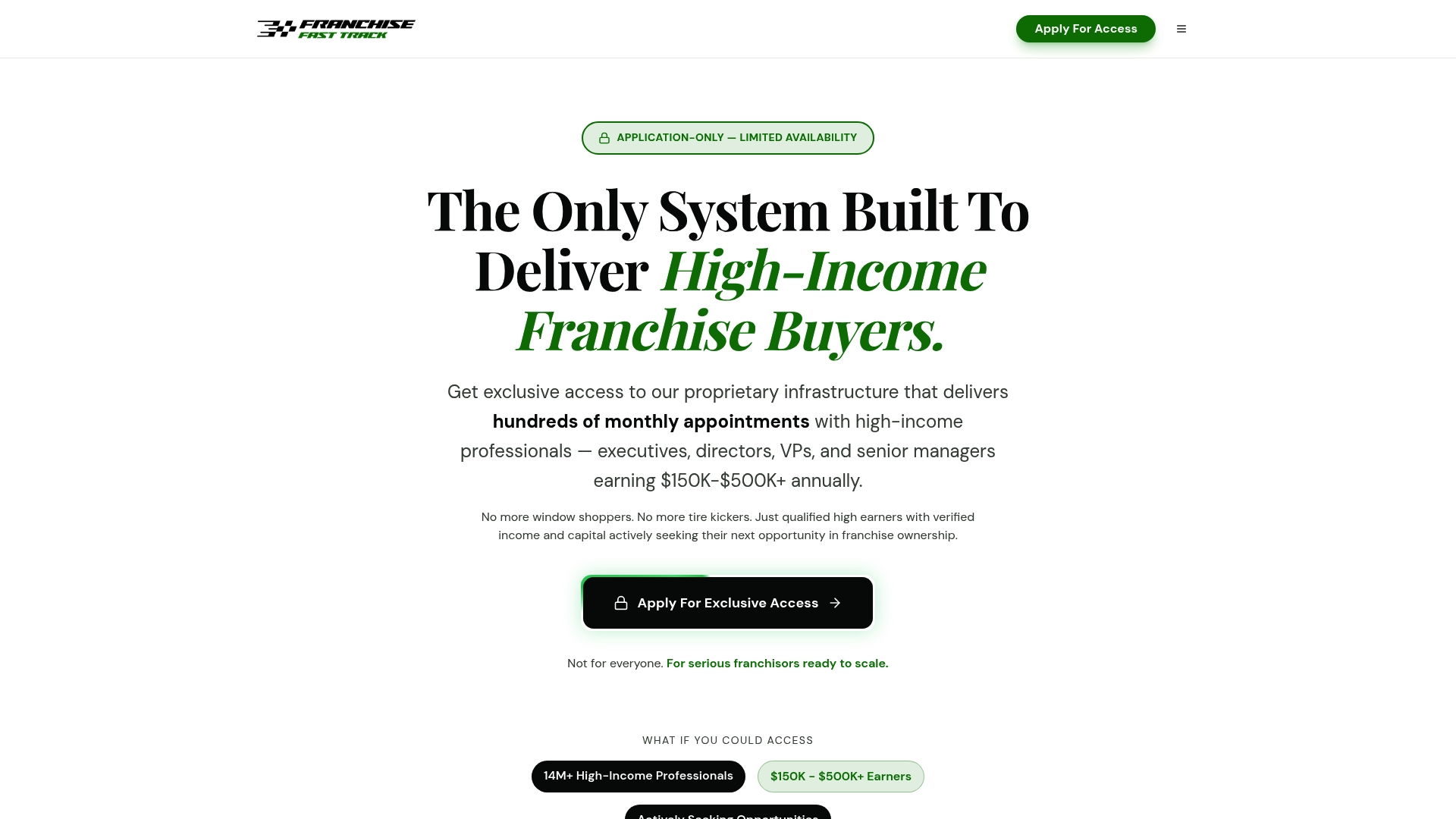
Appointment quality is itself a proof point. A lead generation service reports delivering hundreds of verified appointments monthly with executives, directors, and senior managers earning high incomes, alongside a reported lead-to-close rate of around one-third.
That figure matters less as a marketing stat and more as a benchmark. When appointments are pre-qualified on income and intent, discovery days convert at a materially higher rate because reps stop spending time re-qualifying candidates who were never going to close. Franchisors can borrow this logic directly: cite your own lead-to-close rate, average deal size, or time-to-signature as evidence inside your own FVP, the same way you'd cite AUV. A franchise lead generation program that verifies income before the appointment is booked essentially builds one proof point into your funnel automatically.
Standing Out From Competing Franchise Opportunities
Most FVPs fail at differentiation not because the franchise lacks strengths, but because the messaging copies whatever the last three brands in the category said. "Proven system, great support, be your own boss" describes every franchise opportunity in America and convinces nobody.
Real differentiation starts with a hard look at what candidates are actually comparing you against. If you're in home services, your competitor set isn't just other home-service brands. It's the candidate's alternative of buying an independent business, staying in corporate employment, or investing passively instead. Your FVP has to win against all three, not just against the brand next to you at a franchise expo.
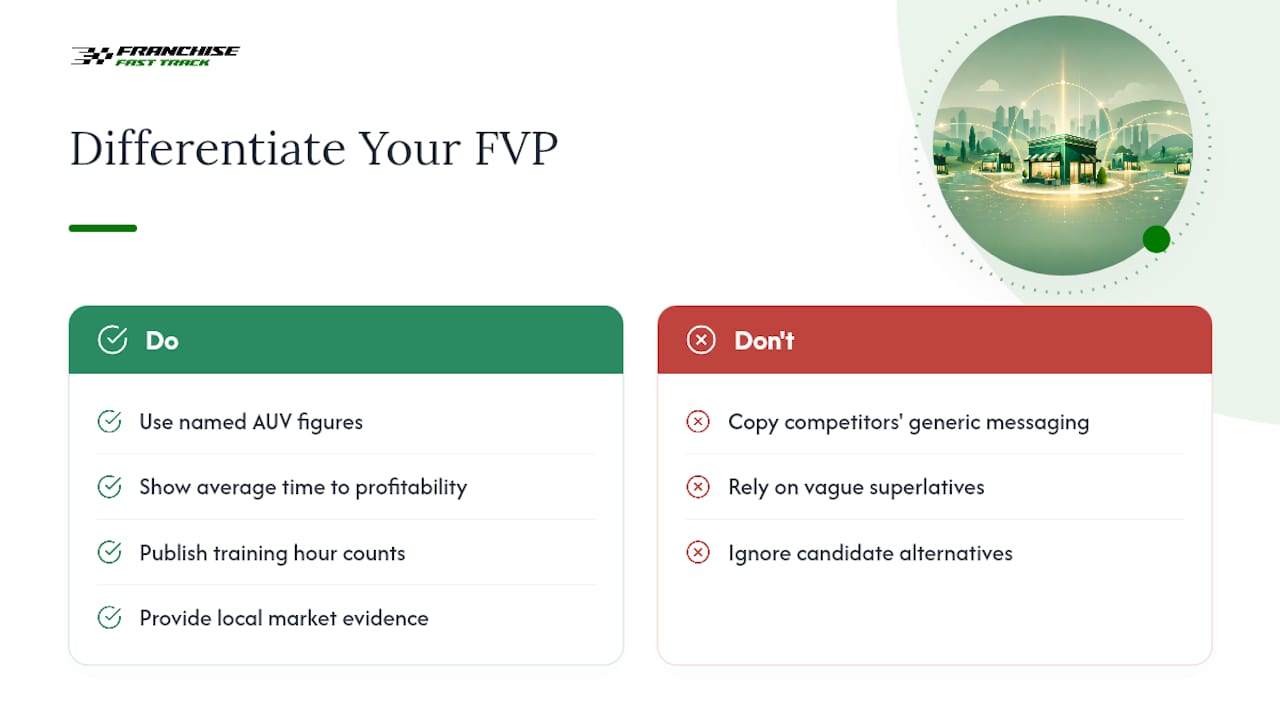
The sharpest way to differentiate is specificity your competitors can't easily copy: a named AUV figure, a documented average time to profitability, a training curriculum with actual hour counts, or a support ratio (one franchise business consultant per how many units). Generic superlatives invite skepticism; specific numbers invite scrutiny you can survive.
Local market evidence matters too. A candidate evaluating territory availability wants to know whether your brand has already validated demand in their area, not just nationally. Resources like the local market insight checklist help franchisors and candidates alike assess whether the demand signal is real before territory gets committed.
Finally, differentiate on buyer red flags you've already solved. If your category is known for high turnover, franchisee lawsuits, or opaque earnings claims, address that directly and show your counter-evidence. Naming the industry's known weakness and then proving you've fixed it is far more persuasive than pretending the weakness doesn't exist.
Legal and Compliance Guardrails for Your Messaging
The FTC's Franchise Rule exists precisely because franchise sales pitches have a long history of overpromising. Any earnings claim you make outside the FDD, verbally, in a deck, on a webinar, creates legal exposure if it doesn't match your Item 19 or lacks the required substantiation on file.
The core compliance principle is straightforward: if a claim could reasonably influence someone's decision to invest, it needs to trace back to a documented, defensible source. That includes AUV figures, franchisee income examples, and even loosely worded statements like "our top performers earn X." The FTC's guide to buying a franchise is explicit that no franchise can guarantee success, and any messaging implying otherwise invites regulatory and legal risk.
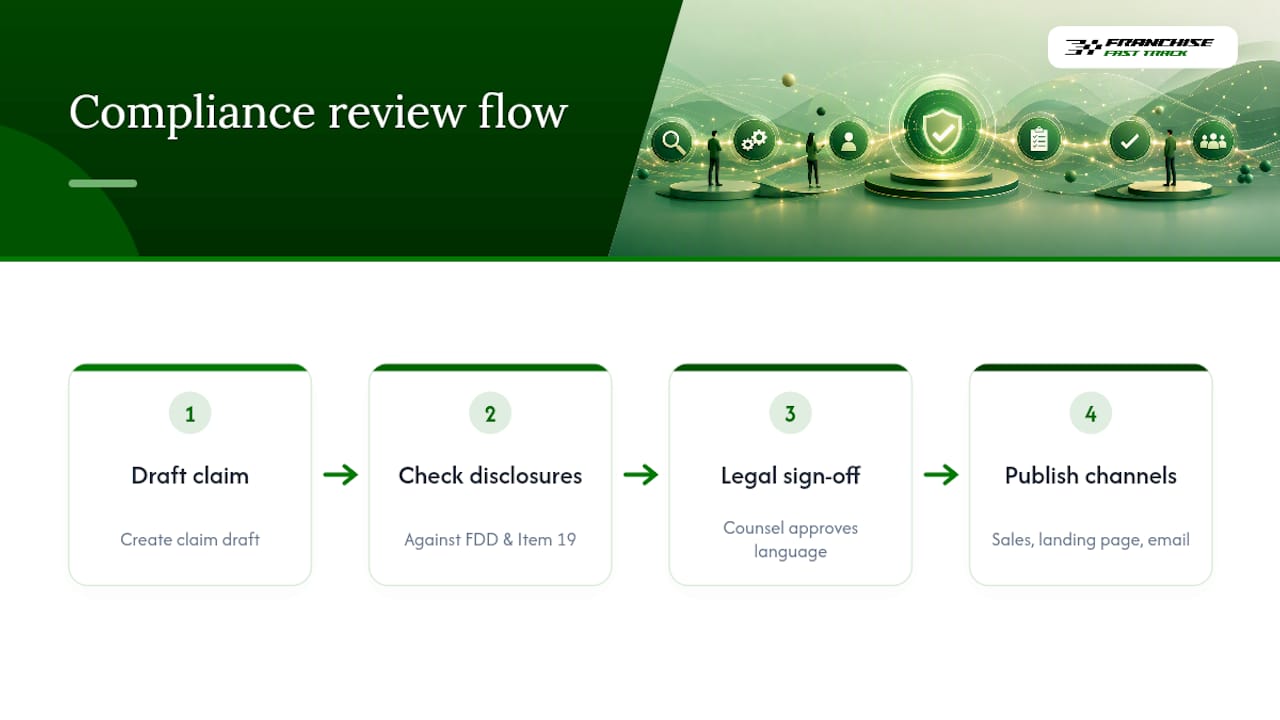
Sales teams are often the weakest link here, not the marketing department. A rep who improvises an earnings estimate on a discovery call outside the Item 19 language creates the same liability as a false claim in a national ad campaign. Every FVP rollout needs a sign-off step where legal counsel checks the language against current FDD disclosures before it reaches a sales script, a landing page, or an email drip.
Territory representations carry their own risk. If your FVP implies exclusivity or market protection that your franchise agreement doesn't actually grant, that gap becomes a dispute later, not a marketing win now. Keep the public-facing promise and the contractual reality in the same document, reviewed by the same eyes, updated on the same schedule. When you evaluate what a franchise investment opportunity actually discloses, compliance and persuasion turn out to be the same exercise done well.
Common FVP Mistakes and Quick Fixes
The recurring failure is vague promises where candidates expect numbers. "Flexible lifestyle" and "proven support" sound like every competitor's pitch because they are. The second failure is promising quality-of-life gains the operations model can't back up, which shows up later as franchisee turnover. The fix is boring but effective: tie every claim to one verifiable metric, and surface one testimonial per promise, not five generic ones.
— Cody
Turn Your FVP Into a Recruitment Advantage
A strong franchise value proposition only proves itself once real candidates test it. Instead of guessing whether your messaging resonates, verified appointments with income-qualified executives can help validate your FVP against candidates who can actually close.
Three ways franchisors put this to work: run a pilot batch of appointments to test a new outcome statement before rolling it out system-wide, use a set volume of verified leads to fill a discovery-day cohort and measure the offer rate, or generate fresh franchisee testimonials tied to a specific claim you're trying to prove. Franchise Fast Track's franchise lead generation service handles the vetting and scheduling, so your team spends its time closing rather than qualifying. If your development team needs outsourced top-of-funnel support to run this at scale, the franchise development program extends the same model. Book a pilot batch and see what your current FVP actually converts against a qualified audience.
Sources
- Consumers' Guide to Buying a Franchise — FTC
- The value of franchising — International Franchise Association Foundation (2026)
- How franchisors can refine their value proposition — FranConnect
Recommended
Ready to see results like these for your franchise?
Stop wasting money on leads that never close. Start getting hundreds of replies from high-net-worth professionals daily.