What Franchise Buyer Verification Really Means for Franchisors
Franchise buyer verification is the process of confirming a prospect's liquid capital, net worth, operational fit, and genuine intent to buy, before a franchisor's sales team spends a single hour on the phone with them. For most franchisors, the fastest path to reliable results is contracting a verified-appointment provider rather than building the whole pipeline from scratch, though a well-run internal system with AI triage and human validation can get there too. Franchise Fast Track built its business around this exact gap, delivering appointments with buyers earning $150,000 to $500,000 a year and reporting a 34% lead-to-close rate on those appointments. Two things drive that number:
- Automated financial and intent gating before any human touches the lead
- Multi-step validation (reference checks, financial documentation, meet-the-team calls) before the appointment ever hits a sales calendar
Key Takeaways
Verified franchise buyer appointments consistently outperform unqualified inbound leads because financial and intent screening happens before, not after, a sales conversation.
| Point | Details |
|---|---|
| Verification means income plus intent | A lead only counts as verified once liquid capital, timeline, and decision authority are all confirmed with documentation. |
| Sequence AI before humans | Automated triage should filter capital and territory fit before any sales rep spends time on a call. |
| Validation calls build trust | Connecting prospects with existing franchisees surfaces fit issues before legal paperwork begins. |
| Track four core KPIs | Monitor qualified meetings booked, show rate, lead-to-close rate, and speed-to-lead every month. |
| Franchise Fast Track delivers verified appointments | The service reports a 34% lead-to-close rate on appointments with buyers earning $150,000 to $500,000 annually. |
Table of Contents
- How the Franchise Qualification Process Actually Works
- What Makes a Franchise Applicant Officially "Verified"
- Which Tools and Roles Keep Verification Running at Scale
- Which Metrics Prove the Verification Process Is Working
- What Proof Should Franchisors Demand From a Verification Vendor
- Build It or Buy It: An Honest Take
- Get Verified Franchise Buyer Appointments Without Building the Pipeline Yourself
- Sources
How the Franchise Qualification Process Actually Works
Verification isn't one gate. It's five, stacked in order of cost, so you spend money on humans only after software has done the cheap filtering.
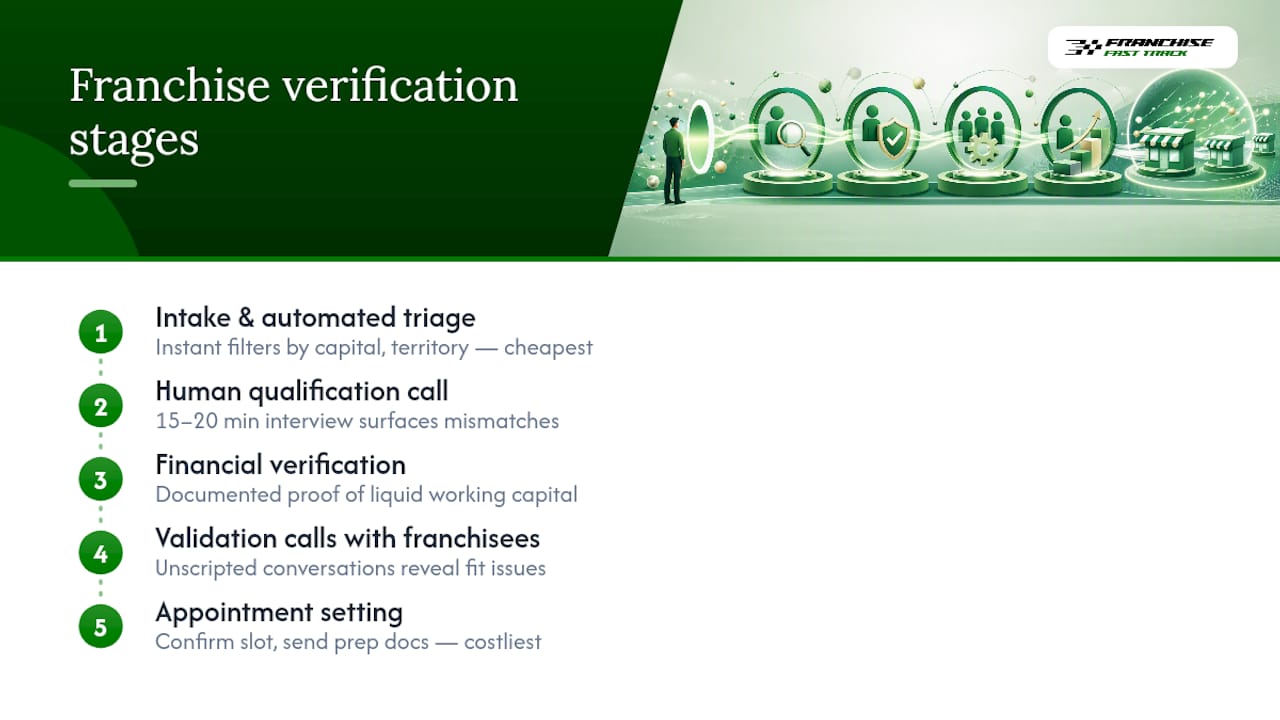
1. Intake and automated triage. Every inquiry answers a short set of questions covering capital range, timeline to open, and territory interest. Automated systems reject or route based on brand-specific thresholds instantly, so nobody with $20,000 in savings ends up on a franchise development director's calendar for a concept requiring $400,000 in liquid capital.
2. Human qualification call. This is where a real person talks through capital sources, current role, decision authority (is this a solo decision or does a spouse or business partner need to sign off?), timeline to open, and territory preference. A 15 to 20 minute call surfaces mismatches that forms can't catch.
3. Financial verification beyond self-reporting. Self-reported net worth means nothing without documentation. Acceptable proof typically includes bank statements, a loan pre-approval letter from an SBA lender, or a letter from a wealth manager confirming liquid assets. Franchisors should confirm working capital specifically, not just net worth. Guidance from Spadea Lignana's franchise field guide recommends declining to move a prospect toward the Franchise Disclosure Document if minimum financial requirements aren't met and no secondary funding is evident.

4. Validation calls. Connect the prospect with two or three existing franchisees for unscripted conversations. These calls build trust and frequently surface fit problems that never come up in a sales-driven conversation.
5. Appointment setting. Confirm the calendar slot, send a reminder 24 hours out, and include a short prep document (concept overview, unit economics summary, one FAQ sheet) so the meeting starts with substance instead of introductions.
Pro Tip: Send validation-call scheduling links directly in the confirmation email for step 5, not as a follow-up task for your sales team. It cuts a full day out of the pipeline and noticeably improves show rates.
Effective qualification systems assess financial fit, operational readiness, and territory alignment before a human ever gets on the phone, and that sequencing is what separates programs with strong close rates from ones drowning in unqualified inquiries.
What Makes a Franchise Applicant Officially "Verified"
A lead isn't verified because someone filled out a form correctly. It's verified when it passes specific, documented gates that your sales team and any outsourced vendor agree on in advance.
- Financial threshold: liquid capital confirmed via bank statement, brokerage statement, or lender pre-approval, not a self-reported number on an intake form
- Working capital confirmation: enough cash beyond the franchise fee to cover setup and the first 6 to 12 months of operations
- Operational fit: prior management or ownership experience, ideally multi-unit oversight or P&L responsibility, which tends to predict franchisee durability more reliably than liquidity alone
- Decision authority confirmed: the prospect, not a spouse or hidden business partner, controls the final decision, or that partner has already been included in the conversation
- Timeline signal: a stated target date to open, not a vague "sometime in the next few years"
- Territory availability confirmed: the prospect's desired market is open and not already under an exclusivity agreement
A simple weighted scoring model works well, assessing financial capacity, operational experience, intent and timeline, and territory fit. Leads scoring well across these categories are ready for a sales conversation. Anything below 60 goes back to nurture, not the calendar. This scoring discipline is also where the 34% lead-to-close rate Franchise Fast Track reports starts to make sense: appointments only reach that stage after clearing every gate above.
Which Tools and Roles Keep Verification Running at Scale
Running this at volume requires a stack, not a spreadsheet. The typical setup looks like this:
- Intake layer: a structured web form or landing page that captures capital range, timeline, and territory before any human involvement
- AI qualification layer: software trained on a brand's own historical approval data, since a model built on a brand's specific financial thresholds and territory rules outperforms generic CRM lead scoring
- CRM integration: every qualified lead lands with full context (capital range, notes from the intake call, territory) so sales never has to ask a prospect to repeat themselves
- Calendar and reminder tools: automated scheduling with 24 hour confirmation sequences
- Verification services: third-party or in-house checks for financial documentation and background screening, including criminal record and regulatory compliance checks appropriate for a franchise relationship
AI-first sequencing matters because it saves sales time and improves funnel efficiency by routing only confirmed leads to a human, with context attached. Data decay is a real cost here too. B2B contact data degrades fast, so regular list cleanses and multi-touch outreach sequences keep speed-to-lead numbers honest. On consent: always get explicit written permission before collecting financial documents, and store them separately from general CRM notes.
Which Metrics Prove the Verification Process Is Working
Four numbers tell you whether the pipeline is actually producing results: qualified meetings booked per month, show rate, lead-to-close rate, and speed-to-lead (time from inquiry to first qualified contact).
- Lead-to-close rate is the clearest ROI signal. Franchise Fast Track's reported 34% rate on verified appointments is a useful external benchmark for franchisors evaluating their own numbers.
- Show rate below 80% usually points to weak confirmation sequences, not bad leads.
- Speed-to-lead under one hour consistently produces better qualification outcomes than a same-day or next-day follow-up.
- Capture a short handoff note at every stage transition (intake to call, call to validation, validation to appointment) so you can trace exactly where a lead stalls or drops.
Run small A/B tests on reminder timing and prep-document content before scaling any change across your whole pipeline.
What Proof Should Franchisors Demand From a Verification Vendor
Poor vetting is expensive. Placing an unqualified franchisee into a system costs far more than the initial franchise fee once you factor in lost territory, brand damage, and the time spent unwinding the relationship. That's the real cost a verification vendor needs to justify against.
Franchise Fast Track's core proof points: hundreds of appointments delivered monthly with buyers in the $150,000 to $500,000 income band, a proprietary verification system built specifically for franchise financial and intent screening, a multi-unit franchisee database with verified contacts, and a 34% lead-to-close rate on delivered appointments.
A verification vendor should be able to show you exactly how a lead moved from inquiry to confirmed appointment, including what was checked, when, and by whom. If a vendor can't walk you through that chain, the "verified" label is just marketing.
Before signing with any vendor, ask for: documented case studies with real numbers, client references you can call directly, and a walkthrough of their specific financial and background verification steps. Vague answers here are the biggest red flag in procurement.
Build It or Buy It: An Honest Take
Outsourcing wins when you need territory growth fast and don't have six months to build and tune an internal AI qualification model. Building in-house wins when you're a large multi-brand franchisor with the volume to justify a dedicated team and want long-term control over the data. Most single-brand franchisors expanding into new territory are better served starting with a specialist and building internal muscle once volume proves it out.
— Cody
Get Verified Franchise Buyer Appointments Without Building the Pipeline Yourself
Franchise Fast Track is the alternative to building an internal qualification team from zero: instead of spending months tuning AI models and hiring setters, you get calendar-ready appointments with pre-verified, high-income buyers starting almost immediately.
The service delivers verified appointments with executives, directors, and senior managers earning $150,000 to $500,000 annually, with income and intent already confirmed before the meeting is booked. Every appointment comes through Franchise Fast Track's proprietary verification system, backed by a multi-unit franchisee database with verified contacts and a reported 34% lead-to-close rate on delivered appointments. Franchisors get hundreds of appointments a month without spending sales hours chasing unqualified inquiries off a portal.
If your team is losing time to leads that fall apart in underwriting, visit the franchise lead generation page to see how the verification and appointment process works for your specific brand and territory footprint.
Sources
- 5.1 Preliminary Screening & Data Collection - Field Guide - Spadea Lignana
- Franchise Lead Qualification for Franchisors: Why Deals Are Lost in the First 72 Hours
- B2B Appointment Setting for Franchise Development: Strategies, Best Practices, and Market Alignment - B2B Appointment Setting
Recommended
- Why Franchise Brokers Benefit From Verified Leads | Franchise Fast Track Blog
- What Is Capital Verification in Franchising | Franchise Fast Track Blog
- Franchisee vs Franchisor: What Each Role Really Means | Franchise Fast Track Blog
- What Does Franchise Equity Mean for Serious Buyers | Franchise Fast Track Blog
Ready to see results like these for your franchise?
Stop wasting money on leads that never close. Start getting hundreds of replies from high-net-worth professionals daily.