Franchise Buyer Personas: A Franchisor's Guide to Better Leads
A franchise buyer persona is a data-backed profile that answers one question: can this person actually buy and run your franchise and do they want to? It's not a demographic sketch. It's a filter built on financial capacity, ownership intent, and operational fit.
Start today with one move: capture net worth, liquid capital, and ownership intent on the very first call or form fill.
- Ask about liquid capital and net worth before anything else
- Confirm whether they plan to run it themselves or hire an operator
- Log the answer directly into your CRM as a qualifying field, not a note
That single habit filters out tire kickers before your sales team wastes an hour on them.
Key Takeaways
Franchise buyer personas work when they enforce hard financial filters at intake and route leads automatically based on fit, intent, and timeline.
| Point | Details |
|---|---|
| Lead with financial filters | Capture liquid capital and net worth on first contact to disqualify unqualified leads immediately. |
| Build from real close data | Pull your last ten signed franchisees to find the pattern before drafting a persona. |
| Use the 30-60-90 framework | Match onboarding pace to persona type across education, setup, and local marketing handoff phases. |
| Tag and score in CRM | Combine a financial score, urgency flag, and ownership code to automate routing decisions. |
| Franchise Fast Track sources pre-qualified appointments | Delivers verified buyers earning $150,000 to $500,000 annually, reporting a 34% lead-to-close rate. |
Table of Contents
- What Makes Franchise Buyer Personas Different From Consumer Personas
- Why Franchise-Specific Personas Matter for Development Teams
- The Essential Data Points Every Franchise Buyer Persona Must Include
- How to Build Your First Franchise Buyer Persona in 30 Minutes
- Four Persona Templates You Can Copy and Test
- Turning Personas Into CRM Tags, Scoring, and Routing Rules
- Measuring Persona Effectiveness and Knowing When to Iterate
- How Franchise Fast Track Applies Persona-Driven Qualification
- What Actually Works vs. What Sounds Good on a Slide
- Get Persona-Qualified Appointments Without Building the Pipeline Yourself
- Sources
What Makes Franchise Buyer Personas Different From Consumer Personas
Consumer personas chase lifestyle signals: age, hobbies, shopping habits. Franchise buyer personas chase something harder: can this person write a check for $150,000 in liquid capital, pass a background check, and follow a system they didn't build?
A working persona has to answer specific franchise-facing questions:
- Does the candidate meet minimum net worth and liquidity thresholds?
- Will they operate the unit themselves or hire a manager?
- Do they have the management or industry experience your franchise agreement requires?
- Is their target territory actually available?
Franchise Intelligence Group's persona template centers on exactly this: investment capacity, owner-operator status, and timeline, not age brackets or income guesses. The common misuse is treating a persona as a demographic sketch, "male, 45 to 55, suburban." That description tells you nothing about whether the person can close.
Why Franchise-Specific Personas Matter for Development Teams
Personas save your sales team's most expensive resource: time with a qualified closer. A well built persona lets an intake coordinator disqualify a $40,000-net-worth applicant in five minutes instead of routing them to a discovery call.
That disqualification speed shows up directly in your numbers:
- Shorter sales cycles because unqualified leads never reach your senior team
- Higher lead-to-close rates because only viable candidates advance
- Fewer wasted discovery calls, which protects morale on the development team
Personas also create internal governance. When marketing, sales, and franchise development agree on what "qualified" means before a lead ever arrives, nobody argues about it mid-pipeline.
The Essential Data Points Every Franchise Buyer Persona Must Include
A persona only works if it's specific enough to route a lead automatically. Franchise Intelligence Group's template calls out roughly ten data points that belong in every buyer profile, and they split into two tiers.
Tier one: hard disqualifiers.
- Liquid capital available for investment
- Net worth threshold required by the franchise agreement
- Credit history or bankruptcy flags
- Territory availability in the candidate's preferred market
Tier two: fit and sequencing data.
- Owner-operator vs. semi-absentee intent
- Prior management or industry experience
- Timeline to purchase (immediate, 3 to 6 months, exploratory)
- Primary motivation (income replacement, wealth building, career exit)
- Decision influencers (spouse, business partner, financial advisor)
- Communication style and preferred contact channel
Enforce tier one at the intake form or first call. Everything else can get collected across the first two or three conversations.
Pro Tip: Put the two hardest financial filters, liquid capital and net worth, on your intake form as required fields. Everything else can wait for the discovery call.
How to Build Your First Franchise Buyer Persona in 30 Minutes
You don't need a workshop to start. Pull your last ten signed franchisees and look for the pattern that repeats.
- Export the last ten deals you closed from your CRM
- Note their liquid capital, prior job title, and timeline from first contact to signature
- Identify the two or three traits that show up most often
- Draft a one-page profile: financial range, background, timeline, top objection
- Assign a CRM tag to that profile so new leads get flagged automatically
That draft becomes real once it has objections mapped to content. If your typical buyer worries about losing autonomy under a franchise system, your nurture sequence needs an email that addresses exactly that, not a generic "why franchising works" blast.
From there, expand into a 30-60-90 structure. The International Franchise Association's 2025 guidance recommends this exact cadence for onboarding each persona type:
- Days 1 to 30: education and expectation-setting matched to the persona's background
- Days 31 to 60: co-marketing setup and territory or site selection support
- Days 61 to 90: local marketing handoff and first operational milestones
The IFA groups personas into three operational buckets, "Do It Themselves," "Do It With Them," and "Do It For Them," which map directly onto how much hand-holding each persona needs during that 90-day window.
Four Persona Templates You Can Copy and Test
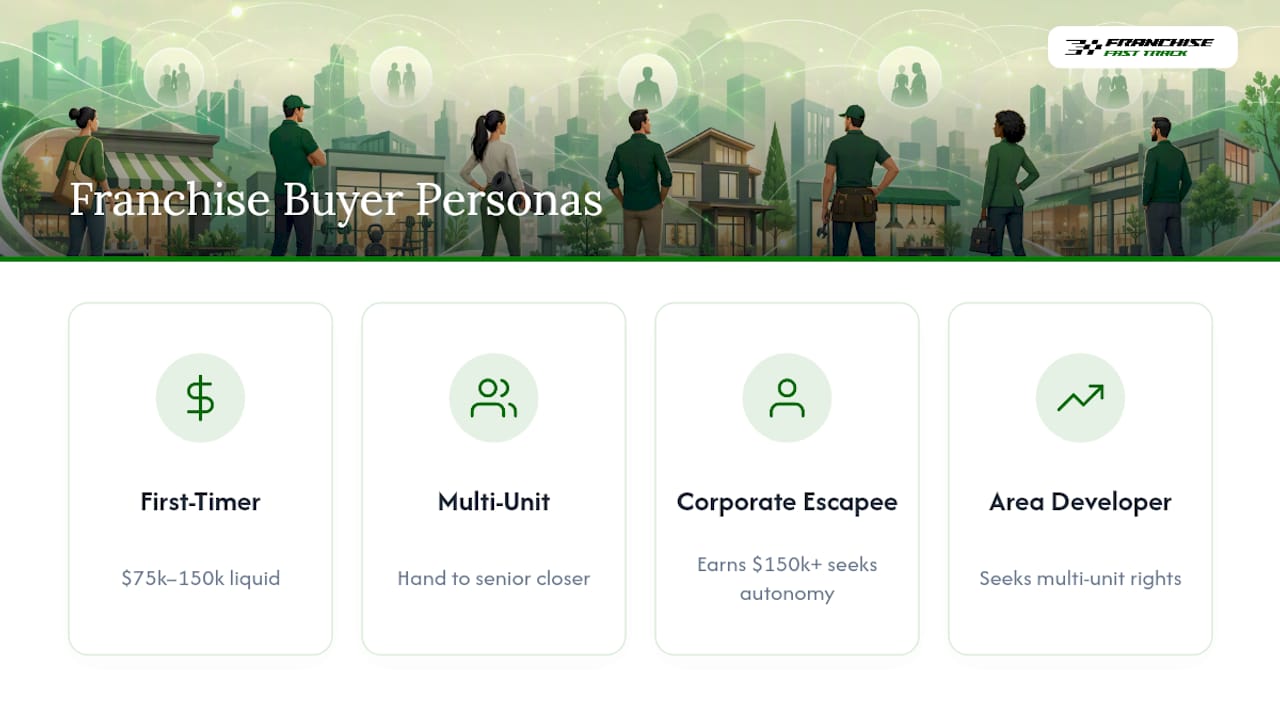
The First-Timer. Needs $75,000 to $150,000 in liquid capital, decides in 3 to 6 months, and worries most about losing income during the transition. Best content: financial projections and validation calls with existing franchisees.

The Multi-Unit Operator. Already runs one or more units, moves fast, and negotiates territory and incentive terms directly. Hand this lead straight to a senior closer, not a nurture sequence.
The Corporate Escapee. A director or senior manager earning $150,000 or more who wants out of a corporate ladder. Motivated by autonomy and legacy building; needs a slower cadence built on trust and proof of system reliability.

The Area Developer. Wants multi-unit rights across a region, has significant capital, and negotiates aggressively on development schedules and fees. Forbes' research on successful franchisees notes this profile skews toward growth-minded operators who see themselves as brand builders, not employees.
Turning Personas Into CRM Tags, Scoring, and Routing Rules
A persona that lives in a slide deck does nothing. It has to become a tag your CRM can act on.
Build a tagging schema that combines three elements: a numeric financial fit score, a timeline urgency flag, and an ownership code (OO for owner-operator, SA for semi-absentee). A lead scoring 8 out of 10 on financial fit with an "immediate" timeline flag routes straight to a discovery call. A lead scoring 4 out of 10 goes to a longer nurture track instead.
- Tag every lead with financial score, urgency flag, and ownership code within the first ten minutes of contact
- Set a scoring threshold (commonly 7 or higher) that auto-escalates to a senior closer
- Build separate nurture sequences per persona: education content for first-timers, fast-track scheduling for multi-unit operators
- Track which persona tag correlates with the shortest time-to-close
Pro Tip: Review your scoring thresholds quarterly. If your "immediate timeline" flag is auto-escalating leads that stall out at discovery, the threshold is too loose.
Measuring Persona Effectiveness and Knowing When to Iterate
Track four numbers: lead quality score at intake, discovery-to-offer rate, lead-to-close rate, and average time to close by persona type. If one persona consistently converts faster, shift ad spend and content toward it.
- Run A/B tests on landing pages and ad targeting by persona segment
- Test email sequence variants against objection types you've already mapped
- Assign one owner, usually the development marketing lead, to review persona performance monthly
How Franchise Fast Track Applies Persona-Driven Qualification
Persona discipline is the backbone of how Franchise Fast Track sources franchise buyer appointments. The platform verifies income and intent before a candidate ever reaches a franchisor's calendar, targeting professionals earning $150,000 to $500,000 annually, matching the executive and director profile that shows up repeatedly in the Corporate Escapee and Area Developer templates above.
That upfront verification is why franchisors working with Franchise Fast Track report a 34% lead-to-close rate, well above what unqualified lead lists typically produce.
What Actually Works vs. What Sounds Good on a Slide
Most franchisors overbuild their personas before they've closed enough deals to know what actually predicts a sale. Start narrow: financial fit and intent, nothing else, until you have real close data.
Two mistakes I see constantly: treating soft preferences like "prefers weekend calls" as hard filters, and building five personas before validating one. Pick your best-performing segment, prove it converts, then expand.
Measure relentlessly. A persona that isn't tested against real close rates is just a guess with better formatting.
— Cody
Get Persona-Qualified Appointments Without Building the Pipeline Yourself
You can spend months refining tagging schemas and nurture sequences, or you can plug into a system that already delivers pre-qualified appointments. Franchise Fast Track exists for franchisors who'd rather spend their team's time closing than filtering.
The service verifies income and ownership intent before a candidate ever lands on your calendar, sourcing hundreds of appointments monthly with executives and directors earning $150,000 to $500,000 a year, the same financial band your Corporate Escapee and Area Developer personas already point to. Instead of building your own scoring model from scratch, you get candidates who've already cleared the hard filters your persona work identified.
If your team is ready to stop screening and start closing, see how franchise lead generation built around verified buyers works, or explore outsourced top-of-funnel support designed for in-house development teams that need volume without adding headcount.
Sources
- International Franchise Association — Understanding franchisee personas (2025)
- Forbes — 8 characteristics of successful franchisees (2024)
Recommended
- Why Franchise Developers Overspend on Bad Leads | Franchise Fast Track Blog
- Franchise Broker Lead Source Diversification Guide | Franchise Fast Track Blog
- Franchise Lead Generation: Qualified Franchisee Candidates for Serious Franchisors | Franchise Fast Track
- Franchise Lead Scoring System: A Franchisor's 2026 Guide | Franchise Fast Track Blog
Ready to see results like these for your franchise?
Stop wasting money on leads that never close. Start getting hundreds of replies from high-net-worth professionals daily.