Grow Franchise Value by Booking Verified Buyer Appointments
Franchisors build wealth through a franchise portfolio fastest by pairing outbound, territory-first appointment-setting with strict buyer verification, not by chasing raw lead volume. A profile-first system like Franchise Fast Track delivers hundreds of appointments monthly with professionals earning $150K to $500K annually, and franchisors using this approach report lead-to-close rates that are notably higher than the low single digits typical of portal-driven inquiries versus the low single digits typical of portal-driven inquiries.
That gap exists because verified appointments skip the qualification work most development teams do manually, after the lead already exists. Here's what changes when you flip the model:
- Fewer, better conversations replace stacks of unqualified inquiries.
- Territory targeting fills priority markets on your timeline, not the portal's.
- Verification happens before the call, not during it.
Key Takeaways
Franchisors grow portfolio value fastest by replacing high-volume, low-qualification lead sourcing with verified, territory-targeted appointment-setting tied to strict capital and engagement checkpoints.
| Point | Details |
|---|---|
| Prioritize quality over volume | Track qualified-conversation-to-signing ratios instead of raw inquiry counts to measure real pipeline health. |
| Verify before scheduling | Confirm capital and engagement consistency ahead of any discovery call to avoid wasted sales cycles. |
| Use discovery day deliberately | Structured discovery days convert at high rates and should follow, not replace, financial verification. |
| Segment buyer personas | Owner-operators and portfolio investors need different messaging, questions, and territory offers. |
| Franchise Fast Track as the pilot partner | Delivers hundreds of monthly appointments with verified $150K to $500K earners and a reported 34% lead-to-close rate. |
Table of Contents
- How Building Wealth Through a Franchise Portfolio Actually Works
- Which Sourcing Method Fits Your Territory Strategy?
- What Should You Ask Before Signing an Appointment-Setting Partner?
- What Verification Steps Actually Separate Serious Buyers?
- What Legal Exposure Should Franchisors Watch in Buyer Outreach?
- How Do You Manage a Franchise Buyer Pipeline With CRM Tools?
- What Should You Budget for Lead Generation and Appointment Setting?
- Who Is the Modern High-Income Franchise Buyer?
- How Do You Convert Booked Appointments Into Signed Franchisees?
- The Playbook Most Franchisors Get Backward
- Book a Pilot Built Around Verified Buyer Appointments
- Sources
How Building Wealth Through a Franchise Portfolio Actually Works
Franchise portfolio value grows through one lever more than any other: awarded units in the right territories, sold to buyers who can actually operate and fund them, supported by personalized financial strategies for small business owners. That sounds obvious until you look at where most franchisor budgets go. Portal listings and broad digital ads generate inquiry volume, but volume is not the same asset as signed agreements with qualified operators.
The practitioners tracking this closely have shifted their language accordingly. Franchise Marketing News frames it as a fundamental recruiting question: are you signing franchisees who will run the business, or accumulating names that behave like passive asset managers with no intention of operating day to day? The distinction matters for portfolio math. A franchisor who signs five well-capitalized, engaged operators in a quarter often outperforms one who fields two hundred portal leads and closes three.
This is also why buyer sophistication has become a bigger factor in 2026 than it was even a few years ago. Buyer-persona research shows today's franchise candidates are more financially deliberate and less casual than the "tire-kicker" inquiries that used to dominate top-of-funnel traffic. They research before they call. They compare franchise ownership against other capital deployment options, including real estate and private equity. Selling to them requires a system built around verification and territory specificity, not generic lead capture forms.
Which Sourcing Method Fits Your Territory Strategy?
Franchisors generally pull candidates from four channels, and each one produces a different mix of volume, qualification depth, and cost. Picking the wrong one for your growth stage wastes a development budget quarter after quarter.
Outbound appointment-setting targets specific buyer profiles in named territories, then verifies income and intent before booking a call. Broker networks rely on independent referral partners who match candidates to concepts across their own portfolios, often without deep territory focus. Franchise portals collect inbound inquiries from candidates browsing multiple brands at once, producing high volume but shallow qualification. In-house development teams build and run their own outreach and screening, which offers control but demands headcount and tooling most single-brand or growth-stage systems don't have.
| Approach | Sourcing method | Qualification depth | Territory targeting | Typical volume | Cost model |
|---|---|---|---|---|---|
| Outbound appointment-setting | Profile-first outreach to named prospects | High: income and intent verified pre-call | Precise, market by market | Moderate, high-quality | Performance-based or retainer |
| Broker networks | Referral matching across multiple brands | Variable, broker-dependent | Loose, broker's book of business | Moderate | Commission on close |
| Franchise portals | Inbound inquiry capture | Low, self-reported | Minimal | High, unqualified | Flat listing or CPL |
| In-house development | Internally built and staffed outreach | Depends on team maturity | Fully controllable | Low to moderate | Fixed salary and tooling cost |
Outbound appointment-setting best fits franchisors racing to fill specific priority territories with buyers who can actually fund a unit. A territory-first outbound sequence recently produced 104 qualified meetings and 25 signed agreements in 90 days, a conversion pattern portal volume rarely comes close to matching. Broker networks and portals still have a place for brand awareness, but neither replaces a system engineered around verified, territory-specific appointments.
What Should You Ask Before Signing an Appointment-Setting Partner?
Vendor selection mistakes are expensive because they cost you a full sales cycle before the underperformance shows up in your pipeline reports. Before signing anything, get the following in writing.
- Request sample appointment logs. Ask for anonymized examples showing how candidates were sourced, verified, and booked, not just aggregate counts.
- Ask how income and intent get verified. A partner should explain their verification method in specific, repeatable terms, such as documentation review or structured pre-call screening, not "we vet everyone."
- Get territory case examples. Ask for a market similar in size or demographics to yours where the partner has actually filled priority territories.
- Push on conversion benchmarks. What is their historical qualified-conversation-to-signing rate? Compare it against your own franchise lead qualification standards.
- Clarify pricing and flexibility. Is it performance-based, retainer, or flat fee? What happens if a territory underperforms for two consecutive months?
- Confirm CRM integration and onboarding timeline. Ask how appointments get handed off and how fast the pipeline goes live.
Pro Tip: Ask any prospective partner what percentage of their booked appointments actually show up for the call. A high booking count means nothing if half the calendar no-shows. Outsourcing this function to specialists is often more cost-effective than building it internally, according to franchise sales practitioners who track the full cycle from lead to signed agreement.
What Verification Steps Actually Separate Serious Buyers?
Capital verification is the first gate, and it should happen before a discovery call gets scheduled, not after. A candidate claiming $200K in liquid capital needs documentation, not a verbal assurance on a discovery call. Franchisors who skip this step often discover the gap only after weeks of relationship-building, when the candidate quietly stalls at the franchise disclosure document review stage.
Engagement consistency is the second gate, and it's easy to overlook. Serious buyers respond to outreach promptly, show up for scheduled calls, and follow through on requested documents without repeated reminders. Buyer-persona research backs this up directly: consistent engagement from first contact is a stronger predictor of eventual signing than the initial inquiry's enthusiasm level. A candidate who takes ten days to return a simple email rarely becomes a fast-moving operator once they own the territory.
Discovery calls function as the third gate, and they should be structured, not conversational. A well-run discovery call confirms territory interest, walks through the general investment range, and asks direct questions about funding source and timeline. It is not the venue for a full sales pitch. Franchisors who compress verification, engagement checks, and discovery into a single rushed call tend to advance unqualified candidates simply because nobody flagged the gaps early. Building these three checkpoints into your intake process, before any candidate reaches your development team's calendar, is what separates a filled territory from a stalled one.
What Legal Exposure Should Franchisors Watch in Buyer Outreach?
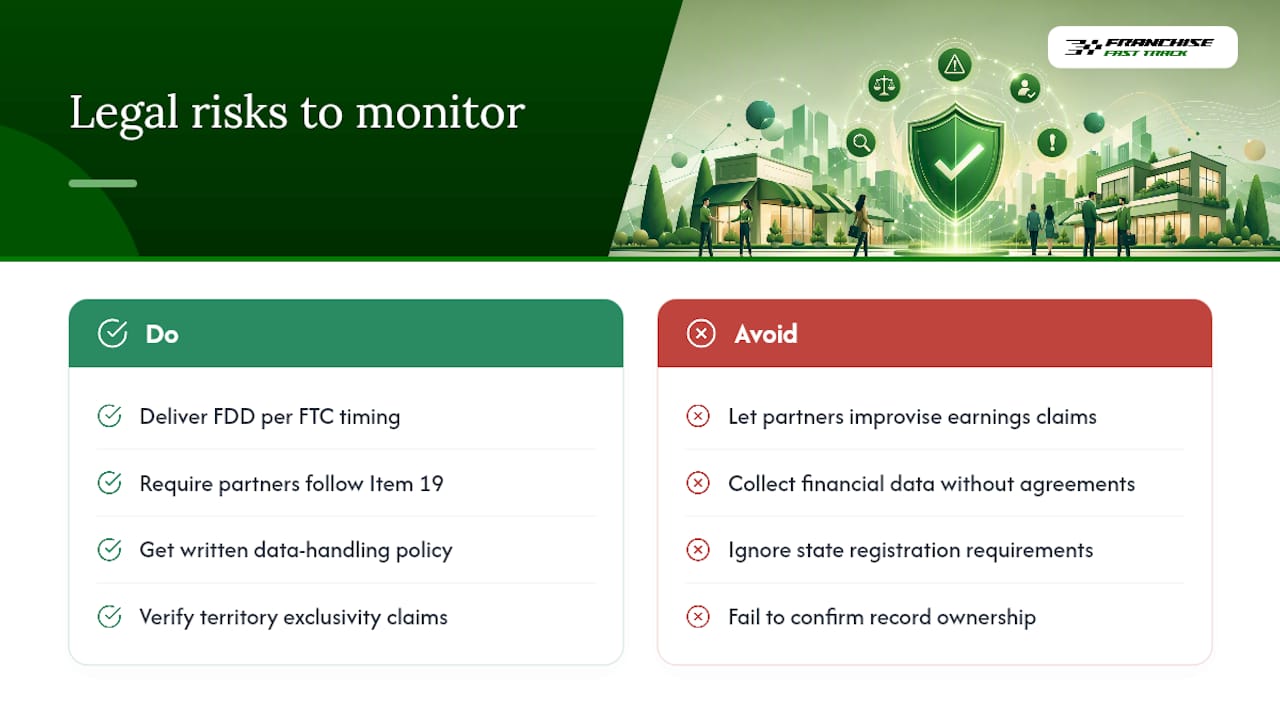
Franchise buyer engagement sits inside a regulated space, and outreach practices carry real compliance weight. The FTC's Franchise Rule governs when and how a franchise disclosure document must be delivered, and outbound teams need clear protocols for timing that delivery correctly relative to any offer or sale discussion. Several states layer additional registration and disclosure requirements on top of the federal rule, particularly for franchisors selling into or from those jurisdictions.
Appointment-setting partners working on your behalf are extensions of your compliance posture, not separate from it. Any claims made during outreach about earnings, unit performance, or investment ranges need to track back to your Item 19 disclosures or stay out of the conversation entirely. A partner who lets a caller improvise earnings claims to close a discovery call creates liability that lands on the franchisor, not the vendor.
Data handling deserves the same scrutiny. Verifying a candidate's income and net worth means collecting sensitive financial information, and that data needs secure handling agreements, particularly if the partner operates across multiple states with varying privacy statutes. Before any pilot begins, get a written data handling policy and confirm who owns candidate records if the contract ends. Franchisors should also confirm territory exclusivity claims made during outreach match what's actually available in their franchise agreement, since a mismatch here becomes a disclosure problem fast. None of this is exotic. It's baseline diligence that separates a defensible growth program from one that invites a state regulator's attention.
How Do You Manage a Franchise Buyer Pipeline With CRM Tools?
A pipeline without a CRM is a pipeline that loses candidates silently. Structured discovery processes paired with CRM integration and automation prevent qualified buyers from falling through the cracks between an initial appointment and a signed agreement, which is exactly where most franchisors bleed conversion without realizing it.
Set up your CRM around the checkpoints, not just contact records. Each candidate should move through defined stages: verified appointment booked, discovery call completed, financial documentation received, discovery day scheduled, agreement sent, signed. Automating reminders at each stage keeps your team accountable to response times, and it gives you visibility into exactly where candidates stall.
Lead scoring adds another layer. Score candidates on capital verification status, engagement responsiveness, and territory fit, then let your team prioritize outreach accordingly instead of treating every contact as equally urgent. A dashboard tracking qualified-conversation-to-signing ratios by territory, rather than total inquiry counts, tells you which markets and which sourcing channels actually convert. That's the metric top-performing development teams watch, according to franchise recruiting analysis that treats vanity metrics as a distraction from real portfolio growth.
Don't let automation replace judgment on the verification steps themselves. Automation should handle scheduling, reminders, and data logging. Financial verification and engagement assessment still need a human reviewing the actual documentation.
What Should You Budget for Lead Generation and Appointment Setting?
Cost structures for franchise buyer sourcing vary widely, and the sticker price rarely tells the full story. Flat-fee portal listings look cheap per lead, until you calculate cost per qualified conversation once you strip out the unqualified inquiries. Broker commissions run higher per closed deal but come with no guarantee of territory focus. In-house teams carry fixed salary and tooling costs regardless of output, which makes them expensive during slow quarters and undersized during growth pushes.
Performance-based and retainer models built around verified appointments shift the cost conversation toward return per appointment rather than cost per lead. If a partner delivers appointments with candidates already verified at $150K to $500K in income, the relevant question becomes how many of those appointments convert to signed agreements, not how many total contacts entered the funnel.
Run the ROI math on qualified-conversation-to-signing rate, not gross lead cost. Factor in the sales cycle time saved too. Verified appointments compress the qualification stage that otherwise consumes weeks of a development team's calendar chasing candidates who never had the capital to begin with. Reviewing your own franchise investment evaluation criteria against a vendor's delivered appointments is a fast way to sanity-check whether the cost structure actually holds up.
Who Is the Modern High-Income Franchise Buyer?
The franchise buyer profile has shifted meaningfully. Today's serious candidates fall into a handful of recognizable personas: the corporate executive seeking a post-career ownership path, the multi-unit investor building a portfolio for passive income, the industry veteran pivoting from employee to owner within a familiar sector, and the semi-retired professional deploying capital for a controlled second act. Buyer-persona research describes this shift clearly, noting that today's candidates are financially sophisticated and intentional, a departure from the casual browsers who once dominated inbound inquiry volume.

This matters for how you build outreach messaging. A corporate executive earning $250K responds to territory specificity and operational control details, not generic "be your own boss" copy. A multi-unit investor wants unit economics by quartile, staffing floor data, and resale multiples within your system. Franchisors targeting portfolio-focused buyers should be prepared to produce those specifics on request, since multi-unit-minded candidates evaluate franchises more like asset managers than first-time owners.
Segmenting outreach around these personas from first contact avoids the trap of running one funnel for two very different buyer types. An owner-operator candidate and a portfolio investor need different qualification questions, different discovery call framing, and often different territory offers entirely. Positioning franchise ownership against other capital options candidates are weighing, including real estate investment comparisons, helps outreach land with buyers already thinking in portfolio terms.
How Do You Convert Booked Appointments Into Signed Franchisees?
A booked appointment is not a sale. It's the start of a nurture sequence that either builds momentum toward signing or lets a qualified candidate go cold. The gap between the two usually comes down to structure.
Move verified candidates toward a discovery call quickly, and make that call's first ask a conversation, not an FDD dump. Outbound practitioners recommend opening outreach with territory-specific detail and a discovery call request rather than immediate document delivery, since candidates respond better to a real conversation before a paperwork drop. That same sequencing logic applies to nurture: keep early touches conversational and specific to the candidate's territory and background.
Once a candidate clears financial and engagement checkpoints, schedule a discovery day. A well-run discovery day combines operations demonstrations, an executive overview, and unstructured time with existing franchisees, and attendance at this stage correlates with a high signing rate among Discovery Day attendees reported in practitioner data. That number alone justifies building discovery day scheduling into your standard pipeline rather than treating it as optional.
Between the discovery call and discovery day, keep the candidate engaged with specific, useful information rather than generic follow-ups. Share unit economics relevant to their target territory. Connect them with a current franchisee for an unscripted conversation. Address financing questions directly rather than deferring them. Candidates who go quiet during this window usually do so because nurture felt like a sales sequence instead of a genuine evaluation partnership.
The Playbook Most Franchisors Get Backward
Most franchise development teams still measure success by inquiry volume, then wonder why their close rate sits in the low single digits. That's backward. The data on qualified-conversation-to-signing ratios makes the case plainly: quality of the first conversation predicts signing far better than quantity of leads entering the top of the funnel.
The overrated part of conventional advice is the "more leads solve everything" instinct. It doesn't. It just moves the qualification burden onto your development team, later and more expensively, after weeks of relationship-building with buyers who could never fund the unit anyway.
What actually works is treating vendor selection as an operational pilot, not a one-time procurement decision. Run 60 to 90 days with clear checkpoints: verified appointment volume, discovery call show rate, and signing conversion by territory. If a partner can't produce those numbers by day 60, that's your answer. Franchisors who prioritize territory-specific, profile-first outreach over portal breadth consistently fill priority markets faster, with buyers who actually close.
Book a Pilot Built Around Verified Buyer Appointments
Franchise Fast Track exists for exactly the problem this article walks through: filling priority territories with buyers who can actually fund and operate a unit, verified before they ever hit your calendar. The system delivers hundreds of appointments monthly with professionals earning between $150K and $500K, targeting executives, directors, and senior managers actively evaluating franchise ownership rather than casually browsing portals.
If you're weighing a build-versus-buy decision for your development team, Franchise Fast Track's outsourced development model is built to integrate directly with your existing CRM and pipeline rather than replace it. Start a pilot conversation through the franchise lead generation page and get a territory-specific appointment plan built around your priority markets.
Sources
- Are you recruiting a franchisee or an asset manager? - Franchise Marketing News
- How to Sell Franchises in 2026: Buyer Personas & Trends
- The Franchisee Discovery Process: From First Contact to Signed Agreement - Franchise Creator
Recommended
- Why Franchise Brokers Benefit From Verified Leads | Franchise Fast Track Blog
- Advertising a Franchise: A Playbook for High-Income Buyers | Franchise Fast Track Blog
- Franchise Fast Track vs GrowthMaster: Outbound Investors vs Lead Gen | Franchise Fast Track
- Franchise Fast Track vs FranLift: Funded Buyers vs Sales Staffing | Franchise Fast Track
Ready to see results like these for your franchise?
Stop wasting money on leads that never close. Start getting hundreds of replies from high-net-worth professionals daily.