B2B Demand Generation: A Practical Playbook for Growth
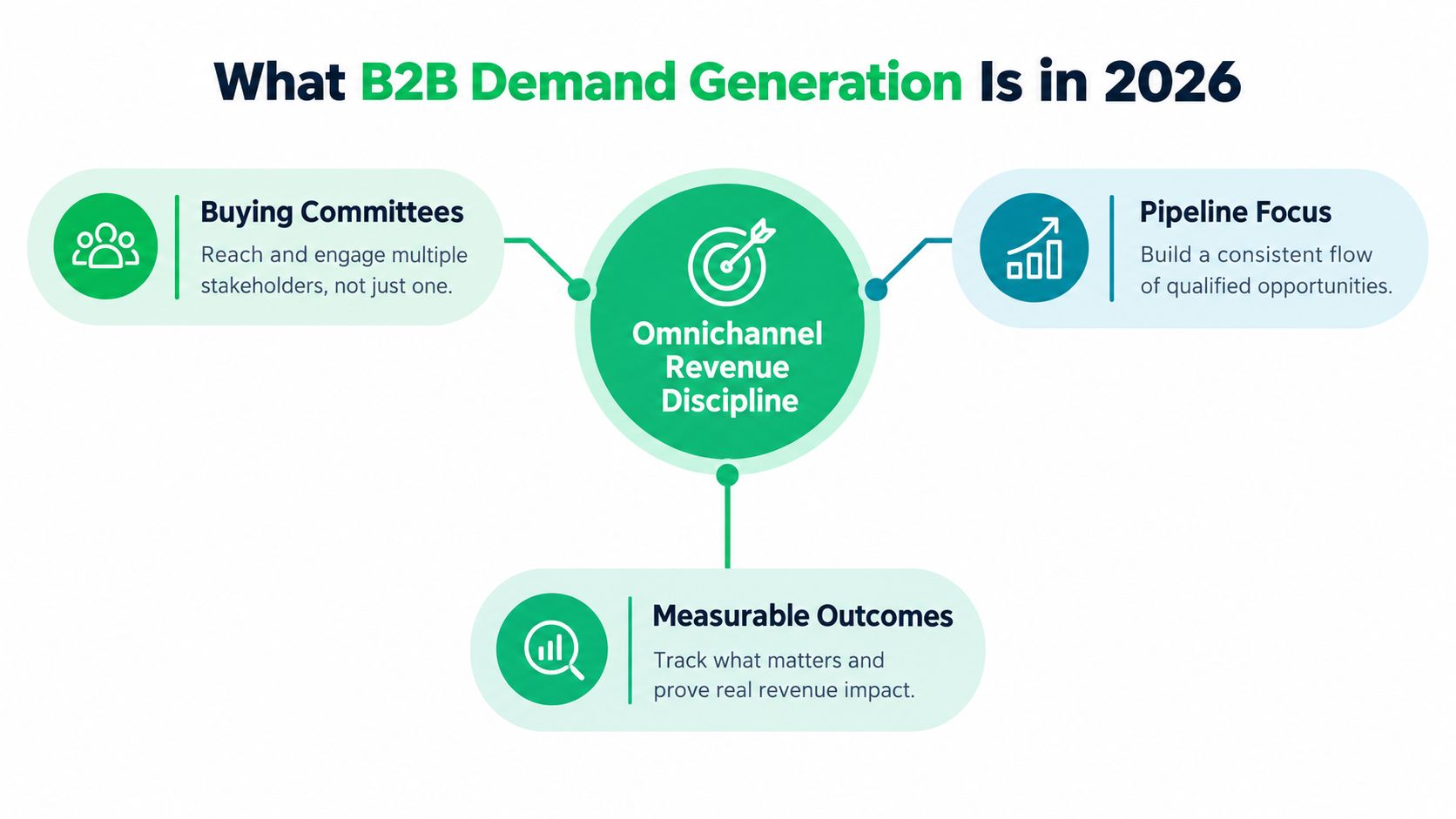
McKinsey's 2024 B2B Pulse research found that business buyers use an average of 10 interaction channels, compared with 5 in 2016, while 42% use more than 11 touchpoints during the purchasing journey. B2B demand generation has therefore become an omnichannel revenue discipline, not a program for collecting more form fills. (McKinsey's B2B growth research)
For United States franchisors with 50 or more locations, the implication is direct. Franchise development teams need consistent positioning across outbound outreach, websites, FDD-based research, live conversations, video meetings, portals, and self-service evaluation. The useful question isn't how many leads marketing produced. It's how many qualified operators entered discovery, progressed through validation, and reached an award decision.
Table of Contents
- What B2B Demand Generation Actually Is in 2026
- Defining the Audiences That Drive Real Pipeline
- Choosing the Right Channel Mix
- Running the Demand Generation Operating Model
- Measuring Pipeline Beyond Last-Touch Attribution
- Why AI Discovery Is Reshaping Demand Generation
- A 90-Day Demand Generation Playbook
What B2B Demand Generation Actually Is in 2026
B2B demand generation creates and converts buying intent across an entire market, while lead generation captures identifiable responses from individuals who have already shown interest. The distinction matters for franchise development because a senior executive, multi-unit operator, private equity team, or development partner may research a concept across several channels without ever completing a portal form.
McKinsey's research found that buyers distribute preferences across formats. At each stage, roughly one-third prefer in-person interaction, one-third prefer remote communication, and one-third prefer digital self-service. More than half wanted an omnichannel experience that allowed movement between channels without losing context. That pattern makes a single-channel franchise recruitment strategy structurally incomplete.
Practical rule: A qualified conversation should carry its source, context, role, capital profile, territory interest, and next action into every subsequent handoff.
The modern operating model has three connected parts:
- Signal-driven audience selection: Identify accounts and individuals using fit, intent, role, capital indicators, vertical relevance, and observable trigger events.
- Channel orchestration: Coordinate paid, owned, earned, and outbound activity so that an executive who encounters a brand through research receives the same commercial logic during a sales conversation.
- Pipeline accountability: Connect spend to contacted prospects, qualified conversations, sales-accepted opportunities, discovery progression, and eventual franchise awards.
A franchisor evaluating QSR, home services, real estate brokerages, fitness and wellness, automotive services, health and beauty, retail, education, or senior care concepts needs more than market awareness. The program has to establish whether a prospect has the investment capacity, operating fit, geography, and commitment required for that category.
A useful primer on the shift from contact acquisition to coordinated demand is Grou's guide to beyond lead gen with Grou. For franchisors, the operating translation is franchise development marketing built around verified fit rather than anonymous volume.
McKinsey also reported that 71% of B2B respondents offered some form of e-commerce, with online sales representing 34% of revenue, compared with 17% for in-person sales. Franchise development isn't identical to software commerce, but the directional lesson is relevant: a buyer may begin with self-service research, move to a video meeting, request documentation, and then require a human conversation before advancing.
Defining the Audiences That Drive Real Pipeline
A demand generation audience should be defined by more than industry and job title. Franchise development executives need an account model that combines capital capacity, role authority, operating relevance, geography, and intent.
The first layer is account fit. A national QSR brand may prioritize executives with multi-unit operating experience, while a home services concept may value leaders with local market knowledge and service-business management experience. A fitness and wellness brand may require a different profile from an automotive services brand, even when both seek expansion capital.
The second layer is role. A chief development officer, chief executive, private equity operating partner, multi-unit franchisee, and regional operator can influence expansion in different ways. A useful buying-group map distinguishes the economic decision-maker, the operating evaluator, the internal champion, and the blocker responsible for risk, compliance, or financing concerns.
The third layer is intent. Relevant signals include research into investment requirements, territory availability, operating models, Item 19 information, franchisee turnover, and category-specific economics. A leadership change, new market focus, acquisition activity, or regulatory shift may also change account priority, but those triggers should be recorded as context rather than treated as proof of readiness.
A scoring model should make the trade-off visible instead of hiding it in a single opaque score.
ICP tiering rubric for B2B demand generation
| Tier | Account criteria | Intent signals | Weight, fit / intent / reach |
|---|---|---|---|
| Tier 1 | Strategic franchise systems, investment groups, or operators with clear category and geographic relevance | Direct research, active outreach response, documented expansion activity, or engagement from multiple relevant roles | High / High / Selective |
| Tier 2 | Established operators and development accounts with verified category, capital, or territory alignment | Repeated research, relevant content engagement, event participation, or response to tailored outreach | Medium to high / Medium to high / Moderate |
| Tier 3 | Lookalike accounts derived from qualified conversations and awarded operators | Early engagement, category interest, or similarity to known converting profiles | Medium / Low to medium / Broad |
The model should be reviewed against outcomes, not merely engagement. A prospect who replies quickly but lacks the capital or role authority required by Item 7 is not equivalent to a slower respondent with verified fit.
Data enrichment can support this process when teams document the origin and freshness of each field. A practical reference is the looot data enrichment tool guide. Franchise brands can also refine multi-unit franchise brand personas by comparing actual discovery outcomes with the assumptions used in campaign targeting.
The strongest audience definition usually combines three evidence types: account-level intent, first-party engagement, and qualitative sales feedback. None is sufficient alone. Together, they help marketing concentrate effort on accounts that can progress through a real franchise development process.
Choosing the Right Channel Mix
Outbound, account-based marketing, content, portals, paid search, paid social, and broker referrals solve different demand problems. Treating them as interchangeable acquisition channels creates misleading comparisons because each produces a different kind of response and requires a different time horizon.
Outbound is best suited to pipeline velocity and audience control. A franchisor can define the executive, operator, geography, vertical, and capital profile before the first message is sent. That control makes outbound useful when the target market is narrow or when portal traffic produces many inquiries that fail qualification.
ABM is designed for named-account concentration. It coordinates messaging, sales activity, and research around a limited set of strategic accounts. Its strength is depth, not reach. ABM becomes inefficient when account selection is loose, buying-group coverage is missing, or sales teams don't act on account signals.
Content is the strongest mechanism for category authority and self-service diligence. Content can explain an investment model, compare vertical requirements, clarify development processes, and make a brand discoverable before a prospect is ready to speak with sales. Content Marketing Institute's 2025 B2B research found that 87% of marketers generated brand awareness through content, 74% generated demand or leads, 62% nurtured subscribers or leads, and 49% generated sales or revenue. (Content Marketing Institute's 2025 B2B benchmarks)
Those results also show why publishing volume isn't a sufficient strategy. Only 22% of B2B marketers described their content marketing as extremely or very successful, and 56% cited ROI attribution and customer-journey tracking as major challenges. Content needs explicit commercial jobs, such as answering Item 7 investment questions, explaining Item 19 evidence, or helping a development executive evaluate operator fit.
| Channel | Primary job | Strength | Main trade-off |
|---|---|---|---|
| Outbound | Create qualified conversations with selected accounts | Audience precision and speed | Requires accurate data, compliant execution, and strong qualification |
| ABM | Build coordinated influence within named accounts | Buying-group depth | Needs close marketing and sales coordination |
| Content | Establish authority during self-directed research | Compounding discoverability and education | Usually requires sustained editorial and measurement discipline |
| Portals and paid acquisition | Capture existing response demand | Immediate inquiry volume | Lead quantity may obscure fit and downstream conversion quality |
| Broker referrals | Access intermediary networks | Relationship-based introductions | Quality and attribution depend on the referral process |
A sensible allocation follows the bottleneck. If a brand lacks conversations, outbound deserves priority. If strategic accounts are known but inactive, ABM can concentrate resources. If prospects repeatedly ask the same diligence questions, content should answer them in a structured, evidence-based format.
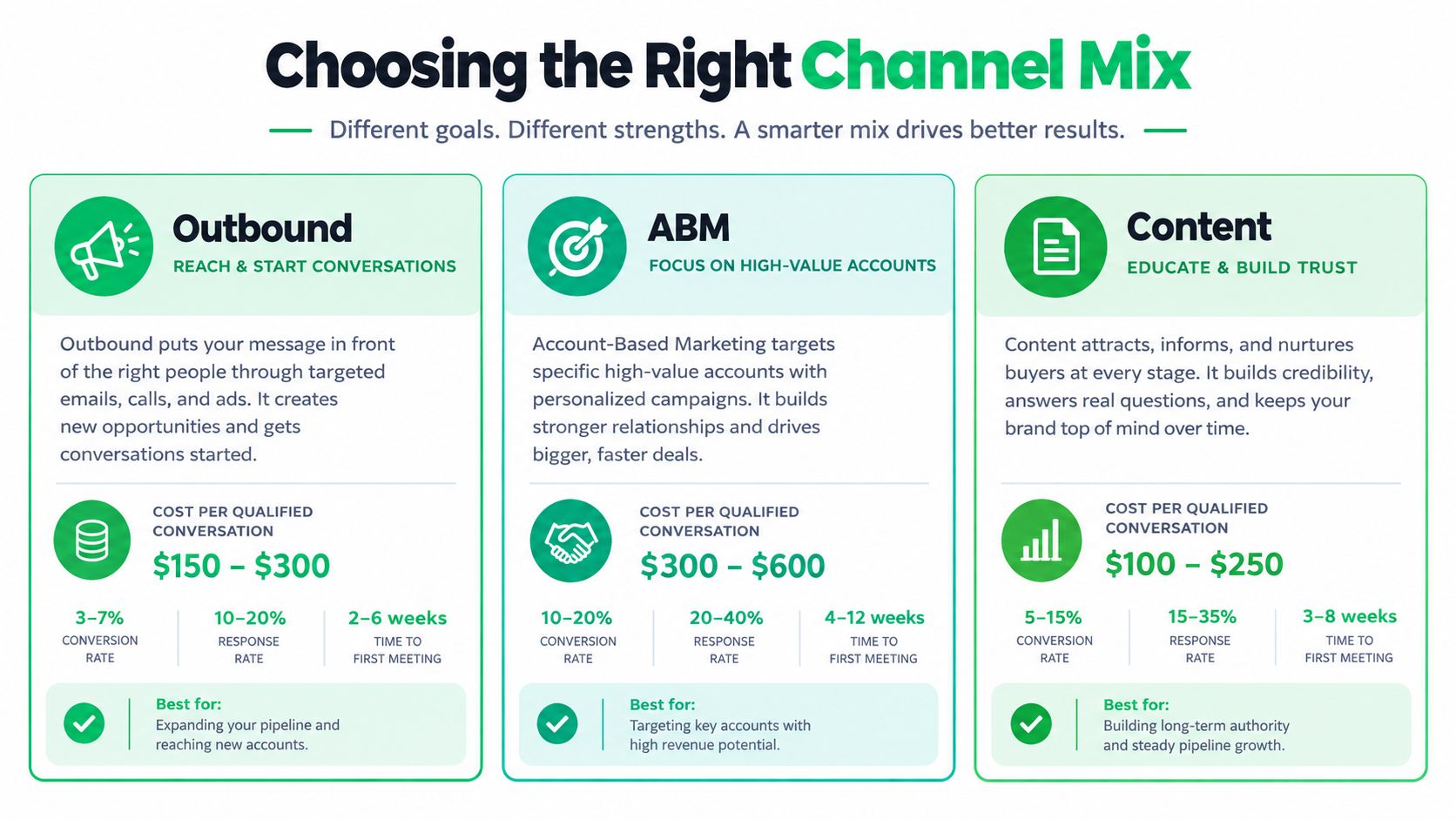
Channel decisions should ultimately use cost per qualified conversation, sales-accepted opportunity rate, opportunity progression, and award rate, not cost per lead alone. Franchisors evaluating franchise lead generation tactics should compare each source using the same downstream definitions.
Running the Demand Generation Operating Model
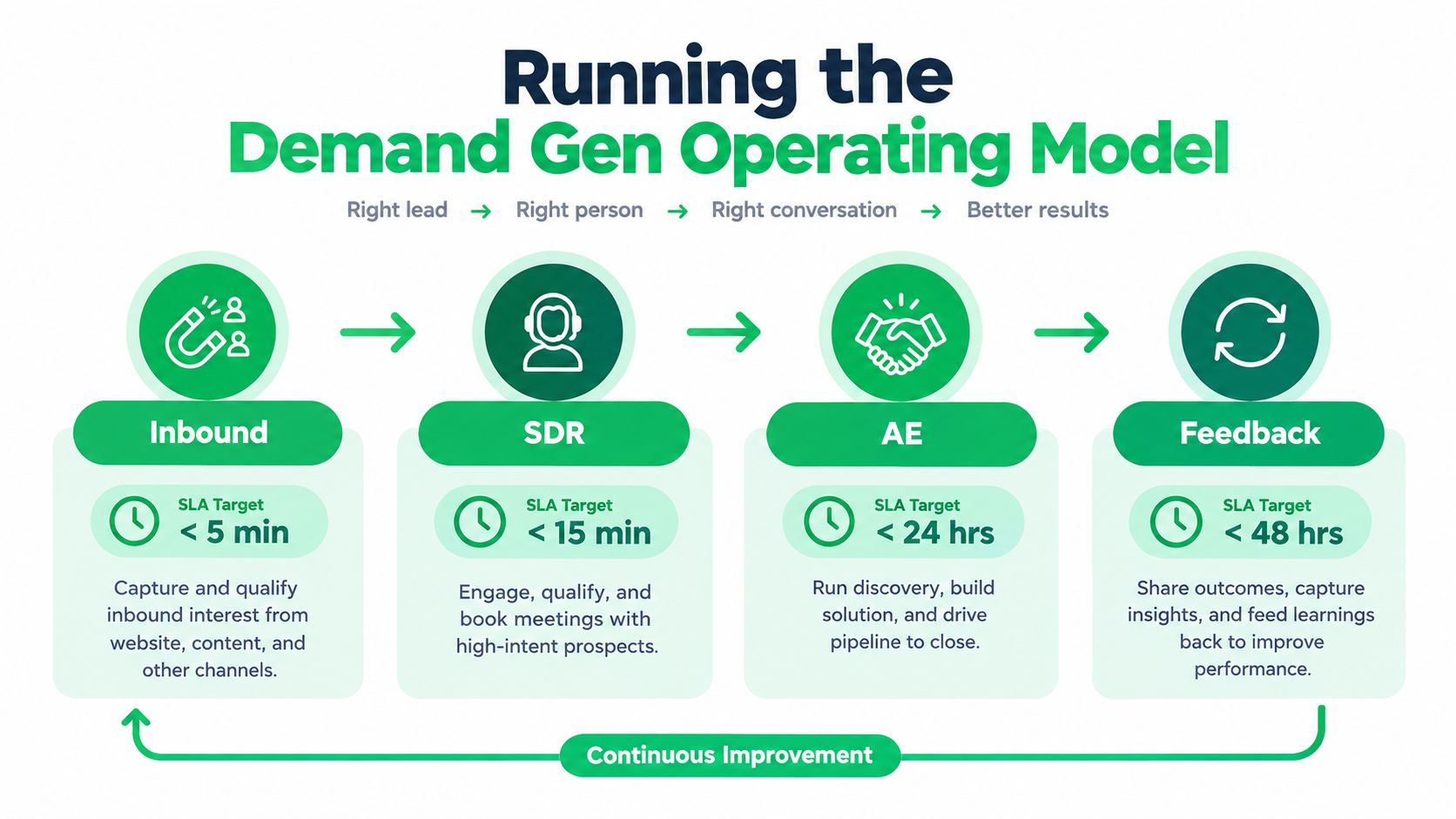
A demand generation strategy becomes operational when every stage has an owner, a service level, required fields, and a measurable output. The most visible control point is speed-to-lead, but speed only creates value when the receiving team applies consistent qualification.
Research summarized by LeanData found that firms attempting contact within one hour were nearly seven times more likely to qualify a lead than firms waiting an additional hour. Organizations waiting 24 hours or longer were approximately 60 times less likely to qualify the lead. Because those studies concern online leads rather than franchise-specific cohorts, franchisors should use the figures directionally and establish their own baseline. (LeanData's speed-to-lead analysis)
The operating cadence should include:
- Capture and enrich: Record the source, account, role, geography, category interest, investment profile, and engagement history.
- Apply qualification rules: Check capital capacity, role authority, territory fit, operating experience, and concept relevance.
- Route immediately: Assign the inquiry to the responsible owner and preserve the context that triggered the handoff.
- Sequence the response: Use a call and personalized email sequence appropriate to the inquiry type.
- Record disposition: Capture contact status, qualification outcome, meeting status, discovery progression, opportunity stage, and award outcome.
High-intent inbound inquiries should receive an operational target below five minutes, while other qualified responses should receive contact within one hour, based on the verified operating guidance above. Teams should audit median and 90th-percentile response times weekly because averages can conceal severe delays.
Stage hygiene and nurture logic
An MQL should meet a documented marketing threshold. An SQL should meet a sales qualification threshold. A sales-accepted lead should have an owner and an explicit acceptance decision. An opportunity should represent a commercial evaluation with confirmed fit, a defined next step, and sufficient information for forecasting.
Nurture logic should reflect the buyer's position. Early-stage prospects need category education and clear definitions. Mid-stage prospects need documented proof, FDD-based context, and answers to operating objections. Late-stage stakeholders need champion enablement, internal business-case material, and a clear path to the next franchise development milestone.
A weekly pipeline standup should inspect new inquiries, response times, qualification yield, stalled opportunities, and feedback from sales. Monthly channel reviews should examine source quality. Quarterly ICP reviews should remove segments that create activity without progression and add segments that produce qualified discovery.
The same principle applies to automation for capital-ready candidates. Automation should remove routing and logging friction, while human specialists retain responsibility for fit, compliance, nuance, and the quality of the conversation.
Measuring Pipeline Beyond Last-Touch Attribution
Last-touch attribution gives all credit to the final interaction before conversion. That can be useful for identifying closing actions, but it undervalues earlier research, outbound awareness, peer influence, and content that helped a buying group establish confidence.
First-touch attribution has the opposite weakness. It identifies the first recorded source, but it cannot explain which later interaction moved an account from interest to discovery or from discovery to opportunity. Multi-touch models distribute credit across the journey, yet they can imply precision where the data only supports directional evidence.
A more reliable measurement stack begins with definitions.
| Metric | Definition | Typical B2B benchmark |
|---|---|---|
| MQL | A person or account that meets the documented marketing threshold for fit and engagement | Establish a baseline by segment and source |
| SQL | A prospect that meets sales qualification criteria and has a credible business or development need | Compare by channel and role |
| SAL | A lead formally accepted by sales with an owner and next action | Monitor acceptance and rejection reasons |
| Opportunity | A qualified commercial evaluation with fit, a defined next step, and forecastable progression | Track progression by category and source |
| MQL-to-SQL conversion | Share of MQLs that satisfy sales qualification | Use historical cohorts, not a universal target |
| SQL-to-opportunity rate | Share of SQLs that become qualified opportunities | Segment by account type and channel |
| Opportunity-to-award rate | Share of opportunities that reach a franchise award | Examine capital, vertical, territory, and operator fit |
| Pipeline velocity | The rate at which qualified opportunities progress through stages | Compare stage duration and source quality |
The hidden measurement problem is substantial. One 2025 synthesis of 6sense research reported that buyers shortlisted vendors before contacting sales 95% of the time, while traditional attribution captured an estimated 27% of the journey. The synthesis identifies AI queries, peer communities, review sites, and private messaging as areas where conventional analytics often cannot observe influence. (The buyer-journey analysis from Geisheker)
For franchise development, the answer isn't to assign invented credit to every anonymous touch. Account-level intent, self-reported source data, discovery-call notes, cohort conversion, sales-accepted opportunities, and holdout tests provide a more defensible combination. A holdout group can reveal whether a channel changes outcomes compared with similar accounts that didn't receive the intervention.
This approach also protects executives from portal volume illusions. A source may produce many inquiries yet weak contact, qualification, meeting-held, opportunity, or award rates. The relevant comparison is the entire funnel, as shown in practical discussions of attribution in franchisee recruitment systems.
Why AI Discovery Is Reshaping Demand Generation
AI discovery changes the point at which a buyer forms an opinion. A prospect can ask an AI system to compare vendors, summarize investment considerations, identify risks, and suggest next steps before visiting a company website. More publishing won't automatically create more demand if the underlying material lacks evidence, structure, and distinctiveness.
Search results citing 2026 buyer research reported that 51% of B2B software buyers began research in an AI chatbot, compared with 29% eleven months earlier, and that 69% selected a different vendor than originally planned after AI guidance. Separate research summarized in the same coverage reported that 25% of spontaneous B2B buyer questions concerned AI or automation, while C-suite buyers asked about ROI and cost twice as often as individual contributors. (The AI-era demand generation coverage from Omnibound)
The franchise equivalent isn't generic AI-optimized content. A serious prospective operator needs answers about initial investment, territory availability, owner involvement, failure risks, Item 19 economics, multi-unit expansion patterns, and category fit. Those answers require structured information that can withstand human diligence, not merely copy written to satisfy a surface-level query.
Proprietary evidence becomes a demand asset
A franchisor's durable data layer can include documented brand facts, FDD fields, outlet activity, franchisee perspectives, territory information, and qualification outcomes. Structured evidence helps content teams publish more credible pages and gives sales teams a reliable foundation for conversations.
AI discovery also creates an attribution problem. Buyers may arrive already educated and may not identify the source that shaped their shortlist. The appropriate response is to combine machine-visible evidence with human verification, then evaluate accounts by qualified progression rather than claimed AI influence.
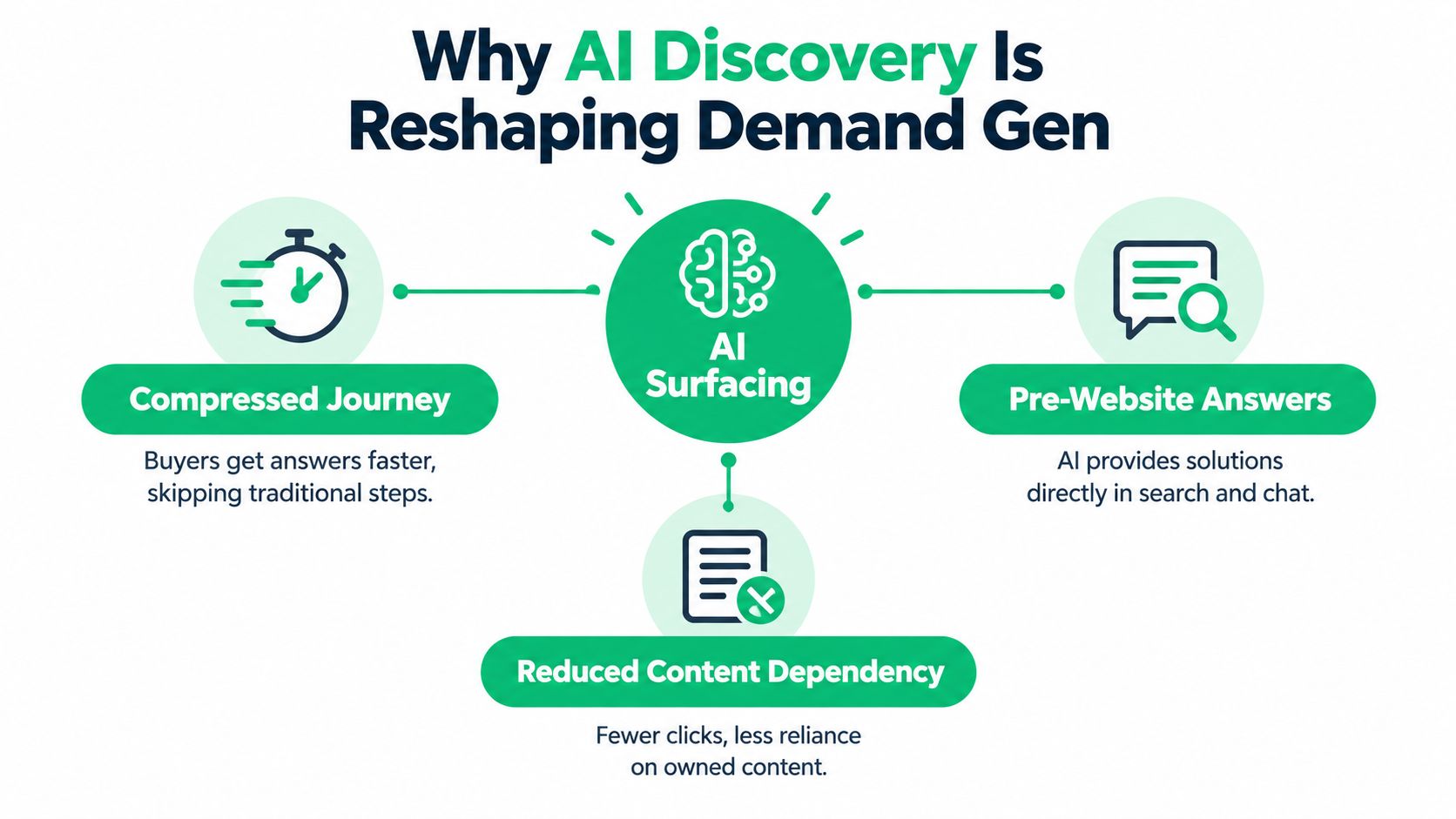
The strategic conclusion is uncomfortable for content-heavy teams: proprietary factual infrastructure may create more defensibility than higher publishing frequency. A smaller set of auditable, category-specific resources can support both AI surfacing and the human diligence required before a high-value franchise development decision.
A 90-Day Demand Generation Playbook
A 90-day program should produce an operating system, not a temporary campaign. The sequence below keeps audience definition, data quality, channel execution, and revenue measurement connected.
Days 1 to 30 build the foundation
The growth leader and franchise development director should agree on the ICP, qualification rules, lifecycle stages, source taxonomy, and required CRM fields. The output should be a written account and operator profile covering category, geography, capital, role, operating capability, and disqualifying conditions.
The data owner should audit duplicates, missing fields, stale contacts, unassigned accounts, and inconsistent stage definitions. The revenue operations owner should establish baseline measures for contact rate, qualified rate, meeting-held rate, sales acceptance, opportunity creation, and award progression.
The first gate is data usability. If the team can't identify why an account was targeted, who owns the next action, and how qualification was determined, channel activation should wait.
Days 31 to 60 activate selected channels
The outbound owner should build a sequence for a defined account segment and document the response categories. The ABM owner should create a named-account list with buying-group roles, relevant triggers, and account-specific messaging. The content owner should produce foundational resources that address investment, operating fit, category economics, and franchise development questions without unsupported financial claims.
Marketing and sales should inspect response quality together rather than celebrating raw activity. An account that responds but fails the capital or concept-fit screen belongs in a different disposition than an account that advances to a qualified discovery conversation.
The second gate is repeatable handoff quality. Each accepted opportunity should contain enough information for the next owner to continue the conversation without restarting qualification.
Days 61 to 90 optimize for progression
The team should compare channels by contacted rate, qualified rate, meeting-held rate, sales acceptance, opportunity rate, stage duration, and award progression. Holdout tests can help isolate channel lift where individual-level attribution is incomplete. Executive reviews should examine whether the program is reaching the intended franchise categories and operator profiles, not whether activity increased.
A weekly pipeline standup should review immediate movement and stalled stages. A biweekly channel review should reallocate attention based on downstream quality. A monthly executive review should decide whether the ICP, message, channel mix, or qualification rules need adjustment.
The final foundation is FDD intelligence. The FTC Franchise Rule requires franchisors to provide a disclosure document containing 23 specified information categories. Item 7 covers estimated initial investment, Item 19 covers permitted financial-performance representations, Item 20 reports outlet activity and franchisee contact information, and Item 21 contains the franchisor's three most recent audited annual financial statements. The FTC also states that financial-performance claims can't be made outside Item 19. (The Federal Trade Commission's Franchise Rule guidance)
A structured FDD layer lets the team enter channel activation with documented account context instead of assumptions. It also helps analysts distinguish net unit growth from replacement demand, resale activity, and operator movement. McDonald's 2024 FDD, for example, reported 843 franchisee-to-franchisee transfers, 29 terminations, 15 non-renewals, 8 franchisor reacquisitions, and 167 franchised outlet openings during the year. (The McDonald's FDD analysis from FDD Insight) The filing illustrates why Item 20 should be treated as a system-health and recruitment dataset, not merely an openings list.
Franchise development teams that need this foundation can evaluate Franchise Fast Track's FDD database as one potential intelligence layer for account research, qualification design, and category analysis.
Franchise Fast Track combines franchise development support with structured industry intelligence for franchisors evaluating B2B demand generation, including FDD research, multi-unit operator data, and qualified outbound conversations. Franchise development leaders can review the platform and its available data resources through Franchise Fast Track.
Ready to see results like these for your franchise?
Stop wasting money on leads that never close. Start getting hundreds of replies from high-net-worth professionals daily.