Sales Pipeline Automation for Franchise Development
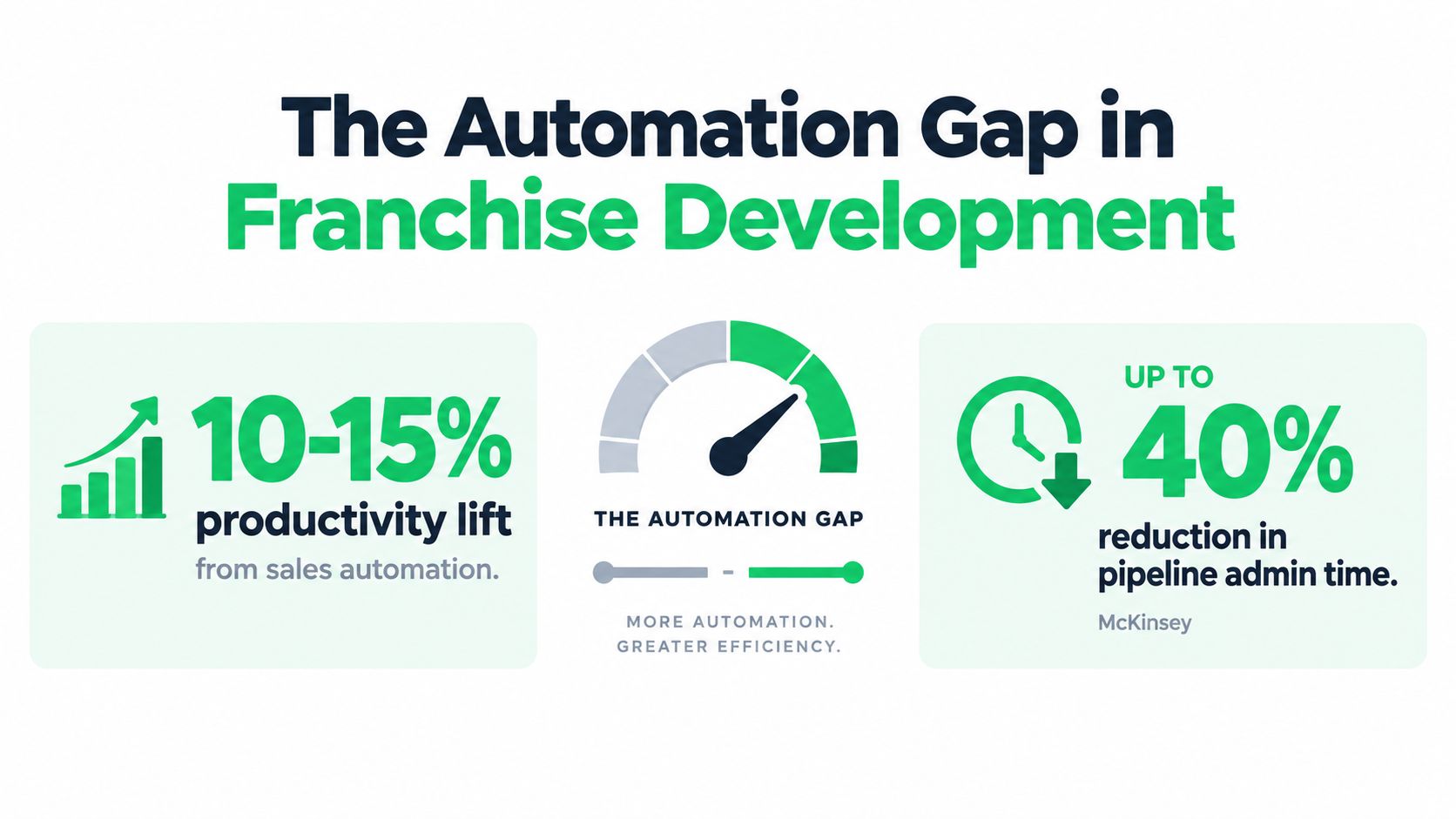
Sales pipeline automation is already used by 61% of overperforming sales teams, compared with 46% of underperforming teams, while 65% of sales professionals use a CRM with automation features. The operational difference isn't the presence of software. It's whether franchise development leaders automate trustworthy decisions or merely accelerate an unreliable process. (Sales automation statistics)
Table of Contents
- The Automation Gap in Franchise Development
- Build the Pipeline in Four Phases
- Configure the CRM Backbone for Franchise Sales
- Lead Routing Rules That Match Capital and Territory
- Trigger-Based Sequences and Calendar Booking
- Where Pipeline Automation Breaks
- A 60-90 Day Rollout and Where to Verify the Data
The Automation Gap in Franchise Development
Sales pipeline automation can reduce administrative work, but it does not determine whether a franchise candidate deserves advancement. That decision depends on definitions, evidence, and accountable handoffs. A pipeline that lacks those controls can move records faster while producing weaker territory decisions, inconsistent qualification, and avoidable compliance risk.
Franchise development teams often start with visible tasks. HubSpot, Salesforce, Pipedrive, and Zoho can create follow-up tasks, send sequences, update stages, and alert representatives when forms arrive. Those functions help with execution. They do not verify liquid capital, confirm territory availability, classify fit for a QSR, home services, or fitness concept, or establish whether the candidate has received the FDD.
That distinction separates task automation from decision automation. A task engine sends the next message because a date elapsed. A governed system changes ownership or progression only when defined conditions are met, such as verified capital, territory fit, multi-unit intent, and FDD status. Governance must come before tooling, because a CRM reproduces bad rules as efficiently as good ones.
Four layers that determine pipeline quality
A controlled franchise pipeline connects four operating layers:
- Routing assigns each inquiry to an owner using geography, available territory, capital evidence, brand category, and operating intent.
- Sequences deliver follow-up based on candidate status, then pause when a reply, booking, FDD delivery, or compliance opt-out changes the required action.
- Triggers record events and enforce stage movement instead of treating every form submission as qualification.
- Reporting shows conversion by source, territory, stage, and owner, helping leaders identify forecast risk and weak handoffs.
These rules differ by brand. A QSR candidate with multi-unit intent may require territory planning and operating-capacity review. A home services candidate may need local market and management-fit checks. A fitness candidate may require a defined capital band before discovery advances. FDD Item 19 context and Item 20 outlet information can also change what a representative may discuss or which follow-up is appropriate.
That is why revenue intelligence for sales teams is useful only when the CRM record reflects the candidate's actual journey. Dashboards cannot correct missing capital evidence or an unlogged document delivery.
The same operating logic applies to franchise development. Automation should enforce accountable decisions, not hide them. The tool is the execution layer. Governance determines whether its routing, sequences, triggers, and reports support sound franchise awards.
Build the Pipeline in Four Phases
A franchise sales pipeline should be built in sequence, not assembled from disconnected automation features. The practical order is standardize stages, centralize data, automate routing, and layer forecasting. Guidance on sales process automation emphasizes the same progression, along with controls for personalization, data audits, thoughtful sequence pauses, and measurement based on conversion impact rather than activity volume. (How to automate your sales process)
Phase 1 standardizes the commercial language
The chief development officer and sales director first need one shared definition of each stage. A team may choose seven or eight stages, but every stage needs an entry condition, required fields, exit criteria, and an accountable owner. “FDD delivered” should mean that the document was sent and receipt was logged, not that a representative believes the candidate saw it. “Capital verified” should mean that the required evidence was reviewed by a representative or finance partner.
A home services brand can use this phase to define what must be true before a discovery call is booked. A fitness concept can specify the capital band that permits advancement. A QSR can define when territory planning begins, rather than allowing every representative to interpret “qualified” differently.
Phase 2 centralizes the candidate record
CRM, email, calendar, enrichment, and campaign data should resolve to one candidate record. The record needs territory ZIP or market, net worth band, verified liquid capital, multi-unit history, preferred vertical, operating role, timeline, source attribution, and FDD receipt status.
Centralization prevents a sequence from relying on one field in the CRM while routing relies on a spreadsheet and a representative's calendar notes. It also makes response-time analysis more credible. Teams assessing the commercial effect of speed can use a resource on response-time math for pipelines while ensuring that the timestamps come from one system of record.
Phase 3 automates deterministic routing
Routing rules should begin with facts that can be evaluated consistently. Geography, capital tier, multi-unit intent, and vertical fit can direct a candidate to a regional representative, an enterprise queue, or a specialist. A rule should explain why the assignment happened and preserve the inputs used.
The workflow for franchise development marketing should therefore pass structured fields into the CRM, not just a name and email address. A QSR territory decision made from incomplete data will remain unreliable no matter how quickly the notification arrives.
Phase 4 adds forecasting and risk scoring
Forecasting belongs after stage definitions and data controls exist. Weighted stage probabilities can estimate expected pipeline, while FDD Item 20 outlet and turnover context can inform territory planning. Discovery booking rates and validation outcomes can then be compared against actual awards.
The order matters because forecasting on inconsistent stages creates a precise-looking summary of contradictory records. The same governance principle applies to AI risk scoring and next-best-action recommendations. Those tools should be introduced only after the pipeline can support their assumptions.
Configure the CRM Backbone for Franchise Sales
HubSpot, Salesforce, Pipedrive, and Zoho can all support franchise development workflows, but the CRM becomes useful only when the stage model reflects the actual decision process. A generic “industry” field is too broad for a system that may sell QSR, home services, real estate brokerage, fitness and wellness, automotive services, health and beauty, retail, education, or senior care concepts.
The record should separate vertical, format, and capital band. Format can distinguish single-unit, multi-unit, area developer, and master franchisee intent. Capital should distinguish net worth from liquid capital, because a candidate can have substantial net worth without having the liquidity required for a particular development plan.
Before any sequence fires, the CRM should contain:
- Financial fields: net worth band and verified liquid capital.
- Market fields: preferred territory, ZIP or MSA, and exclusive territory status.
- Operating fields: current operating role, multi-unit history, and preferred vertical.
- Timing fields: expected development timeline and next scheduled action.
- Compliance fields: FDD receipt date, Item 19 discussion status where applicable, and communication consent.
- Attribution fields: campaign, source, and originating channel.
Capital verification fields shouldn't be auto-populated by a web form. A form can collect a candidate's stated range, but a representative or finance partner must confirm the value before routing or scoring treats it as verified. Every transition should also log who changed the field, when the change occurred, and what evidence supported it.
| Stage | Required Fields | Exit Criteria |
|---|---|---|
| New Inquiry | Source, campaign, contact identity, preferred vertical | Record is deduplicated and assigned an initial owner |
| Qualification | Net worth band, stated liquid capital, territory preference, timeline | Initial fit is reviewed against the ideal candidate profile |
| Discovery Set | Verified contact details, operating role, calendar status | Discovery meeting is booked and preparation data is attached |
| FDD Issued | FDD version, delivery date, receipt status | Delivery is recorded and the candidate enters the appropriate follow-up path |
| Validation | Verified capital, territory fit, multi-unit intent, decision participants | Validation criteria are complete and unresolved objections are logged |
| Discovery Day | Attendance status, development market, stakeholder record | Discovery Day outcome and next decision are recorded |
| Award | Award date, territory, format, approval owner | Internal award decision is documented |
| Closed Won or Lost | Outcome reason, source, final stage date | Record is closed with a standardized reason and audit history |
Teams reviewing integration architecture can compare their approach with how SourceLoop handles CRM integrations, particularly the distinction between moving data and preserving reliable mappings. A franchise CRM with HubSpot should be judged by field governance and auditability, not by the number of workflows activated.
Lead Routing Rules That Match Capital and Territory
Routing turns a raw inquiry into an accountable sales action. In franchise development, the representative needs more than a geographic assignment. The owner must understand whether the candidate can support the concept, whether the requested market is available, and whether the candidate is pursuing a single unit or a multi-unit platform.
Four inputs should drive the first routing decision:
- Geography: State, MSA, ZIP, and potential overlap with an exclusive territory.
- Capital: Verified liquid capital grouped into the brand's approved bands.
- Category fit: QSR, home services, fitness, B2B services, or another defined vertical.
- Multi-unit intent: Single-unit operator, prospective multi-unit operator, or an established portfolio builder.
A candidate with verified liquid capital above the brand's highest enterprise threshold, clear multi-unit intent, and a Texas MSA preference should route to the enterprise development team. A first-time operator with liquid capital below the enterprise threshold and a non-exclusive market preference may belong with the regional representative responsible for that territory. The rule should use verified inputs, not a self-reported form value treated as fact.
| Capital Band | Multi-Unit Intent | Territory | Routes To |
|---|---|---|---|
| Lower approved band | First-time operator | Regional, non-exclusive market | Regional representative |
| Middle approved band | Single-unit or emerging multi-unit | Available priority market | Market development pool |
| Upper approved band | Multi-unit operator | Defined growth MSA | Senior development representative |
| Enterprise band | Portfolio builder | Strategic or multi-state market | Enterprise development team |
The matrix should also include exclusion logic. Competitor applicants, duplicate records, and contacts with a communication restriction should not enter an outbound sequence. A closed-lost lead can re-enter only after the brand's defined re-engagement period and only when a material condition has changed, such as a new territory, a changed capital position, or a new operating objective.
Routing must preserve a reason code. “Assigned to Rep A” is not enough. The CRM should state that the assignment resulted from verified capital, territory, vertical, and multi-unit rules. That record lets a vice president of franchise development audit misroutes and change the rule rather than asking representatives to compensate manually.
A qualified lead generation for franchises program should therefore deliver structured records at the point of handoff. Raw volume may fill a queue, but it doesn't tell a development leader whether the queue contains candidates that the assigned representative can advance.
Trigger-Based Sequences and Calendar Booking
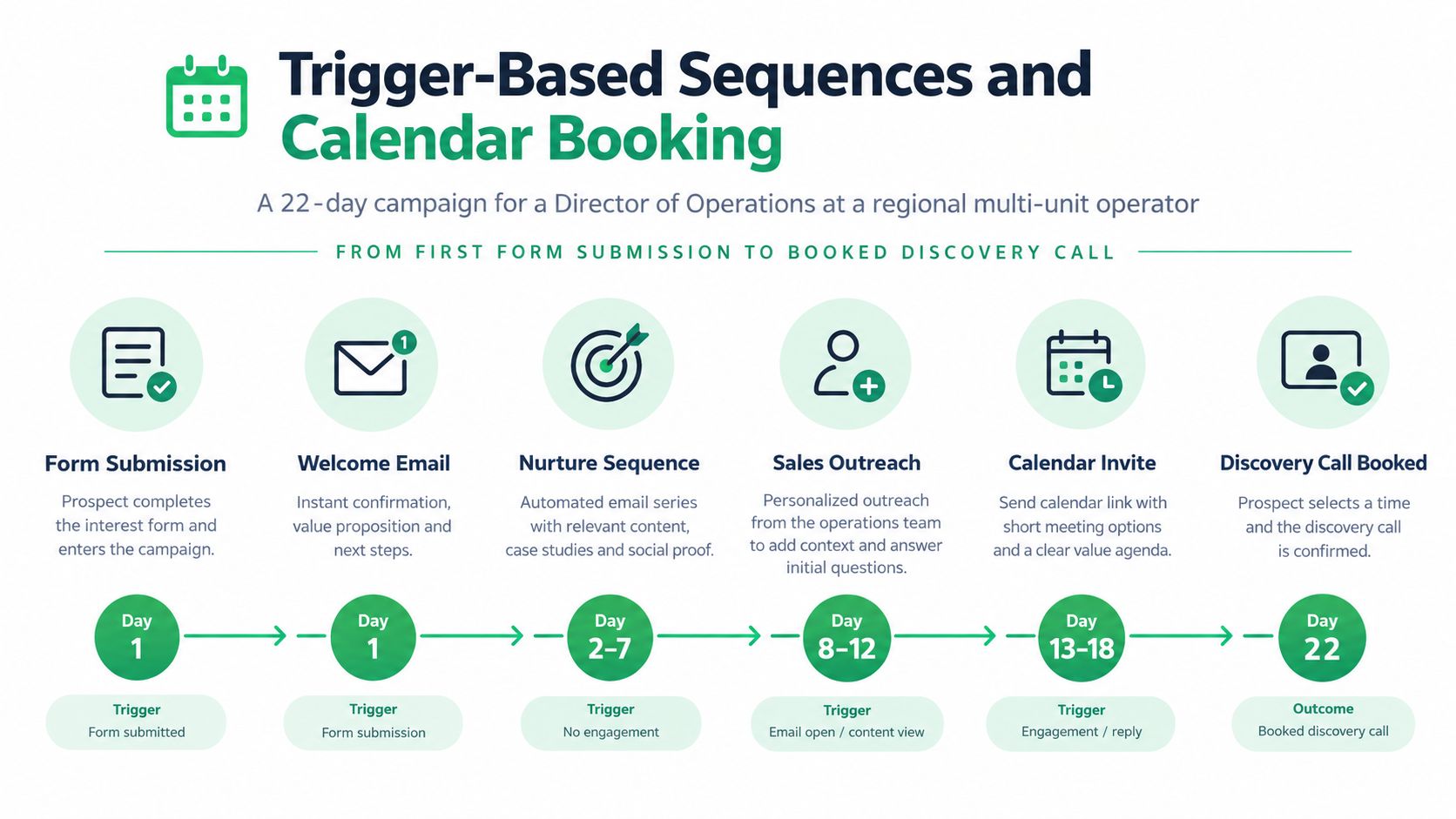
Trigger-based sequences should reflect franchise development rules, not treat every inquiry as a generic nurture contact. A useful test case is a director of operations at a regional multi-unit operator who submits a form for a concept aligned with the operator's preferred vertical.
On Day 0, the CRM sends an acknowledgement, creates a representative task, and records the source campaign. The task should capture the stated territory and capital position, while labeling each field as unverified or confirmed. On Day 2, the candidate receives a follow-up explaining how the brand handles Item 19 financial performance representations. If territory availability or outlet development context is relevant, Item 20 information should follow the approved disclosure path. Neither message should imply financial results or development rights beyond the franchisor's disclosure framework.
On Day 5, the system creates a LinkedIn connection task or sends an approved connection request. On Day 8, it sends a vertical-specific case-study message only after category fit is confirmed. On Day 12, the representative receives call and SMS tasks, subject to consent and communication restrictions. On Day 16, a concise close-the-loop message may include a calendar link. On Day 22, a nonresponsive record moves to a lower-frequency re-engagement workflow instead of remaining in the original campaign indefinitely.
The pause rules matter more than the send schedule
The sequence must stop or change as soon as one of four events occurs:
- A reply arrives: The record becomes representative-owned and exits automated messaging.
- A calendar booking occurs: Promotional steps stop, and the preparation workflow begins.
- FDD delivery is logged: Messaging switches to the disclosure and validation path.
- An opt-out or compliance restriction is recorded: Outbound activity is suppressed across all channels.
A positive reply should route to the discovery-call workflow. Questions about capital, territory, or fees should use an approved FAQ path. An objection should create a representative task, not trigger an unrelated promotional email. An unsubscribe must suppress the contact across every campaign, including email, SMS, calling, and LinkedIn workflows.
If the brand adopts a one-business-hour service level, an inbound reply should reach the assigned representative within that period. The calendar invitation should include a preparation brief covering capital verification status, territory preference, operating background, source campaign, and FDD status. That brief prevents repeated questions and exposes missing evidence before the meeting.
Teams evaluating a practical Franchise Fast Track 2026 implementation should apply four governance tests to every automation: which event starts it, what evidence changes it, which human owns the next decision, and what condition stops it. A sequence that passes those tests supports franchise development. One that fails them can distribute outdated disclosure context, misroute a qualified operator, or continue contact after consent has ended.
Where Pipeline Automation Breaks
More automation does not guarantee more franchise awards. The failure usually begins with governance: a workflow runs without manual intervention, but its fields are incomplete, its stage definitions conflict, or no owner is accountable for correcting the record.
Forbes reports that approximately 91% of CRM data is incomplete (source: Enterprise sales pipeline automation). In franchise development, that gap has direct operational consequences. A missing liquid-capital field can route a candidate to the wrong queue. An outdated FDD receipt date can keep a sequence active after the candidate's status has changed. A duplicate territory record can lead two representatives to promise the same market.
Four failure points that require named owners
Uncontrolled field updates can overwrite verified information. A web form, enrichment tool, or representative might replace a verified capital band with an unconfirmed response. The CRM should apply field-level permissions, source labels, and an audit trail. That history needs to show the original value, the replacement value, and the person or system responsible for the change.
Capital verification deserves a separate control from ordinary lead enrichment. A self-reported range can support initial routing, but it should not replace documented evidence without a clear indication. The field model should distinguish unverified, partially verified, and verified values, with a named owner responsible for advancing the record.
Compliance and communication controls fail when suppression is fragmented. A sequence can continue contacting an unsubscribed or Do-Not-Call record if suppression exists in one platform but not another. Email, SMS, calling, and LinkedIn workflows need a shared suppression state, synchronized with the CRM. Representatives should see why a contact is blocked without searching multiple systems.
The stop condition must be tested, not merely documented. An opt-out should prevent a later task, reminder, or imported audience from restarting contact. If a brand cannot show where suppression is stored and which systems receive it, the automation is not governed well enough for production.
FDD status is ignored. The Federal Trade Commission's Franchise Rule requires franchisors to provide a disclosure document containing 23 specific items about the franchise, its officers, and other franchisees. Item 19 is the only section for financial performance representations, and financial claims must appear there when made. The rule does not require a franchisor to provide those claims. (FTC Franchise Rule)
That requirement changes the sequence rules. A candidate who has not received an FDD may need educational content about the disclosure process. A candidate who has received it and is reviewing financial performance information needs a different path, with the relevant status visible to the representative. Treating both records as identical can produce the wrong message, create confusion, and weaken compliance discipline.
FDD delivery should therefore act as a governed state change, not a casual activity note. The record needs the delivery status, date, responsible user, and next approved action. Automation can schedule follow-up, but a human owner should remain accountable for questions involving Item 19, Item 20, territory availability, or candidate interpretation of the document.
Dashboards report stages that representatives define differently. One representative may mark “Validation” when a candidate states available capital. Another may use the same stage only after supporting documentation is reviewed. Conversion rates then combine records with different evidence standards, while a forecast appears healthier than the underlying pipeline.
Every stage should have one entry condition, one exit condition, and a required evidence set. The CRM should prevent a representative from advancing a record when a required field is missing, or at least create an exception for review.
Practical rule: Every automation needs a named owner, a written entry condition, a written exit condition, and a kill switch.
Reporting must support a QBR decision
Franchise development reporting should connect each metric to a decision that a VP of franchising can defend in a quarterly business review. Pipeline velocity should show how long records remain in Discovery, Qualification, Validation, Award, and Signed stages. The core formulas are:
- Days in stage: Current date or next-stage date minus stage-entry date.
- Conversion to next stage: Records entering the next stage divided by records entering the prior stage.
- Dollar-weighted pipeline: Opportunity value multiplied by the approved stage probability.
A brand can calculate cost per qualified conversation by dividing advertising spend and sequence-tool costs by booked discovery calls that meet the brand's qualification rules. This is more useful than raw form volume because it connects source economics to representative capacity. The qualification rule should include the fields that determine whether a conversation is commercially meaningful, such as capital status, territory fit, and operating profile.
| Metric | Formula | Benchmark Target |
|---|---|---|
| Stage velocity | Days from stage entry to stage exit | Brand-defined threshold by stage |
| Stage conversion | Next-stage records divided by prior-stage records | Historical cohort baseline |
| Dollar-weighted pipeline | Opportunity value multiplied by stage probability | Forecast model approved by finance |
| Cost per qualified conversation | Attributed source and sequence costs divided by qualified booked calls | Below approved acquisition ceiling |
| Source ROI | Attributed award value divided by source cost | Positive against the brand's model |
| Forecast variance | Actual result minus forecast result | Narrowing variance across cohorts |
| FDD-to-validation movement | Validation records divided by FDD-issued records | Brand-defined cohort baseline |
Item 20 provides a separate planning signal. It covers outlet and franchisee information, and FTC guidance says it shows system growth and owner turnover. NASAA's model definition calls for tabular disclosure of franchised and company-owned outlets for each of the franchisor's last three fiscal years. Former franchisees listed in Item 20 can also be valuable contacts during system evaluation. (FTC guide to buying a franchise)
For development teams, this information can shape territory planning. A candidate's preferred geography may overlap an established territory with strong operating history, or it may fall into a white-space gap requiring a different approval path. Item 20 should not determine qualification by itself. It can change the commercial question presented to the candidate and the market team, and it may require a territory review before the sequence advances.
Item 21 adds the franchisor's three most recent audited annual financial statements, according to the FTC consumer guide. FTC FAQs also state that parent-company financials belong in Item 21 when the parent assumes post-sale obligations for the franchisor or guarantees the franchisor's obligations. (FTC franchise financial statements guide) These documents provide diligence context and should be linked to the relevant CRM record. They do not replace candidate-level qualification or evidence review.
The operating cadence keeps the data usable
A practical governance cadence assigns different review questions to different days. Pipeline Monday checks stage aging, missing exit criteria, duplicate records, and owner assignments. Source attribution Wednesday checks campaign mapping, qualified-conversation cost, and channel-level conversion. Forecast Friday checks weighted pipeline against actual movement and escalates records whose evidence does not support the reported stage.
HubSpot or Salesforce can provide operational views, while Looker or another BI layer can support cohort analysis. Cohort views should compare current candidates with prior closed deals using the same stage definitions, source fields, and outcome reasons. That comparison helps a brand decide whether to rebalance territory coverage, pause a sequence, revise its ideal candidate profile, or challenge a forecast in a QBR.
The governance checklist should include a weekly audit of the 20 fields that most affect routing, compliance, and forecasting, provided the brand defines those fields internally. Each automation needs a business owner, a technical owner, a documented change history, and a kill switch. If a sequence falls below its internally established reply baseline for two consecutive weeks, its owner should pause it, inspect the audience and message logic, and block automatic relaunch until the cause is understood.
A 60-90 Day Rollout and Where to Verify the Data
A disciplined rollout can be organized into three sprints of roughly 20 working days each, with the final period used for verification and governance. The schedule should be treated as an implementation framework, not a promise that every brand will reach production on the same calendar.
Sprint 1 builds the foundation
During Days 1 through 20, the team standardizes the pipeline stages and documents exit criteria. The CRM captures net worth band, verified liquid capital, territory, multi-unit history, vertical, timeline, source, and FDD status. The sales director audits existing routing rules and identifies assignments that depend on spreadsheets, personal judgment, or incomplete fields.
The foundation sprint should end with a testable record. A representative must be able to see why a candidate entered a stage, what evidence remains missing, and which person owns the next action.
Sprint 2 connects triggers to human actions
During Days 21 through 50, the team activates sequences, routing, calendar workflows, and suppression logic. The calendar-booking handoff should be tested across at least three lead sources before broader deployment, with the same checks for source attribution, consent, capital status, and territory fit.
The test should include positive replies, objections, no response, calendar bookings, FDD delivery, duplicate records, and opt-outs. A failed test should change the workflow design before additional contacts enter the sequence.
Sprint 3 verifies reporting and governance
During Days 51 through 90, the team activates dashboards, compares forecast outputs with actual stage movement, and documents permissions. Representatives shouldn't be able to override automation logic without recording a reason and preserving the original value.
The FTC framework gives the data layer a practical structure. Item 19 governs financial performance representations, Item 20 covers outlets and franchisee information, and Item 21 contains the franchisor's audited financial statements. Those sections should be connected to the CRM process so that routing, scoring, and forecasting don't rely on rep-entered estimates alone.
The next step is specific: verify every capital-ready candidate against the Franchise Fast Track FDD database, using Item 19, Item 20, and related FDD context before the candidate advances. That verification creates a stronger source of truth for routing, scoring, territory planning, and forecast review than an unconfirmed CRM estimate.
Franchise Fast Track provides franchise development support and structured franchise intelligence for established United States franchisors, including candidate screening, pipeline handoffs, and FDD-based research. Franchisors evaluating sales pipeline automation can visit Franchise Fast Track to review the available development and data resources.
Ready to see results like these for your franchise?
Stop wasting money on leads that never close. Start getting hundreds of replies from high-net-worth professionals daily.