HubSpot Franchise Sales: Building a System That Scales
HubSpot can run both sides of franchise growth, recruiting new franchisees and managing customer-facing sales, when you build it around the right pipeline architecture. Franchisors who set this up correctly typically see faster lead-to-discovery movement, one shared reporting layer for executives, and automated routing that gets candidates to the right development director without manual triage. The starting move isn't picking software features. It's choosing a pipeline archetype and mapping HubSpot's objects to match it.
TL;DR:
- Choose a pipeline archetype before building workflows to prevent complex migrations and reporting issues later.
- Integrate key systems like POS, e-signatures, and scheduling tools to streamline franchise sales processes, avoiding unnecessary system overlaps.
- Use custom objects for franchise applications, territories, and brokers to maintain clear, structured data and improve reporting accuracy.
- Pilot your HubSpot setup for at least six weeks to identify process gaps and ensure staff adoption before expanding.
- Verify candidate quality with Franchise Fast Track's appointment service to ensure qualified leads enter the pipeline's optimal stage for automation.
Table of Contents
- Why HubSpot Fits Franchise Sales (And Where It Doesn't)
- Which HubSpot Modules Actually Support Franchise Growth?
- How Should You Route Franchise Development Leads?
- What Should You Integrate With HubSpot First?
- What KPIs and Dashboards Does Corporate Actually Need?
- Building the Deployment: A Practical Checklist
- What Results Have Franchisors Actually Seen With HubSpot?
- How Franchise Fast Track Complements a HubSpot Deployment
- What Compliance and Privacy Rules Apply to Franchise Data in HubSpot?
- How Do You Customize Messaging for Franchise-Specific Sales?
- How Do You Audit an Existing HubSpot Franchise Setup?
- How Do You Onboard Franchisees to a New HubSpot System?
- What Automation Actually Improves Franchise Sales Outcomes?
- How Do You Keep Data Clean Across Franchisee Portals?
- A Straight Answer on What Actually Works
- How Franchise Fast Track Feeds Better Candidates Into Your Pipeline
- Where to Learn More
- Sources
Why HubSpot Fits Franchise Sales (And Where It Doesn't)
A franchise network has a structural problem most CRMs weren't built for: one brand, dozens of semi-independent operators, and a need for both centralized reporting and local autonomy. HubSpot handles this because it runs marketing automation, CRM, and content management on one data model, so a candidate who fills out a form in Ohio and a customer who books a service in Texas show up in the same system without corporate losing sight of either.
The mechanism that makes this work is partitioning. Teams, role-based permissions, and property-level visibility let a franchisee see and manage their own contacts and deals while corporate retains a roll-up view across the whole network. Bayard Bradford's work with multi-location brands shows this pattern directly: a single shared portal with segmented dashboards lets corporate keep reporting visibility while preserving franchisee autonomy, rather than forcing a choice between the two.
That said, HubSpot isn't a plug-and-play fix. Franchisors run into real tradeoffs:
- Integration complexity with existing POS, scheduling, or franchise management software
- Licensing costs that scale with seats, contacts, and hub tier
- Governance overhead: someone has to own permissions, templates, and data standards long term
A franchisor is ready for this when they already have more than a handful of units, a designated person who can own the CRM (not just "IT will handle it"), and pipeline volume high enough that manual lead tracking is visibly breaking down.
Pro Tip: Don't buy Sales Hub for franchise development and Marketing Hub for customer acquisition as separate afterthoughts. License them together from the start. Splitting the purchase later almost always means rebuilding your data model.
Which HubSpot Modules Actually Support Franchise Growth?
Each hub maps to a specific job in franchise operations, and understanding that mapping is what separates a coherent build from a pile of disconnected automations.
Marketing Hub runs national campaigns that local franchisees can adapt without going off-brand. Original source tracking tells you whether a lead came from a national paid campaign or a franchisee's local Facebook post, which matters enormously when you're deciding where to put next quarter's ad budget. Approved asset libraries let franchisees pull pre-built local content instead of designing their own flyers.

Sales Hub is where franchise development actually happens. Configurable deal pipelines separate franchise candidate stages (inquiry, discovery call, disclosure document review, award) from customer sales stages. Built-in quoting and e-signature tools cut the time between a signed franchise agreement and a signed customer contract.
Service Hub and CMS cover what happens after the sale. Onboarding workflows for new franchisees run on the same automation engine as customer service tickets, and the CMS lets corporate control the site shell while franchisees manage local landing pages.
Custom objects are the piece most franchisors skip and later regret. Instead of forcing franchise applications, territories, and broker relationships into generic contact records, custom objects model them as their own structured data:
- A Franchise Application object with its own properties and pipeline stages
- A Territory object linked to both candidates and existing units
- A Broker/Referral object that tracks attribution separately from the deal itself
Skipping custom objects usually shows up later as messy reporting, not as an immediate problem.
How Should You Route Franchise Development Leads?
Lead routing architecture is the single biggest decision in a HubSpot franchise sales build, and most franchisors default to the wrong archetype simply because nobody told them there were options. The Frandev Lab Report outlines three distinct models worth choosing between deliberately.
- Basic pre-qualification. A lead fills out a short form, gets a quick phone screen, then moves straight into a Deal record. This works for smaller networks with low lead volume, and it keeps the data model simple: Contacts and Deals, no custom objects required.
- Heavy pre-qualification (application-first). Candidates complete a detailed application before ever touching a sales rep. This calls for a custom Franchise Application object, since cramming twenty application fields onto a standard Deal or Contact record wrecks your reporting almost immediately.
- In-pipeline qualification. Screening happens inside the deal pipeline itself, with stage-gates that require specific criteria (financial verification, background check, territory availability) before a candidate advances. This gives the cleanest stage-by-stage conversion reporting but requires more disciplined stage-gate enforcement from your development team.
Whichever archetype you pick, routing rules need to handle territory assignment by postal code, broker and referral attribution (so a paid referral source doesn't get miscredited), and SLA alerts that flag when a lead sits untouched too long. Build a feedback loop where appointment setters can flag low-quality leads back to development directors. Without it, bad lead sources keep getting funded because nobody upstream ever hears about the problem.
Pro Tip: Pick your archetype before you build a single workflow. Retrofitting a Deal-only pipeline into an application-first model later means migrating data across object types, and that migration is where duplicate records and broken reporting come from.
What Should You Integrate With HubSpot First?
Not every system in a franchisor's tech stack belongs in HubSpot, and trying to sync everything usually creates more mess than it solves.
Four integrations matter most for franchise sales specifically:
- POS and revenue systems, so franchise development can point to real unit-level performance when selling the opportunity to candidates
- E-signature tools, since franchise disclosure documents and agreements move faster when signing happens inside the same record as the deal
- Scheduling tools, for discovery calls and site visits
- ERP or franchise management software, for royalty tracking and compliance data that shouldn't live in a sales CRM at all
The single-portal versus multi-portal decision hinges on network size and franchisee independence. A single shared portal, the pattern Bayard Bradford documents across multiple franchise deployments, gives corporate one reporting view and avoids the sync headaches of running several HubSpot instances. Multi-portal setups make sense only when franchisees operate as genuinely separate businesses with their own marketing budgets and legal entities.
Middleware matters here. Point-to-point integrations between five systems create ten different sync paths and a real risk of duplicate contact records. A middleware layer, or at minimum a documented sync order of operations, keeps operational data (inventory, payroll, royalty calculations) in the systems built for it. HubSpot should function as the connective CRM layer, not a replacement for every operational system it touches.
What KPIs and Dashboards Does Corporate Actually Need?
Franchise development reporting fails most often not from missing data but from too much of it dumped into one undifferentiated dashboard. Corporate needs a different view than a franchisee, and building both up front avoids months of dashboard rework later.
Track these core metrics:
- Lead-to-discovery rate (how many inquiries convert to a scheduled discovery call)
- Discovery-to-offer rate
- Offer-to-award rate, the number that ultimately matters to a CFO
- Pipeline velocity, or average days per stage
- Candidate quality scores, based on financial verification and territory fit
Franchisee-level dashboards should show only that operator's local leads, deals, and marketing performance. Corporate roll-up dashboards aggregate across the network without exposing one franchisee's numbers to another, which requires setting up teams and property-level permissions correctly from the start, not patching them in after a data leak complaint.
One example of the kind of gain proper reporting surfaces: No Bounds Digital documented a franchise network that improved lead-to-customer conversion from roughly 3% to 14% after redesigning pipeline stages and routing logic, a jump that only became visible once stage-by-stage reporting existed to catch it.
Building the Deployment: A Practical Checklist
Franchisors who skip straight to workflow-building almost always end up rebuilding within a year. Sequence matters here more than speed.
- Choose your pipeline archetype first, then map Contacts, Deals, and any custom objects to the actual candidate and customer journey, not a generic template.
- Design ownership and permissions before building anything. Decide who owns which teams, who sees which dashboards, and who can edit properties, before a single workflow goes live.
- Clean and migrate existing data. Dedupe contacts, standardize property values (a "Territory" field with six different naming conventions across old spreadsheets will wreck your reporting), and decide what legacy data is worth migrating at all.
- Build automation for routing, SLAs, and nurture sequences, plus a training track for anyone touching the system daily.
- Pilot with one region or one franchisee group, measure against your defined KPIs, then iterate before scaling network-wide.
Pro Tip: Run your pilot for at least six weeks before judging results. Franchise sales cycles run longer than most B2C sales cycles, and a two-week pilot mostly measures how fast people learned the new interface, not whether the pipeline logic works.
Franchisors researching what a coherent rollout costs in time and internal resources often benefit from reviewing a marketing automation roadmap before committing to a build timeline.
What Results Have Franchisors Actually Seen With HubSpot?
Case data beats theory here, and three examples show what a properly architected HubSpot deployment can deliver.
Smash My Trash implemented HubSpot Sales Hub Enterprise with automated quoting and lead routing across its franchise network. The case study reports a 288% revenue increase alongside substantial lead growth, driven largely by automation removing manual bottlenecks in the sales process.
The Junkluggers standardized dozens of locations onto a single HubSpot portal architecture, which simplified onboarding for new franchisees and gave corporate consistent roll-up reporting instead of location-by-location guesswork.
Payroll Vault, documented in the No Bounds Digital case study referenced above, quadrupled its lead-to-customer conversion after a pipeline redesign, not from new software features but from fixing routing logic and stage definitions.
The pattern across all three: none of these gains came from a single killer feature. They came from aligning people, process, and platform, then backing that alignment with structured training. A pipeline redesign without staff training on the new stages tends to produce confusion, not conversion lifts.
How Franchise Fast Track Complements a HubSpot Deployment
A well-built HubSpot pipeline is only as good as what feeds it. Franchise Fast Track's proprietary system delivers hundreds of verified appointments monthly with high-income candidates earning $150,000 to $500,000 annually, reporting a 34% lead-to-close rate for franchisors that use it. That candidate flow drops directly into either an application-first or in-pipeline qualification archetype, feeding pre-vetted prospects into the exact stage where HubSpot's automation and reporting take over.

What Compliance and Privacy Rules Apply to Franchise Data in HubSpot?
Franchise sales data carries more regulatory weight than typical CRM records, largely because franchise disclosure documents involve financial and personal information subject to Federal Trade Commission franchise rules alongside state-level franchise registration requirements. HubSpot doesn't handle FTC compliance for you. It's a data platform, not a legal safeguard, so the compliance obligations still sit with the franchisor and its legal counsel.
Practically, this means a few things inside your HubSpot instance. Candidate financial information (net worth disclosures, funding sources) should live in restricted-access properties visible only to development directors and compliance staff, not open to every franchisee team with portal access. If you operate across multiple states, some of which have registration and disclosure timing requirements, workflow automations that send disclosure documents need built-in date logging so you can prove when a document was delivered relative to a signature date.
Data privacy adds a second layer. Candidate and customer contact data falls under state privacy laws (California's CCPA is the most commonly triggered one for franchisors operating nationally), which means consent capture on forms, documented data retention policies, and a defined process for handling deletion requests need to exist before your first campaign launches, not after a candidate asks where their data went.
Franchisee-level data segmentation matters here too. If one franchisee's customer list becomes visible to another through a permissions gap, that's not just an internal awkwardness. It can trigger contractual disputes over territory data ownership. Property-level and team-level permissions, set up correctly during the build phase, are your first line of defense against that scenario.
How Do You Customize Messaging for Franchise-Specific Sales?
Generic sales content undersells a franchise opportunity, because candidates evaluating a $150,000 to $500,000 investment want specificity, not brochure language about "exciting opportunities."
Build separate content tracks for candidates versus customers inside the same portal. A franchise candidate nurture sequence should reference unit economics, territory availability, and validation calls with existing franchisees, none of which belongs in a customer-facing email about a service appointment. HubSpot's smart content and list segmentation tools make this straightforward once your Contact records distinguish candidate type from customer type at the property level.
Localize proof points without losing brand consistency. National case studies (revenue figures, systemwide growth) belong in top-of-funnel content, while local franchisee testimonials and territory-specific financial performance representations belong further down the pipeline, timed to when a candidate is seriously evaluating rather than just browsing. The approved asset library inside Marketing Hub is where this discipline actually gets enforced. Give franchisees editable templates rather than open text fields, and brand consistency stops being a moderation problem.
One overlooked detail: sales content referencing average unit revenue or investment ranges needs to align with what's stated in your Franchise Disclosure Document. Marketing copy that oversells performance beyond FDD Item 19 figures creates legal exposure, so any content template referencing financial performance should route through legal review before it becomes a reusable HubSpot asset. Understanding standard franchise fee structures helps development teams frame investment conversations accurately from the first call.
How Do You Audit an Existing HubSpot Franchise Setup?
Most franchisors don't build a HubSpot system from scratch. They inherit one that's grown haphazardly over several years, and auditing it follows a different sequence than a fresh build.
Start with the data model. Pull a report of every custom property on Contacts and Deals and ask which ones are actually used versus abandoned relics from a marketing hire who left two years ago. Unused or duplicate properties are the most common source of reporting confusion in older portals.
Next, check pipeline stage definitions against what your development team actually does day to day. It's common to find a five-year-old pipeline with stages nobody follows anymore, because the actual sales process evolved and the CRM didn't. If stage names don't match reality, your conversion reporting is measuring something other than your real process.
Audit permissions third. Pull a list of who has access to what, and specifically check whether any franchisee can see another franchisee's contacts or deals. This single check catches more governance problems than any other step in an audit.
Then review automation health: workflows that haven't fired in months, dead-end sequences, and SLA alerts nobody's monitoring anymore. Finally, benchmark your current KPIs (lead-to-discovery, discovery-to-offer, offer-to-award) against where they stood a year ago. A flat or declining trend usually traces back to one of the first three issues, not to a lack of new features.
How Do You Onboard Franchisees to a New HubSpot System?
Franchisee adoption fails more often from poor change management than from the software itself. Franchisees are independent businesspeople, often skeptical of corporate mandates, and a system rollout that feels imposed rather than supported gets quietly ignored.
Structured training programs matter more than most franchisors budget for. Pilot data referenced earlier in this guide shows that programs pairing a defined rollout period with hands-on training produce markedly higher adoption and performance gains than a documentation link and a single webinar.
Build onboarding around role, not a one-size-fits-all session. A franchisee running local marketing needs a different walkthrough than one focused purely on service delivery. Service Hub's onboarding workflow templates can automate much of this sequencing, sending checklist tasks and training material on a schedule tied to go-live date rather than dumping everything on day one.
Give franchisees a low-stakes way to raise friction points. A monthly office-hours call or a shared Slack channel where franchisees can flag confusing workflows catches small problems before they calcify into "corporate's system doesn't work for us" sentiment across the network. Change management succeeds when franchisees feel the system was built with their input, not just handed down.
What Automation Actually Improves Franchise Sales Outcomes?
Automation should remove manual busywork, not replace human judgment in candidate qualification, and the franchisors who get this backward tend to automate the wrong stages.
Lead routing is the highest-value automation to build first: territory-based assignment rules that fire the moment a lead form submits, with SLA timers that alert a development director if a lead sits untouched for more than a set number of hours. Nurture sequences for candidates still in the research phase should stay light, sending validation resources and FDD walkthroughs on a schedule rather than aggressive sales pushes that scare off serious buyers.
Quoting and e-signature automation inside Sales Hub cuts real time out of both franchise agreement signing and customer contract closing, since both processes benefit from removing manual document handling. Automated internal notifications, alerting a director when a candidate hits a specific pipeline stage, keep deals from stalling silently.
The mistake to avoid: automating stage advancement itself. A workflow that moves a candidate to "Approved" based on form fields alone, without a human reviewing financial verification, defeats the purpose of pre-qualification. Automation should accelerate the process around human decisions, not replace the decisions.
How Do You Keep Data Clean Across Franchisee Portals?
Data quality erodes gradually in franchise CRMs, usually through duplicate contact creation, inconsistent property values, and franchisees entering data their own way despite a documented standard.
Standardized required fields at the point of entry prevent most of this. If "Territory" is a dropdown list rather than a free-text field, you eliminate six different spellings of the same region within a year. HubSpot's native deduplication tools catch obvious duplicate contacts, but they won't catch a franchisee who creates a new Deal for a returning customer instead of updating the existing record. That requires a documented process and periodic manual audits.
For networks running a single shared portal, which Bayard Bradford's franchise deployments show works best for centralized reporting, data quality is a matter of enforcing standards, not syncing between systems. For multi-portal setups, a middleware layer or scheduled sync job needs clear rules about which portal owns which record, or the same contact ends up duplicated across instances with conflicting data.
Quarterly data audits, checking for orphaned records, stale deals sitting untouched for months, and property fields with inconsistent formatting, catch drift before it corrupts your KPI reporting. Assign this to a specific person or team. Data quality that's "everyone's responsibility" is nobody's responsibility in practice.
A Straight Answer on What Actually Works
The franchisors who get real results from HubSpot don't start with automation. They start with an honest pipeline archetype decision and the governance to back it. Run a focused six-week pilot with one region before scaling, and put more weight on who owns permissions and data standards than on which features you license. Operational discipline outperforms feature checklists every time I've seen this play out.
— Cody
How Franchise Fast Track Feeds Better Candidates Into Your Pipeline
A well-architected HubSpot pipeline still needs one thing software can't manufacture: qualified candidates entering at the top of it. Franchise Fast Track's appointment-setting service delivers hundreds of verified appointments monthly with candidates earning $150,000 to $500,000 annually, sourced, vetted, and calendar-booked before they ever touch your development team.
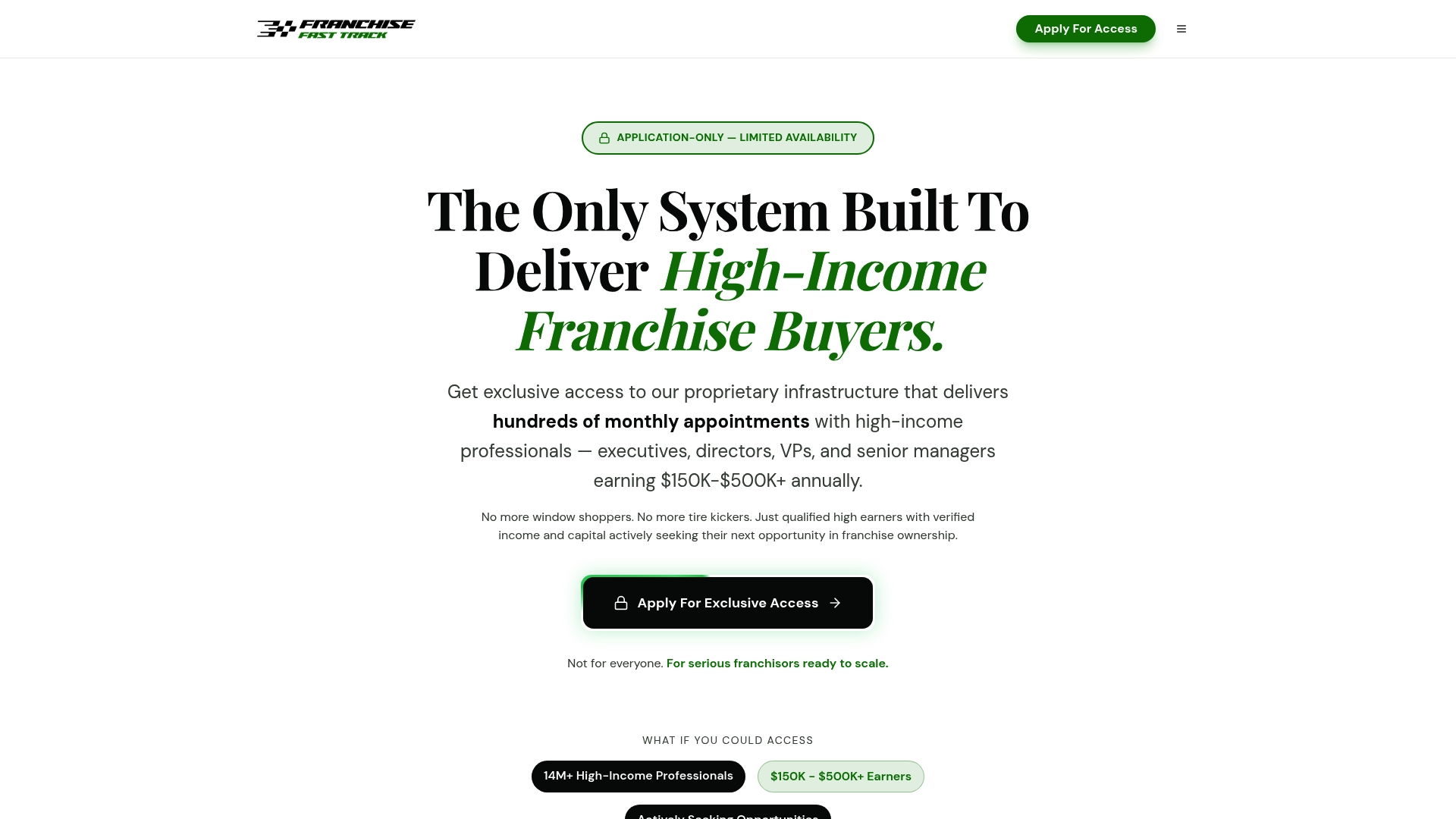
That candidate flow was built to drop directly into either an application-first or in-pipeline qualification archetype inside HubSpot, so verified leads land at exactly the pipeline stage where your automation and reporting take over. If your HubSpot pipeline is built but the top of the funnel is still full of unqualified inquiries, that's the gap worth closing next. Get in touch with Franchise Fast Track to see how a verified appointment pipeline fits into your existing HubSpot setup.
Where to Learn More
For deeper implementation guidance, review Bayard Bradford's franchise architecture notes, the Smash My Trash HubSpot case study, and SBA guidance on franchise fee structures. Franchise Fast Track's lead generation strategy guide covers related sourcing tactics.
Sources
- HubSpot for Franchises — Bayard Bradford
- Smash My Trash case study — HubSpot
- From 3% to 14%: How One Franchise Network Quadrupled Their Lead Conversion with HubSpot — No Bounds Digital
Recommended
- Franchise Marketing Automation: A 2026 Roadmap | Franchise Fast Track Blog
- Franchise Sales: Funded, Pre-Screened Buyers for Your Sales Team | Franchise Fast Track
- Franchise Fast Track - The Only System Built To Deliver High-Income Franchise Buyers.
- Advertising a Franchise: A Playbook for High-Income Buyers | Franchise Fast Track Blog
Ready to see results like these for your franchise?
Stop wasting money on leads that never close. Start getting hundreds of replies from high-net-worth professionals daily.