Starting a Power Washing Business in 2026: Costs and Rules
Starting a power-washing business means entering a $1.2 billion U.S. service market where operator counts are growing faster than revenue, a combination that puts utilization, customer acquisition and wastewater compliance ahead of the price of the machine. IBISWorld estimated U.S. pressure-washing services revenue at approximately $1.2 billion in 2024, while its count of businesses reached 32,193.
For franchise executives and analysts, the same economics offer a useful test of an exterior-cleaning concept: disclosed startup costs matter, but so do crew productivity, territory density and the cost of compliant water recovery. An independent launch budget that treats the owner's labor as free, or wastewater handling as an optional extra, won't tell the full story.
Table of Contents
- What Launching a Power Washing Business Costs
- Sizing Local Demand With 32,193 Competing Operators
- Wastewater and Lead Paint Rules to Clear First
- Equipment Specs That Set Your Daily Capacity
- Pricing Models and Lead Sources for the First Year
- Profit Scenarios for Solo, Crew and Multi-Crew Models
- Franchise Disclosure Benchmarks Against Independent Launch Costs
- Run the 90-Day Launch Sequence Before Your First Contract
What Launching a Power Washing Business Costs
A launch budget depends on what each estimate counts. Surface Measure puts a typical 2026 pressure-washing launch at $2,400 to $7,500. Jobber's equipment guide estimates $4,905 to $20,400 for professional equipment, before a vehicle or trailer, which can add approximately $3,000 to $20,000 or more.
The figures describe different expense baskets. A solo residential operator with portable cold-water equipment may stay near the lower end. A commercial crew with hot-water capacity, tanks, vehicle racks, water-recovery equipment and higher insurance limits needs more capital. A separate industry equipment breakdown estimates a basic equipment subtotal of $1,100 to $2,860, excluding formation, insurance, transportation and wastewater recovery.
| Launch model | Equipment-only range | Total launch range | What the range leaves out |
|---|---|---|---|
| Basic equipment subtotal, Braincuber; typical launch total, Surface Measure, 2026 | $1,100 to $2,860 | $2,400 to $7,500 | Vehicle, wastewater recovery and first-quarter marketing |
| Professional equipment setup, Jobber | $4,905 to $20,400 | Not specified | Vehicle or trailer and insurance |
| Vehicle or trailer add-on, Jobber | Not specified | About $3,000 to $20,000 or more added | Hitch, racks and registration |
| Commercial two-person crew | Not specified | No reliable published figure | Labor, higher liability limits and reclaim system |
Equipment is only one part of the cash requirement. The equipment breakdown estimates LLC registration at $50 to $500, business licenses and permits at $50 to $200, general-liability insurance at approximately $400 to $800 annually, and cleaning solutions at $100 to $300. Formation costs occur once or periodically; insurance renews, and cleaning solutions must be replenished as jobs are completed. Florida operators can consult Coto & Waddington's Florida LLC guide for entity-formation information.
Wastewater recovery, marketing and owner wages also belong in the opening budget. They can consume cash before the schedule fills, even when the equipment estimate looks manageable.
Budget test: Separate one-time purchases, recurring costs and first-90-day cash needs. Use the published ranges where they apply, then add explicit lines for wastewater recovery, first-quarter marketing and the owner's draw while bookings build.
Franchise development teams benchmarking exterior-cleaning concepts against other service categories can compare franchise investment ranges. Compare like with like: equipment, vehicle, working capital and compliance costs should be included consistently in each startup figure.
Sizing Local Demand With 32,193 Competing Operators
IBISWorld estimates that U.S. pressure-washing services generated $1.2 billion in 2024, with an estimated 0.6% compound annual growth rate over the five years through that year; its business count rose 5.2% to 32,193 in 2024. Dividing the revenue estimate by the business count yields roughly $37,000 per business, a simple national average that says little about any operator's profit, staffing or geographic reach, but does underline how misleading it can be to equate a large market with a large typical company. The Grand View Research U.S. equipment-market estimate was $584.0 million in 2024, evidence of equipment demand, not proof of local service demand.
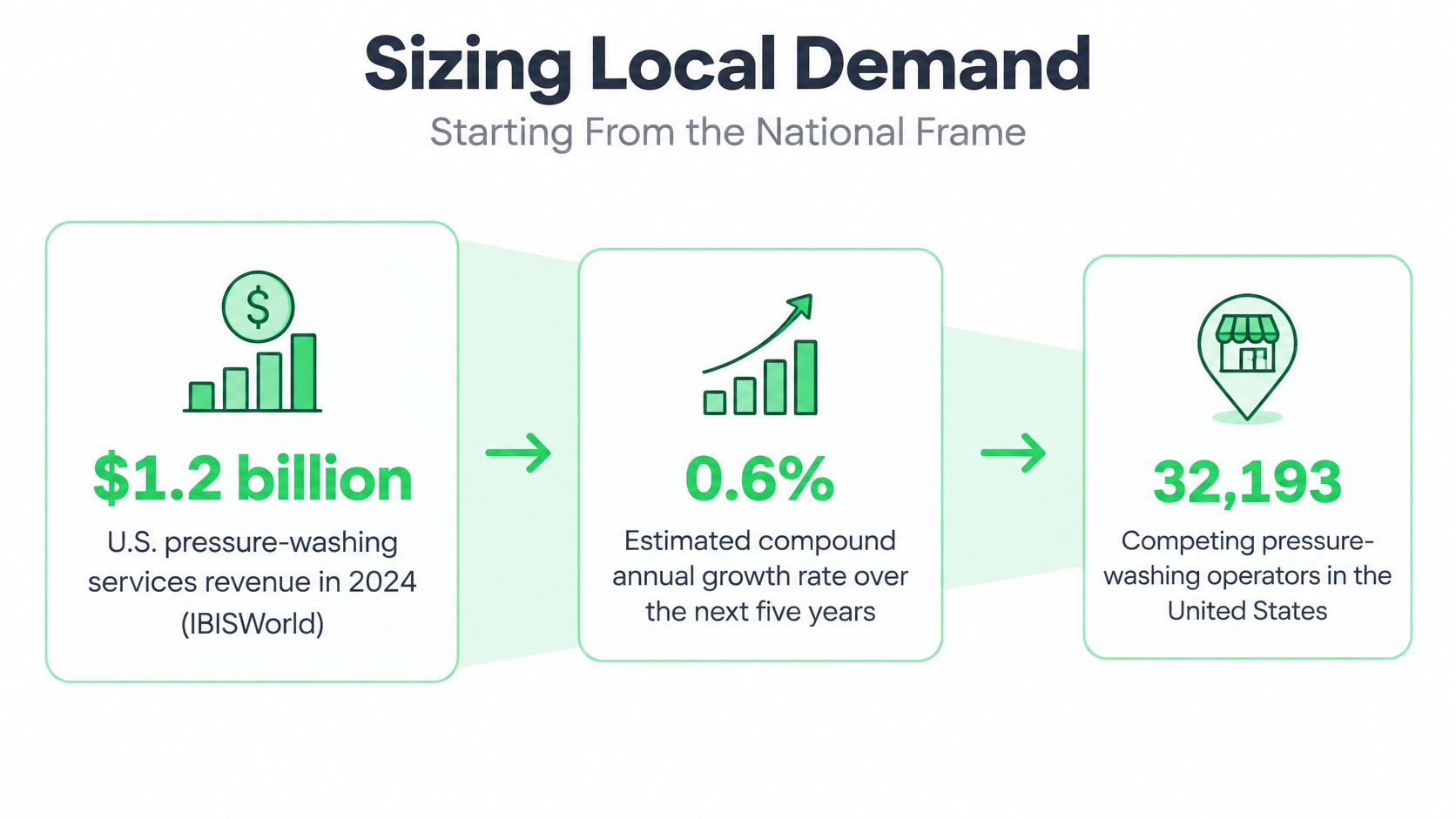
The gap between modest revenue growth and faster growth in business count points to competition for customers and pricing, rather than a rising tide that lifts every operator. National classifications also blur the edges between pressure washing, soft washing and roof cleaning, so the practical decision rests on the properties and competitors in a defined service area.
A local validation exercise can be completed before capital is committed:
- Count reachable properties. Map residential driveways, HOA common areas, restaurant exteriors and fleet yards within a practical radius. Separate one-time prospects from properties that may need repeat maintenance.
- Collect comparable quotes. Request at least ten quotes for the same driveway and storefront scope. Record inclusions, wastewater handling and response time as well as the price.
- Log seasonal slow periods. Ask property managers and operators when exterior cleaning demand falls, then test whether other services or contract work can fill the gap.
- Check recurring offers. Note which competitors advertise maintenance plans and whether those plans specify frequency, scope and payment terms.
For a second perspective on the startup choices involved, Estimatty's power-washing startup advice can serve as a companion to this local validation. The national figures are a starting frame; property counts, comparable bids and seasonality should determine whether a particular territory can support a durable route.
Wastewater and Lead Paint Rules to Clear First
Wastewater belongs on the first page of the startup budget. One contaminated discharge can create cleanup, regulatory and contract-liability costs that exceed the margin on many routine jobs, so the disposal plan should shape equipment selection rather than follow it. Recovery gear, sewer permissions and disposal time are costs to price before the first quote, not after the first complaint.
The operating sequence is straightforward:
- Identify the authority having jurisdiction. Map storm drains, catch basins and every likely discharge point at the worksite.
- Choose an authorized destination. Determine whether washwater can go to a permitted sanitary sewer, treatment facility, recycling system or approved land-application area.
- Contain and recover runoff. Where water could reach a stormwater system, plan for berms, drain covers, vacuum recovery, a pump and a holding tank.
- Document site authorization. Keep disposal approval and the selected recovery procedure on file for each commercial site.
The EPA NPDES guidance says discharges to receiving waters or a municipal separate storm sewer generally require separate NPDES authorization. Applied at the job level, that means preventing uncontrolled runoff, photographing containment before work begins, testing the recovery route and building wastewater handling into every estimate.
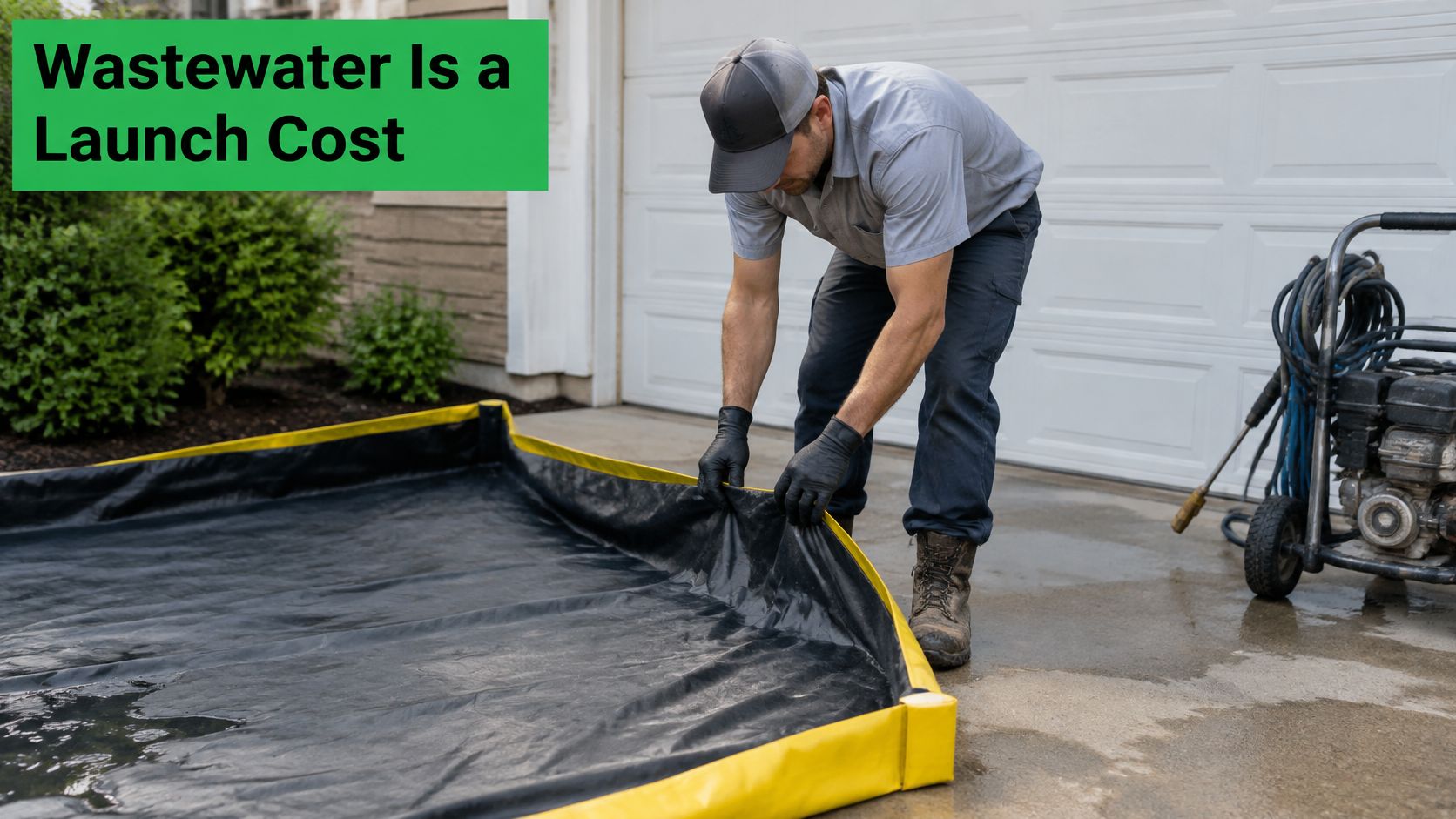
Rules differ across jurisdictions. Massachusetts guidance prohibits discharge to a septic system and requires washwater to be segregated from stormwater collection systems. Eugene, Oregon's best-management practices call for mobile cleaning on a solid surface where washwater can be collected and sent to a sanitary sewer or recycling system, with storm-system discharge allowed only under the specified permit conditions.
| Jurisdiction | Discharge or containment rule | Operator action |
|---|---|---|
| Federal, EPA | Discharge to waters or a municipal separate storm sewer generally requires NPDES authorization | Keep runoff out of storm drains and document containment |
| Massachusetts | Discharge to a septic system is prohibited; washwater must be kept out of stormwater collection systems | Segregate washwater from catch basins, culverts and swales |
| Eugene, Oregon | Wash on a solid surface and collect water to a sanitary sewer or recycling system; storm discharge only with a permit | Use berms, drain covers, vacuum recovery, holding capacity and filtration |
| EPA RRP Rule, pre-1978 housing | Pressure washing is not prohibited, but containment applies to covered renovation work | Isolate the work area, keep containment intact, train the crew and document disposal |
Two patterns hold across these rules. The sanitary sewer is the default destination wherever collection is required, and using it generally takes permission from the local sewer authority rather than assumption. Storm drains are treated as receiving waters, so any runoff path toward a catch basin triggers containment duties before the first surface is washed.
Older painted exteriors add a separate decision. The EPA's RRP Rule guidance says pressure washing is not prohibited when covered renovation work is involved, but containment requirements still apply. Before quoting pre-1978 housing, painted siding or decks, determine whether the job falls under the rule and how the work area and contaminated washwater will be contained. Get sewer authorization in writing, and price recovery and disposal into the scope of work. Operators who bill compliance as an optional line invite clients to strip it out; folding it into the estimate keeps the margin and the paperwork aligned.
Equipment Specs That Set Your Daily Capacity
| Component | Price or spec | Operating rule |
|---|---|---|
| Commercial pressure washer | $760 to $2,000 | Cold-water unit is the baseline; hot-water units need a separate tank and heating plan |
| Water supply | At least 2 GPM at 40 to 80 psi supply | Verify flow at each site before quoting; short supply starves the pump |
| Hose | Minimum 1/2 inch; 50-foot high-pressure hose at $80 to $200 | Hose diameter protects flow at the wand |
| Water temperature | 104°F maximum for the referenced cold-water unit | Check the manual before any hot-water work |
| Nozzles | $25 to $60 each | Select by substrate, not maximum pressure |
| Surface-cleaner attachment | $60 to $150 | Raises productivity and wastewater volume to capture |
| Cleaning solutions | $100 to $300 | Set concentration by substrate and runoff risk |
| Safety equipment | $75 to $150 | Use eye protection, slip-resistant footwear, gloves and hearing protection |
The prices above come from a published pressure-washing equipment cost breakdown. The water-supply and temperature limits are from the commercial pressure-washer manual, which specifies those requirements for its referenced cold-water unit. Together, the figures show why a machine's maximum pressure alone is a poor measure of daily capacity: inadequate supply flow can starve the pump, while poor setup can slow a crew or damage the work surface.
Before the first job, the operator should follow a repeatable sequence:
- Confirm water supply at the site. Check that the source meets the machine's minimum flow before a crew is scheduled.
- Match settings to the substrate. Choose pressure, temperature, nozzle and chemical concentration for the material, not the machine's maximum setting.
- Mark an exclusion zone. Keep customers and passersby away from spray, equipment and wet surfaces; use wet-floor signage where people may walk.
- Complete a written hazard assessment. Record electrical exposure, traffic, ladders, fragile surfaces, chemicals and slip hazards before work starts.
- Inspect equipment and PPE. Document pre-use inspections and require ANSI Z87.1 eye protection or a face shield where splash or debris warrants it, along with slip-resistant footwear, gloves and hearing protection.
GFCI-protected electrical connections should remain dry. The main technical failure is optimizing PSI alone: excess pressure can etch concrete, strip coatings, damage siding, force water behind cladding or injure workers. A surface cleaner can help a crew cover flatwork more consistently, but it also increases the volume of water the business must capture. Franchise development teams comparing service equipment and operating requirements can review pressure washing franchise options.
Pricing Models and Lead Sources for the First Year
A single price list won't fit driveways, storefronts and contracted maintenance. Residential driveways and other flatwork can be priced per square foot, with the rate anchored to the median of comparable local quotes. Storefronts and small commercial sites need a flat per-job price and a minimum charge that covers travel and setup, with wastewater handling shown as a separate line item.
For commercial and HOA accounts, quote a monthly maintenance price for a fixed scope and write payment terms into the contract. Slow collections can erase the apparent benefit of recurring work if the crew has to finance labor and supplies while waiting for payment. Track revenue per crew-hour on each job, then reprice or decline categories that fall below the business's break-even requirement.
Lead generation should be tested in sequence. Establish a Google Business Profile, photograph completed work and ask satisfied customers for reviews; build credibility before committing to paid Meta or Google campaigns. Property managers and HOA boards can provide a path to repeat work, so submit written proposals and log every channel's cost per booked job. Cut a channel when its acquisition cost exceeds the margin earned on the job.
For a useful comparison of response practices in home services, Wojo Media's guidance on rapid response for home service leads offers context for organizing inquiry follow-up. The same discipline applies to pricing: record lead source, quote outcome, booked revenue and collected cash, not just the number of inquiries. Operators examining another route-based service model can also refer to Franchise Fast Track's junk removal guide.
Profit Scenarios for Solo, Crew and Multi-Crew Models
The most common modeling error is treating the owner's labor as free. The U.S. Census NAICS 561790 category includes pressure washing alongside pool, gutter, chimney and duct cleaning, so its figures are a proxy rather than a pressure-washing count. In 2022, the category had 17,574 employer establishments, with about 73% employing fewer than five people and about 88% employing fewer than ten, according to the Census-category figures compiled by Maxx Effect. That profile supports an owner-operated or lean-crew entry model, but it doesn't make a small operation automatically profitable.
Industry commentary estimates labor at roughly 30% to 45% of revenue, a directional estimate rather than an authoritative benchmark, according to staffing-cost commentary from Stealth Agents. The operating model should therefore be tested against crew productivity and the owner's wage, not equipment capacity alone.
| Operating model | Revenue pattern | Labor and overhead exposure | Break-even test |
|---|---|---|---|
| Solo owner | Residential jobs on a weather-dependent calendar | Owner wage must be modeled at market rate, not zero | Profit after a market wage and drive time |
| One two-person crew | Mix of residential and small commercial | Labor at a directional 30% to 45% of revenue | Revenue per crew-hour at conservative utilization |
| Multi-crew operation | Recurring commercial and HOA contracts | Dispatch, quality control and hiring add fixed cost | Jobs per route day after travel time |
| Recurring commercial contracts | Monthly billing with set scope | Price compression and slower payment terms | Net margin after procurement delays and payment terms |
A worked example makes the owner-wage issue visible. At $200,000 in annual revenue, a labor load of 30% to 45% equals $60,000 to $90,000 before drive time, insurance, chemicals and equipment depreciation are added. A two-person crew billing that revenue may leave much less than the owner expects after all operating costs are counted.
The decision should rest on six recurring measures: revenue per crew-hour, non-billable drive time, repeat-service percentage, average ticket, rework rate and seasonal utilization. A solo operator should model an owner wage and travel time; a two-person crew should test conservative utilization; a multi-crew system should measure completed jobs per route day. Recurring contracts can stabilize demand, but price compression and payment terms can offset that advantage.
Run scenarios for a solo owner, one two-person crew and multiple crews without assuming a full calendar. Divide the remaining margin by crew-hours, then test whether the model still pays the owner a market wage and leaves a profit. Analysts comparing route-based service concepts can also consult Franchise Fast Track's window franchise comparison.
Franchise Disclosure Benchmarks Against Independent Launch Costs
A Franchise Disclosure Document turns some independent-launch unknowns into disclosed figures, but only where the franchisor reports them. For an exterior-cleaning concept, the central comparison starts with Item 7, the initial investment table: set it beside the independent launch and equipment ranges, then check whether its listed inclusions account for a vehicle, wastewater recovery and working capital.
| Factor | Independent launch | Franchised unit | Where to verify |
|---|---|---|---|
| Upfront capital | Equipment and launch ranges above | Initial investment disclosed in full | FDD Item 7 |
| Revenue evidence | Owner's own forecasts only | Historical performance, if the franchisor discloses it | FDD Item 19 |
| Operating system | Built by the owner | Training, manuals and approved suppliers | FDD Items 8 and 11 |
| Territory | Owner chooses service area | Protected or non-protected territory terms | FDD Item 12 |
| Outlet health | No disclosure | Openings, closures, transfers and terminations | FDD Item 20 |
| Financial standing | Owner's books only | Franchisor audited financial statements | FDD Item 21 |

Item 19 contains a financial performance representation if the franchisor makes one. A blank item is a finding to record, not permission to fill the gap with an independent forecast. Item 20 provides outlet history, including openings, closures, transfers and terminations over the specified reporting period; a rising closure count can change how an average performance representation should be interpreted. Item 21 contains audited financial statements. Items 8 and 12 matter operationally because suppliers and territory terms affect the costs and customer density that an operator can control.
The unit model should include royalties as a percentage of gross revenue from the first job. Training, approved suppliers and marketing support can carry value, but the comparison should price them explicitly against the independent operator's costs rather than treat them as free. Franchise systems compete for investment across quick-service restaurants (QSR), home services, real estate brokerages, fitness and wellness, automotive services, health and beauty, retail, education and senior care; an exterior-cleaning system should still be benchmarked against similar service operations, not against a category-wide average.
Franchise Fast Track's registry of 7,000+ brands and database of 68,000+ FDDs can support a comparison across at least three disclosed systems in the category. The FDD analysis for franchise leaders provides additional context for reviewing disclosure documents. The test is whether a franchise's required investment, fees and operating support produce a more defensible unit model than a standalone launch, not whether its entry cost looks lower on one line.
Run the 90-Day Launch Sequence Before Your First Contract
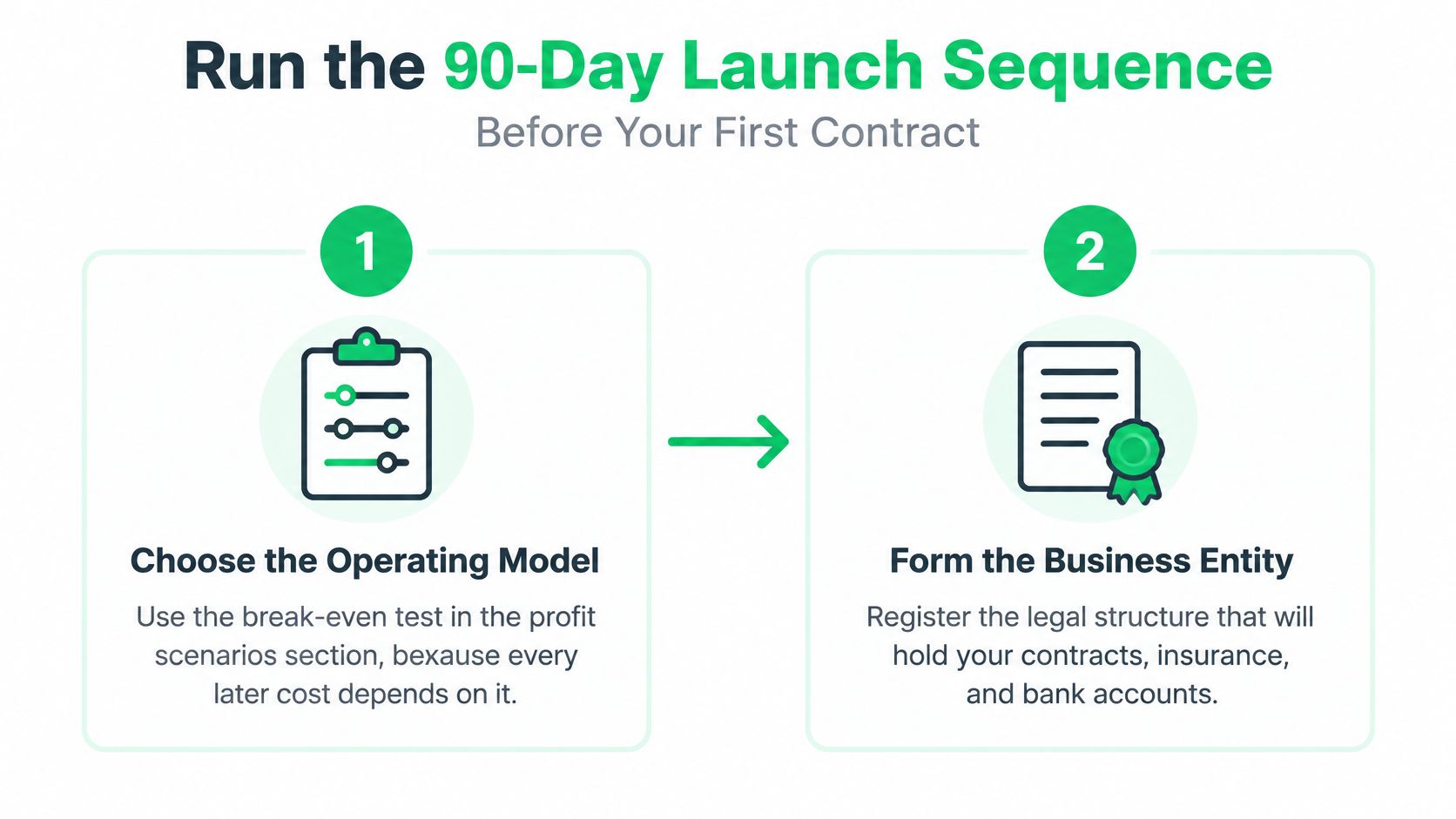
- Choose the operating model. Use the break-even test for a solo operator, one crew or multiple crews, because staffing and equipment decisions follow from the model.
- Form the LLC. Budget for state and local formation costs and keep the business's finances separate from personal accounts.
- Bind general-liability insurance. Match coverage limits to the commercial work being quoted, rather than assuming a residential policy will fit every contract.
- Build and test the wastewater kit. Practice recovery on a driveway before quoting a commercial site, since the authorized disposal route affects job scope and price.
- Publish the rate structure. Use distinct residential, storefront and recurring-contract prices, with wastewater handling listed rather than buried.
- Offer a recurring maintenance plan. Present one defined-scope plan to a property manager or HOA, then track repeat-service percentage and collection timing.
At day 90, review revenue per crew-hour, rework rate, average ticket and cash collected against the launch budget. Continue only if the operating model pays the owner a market wage, covers recurring costs and produces a credible path to repeat work; otherwise, pause expansion and revise the service area, pricing or crew plan. Franchise development teams comparing these independent economics with disclosed unit costs can use the Franchise Fast Track FDD database to examine franchise disclosure benchmarks.
Franchise Fast Track combines franchise development support with an industry intelligence platform, including searchable brand and FDD information relevant to evaluating service concepts. For leaders assessing how an exterior-cleaning system's investment and unit economics compare with the wider franchise market, visit Franchise Fast Track.
Ready to see results like these for your franchise?
Stop wasting money on leads that never close. Start getting hundreds of replies from high-net-worth professionals daily.