7 Power Washing Franchise Brands to Evaluate
The U.S. pressure-washing services industry has been estimated at about $1.2 billion across 32,193 businesses, with 41,799 technicians reported in 2024, according to FranChoice's category summary. That scale creates room for franchising, but the strongest power washing franchise comparison isn't the one with the lowest advertised startup figure. It is the model that aligns Item 7 investment, mobile equipment, recurring service mix, commercial selling cycles, territory density, and the operating systems required to add vehicles, technicians, and territories.
Public websites can show how brands position equipment, services, support, and launch costs. They don't replace the current Franchise Disclosure Document. Item 7 should be reconciled against actual capital requirements, while Item 19, Item 20, and Item 21 require separate review because investment transparency doesn't establish financial performance, outlet health, franchisee turnover, or corporate financial condition.
The seven brands below represent different development strategies. Sparkle Wash emphasizes a purpose-built mobile rig and commercial diversification. Window Genie and Shack Shine build around broader service ecosystems. Men In Kilts and Window Hero foreground public investment transparency. Shine and Window Gang use multi-service property care to address seasonality and upselling. For development executives, the useful question is not which concept looks cheapest online. It is which system can attract the right operator profile, support recurring demand, and expand beyond one service vehicle without creating an acquisition cost problem. Stronger outbound lead conversion also depends on matching each brand's operating model to candidates with the right sales, hiring, and territory-development experience.
Table of Contents
- 1. Sparkle Wash Builds Around Mobile Equipment and Commercial Reach
- 2. Window Genie Adds Power Washing to a Neighborly Service Platform
- 3. Shack Shine Uses Centralized Booking to Sell House Detailing
- 4. Men In Kilts Turns Brand Personality Into a Local Acquisition Asset
- 5. Window Hero Makes Equipment and Working Capital Visible
- 6. Shine Combines Window Cleaning, Pressure Washing, and Holiday Lighting
- 7. Window Gang Puts Contact-Center Economics Into the Comparison
- Top 7 Power Washing Franchises Compared
- Turn Brand Comparison Into a Multi-Unit Growth Benchmark
1. Sparkle Wash Builds Around Mobile Equipment and Commercial Reach
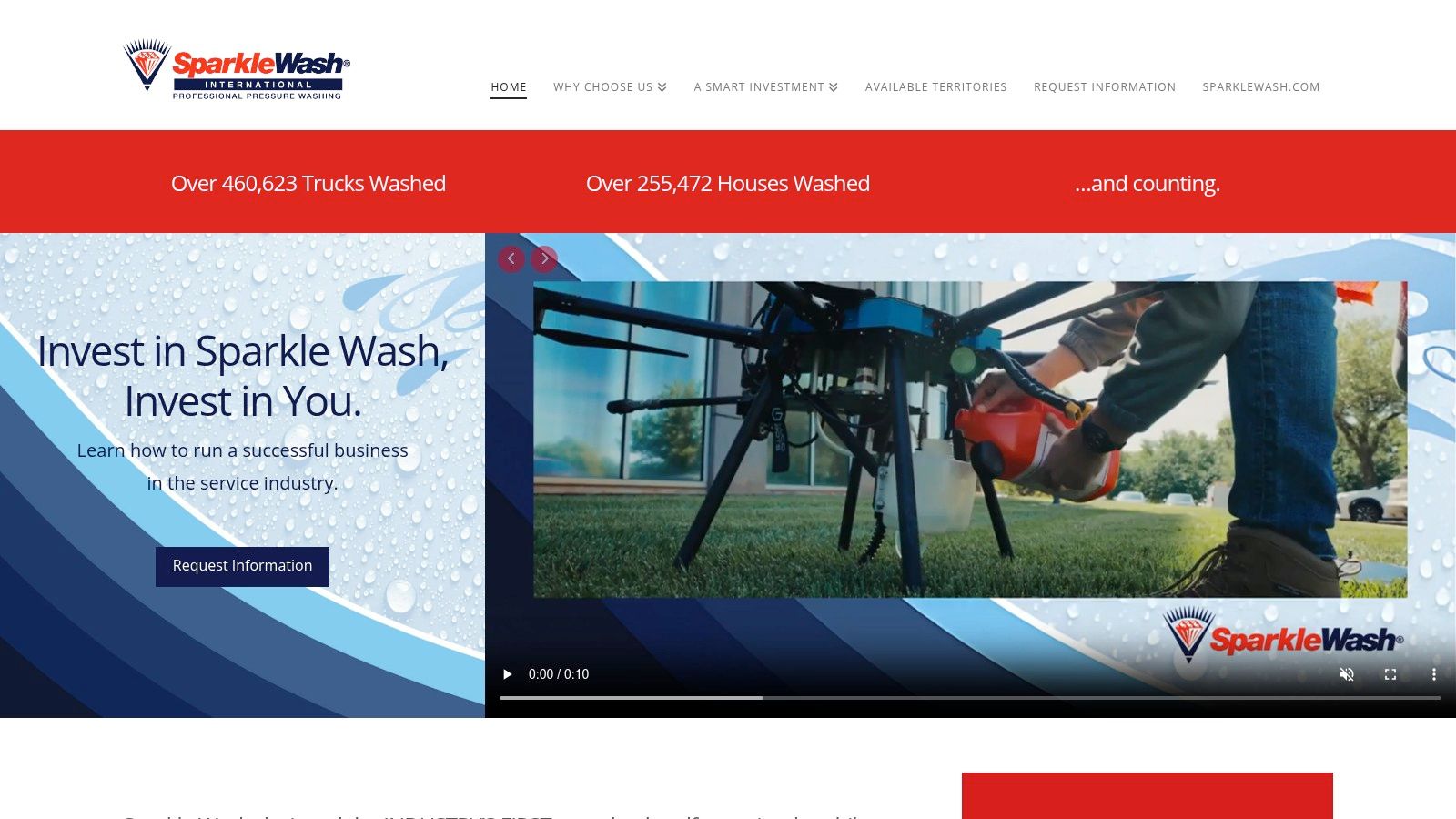
Sparkle Wash is one of the category's longest-running brands, founded in 1965, according to Franchise Clues' pressure-washing franchise overview. Its model is power-washing first, with residential, commercial, industrial, construction, and fleet services creating a broader demand base than a residential-only exterior-cleaning concept.
The central development asset is a purpose-built, self-contained mobile wash rig engineered for the operating model. That matters because the equipment package shapes startup capital, technician training, vehicle utilization, and the pace at which a franchisee can add production capacity. A home-based launch can limit fixed overhead, while fleet and industrial work can create larger account opportunities that aren't dependent on individual homeowners.
A broader service mix changes the candidate profile
Sparkle Wash also trains operators in restoration, sealing, and staining add-ons. Those services can require a different sales conversation, job-estimation process, and quality-control discipline than basic soft washing. Development teams should therefore screen for candidates who can manage both field execution and commercial account development, rather than treating the concept as a simple equipment-led service business.
The public site presents an Item 7-style cost table, which gives candidates and analysts a useful starting point for comparing equipment, launch expenses, and working capital. It still needs to be checked against the current FDD, because a website summary may not reflect the latest fee structure, required purchases, or territory assumptions.
Development implication: Sparkle Wash's strongest fit is an operator who can build route density across residential work while pursuing fleet, industrial, construction, and property-management accounts.
The model's tradeoff is equally clear. A smaller national consumer footprint can require more local brand-building than a large multi-brand platform. Fleet and industrial accounts may also involve longer procurement and selling cycles. The Franchise Fast Track market guide can help position Sparkle Wash against adjacent home-improvement franchises, but current FDD review remains the basis for investment and system-health analysis. The Sparkle Wash franchise site provides the brand's current public positioning.
2. Window Genie Adds Power Washing to a Neighborly Service Platform
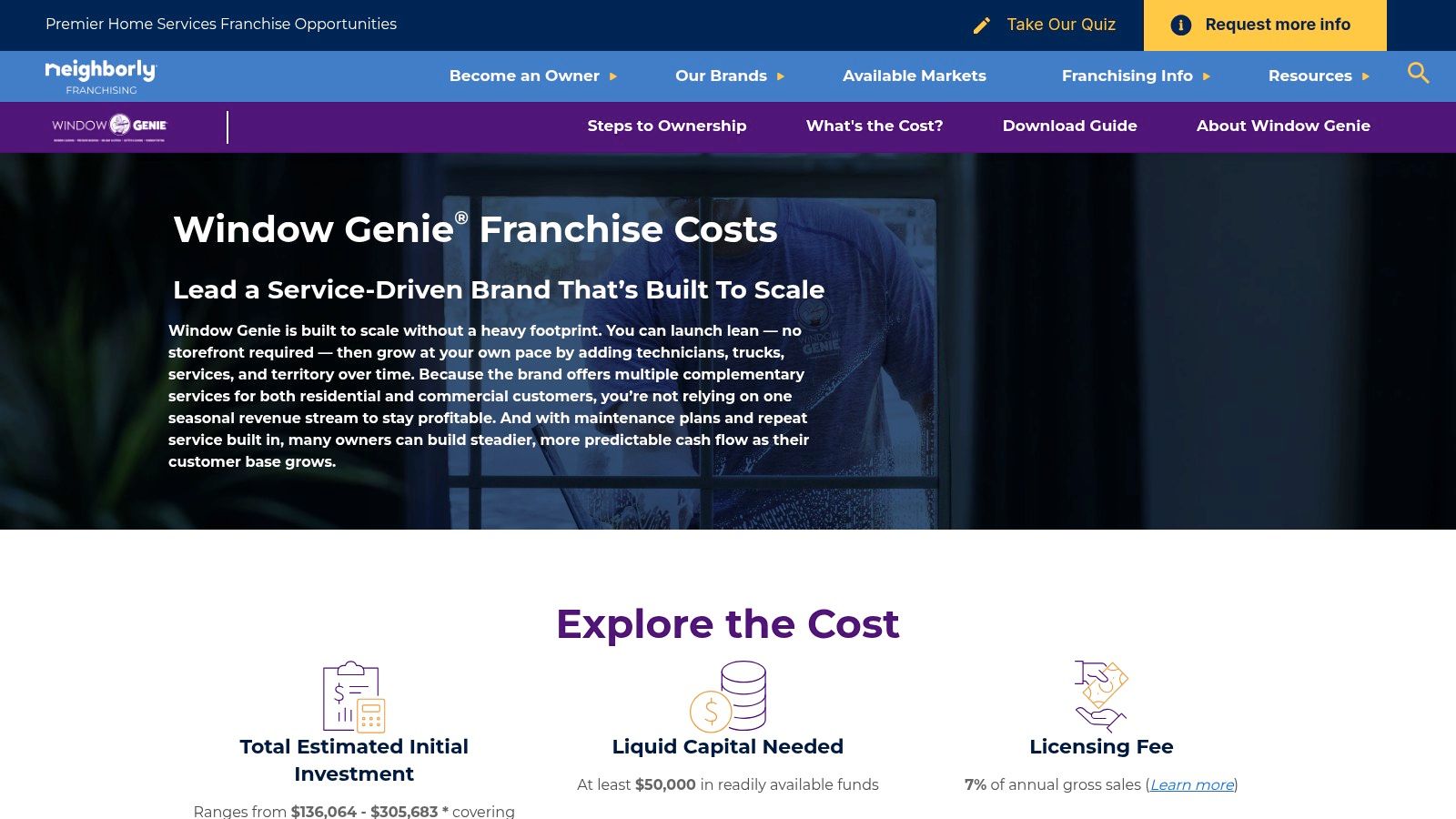
Window Genie competes through service breadth and Neighborly infrastructure. The Neighborly Window Genie investment page describes a concept combining window cleaning, pressure washing, gutter cleaning, and window tinting. For development executives, that creates a different benchmark from a pressure-washing-first brand. The candidate is evaluating a broader property-maintenance platform, with more opportunities to cross-sell and build relationships across service lines.
Neighborly's shared services, supplier relationships, marketing resources, and cross-brand network may influence both recruitment and local execution. ProTradeNet and shared marketing systems are relevant to operators seeking standardized purchasing, supplier access, and campaign support. The model can also add technicians, vehicles, and services without requiring a traditional storefront, although diligence should test how those additions affect labor utilization, route density, and working capital.
Recurring maintenance is the operating test
Window cleaning and gutter services can support planned maintenance relationships. Pressure washing adds project-based demand and cross-sell potential. The analytical question is whether recurring work appears in operating results, rather than only in marketing language. Item 19 review should test the definitions, reporting populations, and mix of mature and newer units behind any disclosed performance.
Network maturity may strengthen recognition and enterprise credibility, while also limiting territory availability. Development teams should compare proposed boundaries with existing outlets, transfers, closures, and owner concentration in Item 20. A recognizable platform does not establish that a market is open or underpenetrated.
Royalty, marketing-fund, technology, and shared-service charges require reconciliation with the unit's sales capacity and route density. The broader platform may support those charges, but the fee stack still needs to work at the local operating level. The commercial cleaning franchise economics guide provides an adjacent benchmark for recurring B2B service models.
Window Genie is best assessed as a multi-service Neighborly platform. Compare its fee structure, territory availability, and service mix with a pressure-washing-first brand before treating the platform advantage as decisive. Current FDD review, including Items 7, 19, 20, and 21, should anchor that comparison.
3. Shack Shine Uses Centralized Booking to Sell House Detailing
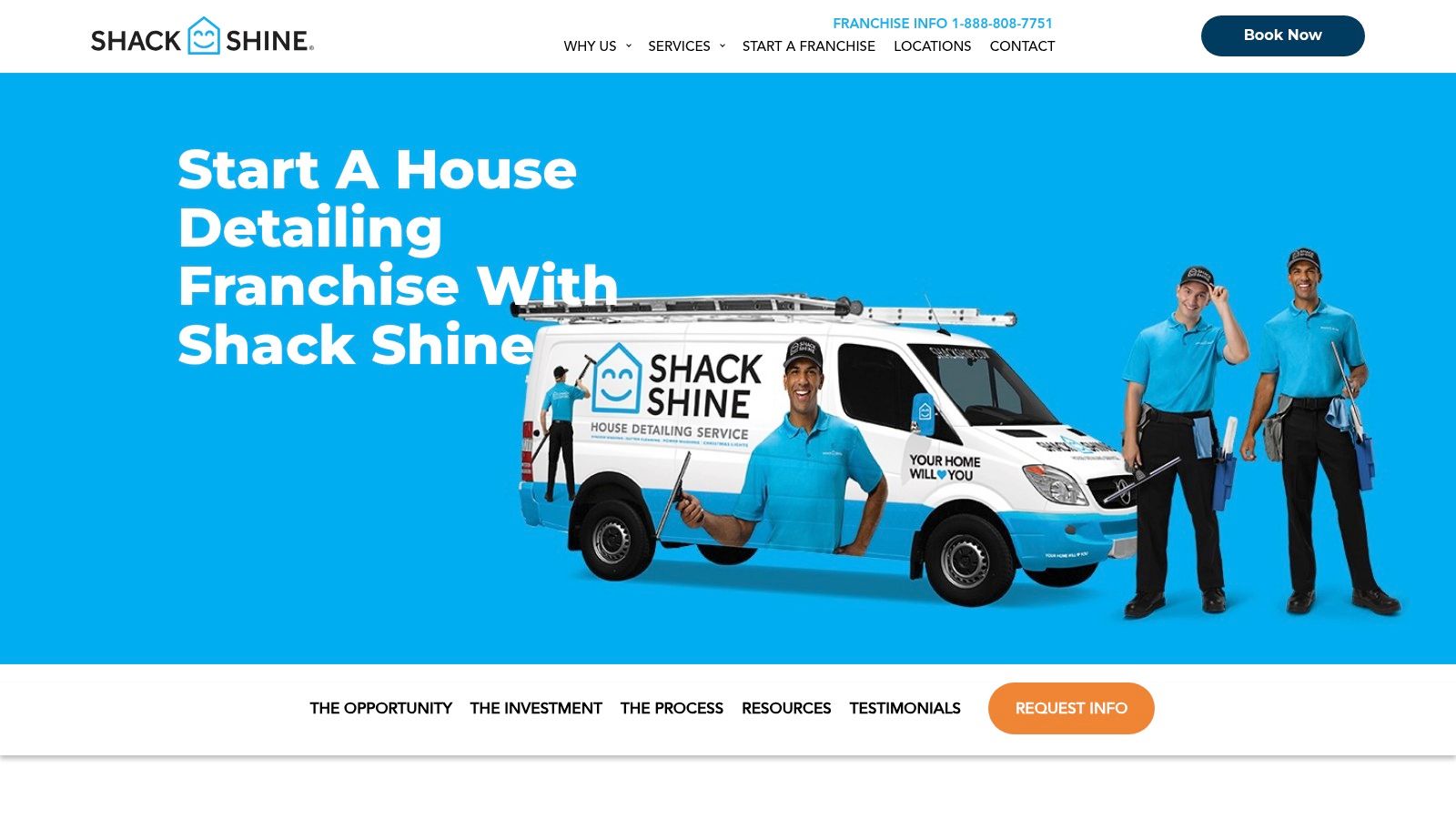
Shack Shine, part of O2E Brands, packages window washing, gutter cleaning, power and soft washing, and holiday lights under a consumer-facing house-detailing model. Its differentiation is less about a single wash rig and more about the customer journey, centralized booking, and the ability to bundle several exterior services.
The Shack Shine business opportunity page emphasizes protected territories structured around population-based sub-areas, with options for multi-subterritory expansion. Those boundaries should be evaluated against household density, service radius, route economics, and existing outlet placement. A territory that looks attractive in population terms may still be difficult to serve profitably if jobs are dispersed or if seasonal services require crews to travel widely.
Booking infrastructure changes the franchisee job
A centralized call center and online booking can move lead handling away from the owner and create a more consistent customer experience. That infrastructure may improve speed to appointment, but it also changes the skills needed at the local unit. The franchisee must manage capacity, technician scheduling, quality control, and exception handling when centralized bookings don't align with weather, equipment, or crew availability.
The holiday-lights service adds a second operating rhythm. It can extend demand beyond pressure-washing season, but it creates inventory, installation, storage, safety, and removal requirements. Development teams should test whether candidates understand seasonal workforce planning rather than assuming that a broader menu automatically produces stable utilization.
Shack Shine publicly presents a franchise payment-plan option involving a franchise-fee down payment and startup marketing. Because the exact total investment range isn't clearly presented in the public summary, the current FDD is especially important. Item 7 should identify the full opening budget, including equipment, vehicles, technology, marketing, deposits, and working capital.
Diligence question: Does centralized booking produce enough qualified local demand to keep crews productive after travel time, cancellations, weather interruptions, and service mix are considered?
The 360clean franchisor recruitment guide provides an adjacent reference point for evaluating centralized support in cleaning concepts. Shack Shine's public model may appeal to candidates who value sales and operations support, but Item 20 remains necessary to test expansion readiness and territory saturation.
4. Men In Kilts Turns Brand Personality Into a Local Acquisition Asset
Men In Kilts, part of Threshold Brands, uses a highly distinctive exterior-cleaning identity across window cleaning, gutter cleaning, siding services, and pressure washing. The concept's brand personality can help a local unit stand out in a category where many independent operators compete through similar service descriptions and vehicle-based marketing.
The Men In Kilts franchising site publishes a U.S. investment and fee table. That public transparency is useful for early candidate qualification and for development teams comparing the brand with other service concepts in home services, automotive services, and commercial cleaning. It can also make lender conversations more concrete, provided the figures are reconciled with the current FDD.
Memorable branding doesn't replace B2B credibility
A distinctive consumer brand can support local marketing cut-through and referral activity. The development risk is that brand personality may not carry equally well into commercial settings, where property managers, facilities teams, and multi-location customers may prioritize procurement controls, service-level expectations, insurance documentation, and reporting.
That doesn't make the brand unsuitable for B2B work. It means the territory plan should specify which customer segments receive priority, how local operators build commercial credibility, and whether the support system supplies sales collateral and account-management processes. The same candidate who thrives on residential marketing may not be prepared for longer commercial sales cycles.
Threshold Brands also gives Men In Kilts a multi-brand platform context. Shared support can improve training, business coaching, and system development, but analysts should distinguish platform-level resources from brand-specific performance. Item 19 should identify whether any financial performance representation applies to the brand being evaluated, while Item 20 should show how the system has added, transferred, or lost outlets.
Practical rule: Public investment transparency supports qualification. It doesn't establish territory quality, unit profitability, or the reliability of the brand's growth engine.
For development leaders, Men In Kilts is a useful benchmark for the relationship between memorable consumer positioning and operationally repeatable exterior services. Analysts can browse qualified franchise brands to compare adjacent concepts, but the current FDD remains the controlling diligence document.
5. Window Hero Makes Equipment and Working Capital Visible
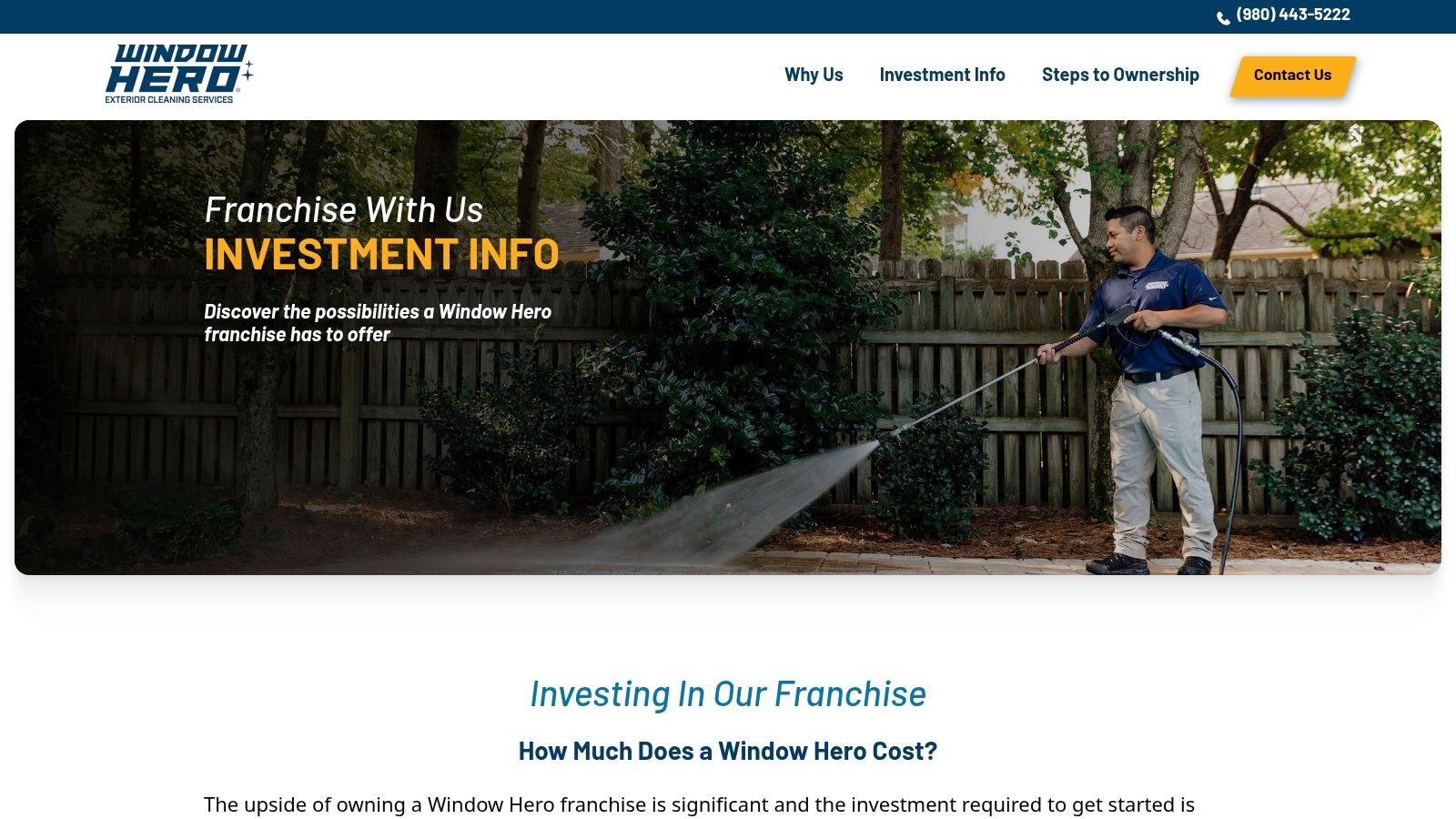
Window Hero, within HomeFront Brands, presents an exterior-cleaning model built around window cleaning, pressure and soft washing, and gutter services. Its public investment presentation is notable because it breaks the launch requirement into practical ownership categories, including the vehicle, tools and equipment, technology, marketing, and working capital.
That structure is more useful than a single headline investment figure. Development executives can see which expenses are tied to production capacity and which support administration, customer acquisition, or early operating runway. Analysts can then compare whether competing concepts define equipment, technology, marketing, and working capital consistently, rather than treating every public estimate as directly comparable.
Higher equipment intensity can support faster capacity growth
A complete vehicle and equipment package may raise initial capital requirements, but it can also reduce the gap between signing and service delivery. The key operating question is whether the franchisee can keep that capacity utilized. An underdeveloped territory, weak lead handling, or limited commercial sales capability can turn a fully equipped vehicle into idle capital.
HomeFront Brands' shared services and customer-support center also matter. Centralized support can help with lead response, customer communication, and process consistency. It can create fee obligations too, so Item 7 and the ongoing fee disclosures should be reviewed together rather than in isolation.
Window Hero's multi-revenue positioning supports a recurring-maintenance discussion. Window cleaning and gutter services may create planned follow-up opportunities, while pressure and soft washing can increase the value of an existing customer relationship. Item 19 diligence should test whether disclosed results separate service lines, identify recurring revenue definitions, and distinguish gross revenue from owner-level profitability.
A newer brand name can also affect local acquisition. Strong playbooks and launch support may compensate for lower unaided awareness, but the candidate profile should include local sales discipline and willingness to build commercial relationships. Development teams should avoid assuming that centralized support can substitute for territory-level execution.
Window Hero is therefore a useful benchmark for capital visibility and speed-to-launch design. Its public investment information should be reconciled with the current FDD before any investment comparison is treated as final.
6. Shine Combines Window Cleaning, Pressure Washing, and Holiday Lighting
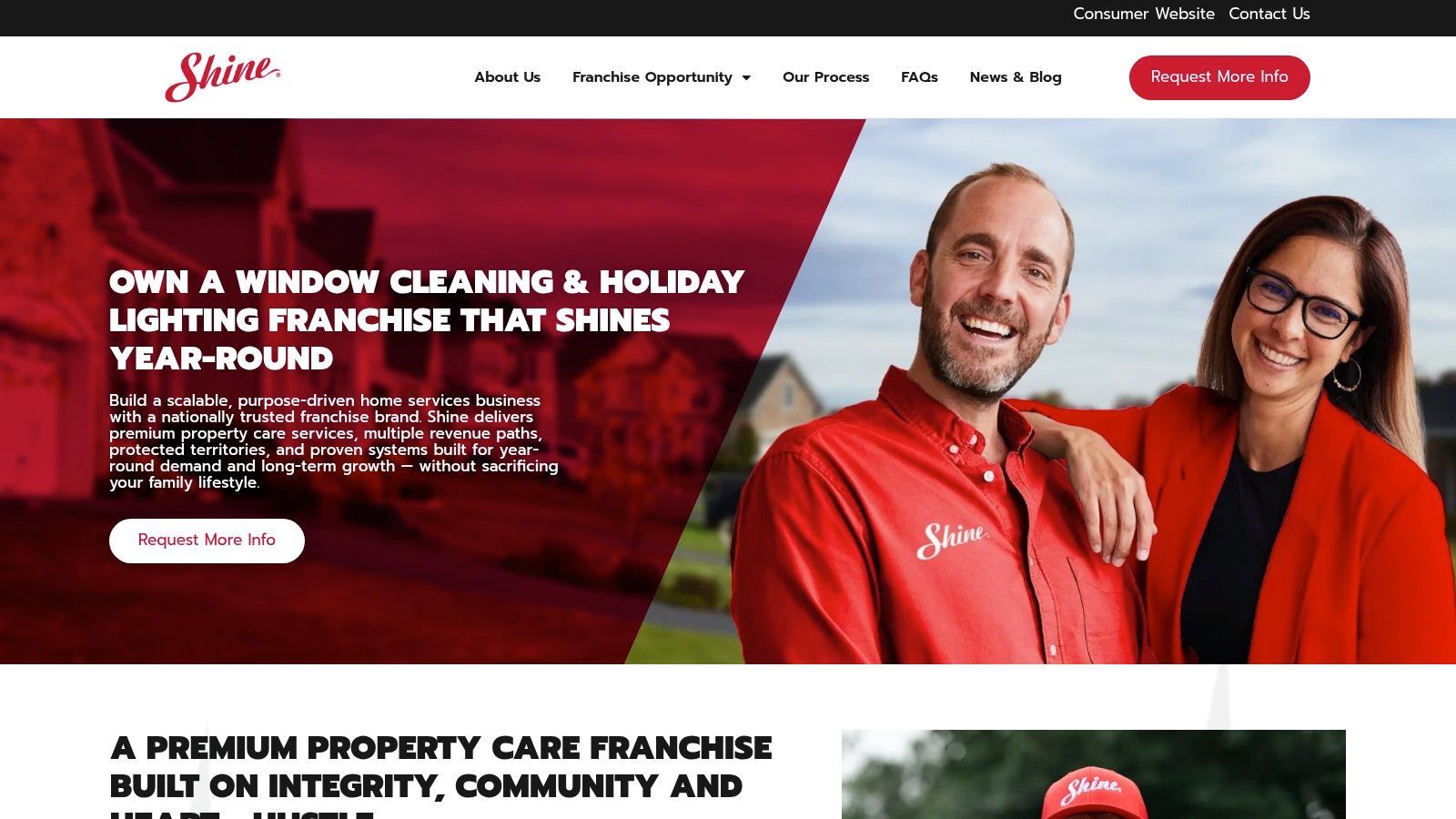
Shine presents a premium property-care model that combines window cleaning, pressure washing, and holiday lighting. The brand has operated for more than 25 years, according to its franchise opportunity page, giving analysts a longer operating history to examine than a recently launched concept.
The service mix addresses a core pressure-washing franchise challenge, seasonal utilization. Window cleaning can support repeat maintenance relationships, pressure washing can add exterior-cleaning projects, and holiday lighting can create a distinct demand period. The combination doesn't eliminate operational complexity. It creates a scheduling and staffing system that must move between recurring work, project work, and seasonal installation logistics.
Launch support should be tested against unit maturity
Shine describes a 17-week Bright Start training and launch program, a public detail that helps candidates understand the expected path from preparation to initial operations. Development executives should still ask how support changes after launch, when the owner must recruit technicians, manage callbacks, sell commercial accounts, and add vehicles.
The commercial component deserves separate attention. Commercial window cleaning and property-care contracts can create planned work, but winning those accounts may require proposal writing, insurance documentation, site audits, and account management. A candidate with residential sales experience may need additional support before taking on institutional or multi-site customers.
Shine's culture and values-led positioning may also support recruiting and local brand building. Recruiting claims should be checked against Item 20, owner interviews, and operating evidence rather than inferred from brand language. Item 21 can provide context on the franchisor's financial statements and the resources supporting training, marketing, and technology.
Holiday lighting adds inventory and logistics work during the fourth quarter. That can produce useful seasonal capacity, but it can also place pressure on hiring, installation quality, storage, and customer communication. A territory plan should therefore measure not only market demand but also the operator's ability to run multiple workflows at once.
Seasonality test: A multi-service menu is valuable only when the system can schedule, sell, staff, and measure each service without degrading the core recurring work.
Shine works as a benchmark for a mature, multi-service model. Its public materials should be compared with the current FDD, especially Item 7 for investment, Item 19 for performance definitions, and Item 20 for system expansion.
7. Window Gang Puts Contact-Center Economics Into the Comparison
Window Gang is an established exterior-cleaning brand within Premium Service Brands. Its service mix includes window cleaning, pressure washing, gutter cleaning, and related work. That combination gives development teams a basis for assessing upsell potential and seasonal workload balance, rather than evaluating a pressure-washing concept in isolation.
The Window Gang investment information identifies the total initial investment range, royalty, marketing fees, contact-center fees, and required liquidity structure. This disclosure supports a fuller comparison of capital needs and recurring obligations. Item 7 should be reconciled with the current FDD, especially where equipment, working capital, vehicles, and technology affect territory launch costs.
The published franchise fee is $65,000. Because that amount sits above the franchise fees disclosed by Sparkle Wash and Men In Kilts in their public tables, Window Gang must demonstrate why its contact-center and platform support package justifies the difference for the intended operator profile. The diligence question is specific: do lead handling, booking, and customer-service functions produce enough incremental capacity or conversion to offset the recurring charge in each territory?
Contact-center support changes the scaling model
A contact center can reduce local administrative work and standardize response times. That may let an owner spend more time on recruiting, field quality, commercial sales, and expansion. The same structure may be less attractive to an owner who wants to control every call, while multi-unit operators may value centralized administration across territories.
Premium Service Brands adds parent-platform context through shared resources across home-service concepts. Analysts should distinguish Window Gang economics from parent-level claims, then confirm the applicable fees, obligations, service levels, and performance representations in the FDD. The operating question is whether shared infrastructure improves utilization and consistency without obscuring brand-level costs.
Item 20 matters for testing multi-unit expansion. Openings do not establish healthy growth by themselves, so analysts should review closures, transfers, reacquisitions, ownership changes, and operator concentration by territory. Item 19 should be tested for the population behind any revenue or profitability representation. Item 21 can help assess whether the franchisor has the financial capacity to maintain training, marketing, technology, and contact-center support.
Window Gang's strongest comparison point is support monetization. The model gives development teams a way to assess whether contact-center infrastructure functions as an operating advantage, a cost burden, or both. The franchise marketing agency provides a separate reference point for evaluating demand-generation responsibilities beyond the brand's internal support model.
Top 7 Power Washing Franchises Compared
| Brand | Implementation complexity | Resource requirements | Expected outcomes | Ideal use cases | Key advantages |
|---|---|---|---|---|---|
| Sparkle Wash | Low–Moderate, franchisor-built mobile rig simplifies setup | Low initial investment; vehicle/rig, basic equipment, training | Steady residential + B2B revenue; year-round service mix | Low-capital, home-based operators; fleet/industrial targeting | Purpose-built mobile system; low disclosed investment; multi-market focus |
| Window Genie (Neighborly) | Moderate, follows Neighborly systems and standards | Moderate capital; access to ProTradeNet, shared marketing and ops | Predictable recurring maintenance revenue and referral leads | Operators seeking strong franchise support and national brand | Parent-company scale; supplier network; cross-brand referrals |
| Shack Shine (O2E Brands) | Moderate, territory rules and centralized booking integration | Franchise fee (payment-plan option), staffing, marketing, logistics | Higher lead-to-job conversion via centralized booking and UX | Owners wanting centralized booking and consumer-facing growth | O2E platform resources; 24/7 booking; protected territories |
| Men In Kilts (Threshold Brands) | Low–Moderate, standardized systems and training | Published investment and fee ranges; equipment and coaching | Transparent financial expectations; steady local demand | Candidates valuing cost transparency and brand differentiation | Published Item 7 data; dedicated coaches; distinctive brand personality |
| Window Hero (HomeFront Brands) | Moderate–High, full kit-up and structured playbooks | Higher capital requirement; vehicle, tools, tech stack, working capital | Faster lender conversations; clear scaling playbook; recurring streams | Well-capitalized buyers wanting fast launch and clear costs | Detailed cost table (Item 7-style); HomeFront shared services; speed-to-launch focus |
| Shine | Moderate, 17-week Bright Start launch program guides setup | Single-territory investment; training program; holiday lighting inventory | Balanced year-round revenue from multi-service mix | Operators seeking premium, structured launch and multi-service model | 25+ year brand; structured 17-week launch; balanced service mix |
| Window Gang (Premium Service Brands) | Moderate, established systems with contact-center integration | Published initial investment, royalties, marketing fees; $65k franchise fee | Clear qualification criteria; upsell and off-season revenue | Candidates preferring transparent fees and platform support | Published capital requirements; contact center support; multi-service upsells |
Turn Brand Comparison Into a Multi-Unit Growth Benchmark
A useful power washing franchise benchmark starts by separating disclosed facts from diligence questions. Public investment pages can reveal how Sparkle Wash, Window Genie, Shack Shine, Men In Kilts, Window Hero, Shine, and Window Gang frame equipment, support, service mix, and launch requirements. They can't prove that one system produces stronger franchisee economics or healthier territory expansion.
The first reconciliation point is FDD Item 7. The Federal Trade Commission identifies Item 7 as the section where franchisors disclose startup costs, including deposits, franchise fees, equipment, leases or rentals, initial inventory, and other opening expenses, as explained in the FTC's Franchise Disclosure Document guidance. Analysts should map every website line item to the current FDD and identify omissions, assumptions, replacement cycles, vehicle requirements, technology charges, and working-capital expectations.
Item 19 answers a different question. It concerns financial performance representations, so the analysis should test whether revenue, gross profit, owner compensation, or profitability figures are disclosed, how the population is defined, and whether the results apply to mature, newer, single-unit, or multi-unit operators. A public investment table cannot substitute for that analysis.
Item 20 should be treated as the system-health file. Openings, closures, transfers, reacquisitions, and franchisee turnover reveal whether a brand is adding durable capacity or merely reallocating territories. Item 21 provides the franchisor's financial statements, which can help analysts evaluate the corporate resources supporting training, technology, marketing, contact centers, and field support.
The category's scale makes that discipline relevant. One industry summary places the U.S. pressure-washing market at about $390 million in 2024, with a projection of roughly $570 million by 2034 and a long-run CAGR near 5%, while broader services estimates place the category at about $1.2 billion in 2024. Those figures use different market definitions, so they shouldn't be combined as if they measure the same market. They do show why development executives need a precise category definition before comparing territory potential.
A practical scorecard for development teams
A multi-unit benchmark should score each brand across the following dimensions:
- Investment structure: Map Item 7 costs to vehicles, wash rigs, tools, technology, marketing, deposits, and working capital.
- Equipment intensity: Assess how much capital is tied to the first production unit and how easily the system adds vehicles or crews.
- Recurring-service penetration: Identify whether window, gutter, maintenance, or commercial contracts create planned repeat work.
- Commercial account acquisition: Test the sales cycle, account-management requirements, fleet potential, and support for B2B selling.
- Seasonality control: Evaluate how holiday lighting, window cleaning, restoration, fleet work, or other services affect annual capacity.
- Territory density: Review boundaries, existing outlets, household concentration, drive time, and multi-territory expansion rights.
- Support economics: Compare contact-center, marketing, technology, royalty, and supplier-related fees with the operating value delivered.
- System health: Use Items 19, 20, and 21 to distinguish marketing claims from unit performance, outlet stability, and franchisor resources.
Technology adoption adds another operating benchmark. A 2026 industry summary reports that 78% of high-performing field-service businesses, including pressure-washing operators, use field-service-management software, according to Jobber's pressure-washing industry statistics. For a franchise system, scheduling, dispatch, job tracking, and customer communication increasingly function as baseline infrastructure. The relevant diligence question is whether the required stack improves route density and communication without imposing fees that weaken unit economics.
Lead generation deserves the same scrutiny. Industry coverage reports that local search costs for terms such as pressure washing plus a city have risen materially in many markets, with some locations experiencing 30% to 40% CPC growth, according to Franchise Signal's exterior-cleaning analysis. That changes the development and operating equation. A candidate may have the capital to launch, but the unit still needs a repeatable way to acquire profitable jobs when paid demand becomes more expensive.
The broader franchise benchmark also matters. U.S. franchising is commonly framed at roughly 3,000 active franchise systems, about 800,000 franchised establishments, and approximately $800 billion in annual economic output, as summarized by WorldMetrics' franchising industry statistics. Power washing sits within a meaningful national franchise environment that also includes QSR, home services, real estate brokerages, fitness and wellness, automotive services, health and beauty, retail, education, and senior care. Development leaders should compare candidate quality and territory growth practices across those verticals, not only within exterior cleaning.
The clearest next step is to build a side-by-side benchmark from current FDDs, then compare each brand's ideal candidate against the demands of multi-unit expansion. A useful sales leader's benchmarking guide can support the measurement framework, but it shouldn't replace legal, financial, and operational diligence. The Franchise Fast Track franchise directory offers a practical starting point for category research and brand comparison, while current FDD review remains essential before any development conclusion is made.
Franchise Fast Track provides franchise development support and franchise industry intelligence for established brands, including structured brand data, FDD research, multi-unit franchisee information, and targeted candidate outreach. Visit Franchise Fast Track to benchmark power washing franchise brands, review adjacent categories, and identify the development data needed for multi-unit growth.
Ready to see results like these for your franchise?
Stop wasting money on leads that never close. Start getting hundreds of replies from high-net-worth professionals daily.