Scalable Franchise Business Models: Top Examples for Growth
Scalable franchise business models are systems designed to replicate success across multiple units with consistent quality and predictable growth. The best examples share three traits: standardized operating procedures (SOPs), multi-unit development potential, and technology-driven support infrastructure. Inspire Brands operates 33,000+ restaurants generating over $33 billion in system sales, proving that platform-level thinking outperforms single-brand growth. Jersey Mike's posts average unit sales of $1.3 million with a failure rate near 3%. These numbers set the benchmark for what genuine franchise scalability looks like.
What makes a franchise business model truly scalable?
Scalability in franchising is not about adding locations. It is about building a system that performs consistently whether you operate 10 units or 10,000. The structural features that separate high-growth franchise concepts from average ones are specific and measurable.
The foundation is SOP documentation. Rigorous SOP standardization gives every franchisee a proven playbook, while allowing limited local flexibility for market adaptation. Without that balance, brands either lose consistency or lose relevance in regional markets.

Franchisee support intensity is the second driver. Modern systems assign dedicated Franchise Business Consultants (FBCs) who each manage 30–40 units, with initial training spanning two weeks and ongoing e-learning support layered on top. That ratio keeps quality control tight as unit counts grow. You can read more about how FBCs drive performance in multi-unit networks.
Technology and supply chain infrastructure complete the picture. Brands that own their logistics platforms generate revenue beyond royalties, which creates economic resilience at scale. The key characteristics of a scalable model include:
- Documented SOPs that cover every operational process from opening to close
- Multi-unit and master franchise development agreements that accelerate geographic expansion
- FBC-to-unit ratios that keep support manageable as the network grows
- Proprietary technology for training, reporting, and customer experience
- Supply chain ownership or preferred vendor programs that protect margins
Pro Tip: Evaluate any franchise's Franchise Disclosure Document (FDD) Item 21 for audited financials. Average unit volume (AUV) and franchisee turnover rates tell you more about real scalability than any marketing claim.
Top examples of scalable franchise business models
The following models represent distinct approaches to franchise growth. Each one demonstrates a different mechanism for scaling, and each carries different investment and complexity profiles.
1. Multi-brand franchisor platform: Inspire Brands
Inspire Brands is the clearest example of platform-level franchise thinking. The company operates six major brands in complementary dining categories, supported by centralized shared services covering technology, analytics, supply chain, and development. That shared infrastructure is what makes the model scale. Adding a new brand does not require rebuilding the operational spine. Franchisees also benefit from cross-brand development opportunities, which deepens their commitment to the platform.
2. Operator-platform model: density-focused growth
The operator-platform model prioritizes geographic density over brand diversity. Operators acquire large unit counts within a single brand or category, building an internal management layer that mirrors a corporate operations team. This model works because dense unit operations create an operating spine that supports standardized multi-site consumer businesses. The result is lower per-unit overhead and stronger negotiating power with suppliers.
3. Category-focused franchise holdco: WellBiz Brands
WellBiz Brands operates in the beauty and wellness category with 750+ locations and roughly $600 million in systemwide sales. The model works because recurring membership revenue creates predictable cash flow, and proprietary technology ties the customer experience across brands. Focusing on a single category means the shared services infrastructure is purpose-built rather than generic. That specificity drives both franchisee performance and brand valuation.
4. Supply chain ownership model: Domino's Pizza
Domino's is the textbook case for supply chain-driven scalability. Over 98% of Domino's stores are franchised, yet the company generates high-margin revenue through its proprietary supply chain and logistics platform, not just royalty fees set at 5.5% of sales. Owning the supply chain stabilizes revenue independent of same-store sales performance. That structure has enabled large-scale international expansion without sacrificing margin quality.
5. Single-brand multi-unit growth: Jersey Mike's
Jersey Mike's demonstrates that a single brand can achieve platform-level results through disciplined multi-unit development. Average traditional location sales reach $1.3 million annually, with a failure rate near 3%. Those metrics reflect a system built for replication, not just growth. The brand's structured development agreements push franchisees toward multi-unit ownership from the start, which accelerates network expansion while keeping operational standards tight.
Pro Tip: When evaluating a single-brand multi-unit model, ask for Item 19 financial performance representations in the FDD. Brands that publish detailed AUV data by unit age and geography give you a far clearer picture of real earning potential.
6. Innovation-first model with company-operated test stores
Top franchise systems maintain a small portfolio of company-operated stores for product testing and workflow development. Proven workflows are handed to franchisees only after validation, which means franchisees receive systems that already work rather than serving as test subjects. This approach reduces franchisee failure rates and accelerates the pace at which new products reach the full network. McDonald's has used this model for decades to maintain operational consistency across tens of thousands of locations.
7. Master franchise development model
Master franchise agreements grant a single operator the rights to develop and sub-franchise an entire territory, often a country or large region. The master franchisee builds a local support infrastructure, recruits sub-franchisees, and collects a share of royalties. This model scales the franchisor's reach without requiring direct capital investment in each new market. The tradeoff is reduced control over brand standards, which makes SOP documentation and franchise training systems critical to maintaining quality at distance.
How scalable franchise models compare across key factors
Not every growth model fits every entrepreneur. The right choice depends on your capital position, operational appetite, and market goals. The table below compares the primary model types across the factors that matter most for scaling.
| Model type | Operational complexity | Typical investment profile | Primary growth mechanism |
|---|---|---|---|
| Multi-brand platform | High | Large, multi-brand capital | Shared services leverage |
| Operator-platform (density) | Medium to high | Moderate, single-brand focus | Unit density and internal ops team |
| Category holdco | Medium | Mid-range, recurring revenue base | Membership model and tech stack |
| Supply chain ownership | High | Large, infrastructure-heavy | Margin from logistics, not just royalties |
| Single-brand multi-unit | Low to medium | Entry to mid-range | Structured development agreements |
| Master franchise | Medium | Variable by territory size | Sub-franchisee recruitment |
The comparison reveals a clear pattern. Higher complexity models generate more revenue streams but require larger capital commitments and stronger management infrastructure. Lower complexity models offer faster entry but narrower margin profiles. Entrepreneurs with strong operational backgrounds and access to capital above $500,000 typically perform better in density-focused or platform models. Those entering franchising for the first time often find single-brand multi-unit models the most manageable starting point.
Organizational structure also affects scalability. Brands that integrate organizational consulting practices into their franchisee support programs tend to build stronger unit-level management teams, which directly reduces franchisee turnover and improves system-wide performance.
How to choose the right model for your growth ambitions
Matching a franchise model to your goals requires honest assessment of three variables: capital, operational capacity, and market fit. Skipping any one of them produces a mismatch that no amount of brand strength can fix.
Start with capital. Multi-brand platform models and supply chain ownership structures require significant upfront investment and ongoing infrastructure costs. Single-brand multi-unit models offer a lower entry point with a clearer path to scaling through reinvestment of unit-level profits. Know your number before you evaluate any specific opportunity.
Operational capacity is the variable most entrepreneurs underestimate. Transitioning from a single-unit business to a franchise system is a capital-intensive shift that demands entirely new skill sets. Building a network requires different management than running one location. Assess whether you have the team, the systems, and the appetite for that complexity before committing.
Market fit determines whether your chosen model can actually grow in your target geography. A wellness membership model thrives in dense suburban markets with high disposable income. A supply chain-heavy food brand needs proximity to distribution infrastructure. Match the model's operational requirements to your local market conditions.
- Evaluate the FDD thoroughly, focusing on Items 19, 20, and 21 for financial performance, unit counts, and audited financials
- Assess franchisee satisfaction by contacting existing franchisees directly, not just those the franchisor refers
- Examine the technology stack to confirm it supports multi-unit reporting and remote management
- Review SOP documentation for depth and clarity before signing any agreement
- Confirm the FBC ratio to understand how much support you will actually receive post-launch
Pro Tip: Request a validation call list of franchisees who left the system, not just current operators. Franchisors who refuse this request are signaling something worth investigating. You can also review franchise growth strategies to benchmark what strong support systems look like.
Key takeaways
The most scalable franchise business models combine documented SOPs, multi-unit development structures, and technology-driven support systems to replicate performance consistently across locations.
| Point | Details |
|---|---|
| SOPs are the foundation | Documented operating procedures make replication possible and quality control manageable at scale. |
| Platform models outperform single-brand growth | Shared services across multiple brands create operational leverage and diversified revenue streams. |
| Supply chain ownership changes the economics | Brands like Domino's generate high-margin revenue beyond royalties by controlling logistics. |
| Capital and complexity must align | Higher-complexity models require larger capital commitments and stronger management infrastructure. |
| Franchisee support ratios matter | FBC-to-unit ratios of 30–40 units per consultant are the industry standard for maintaining quality control. |
What I've learned about scaling franchise systems the hard way
The franchise models that actually scale are not the ones with the best marketing. They are the ones with the most boring, detailed operational documentation you have ever read.
I have watched entrepreneurs get seduced by brand recognition and ignore the SOP manual entirely. That is the single most common mistake in franchise evaluation. A brand with 10,000 locations and a vague operations guide is a worse investment than a 200-unit brand with a 400-page playbook that covers every contingency.
The multi-brand platform model is genuinely powerful, but only when the brands are operationally complementary. Inspire Brands works because its portfolio serves different customer occasions with shared back-end infrastructure. Random brand aggregation without operational coherence produces complexity without leverage. I have seen operators build three-brand portfolios that share nothing except a holding company name, and the management overhead nearly breaks them.
The other thing most articles will not tell you: the transition from single-unit operator to franchisor is harder than the transition from employee to business owner. You stop being an operator and start being a system builder. Most people are not wired for both. The ones who scale successfully either hire that capability or develop it deliberately before they need it.
Technology is not a differentiator anymore. It is table stakes. Any franchise system that cannot offer real-time unit-level reporting, digital training delivery, and centralized supply chain management is already behind. The question is not whether a brand has technology. The question is whether that technology actually reduces the franchisee's daily cognitive load.
— Cody
How Franchise Fast Track connects franchisors with serious buyers
Scaling a franchise network requires more than a great model. It requires a pipeline of qualified buyers who have the capital and the commitment to execute.
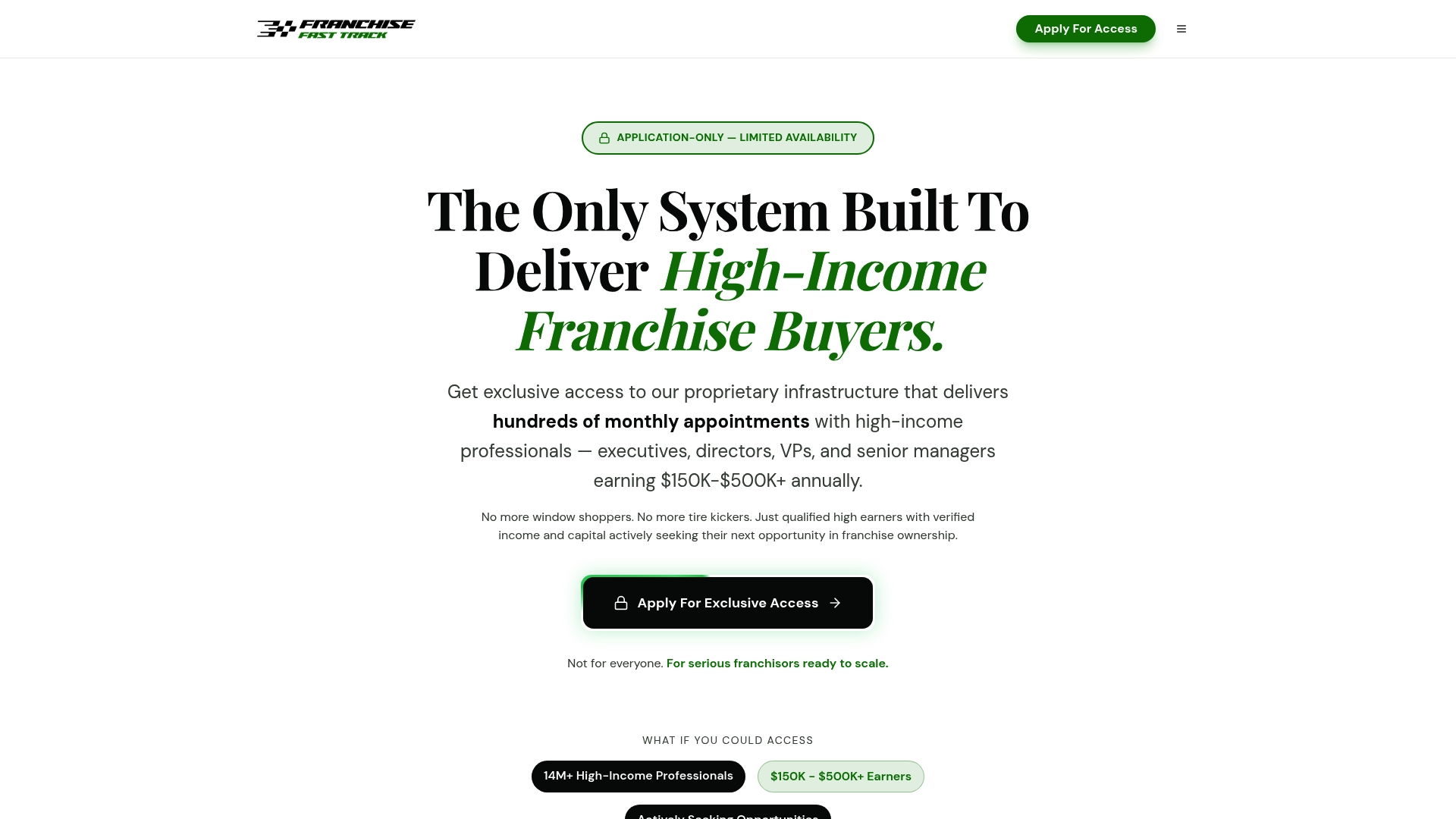
Franchise Fast Track delivers exactly that. The platform connects franchisors with verified high-income professionals earning between $150,000 and $500,000 annually, including executives, directors, and senior managers actively seeking franchise ownership. The reported lead-to-close rate of 34% reflects what happens when franchisors stop chasing unqualified leads and start meeting serious buyers. For franchisors ready to grow their networks with the right operators, qualified franchisee recruitment through Franchise Fast Track replaces volume-based lead generation with precision targeting. The result is faster development cycles and fewer wasted discovery calls.
FAQ
What is a scalable franchise business model?
A scalable franchise business model is a system designed to replicate consistent performance across multiple units through standardized operations, franchisee support infrastructure, and technology. The best examples maintain quality and profitability as unit counts grow.
Which franchise model grows the fastest?
Multi-brand platform models and single-brand multi-unit development agreements typically produce the fastest network growth. Jersey Mike's multi-unit development model achieves average unit sales of $1.3 million with a failure rate near 3%, reflecting a system built for rapid, disciplined expansion.
How important are SOPs for franchise scalability?
SOPs are the single most critical factor in franchise scalability. Rigorous SOP documentation gives every franchisee a proven operational playbook while allowing limited local flexibility, which balances consistency with market relevance across diverse geographies.
What is the role of Franchise Business Consultants in scaling?
Franchise Business Consultants manage 30–40 units each and provide ongoing performance support after the initial two-week training period. That support ratio is the industry standard for maintaining quality control as a franchise network expands.
How does supply chain ownership affect franchise scalability?
Supply chain ownership, as practiced by Domino's, generates high-margin revenue independent of royalty fees. That additional revenue stream creates economic resilience and funds the infrastructure needed for large-scale international expansion.
Recommended
- Franchise Business Model a Strategic Analysis for Growth | Franchise Fast Track Blog
- Franchise Growth Strategies for Sustainable Scale in 2026 | Franchise Fast Track Blog
- Proven Franchise Growth Strategies for 2026 | Franchise Fast Track Blog
- 7 Best Franchises Restaurants for Scalable Growth 2026 | Franchise Fast Track Blog
Ready to see results like these for your franchise?
Stop wasting money on leads that never close. Start getting hundreds of replies from high-net-worth professionals daily.