Outbound Lead Generation for Franchises That Converts
Outbound lead generation should be measured by cost per awarded franchise, not replies or calendar bookings: sequences reaching 21 to 50 recipients averaged a 6.2% reply rate, versus 2.4% for sequences reaching 500 or more. Neither figure establishes whether respondents have the capital, territory fit, or purchase intent required to become franchisees.
For established franchisors, the useful distinction isn't outbound versus inbound. It's unverified attention versus documented buying-stage evidence. A defensible acquisition model follows candidates from delivered outreach through positive reply, verification, booking, attendance, and award, then applies comparable qualification standards to portals, paid advertising, and broker referrals.
Table of Contents
- Why Outbound Lead Generation Is the Real Bottleneck in Franchise Development
- Building the Ideal Franchisee Profile from FDD Item 7, 19, and 20
- Outbound Versus Franchise Portals, Paid Ads, and Broker Referrals
- Sequencing, Cadence, and Cohort Testing That Protects Deliverability
- Deliverability Infrastructure and CAN-SPAM Compliance as Operating Standards
- Turning Replies Into Qualified Discovery Calls Worth Your Sales Team's Time
- Measuring What Matters and Outbound as a Scalable Franchise Development Function
Why Outbound Lead Generation Is the Real Bottleneck in Franchise Development
The International Franchise Association projected 851,000 franchise establishments and more than $936.4 billion in franchise-sector output for 2025, including an increase of more than 20,000 establishments, according to its 2025 economic outlook. Those projections frame recruitment as a territory-growth and operating-capacity problem, not a marketing-volume problem.
For an established system, an interested executive isn't interchangeable with an experienced operator ready to develop an available market. The development team needs evidence that the candidate can fund the investment, execute the operating model, and advance within a realistic decision window. A reply establishes none of those conditions.
That distinction applies across quick-service restaurants (QSR), home services, real estate brokerages, fitness and wellness, automotive services, health and beauty, retail, education, and senior care. Each recruiting brief should describe the actual operating responsibilities, rather than substituting a generic senior-management title for concept fit.
The denominator belongs beside the result
A development dashboard should retain the complete acquisition chain.
| Stage | Required evidence | What the count doesn't establish |
|---|---|---|
| Delivered | Message accepted for delivery | Inbox placement or human attention |
| Positive reply | Relevant expression of interest | Financial capacity |
| Verified | Documented financial and concept fit | Attendance |
| Booked | Accepted calendar invitation | A completed conversation |
| Held | Completed discovery conversation | Franchise approval |
| Awarded | Executed agreement under the brand's definition | An opened location |
The practical implication is that meeting volume is a workload measure until qualification is documented. A sales director can't distinguish productive activity from calendar congestion without knowing which candidates passed the verification gate.
A booked meeting becomes a useful development asset only when the team can explain why that candidate belongs on the calendar.
For broader prospecting context, the LeadBeast lead gen playbook offers an additional resource to evaluate alongside a franchise-specific recruiting process. Any general prospecting approach still needs a disclosure-grounded qualification layer before it becomes suitable for franchise development.
The bottleneck, therefore, isn't necessarily insufficient reach. The better operating question is whether the organization can identify, verify, and advance enough suitable operators without consuming its closing team's capacity on respondents who cannot proceed.
Building the Ideal Franchisee Profile from FDD Item 7, 19, and 20
The Federal Trade Commission identifies Item 7 as the estimated initial investment, Item 19 as financial performance representations when provided, Item 20 as outlets and franchisee information, and Item 21 as financial statements in its franchise disclosure guidance. These disclosures provide a more defensible starting point for recruiting than job title, apparent wealth, or executive seniority alone.
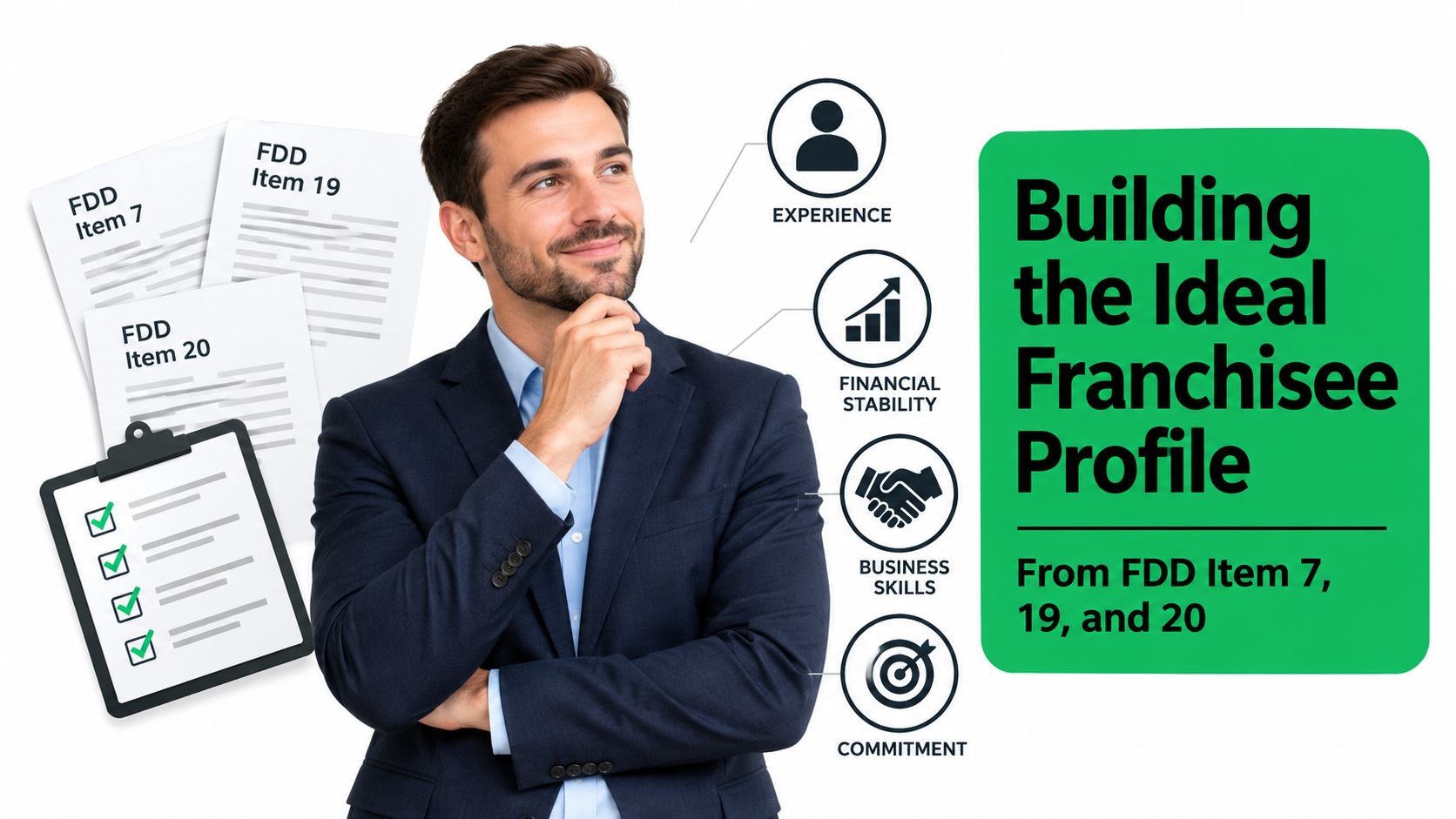
Item 7 defines the investment context, not a universal liquidity rule
The recruiting team should translate the disclosed investment range into an approved screening policy. Estimated project cost, available liquid capital, net worth, and expected financing should remain separate fields. Salary alone shouldn't satisfy the capital requirement.
A QSR recruiting brief might emphasize the candidate's ability to support the proposed development scope. A home services brief might examine management responsibilities and local operating involvement. Fitness and wellness or senior care teams should specify the experience and involvement their own models require, rather than assuming that another category's successful operator profile transfers unchanged.
| Disclosure input | Recruiting application | Verification boundary |
|---|---|---|
| Item 7 | Establish investment context | Don't equate income with liquidity |
| Item 19 | Govern approved financial messaging | Don't imply unsupported earnings |
| Item 20 | Examine growth, transfers, and owner turnover | Don't treat all outlet changes as expansion |
| Item 21 | Support financial diligence | Don't treat franchisor finances as candidate capacity |
Item 20 tests the operator hypothesis
FTC guidance describes Item 20 as a source of system-growth and owner-turnover information, including information useful for examining transfers and outlet-status changes, in its deep dive into the Franchise Disclosure Document. Analysts should distinguish new development from ownership movement before deciding which operator characteristics deserve emphasis.
Item 20 alone doesn't prove the ideal candidate's management style or explain why an owner exited. The development team should combine disclosure analysis with internal operator records and franchisee conversations. Otherwise, the team risks building a recruiting hypothesis from an outlet count rather than an operating history.
The resulting execution brief should identify approved markets, investment requirements, operating involvement, transferable experience, expansion scope, and exclusion criteria. It should also identify which facts remain unknown until human screening.
Item 19 requires particular discipline. Outreach shouldn't turn a disclosed financial representation into a personalized earnings promise, and the FTC guidance prohibits financial-performance claims outside the disclosure when they don't appear there. The targeting brief and the message-approval process should therefore share the same financial-claims boundary.
Outbound Versus Franchise Portals, Paid Ads, and Broker Referrals
No defensible channel comparison begins with an unsupported average price. Without matched spending records and consistently qualified outcomes, a claim that outbound costs less than portals, Meta, Google, or broker referrals is a hypothesis, not an established result.
The appropriate comparison starts with a shared definition: a qualified conversation is a held discovery call with a candidate who has passed the franchisor's documented financial, location, and concept-fit requirements. A form submission or booked appointment doesn't meet that standard.
Candidate-Source Economics for Established Franchisors
| Channel | Capital Verification | Exclusivity | Avg Cost per Qualified Conversation | Primary Weakness |
|---|---|---|---|---|
| Targeted outbound | Require before introduction | Specify in engagement terms | Attributable cost divided by verified held calls | Targeting assumptions may mistake fit for intent |
| Franchise portals | Audit before counting qualification | Confirm lead-sharing terms | Portal and follow-up cost divided by verified held calls | Inquiry alone doesn't establish capacity |
| Meta | Add screening after response | Audit audience and acquisition terms | Media, creative, and screening cost divided by verified held calls | Engagement doesn't establish operator fit |
| Add screening after response | Audit campaign and provider terms | Media, management, and screening cost divided by verified held calls | Search intent doesn't establish financial readiness | |
| Broker referrals | Confirm the broker's evidence | Review referral agreement | Attributable referral and handling cost divided by verified held calls | Qualification definitions may differ |
The table intentionally uses formulas rather than fabricated market averages. A CDO should populate it with actual channel costs and the same verification rules before reallocating budget.
Budget rule: Compare channels after qualification and attendance, then confirm the decision against awards from sufficiently mature cohorts.
Outbound's strategic case is control over whom the team approaches and which markets receive attention. That control creates an opportunity to improve acquisition economics, but it doesn't establish an automatic cost advantage. The full franchise development marketing model should connect targeting decisions to screening cost and eventual awards.
Execution quality also belongs in the comparison. Email infrastructure is part of outbound's acquisition cost, not a free background service.
The illustration is a workflow aid, not evidence of a campaign's actual deliverability. Procurement decisions require measured operating records, not a graphic's illustrative status indicator.
Sequencing, Cadence, and Cohort Testing That Protects Deliverability
Sequences sent to 21 to 50 recipients averaged a 6.2% reply rate, compared with 2.4% for sequences sent to 500 or more, according to the cold-email benchmarks compiled by BlazeHive. The comparison supports controlled testing, but it doesn't prove that reducing batch size alone causes better results.
A development operator should treat cohort size as part of an experimental design. Market, seniority, operating background, buying trigger, and message relevance can all differ between batches. Changing those inputs simultaneously prevents the team from identifying which decision improved qualification.
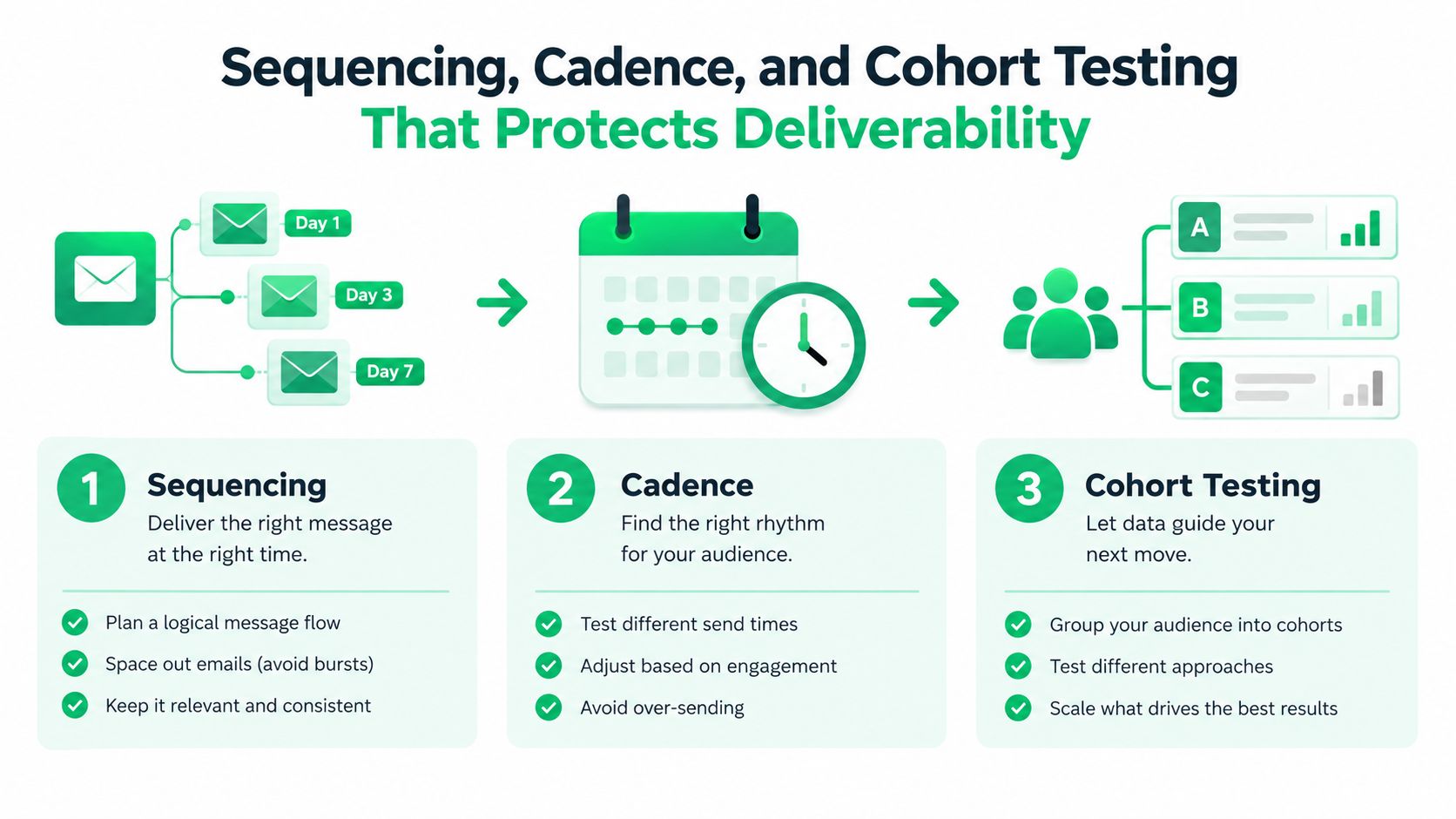
Test a recruiting hypothesis before increasing volume
The first cohort should represent a specific proposition, such as experienced operators in an approved market with a documented reason to consider expansion. The message should explain that relevance without claiming knowledge of private intentions.
- Clean the cohort: Remove invalid, duplicated, opted-out, and previously disqualified records before enrollment.
- Isolate the variable: Test an opening, proposition, or next-step request without simultaneously replacing the audience.
- Classify the response: Separate genuine interest, timing objections, referrals, negative replies, and automated messages.
- Authorize expansion: Increase reach only when delivery health and candidate quality support it.
A short sequence should add relevant information rather than repeat an unanswered meeting request. A reply should trigger review and an appropriate handoff, not another automated follow-up. A negative response should produce an explicit disposition under the campaign's suppression policy.
Cadence decisions need a defined denominator
An analysis covering 16.5 million emails reported average reply rates declining from 6.8% in 2023 to 5.8% in 2024, while a separate strict-cold-outreach dataset reported 0.45% when replies were divided by all emails sent, as described in Prospeo's reply-rate analysis. These figures shouldn't be merged into a universal forecast because their populations and denominators differ.
A campaign report should identify whether its reply rate uses messages, delivered messages, unique prospects, or sequence recipients. Otherwise, the team can appear to improve performance merely by changing the calculation.
Cyndra's resource on how to scale outbound without headcount provides additional context for automation planning. The operational requirement remains a controlled workflow: automation should execute approved decisions, while human reviewers retain responsibility for ambiguous responses and expansion approvals.
Documented sales sequences for franchise recruitment should therefore include entry criteria, exit conditions, response ownership, and pause authority, not merely a schedule of messages.
Deliverability Infrastructure and CAN-SPAM Compliance as Operating Standards
Gmail and Yahoo requirements include sender authentication, one-click unsubscribe, and spam complaints below 0.3%; Validity's benchmark recommends a tighter operating target below 0.1%, according to its 2025 deliverability report. The same report says more than 90% of marketing emails contain critical or serious accessibility issues.
For a franchise development team, these requirements belong in vendor governance and internal operating reviews. Message approval alone doesn't establish that the sending system authenticates correctly, handles complaints, or stops outreach when recipients withdraw interest.
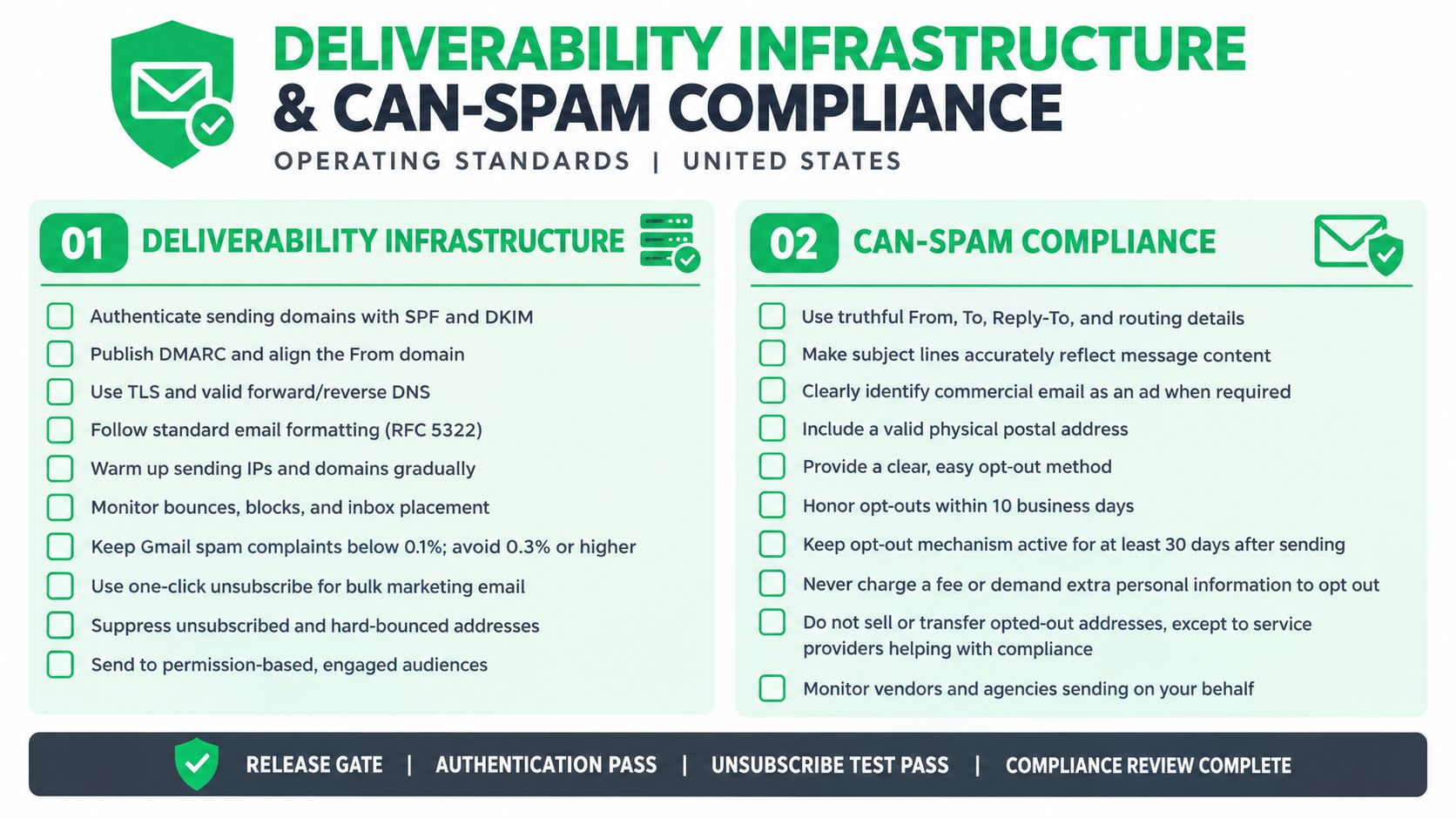
Authentication needs an accountable owner
Technical administrators should validate SPF, DKIM, and DMARC before campaign launch and investigate failures rather than leaving development managers to infer technical health from reply counts. MailGenius's SPF and DKIM checker is an additional diagnostic resource to evaluate within that review process.
The campaign owner should also receive records of hard bounces, complaints, unsubscribe processing, and inbox-placement monitoring. These measures answer different questions and shouldn't be compressed into an unexplained health score.
| Operating control | Evidence the franchisor should request |
|---|---|
| Authentication | Documented validation and remediation ownership |
| Suppression | Shared exclusions across active campaigns |
| Complaint handling | Monitoring records and pause decisions |
| Accessibility | Readable text, descriptive links, and usable opt-out controls |
| Vendor oversight | Named responsibility for failures and corrective action |
Commercial email to businesses isn't exempt
The CAN-SPAM Act took effect on January 1, 2004, applies to business-to-business commercial email, requires opt-outs to be honored within 10 business days, and can carry penalties of up to $53,088 per violating email, subject to applicable adjustments and enforcement circumstances, according to the FTC's CAN-SPAM compliance guide. The guide also requires accurate headers, nondeceptive subject lines, advertising identification, a valid physical postal address, and a clear opt-out mechanism.
The legal deadline shouldn't become the routine suppression target. A prudent workflow stops eligible outreach promptly and preserves a record showing when the request arrived, when suppression occurred, and which campaigns received the update.
Operating standard: An unsubscribe is a system-wide instruction, not an isolated task in a salesperson's inbox.
A franchisor should require its outsourced partner and internal team to use consistent suppression rules. Otherwise, separate campaigns may approach the same recipient after another team has already recorded an opt-out.
Personalization doesn't replace these controls. A carefully written message still requires lawful sending practices, authenticated infrastructure, accessible presentation, and accountable handling of recipient choice.
Turning Replies Into Qualified Discovery Calls Worth Your Sales Team's Time
Buyer receptiveness and message relevance aren't the same thing. A 2025 buyer study reported that 88% of B2B buyers wanted vendor contact during research and evaluation, while separate reporting on Gartner research said 65% considered most vendor cold emails irrelevant to current priorities, according to Sopro's buyer-research overview.
Those findings concern B2B buying rather than franchise recruitment specifically. Their useful implication is narrower: willingness to hear from a provider doesn't establish that a particular message matches the recipient's current decision.
Classify buying stage before offering calendar access
A positive reply can mean active evaluation, early curiosity, a future possibility, or a request for information. The qualification specialist should record which interpretation the conversation supports.
| Verification field | Evidence to capture | Disposition if unresolved |
|---|---|---|
| Investment capacity | Available capital and financing assumptions | Continue screening |
| Income | Candidate-confirmed financial context | Don't infer from title |
| Location | Preferred market and relocation constraints | Check territory alignment |
| Operating role | Intended involvement and management plan | Review concept suitability |
| Timing | Decision window and current evaluation activity | Route to nurture when appropriate |
| Experience | Relevant operating responsibilities | Compare with the approved profile |
Income and investable capital require separate treatment. A senior title doesn't establish either, and a candidate's income doesn't show whether funds are available for development. Records should distinguish self-reported information from corroborated information rather than labeling both verified.
The specialist can ask which markets the candidate can operate in, what capital is available for the proposed development, how the candidate expects to participate, and what has changed to make evaluation relevant now. These questions establish buying-stage evidence without turning the first conversation into an earnings presentation.
The handoff should contain a decision record
Before booking, the development specialist should prepare a concise record of confirmed facts, unresolved issues, the candidate's stated objective, and the reason for accepting the introduction. The franchisor should be able to audit that decision without replaying the entire conversation.
The Franchise Fast Track lead qualification guide is an additional resource for structuring this handoff. The governing principle is that qualification must be inspectable rather than implied by appointment placement.
A human reviewer should retain authority to decline a meeting when the evidence doesn't support fit. Otherwise, the qualification function becomes appointment setting with a different label.
The strongest handoff isn't a declaration that the candidate is enthusiastic. It's a documented explanation of why the franchisor should invest discovery time, what remains uncertain, and what the next conversation must establish.
Measuring What Matters and Outbound as a Scalable Franchise Development Function
HubSpot reports an average email click-through rate across industries of 2.5% in 2025 in its marketing statistics. That benchmark can describe an intermediate engagement event; it cannot establish financial capacity, operator suitability, or the probability of a franchise award.
A CDO's dashboard should preserve that distinction. Marketing activity, qualification work, sales progression, and awards belong in the same reporting system, but they shouldn't be treated as equivalent outcomes.
Every conversion rate needs a named denominator
| Dashboard measure | Calculation | Management use |
|---|---|---|
| Positive-reply rate | Positive unique respondents divided by unique delivered prospects | Test audience-message relevance |
| Verification rate | Verified candidates divided by positive respondents | Evaluate targeting and screening |
| Booking rate | Booked candidates divided by verified candidates | Review handoff acceptance |
| Attendance rate | Held calls divided by booked calls | Examine scheduling and commitment |
| Award conversion | Awarded candidates divided by held qualified calls | Assess downstream commercial yield |
| Cost per awarded franchise | Attributable acquisition cost divided by awards | Compare source economics |
Message-level delivery reporting should remain available separately from prospect-level conversion reporting. Mixing the two allows follow-up volume to change the apparent funnel without changing the number of people reached.
The organization should also define whether an award means an agreement, a development commitment, or awarded units. Those outcomes aren't interchangeable, particularly when comparing single-unit and multi-unit recruitment.
Mature cohorts should govern budget decisions
Cost per awarded franchise is the final channel decision metric, but recent cohorts need leading indicators while decisions remain unresolved. Comparing a recently launched outbound cohort with a mature referral cohort would confuse elapsed selling time with source quality.
The finance team should include data, infrastructure, campaign management, screening labor, and attributable sales handling in acquisition cost. Referral fees and media-management costs should receive equally consistent treatment. An apparently inexpensive source can become less attractive once the organization includes the work required to verify and advance its candidates.
A data-driven franchise sales playbook should connect these definitions to spending authority. Expansion should follow stable qualification and downstream progression, not a favorable screenshot of reply volume.
The less obvious conclusion is that outbound becomes scalable when the organization standardizes rejection as carefully as acceptance. Consistent disqualification reasons reveal which audiences should stop receiving investment, while accepted-candidate records show which recruiting hypotheses deserve further testing.
That discipline gives franchisors a defensible comparison with portals, Meta, Google, and broker referrals. The winning source is the one that produces suitable awards at acceptable acquisition cost, not the one that supplies the fullest calendar.
Franchise Fast Track offers franchise development support and franchise-industry intelligence for established brands evaluating targeted recruitment. Development leaders can visit Franchise Fast Track and review its pre-call service overview to assess how candidate verification, outbound execution, and sales handoffs could fit their existing development function.
Ready to see results like these for your franchise?
Stop wasting money on leads that never close. Start getting hundreds of replies from high-net-worth professionals daily.