B2B Lead Qualification for Franchises: A Practical Playbook
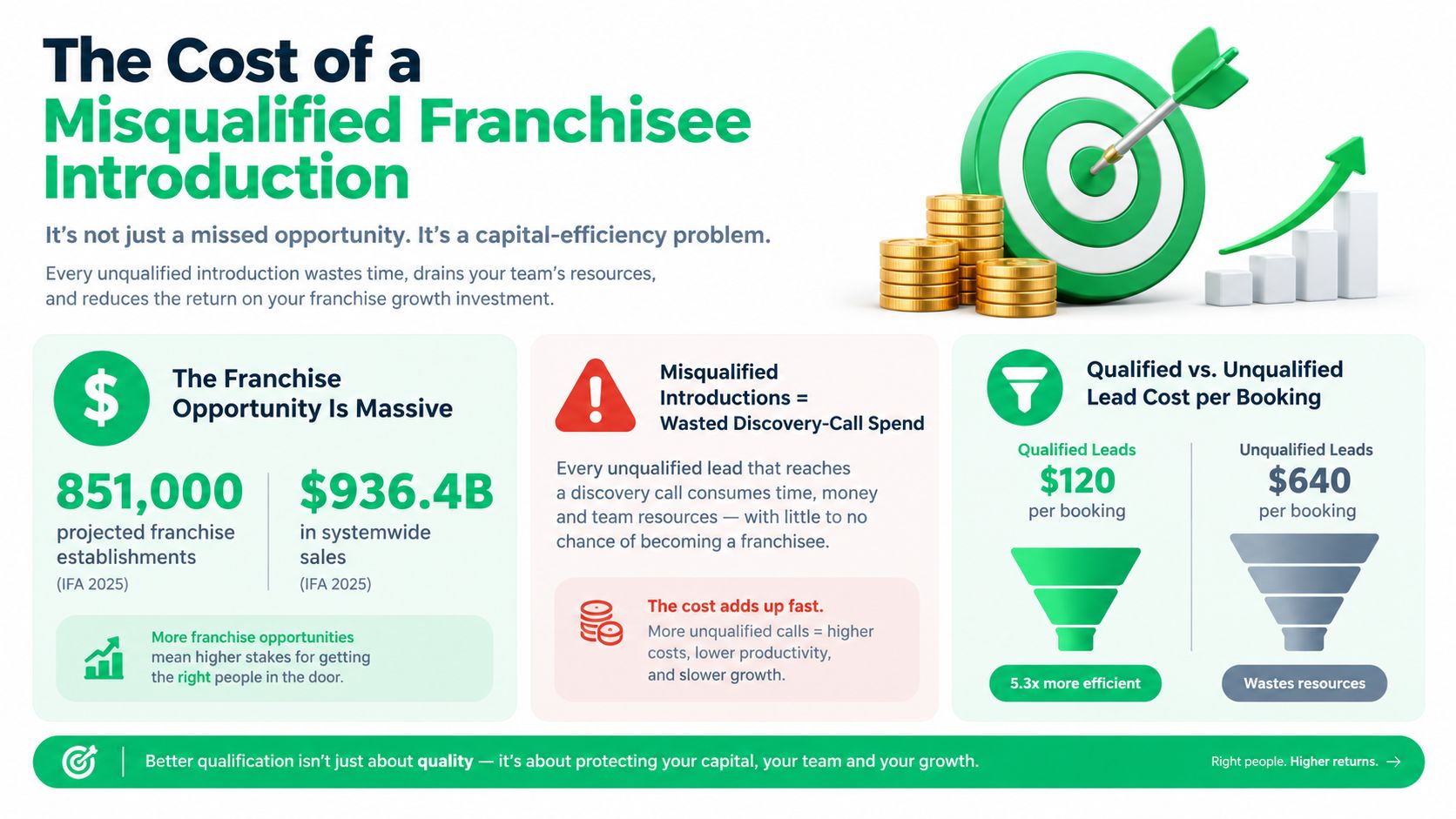
The U.S. franchise sector is projected to reach 851,000 franchise establishments and $936.4 billion in total economic output, so a single misqualified introduction is not a minor sales inefficiency, it is a capital allocation mistake. In b2b lead qualification for franchisors, speed matters, but Item 7 capital coverage, Item 20 operator context, and SBA eligibility matter just as much.
Table of Contents
- The Cost of a Misqualified Franchisee Introduction
- The Six-Step Qualification Workflow That Routes Fit Before Volume
- Why Response Speed Without Fit Scoring Still Burns the Calendar
- Scoring Models That Map BANT and MEDDIC to Franchise Realities
- The Buying-Group Problem in Franchise Recruitment
- FDD Anchors and the SBA Financing Gate
- Verification, Handoff SLA, and What 22 Days of Outbound Actually Looked Like
The Cost of a Misqualified Franchisee Introduction
851,000 projected franchise establishments and $936.4 billion in total economic output make franchise development a scale business, not a hobbyist funnel (IFA 2025 economic outlook). That scale is exactly why raw inquiry volume hides bad economics. A discovery slot spent on a contact who cannot clear Item 7 capital requirements, cannot operate in the target geography, or lacks the right operator profile is calendar waste, not pipeline creation.
Franchise Vertical Qualification Priorities
| Vertical | Typical Item 7 Range | Primary Qualification Gate |
|---|---|---|
| QSR | Higher construction, site, and working-capital exposure | Liquid capital plus development capacity |
| Home services | Lower buildout burden, but execution discipline matters | Operator fit and market coverage |
| Fitness and wellness | Equipment, leasehold, and staffing sensitivity | Capital, territory, and leadership profile |
| Automotive services | Facility and operational complexity | Experience and financing readiness |
| Health and beauty | Brand standards and local demand fit | Authority, timing, and capital |
| Real estate brokerages | Lower physical buildout, stronger recruiting dependence | Producer profile and market fit |
| Retail | Inventory and site economics | Working capital and territory alignment |
| Education | Compliance, staffing, and local demand | Operator maturity and timing |
| Senior care | Trust, regulation, and service delivery | Operating profile and caregiver model fit |
For a franchisor, the central question is not whether a contact is interested. It is whether that person can survive the brand's actual expansion model. A QSR system, a home services brand, and a senior care network all qualify leads differently, even though all three still need fit, intent, authority, and timing.
Practical rule: every unqualified discovery call should be treated as a failure of routing, not a failure of sales effort.
That's why many brands are shifting from portals, Meta and Google ads, and broker referrals toward outbound to verified candidates, where the conversation starts with evidence instead of hope. A useful reference point for how their how their franchisee recruitment system works is to look at verification first, then calendar access.
The Six-Step Qualification Workflow That Routes Fit Before Volume
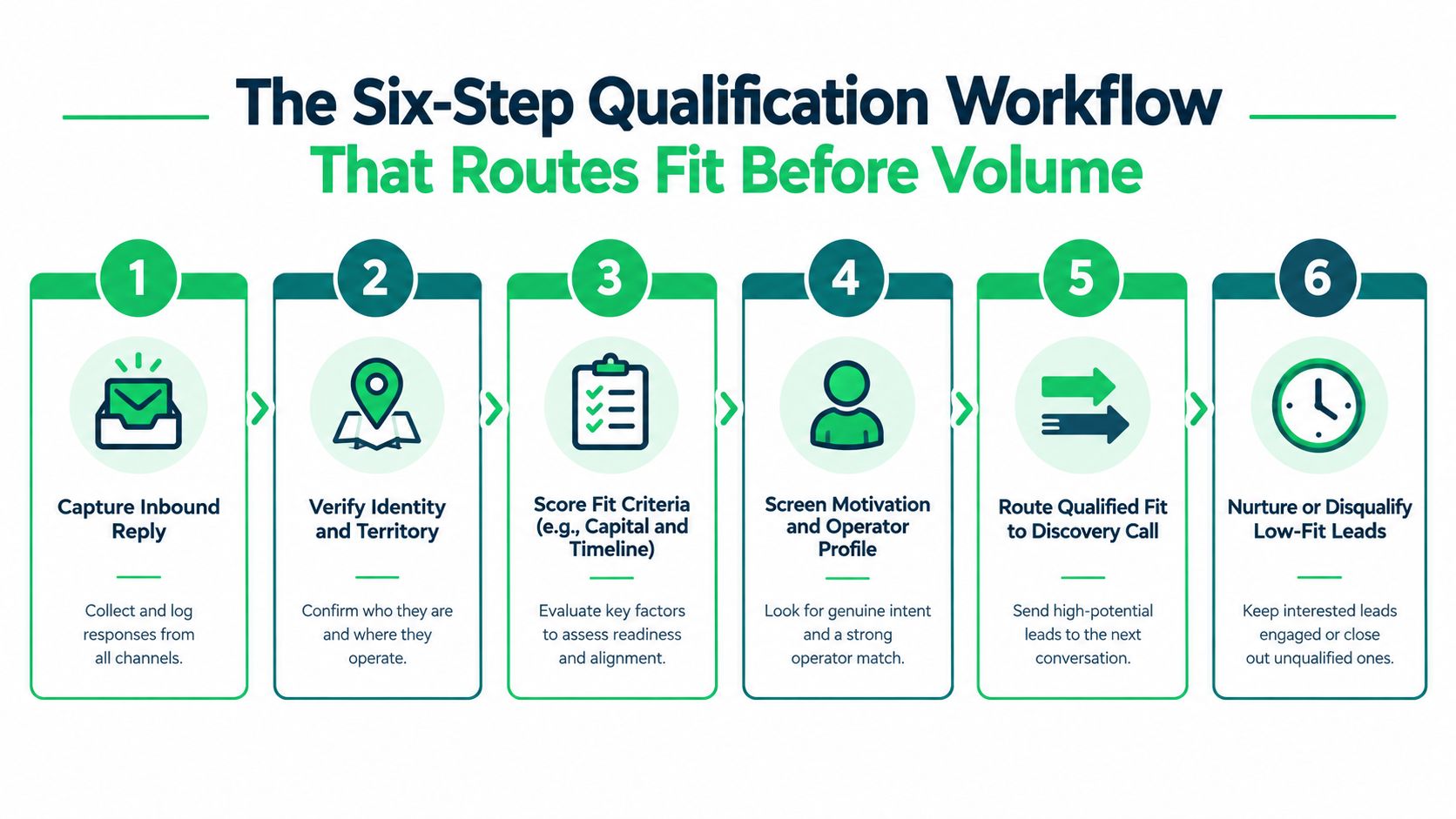
The fastest franchise development teams don't start with a discovery calendar. They start with a qualification sequence that screens out obvious mismatches before the first meeting gets booked. That sequence works only when speed is treated as part of qualification, not as a separate service metric.
Step 1 through step 3
A practical workflow starts with firmographic fit. The team checks industry, geography, company size proxy, and investment capacity against the brand's operating model, then verifies the person's role and decision influence. After that, the team establishes an active trigger and buying timeframe, because a contact with no timing signal is usually a nurture record, not a sales lead.
The next gate is the problem itself. If the reply doesn't show a real business motivation and economic consequence, the calendar invite is premature. That's the point where a short discovery script should test authority, financial capacity, need, timing, and fit, then require a mutually agreed next step before handoff.
A useful field-level guide sits in B2B lead qualification tips, especially for teams that need a clean set of screening questions without turning discovery into an interrogation.
Step 4 through step 6
The last three steps are operational, not philosophical. The qualifier must record evidence for each criterion in the CRM, route qualified fit to sales, and disqualify or nurture the rest. That record matters because franchise development teams often confuse interest with readiness, which creates bloated pipelines and false confidence.
The speed data is blunt. In a study of 2,241 U.S. companies, firms that contacted a lead within one hour were nearly seven times more likely to qualify that lead than firms waiting an additional hour, and waiting 24 hours or longer reduced qualification likelihood by roughly 60 times compared with the first-hour response (Harvard Business Review study summary). In franchise terms, that means a trained qualifier should get high-fit replies immediately, while minimum capital, market, concept, or operator-profile failures should be suppressed automatically.
A practical implementation also belongs inside franchise development marketing, because routing rules only work when the demand side and the sales side use the same definition of fit.
Why Response Speed Without Fit Scoring Still Burns the Calendar
Speed matters because it changes contact odds. The MIT and InsideSales.com analysis of more than 15,000 inbound leads and about 100,000 call attempts found that reaching out within five minutes made reps about 100 times more likely to reach a lead and 21 times more likely to qualify it than waiting 30 minutes (MIT/InsideSales.com analysis). In franchise development, that only helps if the lead can clear the gate.

A five-minute callback to someone without liquid capital, outside the territory, or missing the right operating profile still burns the calendar. The meeting gets booked faster, but the outcome is still weak. Speed should follow an evidence check, not replace it.
A franchise development specialist is deciding whether a reply deserves a seat on the calendar. If the contact is a high-income executive but the brand requires a co-signing spouse, an operating partner, or a territory-specific operator profile, the qualifier still needs to stop. A franchise lead generation company that optimizes only for speed will fill calendars with poor-fit candidates rather than qualified conversations.
Operational rule: speed multiplies fit, it does not create fit.
That distinction matters because a calendar full of weak conversations looks active while reducing the share of discovery calls that become real franchise opportunities. Trained qualifiers should make the yes-or-no call before the meeting request goes out, not after. In practice, that means separating fast response from fast approval. Franchise teams that do both protect rep time, keep the pipeline cleaner, and stop weak leads from consuming the next opening on the calendar.
Scoring Models That Map BANT and MEDDIC to Franchise Realities
Classic qualification frameworks still work in franchise development, but only after they're reweighted around Item 7, buying-group reality, and territory commitment. A generic BANT score can tell a rep that somebody sounds interested. It can't tell a franchisor whether the candidate is capital-ready, operator-ready, and able to move through a multi-stakeholder decision.
A franchise-specific translation of BANT
| Criterion | Classic B2B Test | Franchise-Adapted Test |
|---|---|---|
| Budget | Can the buyer spend? | Can the candidate clear Item 7 plus working capital? |
| Authority | Is this the decision-maker? | Does the contact have personal influence, and who else must approve? |
| Need | Is there a business problem? | Does the candidate want ownership, and does the profile fit the brand? |
| Timing | Is there urgency? | Is there a documented development window and territory commitment? |
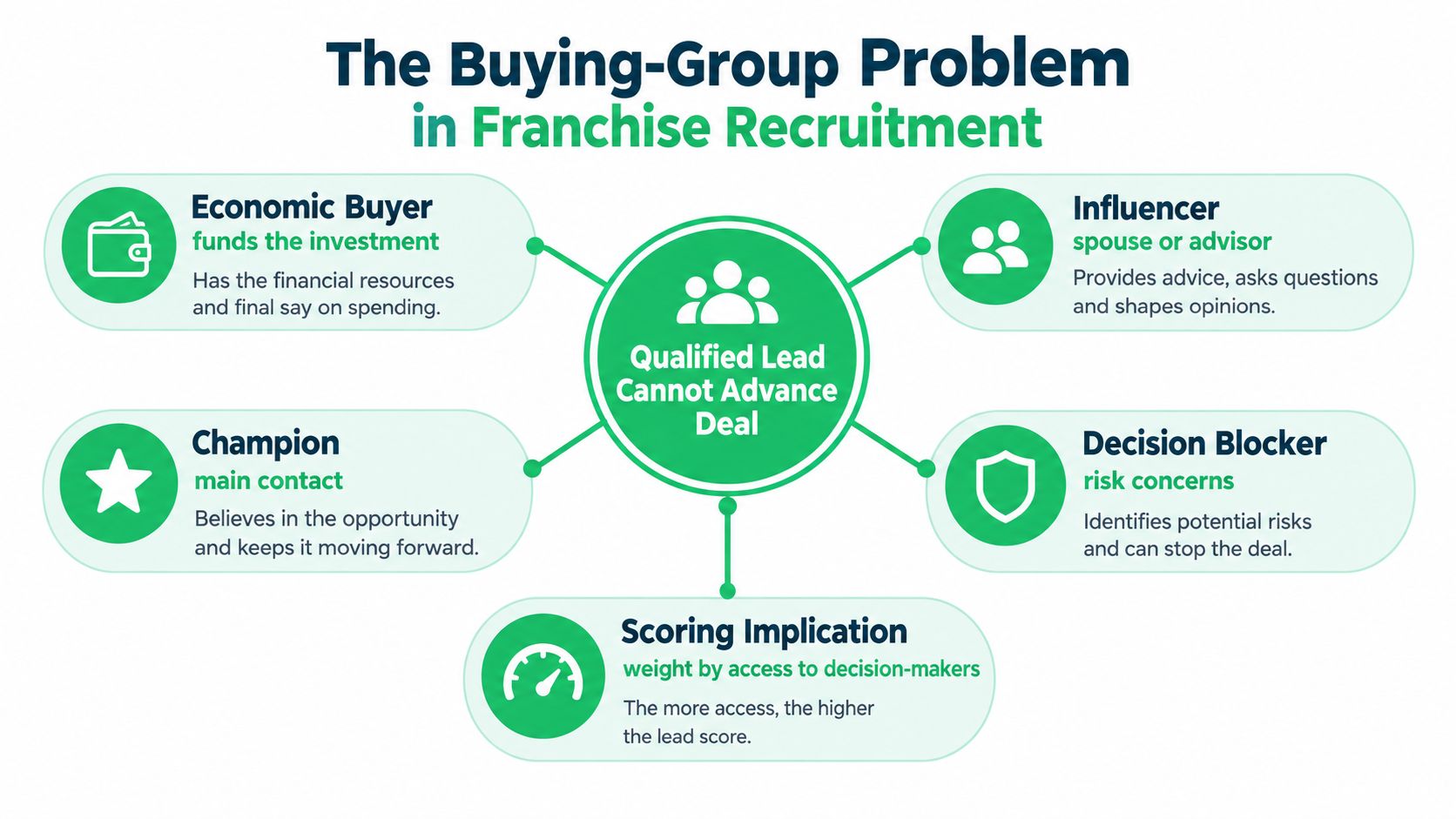
The same logic applies to CHAMP and MEDDIC. Challenges matter, but in franchise sales the challenge has to be connected to a real expansion path. Economic buyer matters, but the economic buyer may be a spouse, a partner, or a board-level finance contact in a multi-unit situation. Champion matters, but the champion still needs authority and capital coverage behind them.
Buyer complexity is not theoretical. 87% of B2B buying groups include at least four stakeholders, and 35% of buyers identify themselves as one of many decision makers in the purchase process (buying-group research). That's why a franchise score should separate hard disqualification, soft qualification, and buying-group readiness. A candidate can be strong on fit and weak on access to the rest of the decision group.
A practical scoring model is simple enough to run inside the CRM. Score each criterion from 0 to 5, set a hard stop if any core category drops below threshold, and weight capital coverage and territory fit above raw enthusiasm. For teams that need a working reference point, a useful guide to qualified leads for franchisors is most valuable when it treats the handoff as an evidence event, not a gut call.
Practical rule: a perfect contact with no access to the decision group is still a weak opportunity.
For recruiting workflows, tools like dreach AI for recruiting are relevant only when they're used to structure evidence, not to create artificial volume. The test stays the same, does the candidate clear the brand's capital, authority, need, and timing gates.
The Buying-Group Problem in Franchise Recruitment
Recent buyer research says 90% of B2B buyers research before speaking with a vendor, more than half do extensive research, and two-thirds prefer engaging sales only after independent research (buyer research report). That matters in franchise recruitment because the first responder is often just the most visible person in a larger internal decision process, not the only one who matters.
One lead, many veto points
A serious franchise candidate may need a spouse, partner, investor, or operating executive to move forward, and each of those stakeholders can stop the process. The contact who fills out a form may understand the concept, but that doesn't mean the economic buyer is aligned. In multi-unit cases, the franchisor may also need to check whether the territory decision, financing path, and operator profile line up with the brand's expansion model.
That is why stakeholder coverage should be scored separately from demographic fit. The questions are simple but revealing. Has the contact acknowledged other stakeholders, can they name them, have they already discussed timing and capital internally, and is there any evidence the group is moving toward consensus?
The answer changes the value of the lead. A lower-volume pipeline of multi-stakeholder opportunities can be more valuable than a larger list of individually impressive contacts who can't advance the deal. The job is not to celebrate volume, it is to detect whether the buying group can reach a decision.
A useful framing sits in the Franchise Fast Track guide, because persona work only becomes useful when it's tied to the internal decision structure around the deal. In franchise development, the buyer isn't always the only buyer.
FDD Anchors and the SBA Financing Gate
The Franchise Rule gives franchise development teams a concrete screening framework. The Federal Trade Commission requires a disclosure document with 23 specified information items, including Item 7 for initial investment, Item 19 for financial performance representation, Item 20 for current and former franchisees, and Item 21 for financial statements (FTC Franchise Rule FAQs). Those are not just legal sections, they're qualification anchors.
Three gates that matter before discovery
Item 7 is the first capital test. It tells the team whether the candidate's likely resources can cover startup costs and early working capital. Item 20 is a quality signal, because the current and former franchisee list gives the recruiter a way to assess system churn and operator continuity. Item 21 helps diligence the franchisor's own financial condition, which matters when the candidate is comparing brands with similar concepts.
The SBA adds a separate financing gate. A brand must appear in the SBA Franchise Directory for lenders and Certified Development Companies to evaluate eligibility for SBA financial assistance (SBA Franchise Directory). In plain terms, a candidate saying “I'm interested” does not establish financing readiness. The proposed brand, documentation path, and lender requirements still have to line up.
For a development team, the pre-screen can stay short. Check Item 7 coverage, confirm whether the brand sits in the SBA directory, and verify that the candidate's operator profile and territory fit the concept. If any of those fail, the right move is not a calendar invite.
Verification, Handoff SLA, and What 22 Days of Outbound Actually Looked Like
A useful handoff starts with timestamps, not opinions. Lead creation, first human response, first two-way conversation, qualification decision, and booked meeting should each have a target and a disqualification rule so marketing, the qualifier, and the sales calendar all follow the same path. That's how a lead moves from interest to evidence to meeting.
A real outbound campaign for a 9-figure restaurant brand generated 937 potential qualified franchisees from 359,815 outbound messages and 2,454 inbound replies, with every reply coming from a $250,000+ verified income earner (Franchise Fast Track campaign data). The lesson is simple, verification changes the economics before the meeting even happens.
What to measure instead of raw replies
- Verified-fit rate over reply count
- Qualified-conversation rate over booked meetings
- Show rate over calendar volume
- Discovery-to-application rate over activity
- Territory or unit conversion over interest volume
That chain is harder to game than raw response metrics, which is why it produces cleaner pipeline. For brands that want the underlying data stack, the useful infrastructure is the Franchise Fast Track FDD database and the multi-unit franchisee directory, because verification gets much easier when the team can cross-check candidates against brand and operator records.
Franchise Fast Track builds verified franchisee recruitment around capital, territory, and operator fit, not just reply volume. For franchisors that want a qualification process anchored in FDD data, multi-unit operator intelligence, and pre-screened candidate routing, Franchise Fast Track shows how the system works and where the data comes from.
Ready to see results like these for your franchise?
Stop wasting money on leads that never close. Start getting hundreds of replies from high-net-worth professionals daily.